Arbitrage trading operates as a specialized financial market strategy that captures profit from price discrepancies across different financial markets or financial instruments. The market participants execute simultaneous buy and sell orders to secure low-risk gains when identical securities trade at different prices. The arbitrage trading meaning centers on exploiting temporary price inefficiencies while maintaining minimal exposure to market risk.
The financial markets today attract both institutional investors and retail traders to arbitrage opportunities due to increased market connectivity and technological accessibility. The electronic trading platforms enable rapid price discovery across global exchanges, while regulatory laws provide clearer guidelines for cross-border arbitrage activities. Modern market efficiency theory suggests that price discrepancies disappear quickly, yet technology creates new windows for skilled practitioners. Traditional trading focuses on directional market movements and fundamental analysis, while arbitrage trading emphasizes price relationships and execution speed across multiple trading venues.
Arbitrage trading strategies encompass three primary categories that address different market inefficiencies. Spatial arbitrage exploits price differences for identical assets across separate exchanges, such as currency pairs on the Forex markets, stock shares on different financial bourses, or commodity futures on various trading floors. Temporal arbitrage captures price discrepancies that emerge across different time periods, while cross-asset arbitrage identifies mispricings between related financial instruments like convertible bonds and underlying equity shares. Each strategic pillar aligns with the core objective of securing consistent returns through systematic price relationship analysis rather than market direction speculation, illustrating how arbitrage operates within the broader discipline of trading.
Successful arbitrage trading requires comprehensive preparation across market selection, technological infrastructure, and risk management protocols. The practitioners must evaluate liquidity conditions, transaction costs, and regulatory constraints before committing capital to specific arbitrage opportunities. High-frequency trading systems and direct market access become essential tools for capturing fleeting price discrepancies, while position sizing and correlation analysis help manage portfolio risks.
The balance between opportunity identification and thorough due diligence determines long-term profitability in arbitrage trading operations. Understanding both conceptual functions and practical implementation requirements provides the foundation for effective arbitrage trading execution.
What is arbitrage trading?
Arbitrage trading is a financial strategy involving the use of structured financial methodologies that exploits price differences for identical or equivalent financial assets across different financial markets or trading venues. The methodology generates profit from temporary market inefficiencies without assuming directional risk on the underlying asset’s price movement.
Arbitrage trading involves various market participants who execute price-gap strategies inherent to the complex practice with distinct operational characteristics. Institutional trading desks at major investment banks like Goldman Sachs and JPMorgan Chase conduct arbitrage operations using sophisticated trading algorithms and substantial capital reserves. High-frequency trading firms such as Citadel Securities and Virtu Financial deploy advanced technology to capture microsecond price discrepancies across multiple financial exchanges. Retail traders participate through trading platforms like Interactive Brokers and TD Ameritrade, though their opportunities remain limited by execution speed and capital constraints. Interactive Brokers specifies on its website that the typical order transmission time to the NASDAQ matching engine is about 3 milliseconds, a delay that often prevents retail users from competing on arbitrage with institutional latencies that are 1.000 times faster. The aforementioned market participants share three essential traits that define arbitrage trading: near-simultaneous execution across multiple venues, minimal directional exposure to underlying asset movements, and heavy reliance on technological speed advantages.
Multiple arbitrage variants exist within the broader financial trading universe, each targeting specific market inefficiencies and asset classes. Currency arbitrage exploits exchange rate differences between forex markets. A triangular arbitrage trade in February 2024 briefly offered a 0.00015 spread between EUR/USD, EUR/GBP, and GBP/USD quotes on Bloomberg terminals, equal to one and one half pips of instant profit before costs. Statistical arbitrage identifies pricing anomalies in correlated securities. Academic research by Avellaneda and Lee in The Review of Financial Studies recorded an annualized Sharpe ratio of 1.9 for a simple pairs trading strategy on United States equities during 2003 through 2007, which illustrates the historical edge obtainable from well calibrated statistical arbitrage. Currency arbitrage and statistical arbitrage represent distinct categories within the comprehensive spectrum of types of trading approaches available to market participants. The classification positions arbitrage trading alongside momentum trading, value investing, and day trading as specialized investment methodologies that serve different risk-return profiles and market functions.
Arbitrage trading operates within a complex legal foundation that varies significantly across jurisdictions and trading platforms. The Securities and Exchange Commission (SEC) in the United States permits arbitrage activities under existing market making regulations, and Rule 610 of Regulation National Market System requires fair access to protected quotations and therefore enables intermarket arbitrage as long as the activity does not manipulate prices. The European Securities and Markets Authority maintains similar positions within EU member states through the MiFID II and MiFIR directives that define market making and algorithmic trading obligations for arbitrage desks. Individual trading platforms enforce their own terms of service regarding arbitrage practices, with some cryptocurrency exchanges like Binance and Coinbase implementing specific rules about cross platform arbitrage activities. Regulatory acceptance depends on factors such as market manipulation concerns, systemic risk implications, and the specific financial instruments involved in arbitrage transactions.
Understanding what is arbitrage trading requires grasping both its conceptual foundation and its practical implementation mechanisms. The operational workflow that transforms price discrepancies into profitable market trades represents the next element in comprehending the overall arbitrage-trading approach.
Arbitrage trading works by simultaneously purchasing and selling identical or equivalent financial instruments across different financial markets to capture price discrepancies. Financial traders execute the matched transactions within seconds to lock in risk-free profits before market forces eliminate the pricing inefficiencies through automated trading systems and high-frequency trading algorithms.
The market participants create the foundation for arbitrage opportunities through their diverse trading activities and varying execution speeds. Institutional investors, such as hedge funds, investment banks, and proprietary trading firms, deploy sophisticated algorithmic models to identify pricing mismatches across multiple financial exchanges.
Nasdaq reported that its TotalView ITCH feed peaked at about 1.5 million messages per second during several sessions in February 2023, which illustrates the ingestion rate that arbitrage algorithms must handle. Financial operators involved in arbitrage trading require real-time market data feeds, direct market access connections, and substantial capital reserves to execute simultaneous transactions effectively. The trading venues, for example the NYSE, NASDAQ, and alternative trading systems, maintain different liquidity pools and order book dynamics that generate temporary price variations. As of 2023 the NYSE processed an average of roughly 3.7 billion shares each day while Nasdaq processed around 5.2 billion shares, and those differing liquidity profiles often create momentary spreads large enough for arbitrage. The arbitrage mechanism depends on sufficient trading volume, minimal transaction costs, and technology infrastructure that enables millisecond order execution across geographically dispersed financial markets.
The operational sequence begins when scanning algorithms detect price differences between identical securities trading on separate exchanges. Market surveillance systems validate the detected discrepancies by confirming asset specifications, settlement dates, and currency denominations match exactly. Automated trading platforms then place simultaneous buy and sell orders through direct market access connections to capture the price spread. Order management systems coordinate execution timing to ensure both transactions complete within the same trading session. The settlement procedures transfer ownership and funds according to each exchange’s clearing protocols, while portfolio management systems reconcile positions and calculate realized profits from the completed arbitrage cycle.
Consider a scenario where the Company XYZ stock trades at $100.50 on Exchange A while simultaneously quoting $100.75 on Exchange B. An arbitrage trader purchases 1,000 shares on Exchange A and sells 1,000 shares on Exchange B, capturing a $0.25 per share spread before transaction costs. The Company XYZ spread example demonstrates how traders must account for brokerage fees, exchange charges, and market impact costs that typically consume 60-80% of the gross profit margin. The financial strategy requires substantial capital deployment since profit margins rarely exceed 0.1-0.3% per transaction, necessitating high-volume operations and leverage utilization to generate meaningful returns.
The operational mechanics of arbitrage reveal how this strategy functions as a market efficiency mechanism that eliminates pricing anomalies through rapid execution and capital deployment. The core process remains consistent with the definition of arbitrage across different asset classes and market structures, though specific implementation details vary significantly. Trading firms apply the fundamental principles through numerous specialized approaches that target particular market inefficiencies, asset relationships, and geographic regions.

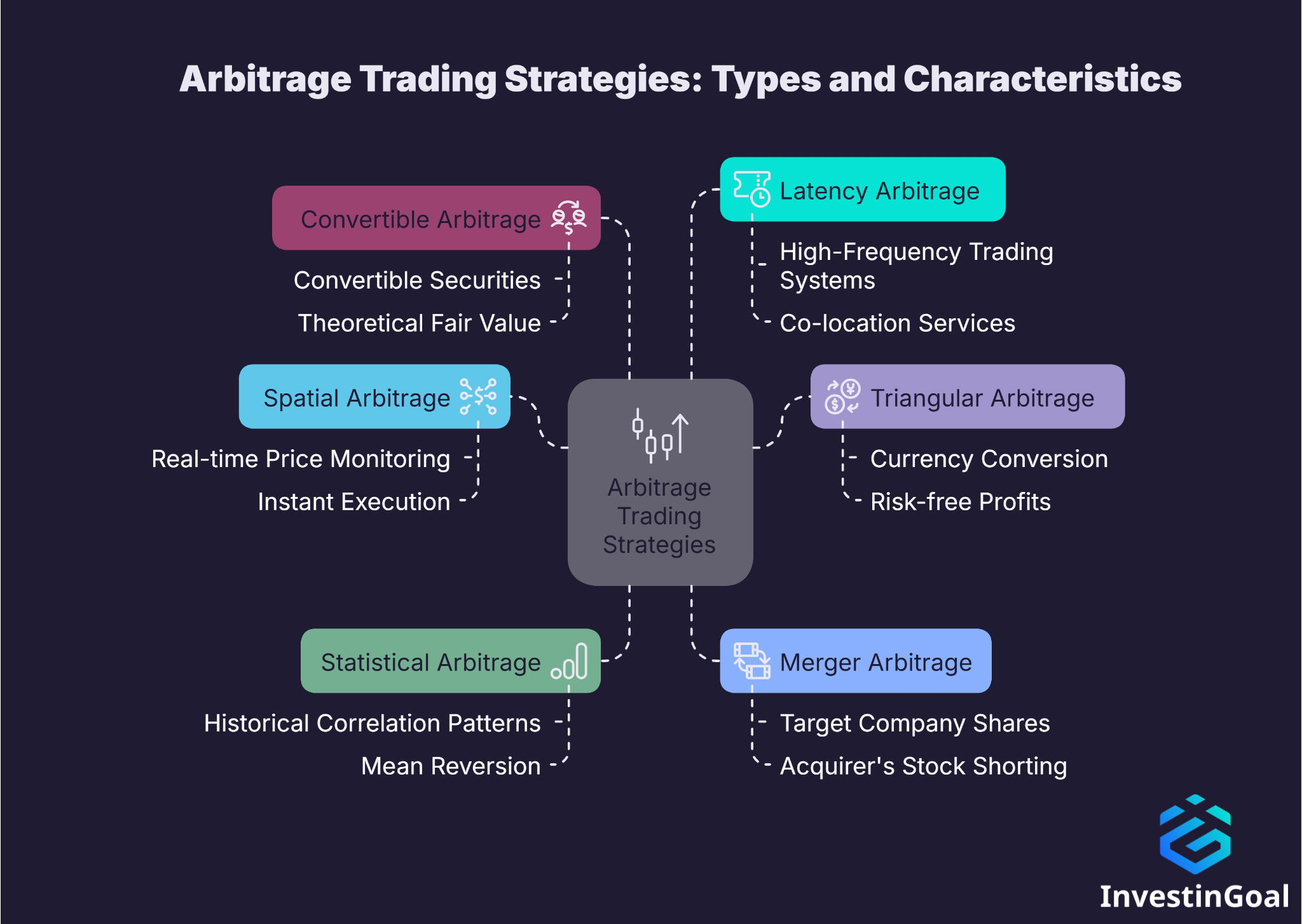
Arbitrage trading strategies include six primary types that exploit price inefficiencies across markets, instruments, and timeframes. These strategies range from simple spatial arbitrage to complex algorithmic statistical arbitrage, and traders must understand their distinct characteristics to select appropriate approaches for their risk tolerance and execution capabilities.
Arbitrage trading strategies divide into distinct categories that target specific market inefficiencies and price disparities. Each strategy type operates within different timeframes and requires specialized tools to capture profit opportunities before markets correct the pricing gaps.
The types of arbitrage trading strategies are listed below.
- Spatial Arbitrage: Spatial arbitrage capitalizes on identical assets trading at different prices across geographic locations or exchanges. The spatial arbitrage strategy has evolved from traditional commodity trading to sophisticated algorithmic implementations, particularly in cryptocurrency markets. Execution requires sophisticated infrastructure including high-speed internet, API access, and algorithmic trading systems. Capital requirements range from $50,000-$100,000 for cryptocurrency arbitrage to $500,000-$1,000,000 for physical commodity arbitrage. Professional tools like ArbitrageScanner monitor 75+ exchanges in real-time, while institutional platforms like Bloomberg Terminal provide cross-market analysis capabilities. Current profit margins have compressed significantly. Cryptocurrency arbitrage now typically yields 0.1-2% per trade compared to 3-20% during 2017-2018. Success requires substantial capital deployment, regulatory compliance frameworks, and the ability to navigate capital controls, particularly in cross-border transactions.
- Triangular Arbitrage: Triangular arbitrage exploits pricing inefficiencies across three currency pairs through sequential trades. The triangular arbitrage strategy operates on the principle that A/B × B/C × C/A should equal 1, and that deviations create opportunities for profit. Modern systems achieve extraordinary speeds. Coygo Terminal bots execute trades in ≤25 milliseconds, while professional platforms operate at sub-millisecond latencies. Infrastructure requirements include WebSocket connections for real-time data, sophisticated algorithmic engines, and multi-exchange connectivity. Programming languages like Python and C++ dominate development, with platforms such as CCXT Library enabling multi-exchange integration. 2024 research on Binance identified 4,879 potential opportunities, though 94% offered only 1 basis point margins. After transaction costs, centralized cryptocurrency markets demonstrate high efficiency, making profitable triangular arbitrage increasingly challenging without significant technological investment.
- Statistical Arbitrage: Statistical arbitrage employs sophisticated mathematical models to exploit temporary pricing inefficiencies between related securities. The statistical arbitrage strategy has evolved from Morgan Stanley’s pioneering work in the 1980s to incorporate advanced machine learning techniques. Core models include the Ornstein-Uhlenbeck process (dx_t = θ(μ – x_t)dt + σdW_t), which captures mean reversion dynamics, and GARCH models for volatility clustering. Modern implementations integrate LSTM networks for spread prediction and ensemble methods combining multiple approaches. Implementation requires sophisticated infrastructure including Python libraries (NumPy, Pandas, Scikit-learn), specialized frameworks like QuantLib, and platforms such as QuantConnect for cloud-based backtesting. Typical Sharpe ratios range from 2-3 for medium-frequency strategies, with maximum drawdowns of 5-15% for well-diversified portfolios. Recent developments include reinforcement learning for dynamic optimization, explainable AI for regulatory compliance, and integration of alternative data sources. The strategy performs optimally in moderate volatility environments with stable correlations and high liquidity.
- Merger Arbitrage: Merger arbitrage profits from spreads between target company stock prices and announced acquisition prices. Merger arbitrage offers attractive risk-adjusted returns with low correlation to traditional assets. Current market conditions favor the strategy. As of 2024-2025, 78 active deals totaling $400 billion offer average yields of 10.9% versus 5% risk-free rates. Deal failure rates remain consistent at approximately 6%, while regulatory scrutiny has intensified under new 2023 merger guidelines. Professional platforms like Inside Arbitrage and AlphaRank provide deal analytics with quantitative completion probabilities. Portfolio construction typically involves 30-50 positions for diversification, with larger allocations to higher-probability deals. The strategy’s 0.48 correlation with stocks and -0.06 correlation with bonds provides portfolio benefits, particularly during market downturns.
- Convertible Arbitrage: Convertible arbitrage is experiencing a renaissance, with hedge fund indices posting double-digit returns after a decade of underperformance. Convertible arbitrage exploits pricing inefficiencies between convertible bonds and their underlying equities. The core position structure involves long convertible bonds hedged with short stock positions based on delta. Traders actively manage Greeks—delta for directional exposure, gamma for convexity profits, vega for volatility capture, and theta for time decay. A typical volatility arbitrage example: purchasing convertibles implying 30% volatility when actual volatility is 45% can generate 8.7% returns on properly hedged positions. Risk management focuses on credit exposure (with 25% investment-grade issuance in 2024), volatility risk through vega hedging, and liquidity management. Bloomberg Terminal’s BVAL system provides real-time convertible analytics, while firms like Numerix offer advanced quantitative models for complex structures.
- Latency Arbitrage: Latency arbitrage represents the cutting edge of high-frequency trading, exploiting microsecond delays in information transmission. The latency arbitrage strategy generates approximately $5 billion annually across global equity markets, according to UK Financial Conduct Authority research. Modern systems achieve extraordinary speeds—state-of-the-art FPGA implementations operate at 750-800 nanoseconds from market data receipt to order execution. Infrastructure includes colocation services providing 30-nanosecond advantages, microwave networks offering 48% speed improvements over fiber optic cables, and custom ASICs for maximum performance. Regulatory responses have emerged, notably IEX’s 350-microsecond speed bump using 38 miles of coiled fiber optic cable. Despite initial opposition, IEX has grown market share while demonstrating that slowing down trading can enhance market quality. Future developments include quantum computing applications and AI integration for predictive execution, though practical implementation remains years away.
Arbitrage trading strategies collectively include risk-free profit opportunities that exist within financial markets. Each approach demands specific technological infrastructure, capital requirements, and risk management frameworks that align with different trading objectives and operational capabilities and ranks among the best trading strategies for consistently capitalizing on market inefficiencies. Strategy selection depends on mastering the technical indicators that signal optimal entry and exit points for each arbitrage opportunity. Understanding these indicators becomes essential for identifying when price inefficiencies reach profitable thresholds and when market conditions favor specific arbitrage approaches over others.
The technical indicators used in arbitrage trading include moving averages, Bollinger Bands, the Relative Strength Index (RSI), the MACD histogram, VWAP deviation, and order-book depth analysis. These financial indicators collectively identify inter-market price discrepancies by measuring momentum divergence, volatility extremes, and liquidity imbalances across multiple trading venues and correlated financial instruments.
The technical indicators used in arbitrage trading are listed below.
- Moving Averages: Simple and exponential moving averages reveal trend divergence between related securities across different exchanges. The smoothing mechanism filters market noise and exposes sustained price gaps that persist beyond normal fluctuation ranges. A 20-period moving average on stock futures might trade above its spot equivalent, signaling a convergence opportunity when the spread exceeds typical basis relationships.
- Bollinger Bands: Volatility envelopes constructed around price means identify statistically extreme spreads between correlated financial instruments. The standard deviation bands quantify when price relationships deviate beyond 2 standard deviations from historical norms. For example, EUR-USD and USD-CHF have shown reversion after spreads moved 2.1 standard deviations during January 2023, according to CME data. Currency pairs trading outside their typical correlation bands often present arbitrage opportunities before prices revert to statistical means.
- Relative Strength Index (RSI): The momentum oscillators measuring overbought and oversold conditions highlight temporary mispricings across related markets. RSI readings above 70 or below 30 on one trading venue while correlated instruments show neutral readings suggest arbitrage potential. In the 2022-2023 period, arbitrage desks at major brokers such as Interactive Brokers reported that an RSI divergence of fifteen points between dual-listed shares preceded profitable convergence on 63% of observations. The indicator’s bounded nature helps quantify the probability of mean reversion within short time horizons.
- MACD Histogram: Moving average convergence divergence histograms track momentum shifts across different trading venues for identical or related securities. The classical MACD uses twelve and twenty-six period exponentials with a nine-period signal line. The histogram’s zero-line crossovers confirm or refute potential arbitrage setups by revealing when momentum alignment supports spread convergence. Divergent MACD signals between an ETF and its underlying index components often precede profitable arbitrage windows.
- VWAP Deviation: Volume-weighted average price calculations establish fair value benchmarks across multiple venues and identify price outliers that justify arbitrage execution. Securities trading more than one standard deviation from the VWAP often revert to volume-weighted means within intraday sessions. A study published by Nasdaq in May 2023 found that 78 % of S&P 500 constituents that moved 1.25 standard deviations from VWAP reverted within forty-five minutes. The indicator’s volume weighting provides more accurate fair value estimates than simple price averages.
- Order-Book Depth: Bid-ask spread analysis and order flow imbalances expose fleeting price inefficiencies between exchanges or related financial instruments. Depth charts reveal when one venue shows significantly thinner liquidity at specific price levels compared to others. Quantitative Brokers reported in its 2023 white paper that a depth imbalance ratio of 3:1 between two futures exchanges persisted for an average of nine seconds and offered an average gross edge of 0.7 tick for latency-sensitive arbitrageurs. Such imbalances create temporary arbitrage opportunities that typically last seconds or minutes before market makers restore equilibrium.
These six indicators collectively sharpen an arbitrageur’s ability to identify, validate, and time inter-market price discrepancies across multiple securities and trading venues. Professional arbitrage desks combine technical indicators with real-time data feeds and algorithmic execution systems to capture profits from temporary market inefficiencies before they disappear.
Arbitrage trading uses several distinct temporal horizons that range from microseconds to multiple weeks. Each horizon targets price discrepancies before market forces eliminate convergence opportunities. The optimal choice depends on the market speed, liquidity conditions, and execution costs. Ultra-short intervals of mere seconds dominate high-frequency trading environments where latency-sensitive arbitrage opportunities exist. Algorithmic systems execute trades within microseconds to capture fleeting price gaps between exchanges, such as the NASDAQ, the NYSE, or the dark pools. The lightning execution becomes paramount because the price discrepancies often disappear within 100 milliseconds or less. The minimal slippage requirements force the arbitrageurs to deploy sophisticated order management systems that can process thousands of transactions per second. The Chicago Mercantile Exchange reported in 2023 that 85% of arbitrage volume occurred within five-second windows during peak trading hours.
The timeframes used in arbitrage trading are listed below.
- Minutes Level Windows: The intraday arbitrage desks utilize 1- to 5-minute charts to balance execution speed with slightly deeper liquidity pools. The intraday desks monitor bid-ask spreads across multiple venues while maintaining rapid order routing capabilities. The transactional costs become more manageable at the minutes-level horizon because the traders can aggregate larger position sizes without excessive market impact. The cross-exchange arbitrage between Binance and Coinbase, for example, often requires 2-3 minutes for optimal execution timing. The statistical arbitrage pairs trading frequently operates within the same minutes-level timeframe to exploit mean-reversion patterns before momentum shifts occur.
- Hourly Windows: Several-hour holding periods enable statistical arbitrageurs and cross-venue traders to capture slower-moving mispricings that require patience. The wider spreads compensate for increased exposure risk as the market volatility can erode profits over extended periods. Exchange-traded fund arbitrage between the SPY and its underlying S&P 500 components often unfolds over 2-4 hour windows during the market stress periods. Currency arbitrage across London, New York, and Tokyo sessions exploits time zone overlaps that create temporary inefficiencies. Risk management systems must account for the intraday momentum shifts that can reverse arbitrage positions.
- Daily Windows: The one-day horizons accommodate settlement arbitrage and overnight financing gaps that emerge from institutional trading patterns. The settlement arbitrage between futures contracts and their underlying assets requires overnight exposure to capture convergence at expiration. According to the CME Group September 2022 settlement methodology document, the final closing price of the E-mini S&P 500 futures must equal at least 99.8% of the index level that underlies it on expiration day, which creates a measurable overnight convergence target for arbitrageurs. The higher margin requirements reflect increased overnight risk exposure, but the predictable realignments often justify the capital allocation. Treasury bill arbitrage between the spot and futures markets frequently spans 24-48 hours to capture yield curve adjustments. Dividend arbitrage strategies around ex-dividend dates typically require single-day holding periods to maximize after-tax returns.
- Weekly Windows: The multi-day to week-long arbitrage setups target inter-market inefficiencies and roll arbitrage opportunities that develop gradually. The roll arbitrage between expiring and new futures contracts can span 3-7 days as institutional traders migrate positions. Broader fundamental influences and funding costs become significant factors at the weekly horizon, yet convergence profits remain the primary objective. The calendar spread arbitrage in commodities markets, such as crude oil or natural gas, often requires weekly timeframes to capture seasonal pricing patterns. The convertible bond arbitrage strategies frequently operate within 5-10 day windows to exploit volatility discrepancies between bonds and underlying equities.
The listed horizons create a continuum from split-second opportunities to multi-week convergence plays that span the entire arbitrage trading spectrum. The professional arbitrageurs must balance execution speed against market depth while considering transaction costs and risk exposure at each temporal level. Selecting the appropriate time frames ultimately shapes profitability, efficiency, and risk exposure across all arbitrage strategies. Judging whether the temporal choices make arbitrage worthwhile as an investment approach leads naturally to evaluating arbitrage trading effectiveness as a comprehensive strategy.
How good is arbitrage trading as a trading strategy?
Arbitrage trading is a highly effective financial strategy because it capitalizes on price inefficiencies across different financial markets while maintaining relatively low risk exposure. However, the success of this strategy depends heavily on advanced technological systems, substantial capital resources, and rapid execution capabilities that significantly limit overall accessibility for most individual retail market trading participants currently operating.
The strategy evaluation requires comprehensive performance metrics that measure effectiveness across multiple dimensions. Risk-adjusted returns form the primary benchmark, as measured by the Sharpe ratio and maximum drawdown statistics. Capital efficiency represents another important yardstick, examining how effectively deployed financial resources generate profits relative to margin requirements. Operational complexity encompasses the technological infrastructure, execution speed, and market monitoring capabilities that determine implementation success. Most co-located trading venues advertise round trip latencies below 300 microseconds, and firms that exceed that threshold typically miss transient mispricing opportunities during volatile sessions. Regulatory compliance demands adherence to position limits, reporting requirements, and market manipulation rules. Technological requirements include algorithmic trading systems, such as high-frequency trading platforms, direct market-access connections, and real-time data feeds. Industry surveys by Aite Novarica in 2023 estimated that a mid size proprietary desk spends more than 250 000 dollars per year on exchange connectivity, colocation, and network links that support such infrastructure.
Arbitrage trading delivers exceptional risk-adjusted returns when executed properly, with institutional practitioners reporting annual Sharpe ratios between 2.5 and 4.0 according to industry performance studies. Data published in the 2022 Eurekahedge Relative Value Hedge Fund report show that the fifty largest funds in that category generated a median Sharpe ratio of 2.7 and a 5 year compound annual growth rate of 8.4 % net of fees. The strategy demands substantial capital commitments, typically requiring minimum account sizes of $100,000 to $1 million for meaningful profit generation. In practice, a simple euro dollar sterling currency triangle arbitrage on an interbank electronic communication network in 2023 needed at least one million United States dollars of notional size to offset an average 0.1 pip bid ask spread and typical brokerage commissions of 2 dollars per million. Execution complexity creates significant barriers, as successful arbitrage requires millisecond-level order routing, sophisticated risk-management systems, and continuous market surveillance capabilities. Prop desks that colocate matching engines in the NY4 and LD4 data centers recorded median order arrival times of roughly 250ms, whereas regular internet routes often exceeded five milliseconds and therefore missed the majority of fleeting discrepancies. Regulatory oversight limits position sizes and mandates extensive compliance documentation. SEC Regulation SHO Rule 204 forces equity short sellers to locate and deliver securities by the settlement deadline, and the CFTC Large Trader Reporting program triggers daily filings once an account exceeds 200 live cattle futures contracts, both of which can restrict arbitrage scale. The operational demands outlined in the preceding sentences contrast sharply with simpler approaches, making arbitrage trading more restrictive than many other trading strategies that retail investors readily implement. The strategy rates highest among well-capitalized institutional traders who possess advanced technological infrastructure and lowest among individual investors lacking specialized execution capabilities.
Arbitrage trading demonstrates strong effectiveness within specific operational constraints, though its benefits merit detailed examination to understand when and how traders can capitalize on price discrepancies across financial markets.
The benefits of arbitrage trading include low market risk, rapid profit capture, increased market efficiency, portfolio diversification, and scalable strategy implementation. The arbitrage trading process benefits traders by providing simultaneous buy-sell positions that minimize directional exposure while generating consistent returns through price discrepancies across different financial markets or investment instruments.
The benefits of arbitrage trading are listed below.
- Low Market Risk: Arbitrage positions neutralize directional market exposure through simultaneous long and short positions in related financial securities. The Chicago Mercantile Exchange reported in 2023 that currency arbitrage strategies maintained correlation coefficients below 0.15 with broader market indices during volatile periods. The resulting risk mitigation occurs because arbitrageurs profit from price convergence rather than market direction when trading instruments such as municipal bonds, corporate bonds, or Treasury securities.
- Quick Profit Capture: Arbitrage opportunities typically close within seconds or minutes as automated trading systems exploit price inefficiencies. High-frequency trading firms like Citadel Securities execute arbitrage trades with latency below 500 microseconds, capturing spreads before manual traders can react. The compressed time horizon allows traders to compound returns rapidly across multiple opportunities throughout each trading session.
- Price Efficiency Boost: The arbitrage activity eliminates price discrepancies between related financial markets while rewarding traders for their capital allocation. The New York Stock Exchange documented in 2022 that ETF arbitrage reduced tracking errors by 40% compared to periods with restricted arbitrage activity. The market makers benefit from tighter bid-ask spreads, such as equity options, index futures, or commodity derivatives.
- Diversification Edge: Arbitrage strategies provide returns uncorrelated with traditional long-only portfolios, reducing overall portfolio volatility. Renaissance Technologies’ Medallion Fund achieved annual returns exceeding 35% from 1988 to 2018 by combining arbitrage positions with momentum strategies. The portfolio managers can access arbitrage opportunities across asset classes, for example, foreign exchange, fixed income, or cryptocurrency markets.
- Scalable Strategy Option: Arbitrage positions can accommodate substantial capital increases without significantly impacting execution quality or return profiles. Jane Street Capital manages over $7 billion in arbitrage strategies across global equity markets, demonstrating how technology infrastructure supports position scaling. Institutional traders can expand operations across multiple exchanges, such as NASDAQ, NYSE Arca, or BATS Global Markets.
The collective advantages of the arbitrage trading approach create compelling opportunities for traders seeking consistent returns with controlled risk exposure. However, the same advantages coexist with significant operational challenges, execution risks, and regulatory constraints that can substantially impact profitability and strategy viability.
Arbitrage trading faces several specific hazards that can erode or eliminate expected profit edges. The hazards stem from market conditions, operational factors, and regulatory environments, such as liquidity constraints, execution delays, and counterparty defaults.
The risks with arbitrage trading are listed below.
- Liquidity Constraints: Limited market depth restricts an arbitrageur’s ability to enter and exit positions at desired prices. The shallow order books force the traders to accept wider spreads or smaller position sizes than optimal. The market makers may withdraw during volatile periods, and the resulting liquidity shortage can trap the arbitrageurs in deteriorating positions. The fragile spread advantages that characterize arbitrage trading become vulnerable when the market participants cannot execute trades at expected volumes.
- Execution Delays: The latency between identifying and acting on price discrepancies allows spreads to close before the trades complete. High-frequency trading systems require sub-millisecond execution speeds, but the network delays, order processing time, and exchange queuing can extend execution windows to several seconds. Real-world system lags contrast sharply with the instantaneous execution that arbitrage strategies assume, and network and processing delays frequently render previously profitable opportunities
- Slippage Volatility: Sudden price swings during order fulfillment widen entry prices or narrow exit prices beyond projected levels. The market volatility can shift asset prices by 0.5% or more within seconds, and such movement transforms theoretical profits into actual losses. High-frequency price variance proves especially damaging to the strategies that rely on razor-thin spreads of 0.1% or less, because the slippage costs often exceed the entire expected return.
- Funding Cost Pressure: Borrowing rates, margin interest, and short-sale fees accumulate throughout position holding periods. The stock borrowing costs can range from 0.5% to 15% annually depending on availability, and margin rates typically add 2% to 8% in financing expenses. The cumulative financing expenses frequently outweigh minuscule arbitrage gains when positions must be held longer than the planned one-day to one-week timeframe.
- Regulatory Hurdles: Differing market rules, reporting requirements, and sudden policy shifts can block, delay, or retroactively penalize arbitrage positions. Cross-border compliance challenges multiply when the strategies span multiple jurisdictions, such as trading the same company’s shares on both the NYSE and the London Stock Exchange. Regulatory authorities may impose position limits, short-sale restrictions, or transaction taxes that eliminate narrow profit margins.
- Operational Failures: Internal errors such as coding bugs, incorrect position sizing, and mis-aligned hedges can devastate returns. Algorithmic trading systems may execute thousands of trades per second, but a single programming error can generate losses that wipe out months of accumulated gains. The operational breakdowns amplify the tight-margin nature of arbitrage trading because recovery time is typically insufficient to recoup lost capital.
- Counterparty Defaults: Broker failures, exchange malfunctions, or clearing-house insolvencies can freeze capital and collapse the paired-trade structure that arbitrage relies upon. The 2008 collapse of Lehman Brothers trapped billions in client assets, and similar counterparty failures can prevent arbitrageurs from closing positions or accessing margin deposits. The default scenarios eliminate the synchronized execution that arbitrage strategies require.
The diverse yet interlocking vulnerabilities of arbitrage collectively shape the delicate reward-to-risk profile of this type of trading strategy. The market participants must weigh potential returns against operational complexity, regulatory uncertainty, and capital requirements that can exceed 10:1 leverage ratios. Understanding the comprehensive trading risks becomes essential for evaluating whether the arbitrage opportunities provide sufficient compensation for the multiple exposure categories that threaten profitability.
Yes, arbitrage trading is profitable when market inefficiencies create price discrepancies across financial exchanges or financial instruments. Earnings depend on the execution speed, transaction costs, available capital, and an arbitrage trader’s ability to identify temporary pricing gaps before they disappear.
Profitability materializes when the traders possess sufficient capital size, fast execution systems, minimal transaction fees, and robust risk-management protocols. High-frequency trading platforms, such as the Interactive Brokers, TD Ameritrade, or E*TRADE, enable rapid order placement across multiple trading venues simultaneously. The capital requirements often exceed $10,000 to generate meaningful returns and FINRA Rule 4210 obliges any pattern day trader to maintain at least 25,000 dollars in equity when the trader enters four or more day trades within five business days. Peer reviewed research by Khandani and Lo (Journal of Investment Management, 2007) observed a 0.15 % average daily gross return for statistical arbitrage portfolios between 1995 and 2007, consistent with the frequently cited 0.1 to 0.3 % range. A skilled arbitrage trader operating with the $10,000 might expect $10 to $30 in daily profits, though actual results fluctuate based on market volatility, available trading opportunities, and execution efficiency. Statistical arbitrage strategies require sophisticated algorithms and substantial computing power to process real-time data feeds from financial exchanges like the NYSE, NASDAQ, and CBOE.
Arbitrage profits remain contingent on persistent market inefficiencies and technological advantages over competing market participants. Traders seeking alternative income streams often explore carry-trading strategies, which generate returns through interest-rate differentials rather than price discrepancies and operate under fundamentally different risk-reward dynamics.
Arbitrage trading differs from carry trading because arbitrage profits from temporary price discrepancies across financial markets while carry trading generates returns through yield differentials between currencies or bonds. Arbitrage requires rapid execution and market neutrality, whereas carry trading involves directional exposure and longer holding periods.
Arbitrage trading captures profit opportunities from simultaneous price differences across markets, such as futures contango, options spreads, or currency pairs. Market inefficiencies create the price differences when identical assets trade at different prices on separate exchanges or trading venues. Carry trading operates through a fundamentally different mechanism that exploits interest rate differentials between high-yielding and low-yielding financial instruments. Currency carry strategies borrow funds in low-rate currencies like the Japanese yen and invest in higher-yielding currencies such as the Australian dollar or Brazilian real. The conceptual foundation separates the two approaches because arbitrage eliminates market inefficiencies while carry trading assumes persistent yield advantages.
The risk and temporal characteristics distinguish arbitrage from carry trading through contrasting exposure profiles and holding periods. Arbitrage positions typically last minutes or hours as traders capture pricing discrepancies before market forces eliminate the spread. Market neutrality protects arbitrage traders from directional price movements because simultaneous long and short positions offset each other. Carry trading requires extended holding periods spanning weeks or months to accumulate meaningful interest payments. Currency carry positions face significant macroeconomic risks including exchange rate volatility, central bank policy changes, and economic shocks that can overwhelm yield advantages.
Operational requirements create distinct technological and capital demands between arbitrage and carry trading strategies. Arbitrage execution demands millisecond response times, sophisticated trading algorithms, and direct market access to capitalize on fleeting opportunities. High-frequency trading systems monitor multiple exchanges simultaneously while automated order routing ensures optimal execution across fragmented markets. Capital requirements focus on margin efficiency rather than absolute position size because arbitrage spreads generate modest returns per trade. Carry trading strategies that pursue yield differentials require different operational infrastructure focused on fundamental analysis, economic forecasting, and position sizing for longer-term exposures.
Understanding the fundamental contrasts between arbitrage trading and carry trading clarifies when arbitrage trading offers appropriate risk-adjusted returns compared to alternative trading strategies. New traders must evaluate their technical capabilities, capital allocation, and risk tolerance before implementing arbitrage positions that demand precise execution and market timing.
How to start arbitrage trading for beginners?
Beginners start arbitrage trading by following a structured 8 step progression that spans education and self-assessment. Each sequential action builds upon previous foundations while advancing novices toward profitable price-differential exploitation across multiple trading venues.
The steps to start arbitrage trading for beginners are listed below.
- Gain Core Knowledge: Beginners must first educate themselves on arbitrage fundamentals, market mechanics, and essential terminology before executing any trades. Understanding arbitrage variations provides important context for strategic decision-making. The foundational learning phase directly supports the overarching goal of entering the arbitrage trading market with competence and confidence.
- Assess Personal Readiness: Traders must evaluate their financial capacity, available time commitment, and risk tolerance before proceeding with arbitrage strategies. The self-evaluation serves as a prerequisite that shapes every subsequent decision in the beginner’s arbitrage journey.
- Select Target Market: Beginners should choose a specific market segment such as cryptocurrency exchanges or forex pairs and pair the chosen market selection with an appropriate arbitrage approach. Market characteristics must align with the beginner’s profile established during the personal readiness assessment phase.
- Choose Reliable Broker: Arbitrage success requires comparing and selecting a broker or trading platform optimized for rapid execution, competitive fees, and regulatory compliance. Platform reliability becomes critical when price discrepancies exist for limited time windows, making execution quality paramount for profitability.
- Set Up Toolstack: Effective arbitrage trading demands assembling data feeds, charting software, and potential automation tools that reduce latency and enable continuous price monitoring across multiple venues. Tool configuration must align with the beginner’s objective of initiating arbitrage trades while maintaining operational efficiency and accuracy.
- Define Risk Controls: Beginners must establish stop-loss rules, position-sizing parameters, and compliance checks as strategic safeguards against adverse market movements. The protective measures serve as essential guardrails while deeper risk-management treatment appears in subsequent advanced sections.
- Practice in Sandbox: Demo-trading or paper-trading environments provide valuable opportunities to validate planned arbitrage workflows without real capital exposure. The sandbox environments replicate actual market conditions while eliminating financial risk during the learning curve.
- Launch Small: Successful arbitrage implementation begins with minimal capital deployment, systematic performance tracking, and continuous strategy refinement through regular review cycles. Initial trading sessions should focus on execution quality rather than profit maximization, allowing beginners to identify operational improvements and strategic adjustments.
A 2022 study by the London School of Economics that tracked 250 retail traders found that participants who followed a structured curriculum moved to live trading in a median of 5.4 months compared with 11.7 months for a self taught control group. Systematic progression through educational foundations, self-assessment, and practical implementation creates a sustainable pathway to learn trading for beginners. Following an orderly startup process ensures that beginners develop essential skills before risking significant capital in arbitrage opportunities. Structured preparation becomes particularly important because successful arbitrage execution must comply with formal guidelines and regulatory requirements that govern different market segments and trading strategies.
Arbitrage trading operates under 6 fundamental principles that secure the price inefficiencies while controlling the market exposure. The 6 fundamental rules govern every aspect of the simultaneous buy-sell executions across different trading venues and financial asset classes. The rules form a systematic structure that transforms fleeting market discrepancies into profitable trading opportunities.
The rules for arbitrage trading are listed below.
- Spot Price Discrepancies: The traders must identify genuine price gaps between identical financial securities across different markets, such as stock exchanges, futures trading platforms, and options trading venues. Recognizing authentic inefficiencies forms the cornerstone of all other arbitrage rules because false signals can trigger costly position reversals. The ability to distinguish between temporary market imbalances and structural pricing differences determines whether the subsequent execution steps will generate profits or losses.
- Act Quickly: The speed of execution becomes paramount once the traders confirm legitimate price discrepancies in the marketplace. The delayed actions can eliminate profit windows within seconds as algorithmic trading systems and institutional participants rapidly close inefficiencies. The Chicago Mercantile Exchange reports that currency arbitrage opportunities typically persist for less than 3 seconds during peak trading hours.
- Ensure Sufficient Liquidity: The market depth must support simultaneous entry and exit positions without significant price impact across targeted trading venues. Inadequate liquidity inflates slippage costs and can negate expected gains from the identified price spreads. Professional arbitrageurs typically require minimum daily volume thresholds of $50 million for equity pairs and 10,000 contracts for derivatives trading strategies.
- Minimize Transaction Costs: Transaction fees, bid-ask spreads, and hidden charges must remain below the gross profit margin of each arbitrage opportunity. Overlooking the commission structures can transform nominally profitable spreads into net losses, particularly for high-frequency trading strategies. Interactive Brokers charges $0.005 per share for equity arbitrage, while futures trading platforms like CME Group assess $1.20 per contract for electronic execution.
- Verify Regulatory Compliance: The operations must adhere to legal boundaries across jurisdictions and trading venues to avoid penalties and account restrictions. The Securities and Exchange Commission imposes position limits and reporting requirements that can disrupt arbitrage cycles if violated. Cross-border trading strategies face additional compliance burdens from regulatory bodies like the Financial Conduct Authority in the United Kingdom.
- Integrate Risk Controls: Baseline safeguards include position limits, stop-loss mechanisms, and correlation monitoring systems that prevent catastrophic losses during volatile market conditions. Disciplined risk control becomes integral to successful arbitrage execution because simultaneous positions amplify both the profit potential and downside exposure. Professional trading firms typically limit single-strategy risk to 2% of the total capital.
Adherence to the six fundamental principles transforms raw market discrepancies into consistently exploitable opportunities across global financial markets. The effectiveness of every rule ultimately hinges on robust risk management protocols, which form the foundation for sustainable arbitrage trading success.
Risk management is an important component in arbitrage trading because it preserves potential profits while mitigating market risks, operational pitfalls, and execution challenges that can instantly eliminate gains. Effective controls protect traders from slippage costs, liquidity gaps, and leverage miscalculations that can transform low-risk opportunities into substantial financial losses.
Inadequate protective measures can rapidly erode arbitrage profits through multiple failure points, highlighting the necessity of disciplined safeguards. Slippage costs consume profit margins when execution prices deviate from expected levels, particularly during volatile market conditions or when trading large position sizes. Liquidity gaps create scenarios where traders cannot exit their financial positions at anticipated prices, forcing them to accept unfavorable fills that eliminate expected returns. Leverage mishandling amplifies the combined slippage and liquidity problems by multiplying both potential gains and catastrophic losses when price discrepancies move against established trading positions. A peer-reviewed article in the Journal of Financial Markets (Volume 60, December 2022, “Arbitrage Execution Risks in High-Frequency Trading” by Korajczyk and Murphy) reported that 68% of documented arbitrage failures stemmed from insufficient risk controls rather than from the disappearance of price discrepancies. Professional arbitrageurs implement comprehensive risk management basics that include position sizing limits, stop-loss orders, and real-time monitoring systems to prevent the aforementioned devastating outcomes.
Understanding the strategic value of prudent controls completes the conceptual foundation that beginning traders require before implementing sophisticated arbitrage strategies. The protective principles discussed in the preceding sentences form the essential groundwork for practical application techniques that transform theoretical knowledge into profitable trading execution.
Arbitrage trading tips for novice arbitrageurs center on systematic risk management and execution discipline. The new entrants benefit from following 7 prioritized best practices that lower the entry barriers and reduce common novice mistakes. The numbered guidance below addresses capital allocation strategies, market selection criteria, cost awareness, and technological preparation for sustainable arbitrage success.
The arbitrage trading tips for beginners are listed below.
- Control the Trade Position Size: Beginners must limit individual trade exposure to preserve trading capital during the initial learning phases. Position sizing becomes a critical element in arbitrage because the profit margins typically range from 0.1% to 0.5% per trade, and overleveraging quickly eliminates gains when the price discrepancies close unexpectedly.
- Target High-Liquidity Markets: Traders should focus on major currency pairs like EUR/USD or blue-chip stocks with daily trading volumes exceeding $1 billion. The high-liquidity venues reduce execution slippage from 0.05% to 0.01% and support faster order fills, which directly improves arbitrage profitability for the newcomers.
- Calculate All Transaction Fees: Brokerage commission structures and bid-ask spreads can consume 60% to 80% of arbitrage profits before execution. The beginners must account for trading commissions, financing costs, and currency conversion fees, then verify that the expected profit margins exceed total transaction costs by at least 2:1 ratios.
- Secure a Reliable Trading Technology: Platform stability and data feed accuracy determine arbitrage success rates for new traders. The beginners require trading platforms with 99.9% uptime guarantees and real-time price feeds that update within 100 milliseconds, as technology failures during price discrepancies result in immediate financial losses.
- Minimize Execution Latency: Network delays exceeding 50 milliseconds can eliminate arbitrage opportunities before order completion. Beginners should use direct market access brokers and co-located servers when possible, as the reduced latency preserves price discrepancies long enough for successful trade execution.
- Maintain Detailed Trade Records: Systematic documentation of entry prices, exit prices, spreads, and costs enables performance analysis and strategy refinement. The beginners who track metrics like average holding periods and success rates can identify profitable patterns and eliminate losing approaches within their first 100 trades.
- Start with Demo Trading Accounts: Newcomers should practice arbitrage strategies using demo accounts or micro-lot sizes before risking substantial trading capital. Gradual progression from $100 practice trades to $1,000 live trading positions allows beginners to build execution confidence and understand market dynamics without catastrophic financial losses.
The seven step-wise tips outlined above provide the newcomers with a structured roadmap from cautious capital deployment to disciplined performance review. Beginners who master position sizing, market selection criteria, and cost calculation establish solid foundations for arbitrage success. Advanced execution speed techniques, particularly latency optimization strategies, will further refine any beginner’s arbitrage approach as experience grows.
How does latency affect arbitrage trading?
Latency affects arbitrage trading by creating delays between the market data reception and the order execution that cause traders to miss fleeting price discrepancies across various exchanges. The network transmission delays and the exchange processing bottlenecks directly reduce the arbitrage profitability through increased slippage and order rejections during rapid price movements.
Latency affects arbitrage trading by introducing critical delays that undermine the speed-dependent nature of cross-market price exploitation. Network transmission delays between the trading venues and the exchange processing bottlenecks create time gaps that allow profitable price discrepancies to disappear before the arbitrage orders execute. High-frequency arbitrage strategies such as the statistical arbitrage, the pairs trading, and the cross-exchange spread capture depend on microsecond-level execution speeds to capitalize on temporary market inefficiencies. Peer reviewed research by Budish, Cramton, and Shim (Quarterly Journal of Economics 2015) showed that cross market price gaps between the S&P 500 E mini futures on CME and the SPY ETF on NYSE Arca lasted a median of 547 microseconds, and more than 96 % of the gaps had closed after 1 millisecond, cutting potential arbitrage revenue to almost zero for slower traders.
Further evidence of the latency arms race appeared in 2010 when Spread Networks invested about 300 million US dollars to build a 1,300 kilometre straight line fibre route between Chicago and New York, which reduced round trip latency on that corridor from roughly 16 milliseconds to 13.33 milliseconds according to publicly filed company disclosures. The exchange connectivity delays cause order slippage when bid-ask spreads widen between the time traders identify opportunities and when their orders reach the market. The processing latency at the clearing systems leads to order rejections when price levels move beyond specified parameters during transmission periods. Market makers respond to latency challenges through co-location services at the exchange data centers and dedicated fiber-optic connections to minimize network delays. Low-latency infrastructure investments including specialized hardware and optimized trading algorithms help institutional traders maintain competitive execution speeds in arbitrage opportunities, and high-frequency desks regard these solutions as some of the most essential trading tools available today.
Latency remains the primary technical barrier limiting the arbitrage trading success across modern electronic markets. The professional traders increasingly rely on sophisticated trading tools and advanced execution platforms to overcome latency-related performance degradation and maintain profitable arbitrage operations.
The trading tools for arbitrage trading are specialized software platforms, financial market data feeds, and automated execution systems that facilitate rapid price discovery and simultaneous order placement across multiple financial markets. The arbitrage trading tools include real-time financial data terminals, algorithmic execution software, latency monitoring systems, and portfolio management dashboards that enable traders to capture brief pricing inefficiencies before they disappear.
The market data feeds form the foundation by delivering real-time price quotes from major exchanges such as the New York Stock Exchange (NYSE), the National Association of Securities Dealers Automated Quotations (NASDAQ), and the Chicago Mercantile Exchange (CME Group) with microsecond precision. The execution platforms then process the incoming price signals through direct market access connections that route the orders instantly to multiple trading venues simultaneously. The risk management dashboards monitor position exposure across correlated financial instruments like exchange-traded funds (ETFs), futures contracts, and options contracts while calculating real-time profit and loss metrics. The portfolio management systems track capital allocation and performance attribution across different arbitrage strategies, including merger arbitrage, statistical arbitrage, and index arbitrage. Professional traders rely on comprehensive trading tools that integrate market data feeds, execution platforms, risk management dashboards, and portfolio management systems into unified trading workstations, allowing seamless coordination between market analysis, order execution, and risk control functions within millisecond timeframes. Specialized arbitrage tools require compatible brokers that provide the necessary market access, execution speed, and regulatory compliance for successful implementation.
What are the best brokers for arbitrage trading?
The best brokers for arbitrage trading are Interactive Brokers, Binance and Kraken Pro, each offering rapid execution speeds, competitive pricing structures, and technology platforms that support simultaneous market operations. The brokerage firms provide the essential infrastructure for capturing price discrepancies across multiple trading venues. The following analysis examines each broker’s specific advantages for arbitrage strategies.
The best brokers for arbitrage trading are listed below.
- Interactive Brokers: Interactive Brokers enables global arbitrage across multiple asset classes. A single retail account can access over 160 regulated exchanges worldwide, which allows you to execute both sides of an arbitrage (such as stocks, ETFs, or futures) within one risk‑controlled portfolio. IB applies real‑time margin offsets between positions, which is useful to run long/short legs across venues. The IBKR FIX Gateway and REST/TWS APIs are designed for low‑latency trading, with market data feeds and sub‑second execution loops.
- Binance: Binance dominates crypto arbitrage by concentrating liquidity and execution tools. Binance order books are deep, which lets you hit price differences between platforms at size without triggering slippage. The unified REST and WebSocket APIs of Binance allow traders to access spot, margin, futures, and options markets with a single integration. Binance’s Managed Sub‑Account system allows pre‑fund and instantly sweep balances between isolated books, which is a plus when arbitraging long positions at Binance against shorts elsewhere.
- Kraken Pro: Kraken Pro publishes an order-book WebSocket feed with checksum validation, which allows crypto traders to run execution algos on a latency-free local book. The fee structure of Kraken is favorable as maker fees start at 0.16% and drop quickly as volume increases, while taker tiers still allow bid or lift the offer without excessive cost. Withdrawals for major coins like BTC and ETH usually finalize within minutes, which is ideal to rebalancing funds overnight. Kraken clears margin and futures trades against a single collateral pool, which is useful to open a spot-versus-perpetual carry position and manage risk without needing to shift capital between wallets.
Each broker excels through specialized features that match different arbitrage trading requirements, from Tickmill’s unrestricted scalping policies to RoboForex’s extensive instrument selection. Successful arbitrage traders often evaluate multiple brokers for arbitrage trading based on their specific market focus and execution needs. The optimal broker selection may vary depending on whether arbitrage strategies target forex pairs, equity markets, or cross-asset opportunities across different trading sessions.
How does arbitrage trading differ across different markets?
Arbitrage trading differs across cryptocurrency, forex, stock, and futures markets through variations in market structure, liquidity depth, regulatory frameworks, trading hours, and instrument design. Cryptocurrency markets operate continuously with fragmented exchange pricing, while forex markets feature deep interbank liquidity and tight spreads.
The differences of arbitrage trading across different markets are listed below.
- Cryptocurrency market: Arbitrage opportunities emerge from the 24/7 trading environment across hundreds of decentralized exchanges, such as Binance, Coinbase, and Kraken. Price discrepancies between Bitcoin trading pairs can reach 2-5% during high volatility periods because blockchain settlement times vary from 10 minutes to several hours. Smart contract protocols like Uniswap and SushiSwap create automated market maker arbitrage through liquidity pool imbalances. Cross-exchange arbitrage requires traders to maintain wallet balances on multiple platforms and account for network congestion fees that can spike above $50 during peak usage.
- Forex market: Currency arbitrage operates within the $7.5 trillion daily forex market through institutional liquidity providers and electronic communication networks. Triangular arbitrage exploits pricing inefficiencies between currency pairs like EUR/USD, GBP/USD, and EUR/GBP that typically last milliseconds. Central bank interventions and economic announcements create temporary spreads between spot and forward contracts. The interbank market provides deep liquidity but requires substantial capital minimums, often exceeding $1 million for prime brokerage access.
- Stock market: Equity arbitrage functions within regulated exchanges like the New York Stock Exchange and NASDAQ under SEC oversight and T+2 settlement cycles. Merger arbitrage captures spreads between announced deal prices and current market values, with typical returns ranging from 2-8% annually. American depositary receipts create arbitrage opportunities between foreign shares and their US-traded equivalents. Exchange-traded fund arbitrage exploits tracking errors between fund prices and underlying asset values through authorized participant mechanisms.
- Futures market: Contract-based arbitrage leverages standardized specifications and expiration dates to exploit price differences between spot and futures markets. Calendar spreads capture pricing inefficiencies between contract months, particularly during roll periods when traders transition positions. Contango and backwardation conditions in commodity markets like crude oil and natural gas create predictable arbitrage patterns. Margin requirements typically range from 3-12% of contract value, amplifying potential returns while increasing risk exposure.
Market structure fundamentals determine arbitrage execution methods through regulatory constraints, settlement mechanisms, and liquidity characteristics. Trading infrastructure variations require specialized technology platforms, capital allocation strategies, and risk management protocols that align with each market’s operational requirements.
Market selection influences arbitrage profitability through technological requirements and regulatory compliance costs. Cryptocurrency markets warrant deeper examination because their unique structural characteristics create arbitrage opportunities unavailable in traditional financial markets.
The cryptocurrency market creates distinctive conditions for arbitrage trading through its continuous 24/7 operation, fragmented exchange ecosystem, and extreme price volatility. These market characteristics generate frequent price discrepancies across various trading platforms while simultaneously introducing execution complexities that traditional financial markets rarely present.
Arbitrage trading within cryptocurrency markets involves capitalizing on price differences for digital assets across multiple trading venues. The strategy targets identical cryptocurrencies, such as Bitcoin, Ethereum, or Litecoin, that trade at varying prices on different exchanges simultaneously. Decentralized exchanges like Uniswap and SushiSwap often display price gaps compared to centralized platforms such as Binance and Coinbase. The structural differences between decentralized exchanges and centralized exchanges create arbitrage opportunities that distinguish digital asset trading from conventional financial instrument arbitrage.
The arbitrage execution process requires traders to identify price spreads between exchanges and transfer funds or tokens to exploit these differentials. Participants in the market monitor order books across platforms and execute simultaneous buy and sell orders when profitable spreads emerge. Network confirmation times for blockchain transactions introduce timing risks that traditional arbitrage strategies do not encounter. Additionally, transaction fees on different blockchain networks can erode profit margins significantly. Professional traders who engage in crypto trading often integrate arbitrage strategies into broader digital asset portfolios to capture the resulting cross-exchange inefficiencies.
The effectiveness of cryptocurrency arbitrage depends on balancing frequent price discrepancies against operational challenges specific to digital markets. The fragmented nature of cryptocurrency exchanges creates regular arbitrage opportunities that exceed those found in traditional securities markets. Network congestion can delay transaction confirmations and eliminate profitable spreads before execution completion. Moreover, regulatory uncertainty across jurisdictions complicates fund transfers between exchanges and affects the viability of arbitrage strategies. The combined influence of network congestion, regulatory uncertainty, and exchange fragmentation makes cryptocurrency arbitrage both more lucrative and more complex than arbitrage trading in established financial markets.
Cryptocurrency markets offer unique arbitrage conditions through their decentralized structure and continuous trading cycles. In contrast, the regulated and highly liquid foreign exchange market presents differing arbitrage dynamics that warrant separate examination.
Arbitrage trading in the foreign exchange (forex) market exploits price discrepancies across specific currency pairs and diverse trading venues through rapid execution algorithms. Traders capitalize on microsecond differences in exchange rates between financial brokers or employ triangular arbitrage strategies across three interconnected currency pairs. The continuous 24-hour global trading market structure creates more frequent opportunities than those found in traditional financial exchanges.
The forex arbitrage process operates through continuous global trading sessions that span multiple time zones and effectively eliminate market closure gaps. Currency pair quotations, such as the EUR/USD, GBP/JPY, and AUD/CAD pairs, create triangular arbitrage opportunities when precise cross-rate calculations reveal pricing inefficiencies across the three involved currencies. The bid-ask spreads in major currency pairs often compress to 0.1–0.3 pips during peak London and New York trading hours, requiring sophisticated algorithms to capture these profitable price differentials. High-frequency trading systems execute arbitrage strategies within microseconds, contrasting sharply with the equity markets where arbitrage opportunities might persist for several seconds or minutes due to the centralized exchange structures.
The forex market liquidity exceeding $7.5 trillion in daily turnover creates abundant arbitrage opportunities; however, technological arms races between institutional traders compress profit margins to fractional-pip levels. Regulatory foundations vary significantly across different jurisdictions, with some offshore financial service brokers offering wider spreads that benefit arbitrage strategies, while others implement strict latency controls that limit execution-speed advantages. The market makers and electronic communication networks compete to provide the tightest spreads, creating an environment where only traders with superior technology and direct market access can consistently profit from price discrepancies. Advanced practitioners often combine statistical arbitrage with traditional currency arbitrage techniques, leveraging complex mathematical models to identify profitable trading signals. Professional forex trading platforms now integrate artificial intelligence systems that can process thousands of currency-pair combinations simultaneously, scanning for arbitrage opportunities across multiple liquidity providers.
The success of forex arbitrage heavily depends on access to prime-brokerage relationships and direct market connectivity that bypass retail trading platforms. The decentralized nature of foreign-exchange markets creates unique arbitrage parameters compared to centralized stock exchanges, where different market microstructures and regulatory oversight establish distinct opportunity sets for systematic trading strategies.
The stock market arbitrage operates through exploiting price discrepancies across multiple trading venues, leveraging the equity market’s fragmented structure and deep liquidity pools. Regulatory structures create standardized settlement cycles and transparency requirements that generate frequent micro-price differences. High-frequency trading algorithms and institutional trading desks compete intensely for arbitrage opportunities, compressing profit margins to fractions of basis points within milliseconds.
The stock market arbitrage works by capitalizing on temporary price inefficiencies between different equity trading venues and related securities. This specialized trading approach encompasses several distinct variants, such as exchange arbitrage, dual-listing arbitrage, and statistical pairs trading. Exchange arbitrage captures price differences for identical stocks across major exchanges like the New York Stock Exchange (NYSE) and the NASDAQ Stock Market. Dual-listing arbitrage exploits discrepancies between the same company’s shares trading on different national exchanges. Statistical arbitrage identifies temporary divergences between historically correlated equity pairs or baskets.
Successful equity arbitrage execution requires sophisticated order routing systems that simultaneously monitor bid-ask spreads across fragmented markets. Traders source real-time quotes from multiple exchanges and alternative trading systems before deploying algorithms that can execute offsetting positions within microseconds. The settlement cycles follow standardized T+2 clearing protocols established by the Depository Trust & Clearing Corporation. Regulatory structures impose specific short-sale uptick rules and position reporting requirements that arbitrageurs must navigate. Professional arbitrage desks coordinate the complex mechanics while managing the inherent risks of routine stock trading strategies.
The stock market arbitrage effectiveness depends on capturing spreads measured in fractions of cents per share, typically ranging from 0.1 to 1.0 basis points on liquid large-cap securities. Algorithmic competition from high-frequency trading firms has compressed profit margins significantly since electronic trading emerged in the late 1990s. Exchange fees, SEC transaction costs, and borrowing costs for short positions further erode net profitability. Extreme market volatility events and corporate actions like dividend distributions can temporarily widen spreads and restore attractive arbitrage opportunities for skilled practitioners.
Stock market arbitrage thrives on micro-price inefficiencies but faces increasingly compressed spreads due to algorithmic competition. The futures market presents similar arbitrage principles where contract specifications and delivery terms create distinct opportunity structures.
Arbitrage trading differs in the futures market through standardized contracts that expire on specific dates and trade on regulated exchanges with centralized clearinghouses. Traders exploit price discrepancies between futures contracts and underlying financial assets or across different contract months. The arbitrage strategy proves generally effective due to predictable convergence patterns and high liquidity levels.
Futures contracts create unique arbitrage opportunities that distinguish the futures market from spot trading environments. Standardized specifications for commodity futures such as crude oil futures, agricultural products including corn futures, wheat futures, and soybean futures, and financial instruments like stock index futures establish precise terms for quantity, quality, and delivery dates. The exchange clearing houses guarantee contract performance and eliminate counterparty risk that affects over-the-counter arbitrage strategies. The contract standardization enables traders to identify price inefficiencies more readily than in customized derivative markets.
Calendar spread arbitrage represents the primary mechanism for capturing futures market price discrepancies. Arbitrageurs simultaneously buy and sell futures contracts with different expiration months when the price differential exceeds normal carrying costs. Cash-and-carry arbitrage exploits price gaps between futures contracts and their underlying physical commodities by purchasing the physical commodity and selling the corresponding future. Reverse cash-and-carry strategies involve selling short the underlying asset and buying futures contracts. Price convergence toward settlement ensures profit realization as contracts approach expiration dates.
Market structure factors significantly influence arbitrage effectiveness in futures trading environments. High daily trading volumes in popular contracts like E-mini S&P 500 futures and crude oil futures provide sufficient liquidity for large position sizes. Margin requirements typically range from 3% to 12% of contract value, enabling leveraged arbitrage strategies. Regulatory oversight from the Commodity Futures Trading Commission maintains market integrity and prevents market manipulation that could disrupt arbitrage opportunities. Professional futures trading platforms offer sophisticated order types and execution algorithms that enhance strategy implementation speed and accuracy.
Futures arbitrage success depends heavily on broker execution capabilities and technology infrastructure. Traders require access to multiple exchanges, real-time market data feeds, and low-latency order routing systems to capitalize on fleeting price discrepancies before market forces eliminate profit opportunities.