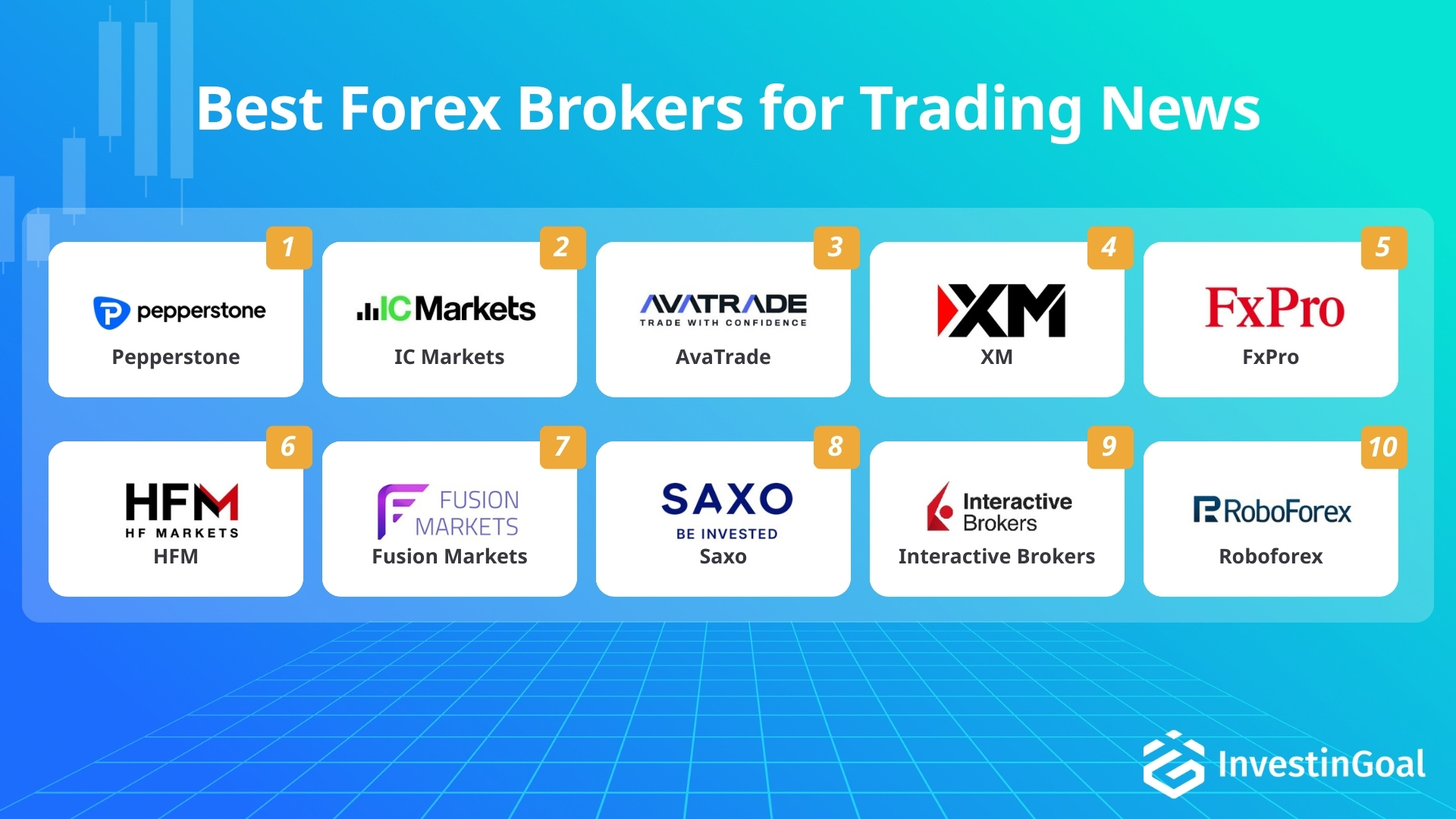
The best Forex brokers for news trading are Pepperstone, IC Markets, AvaTrade and XM.
The most important criteria to consider when choosing the best Forex broker for news trading are low-latency execution (no dealing desk / no requotes), tight all-in trading costs (spreads + commissions), a clear policy that allows news trading and scalping, and strong volatility handling (deep liquidity, manageable spread widening, and controlled slippage during high-impact releases).
Pepperstone is the best news trading Forex broker overall, thanks to offering low-latency execution (no dealing desk / no requotes), tight all-in trading costs (spreads + commissions), a clear policy that allows news trading and scalping, and strong volatility handling (deep liquidity, manageable spread widening, and controlled slippage during high-impact releases). Some of the best news trading brokers like Pepperstone, IC Markets, AvaTrade, and XM are also regarded among the top forex brokers overall due to their combination of competitive trading costs, strong execution speed, and dependable trading conditions.
Ranked just behind Pepperstone, the best news trading FX brokers for execution speed, trading costs, strategy flexibility, and volatility-time execution quality include IC Markets, AvaTrade, and XM. IC Markets features ultra-tight raw spreads with fast ECN-style execution and no strategy restrictions. AvaTrade comes with strong built-in news/research tools and risk-management features designed to help during volatile events. XM provides fast market execution with no requotes, news-trading-friendly conditions, and very accessible entry requirements for smaller accounts.

Pepperstone
(best news trading Forex broker overall)
Pepperstone is the best news trading Forex broker thanks to low-latency no-dealing-desk execution on Equinix NY4/LD5, deep liquidity from 20+ tier-1 providers with no requotes, and Razor raw pricing that typically starts near 0.0 – 0.3 pips (about $7 per lot round-turn). Pepperstone is an exceptional option for news trading overall because its co-located infrastructure targets rapid fills when volatility spikes and spreads briefly widen (for example, EUR/USD can expand from 0.7 pips to 2.5 – 3.0 pips around major announcements like CPI, NFP, or central-bank rate decisions). Pepperstone’s low-latency NDD execution helps traders with faster order fills when milliseconds and slippage decide whether an entry is filled near the intended price or several pips away.
-
Regulations:
-
Avg. EUR/USD Spread:
-
Platforms:
Pepperstone Features
The features of Pepperstone are listed below.
- Pepperstone allows news trading and scalping with no strategy restrictions.
- Pepperstone uses no dealing desk execution with no requotes or intervention.
- Pepperstone runs low latency servers in Equinix NY4 and LD5 to reduce slippage during news spikes.
- Pepperstone provides deep liquidity from 20+ tier 1 providers to keep fills stable in fast markets.
- Pepperstone offers the Razor account with raw spreads from 0.0 pips and about $7 per lot round turn commission.
- Pepperstone is regulated by ASIC, FCA, CySEC, BaFin, DFSA, CMA, and SCB.
Pepperstone Pros and Cons
Advantages of Pepperstone
The advantages of Pepperstone are listed below.
- Stable raw spreads (0,10 pips on EUR/USD on average)
- Caters for algorithmic trading
- Has won over 30 Forex industry awards
Disadvantages of Pepperstone
The disadvantages of Pepperstone are listed below.
- The demo account is not unlimited
About Pepperstone
Pepperstone is a global forex and CFD broker founded in 2010 in Melbourne, Australia. Pepperstone offers trading on currencies, commodities, indices, stocks, and cryptocurrencies through MetaTrader and cTrader platforms. Pepperstone is regulated by multiple authorities including ASIC, FCA, and CySEC. Pepperstone is known for competitive spreads, fast execution, and extensive educational resources. Pepperstone serves clients in over 160 countries worldwide. The Pepperstone CEO is Tamas Szabo.

IC Markets
(best news trading Forex broker for raw spreads)
IC Markets is the second best news trading Forex broker due to its raw-spread ECN pricing (EUR/USD around 0.1 pips typical before commission), Equinix NY4/LD5 server co-location for low latency, and a no-restrictions policy that allows scalping and news trading without requotes. IC Markets is an outstanding choice for raw-spread news trading since its Raw account pairs interbank-style pricing with a $7 per lot round-turn commission, keeping the all-in trading cost around 0.6 – 0.7 pips in normal conditions. IC Markets’ raw pricing model provides traders with tighter entry/exit costs, which is critical when orders must trigger and close quickly without the spread consuming most of the expected move.
-
Regulations:
-
Avg. EUR/USD Spread:
-
Platforms:
IC Markets Features
The features of IC Markets are listed below.
- IC Markets allows news trading and scalping with no strategy restrictions.
- IC Markets co-locates trading servers in Equinix NY4 and LD5 for low latency execution during news.
- IC Markets offers Raw Spread pricing with about 0.1 pips average EUR/USD spread plus $7 per lot round turn commission.
- IC Markets can see EUR/USD spreads widen to about 2.5 to 4.0 pips during major news events.
- IC Markets supports MT4, MT5, cTrader, and TradingView for fast order entry and automation.
- IC Markets is regulated by ASIC and CySEC and also operates under FSA Seychelles, SCB Bahamas, and FSCA South Africa entities.
IC Markets Pros and Cons
Advantages of IC Markets
The advantages of IC Markets are listed below.
- Low-latency trading environment
- Institutional level liquidity
- MT4, MT5, cTrader platforms are all available
Disadvantages of IC Markets
The disadvantages of IC Markets are listed below.
- Small amount of educational tools for new traders
- Small range of tradable assets compared to other CFD/Forex brokers
About IC Markets
IC Markets is a global forex and CFD broker founded in 2007 and based in Sydney, Australia. IC Markets offers trading on over 2,250 instruments including currencies, commodities, indices, stocks, and cryptocurrencies. IC Markets provides MetaTrader 4, MetaTrader 5, and cTrader platforms. IC Markets is regulated by multiple authorities including ASIC and CySEC. IC Markets is known for its ECN execution model and low spreads. The IC Markets CEO is Andrew Budzinski.

AvaTrade
(best news trading Forex broker for research tools)
AvaTrade is the third best news trading Forex broker because of its built-in research stack (Trading Central signals and daily market breakdowns), commission-free pricing with about 0.9 – 1.0 pips on EUR/USD in normal conditions, and event-focused risk tools like AvaProtect plus negative balance protection. AvaTrade is an excellent option for research-driven news trading because its platforms (such as AvaTradeGO and MetaTrader 4) integrate news, analysis, and Trading Central signals directly into the workflow, helping you prepare for scheduled releases instead of reacting late. AvaTrade’s research suite provides traders with timely context (key drivers, levels, and signal ideas) that turns into clearer pre-news plans – what to watch, where key levels sit, and what would invalidate the setup.
-
Regulations:
-
Avg. EUR/USD Spread:
-
Platforms:
AvaTrade Features
The features of AvaTrade are listed below.
- AvaTrade integrates Trading Central news, analysis, and signals to support event driven decisions.
- AvaTrade offers AvaProtect to buy temporary loss protection for volatile news periods.
- AvaTrade charges no forex commissions and prices trades via fixed or tight variable spreads.
- AvaTrade supports MT4, MT5, AvaTradeGO, WebTrader, AvaOptions, and copy trading apps like DupliTrade and ZuluTrade.
- AvaTrade averages about 0.9 to 1.0 pips on EUR/USD on its standard account pricing.
- AvaTrade is regulated by the Central Bank of Ireland, ASIC, JFSA, FSCA, CySEC, and ADGM.
AvaTrade Pros and Cons
Advantages of AvaTrade
The advantages of AvaTrade are listed below.
- Tight fixed spreads from 0.6 pips (0.9 pips for retail traders)
- The mobile apps are well designed
- Can be connected to ZuluTrade and Duplitrade
Disadvantages of AvaTrade
The disadvantages of AvaTrade are listed below.
- High inactivity fees
- The demo account is limited to 30 days
About AvaTrade
AvaTrade is a global forex and CFD broker founded in 2006 and headquartered in Dublin, Ireland. AvaTrade offers trading on currencies, commodities, indices, stocks, bonds, ETFs, and cryptocurrencies. AvaTrade provides proprietary platforms alongside MetaTrader 4 and 5. AvaTrade is regulated by multiple authorities including CySEC, ASIC, and FSA. AvaTrade serves over 300,000 clients worldwide. AvaTrade is known for competitive spreads and extensive educational resources. The AvaTrade CEO is David Dryzin since 2016.

XM
(best news trading Forex broker for micro lots)
XM is the fourth best news trading Forex broker thanks to micro-lot contract sizing, 100% market execution with no requotes (99.35% of orders executed in under 1 second), and a very low entry point with Micro/Standard accounts starting around $5. The micro-lot contract sizing of XM ranks it among the great choices for news trading because 0.01-lot increments let you size risk precisely on fast-moving events, especially when testing straddles or scaling out around CPI, NFP, or rate decisions. The micro-lot sizing of XM improves traders’ risk granularity, so you can match position size to your stop distance instead of taking a larger lot and hoping volatility stays contained.
-
Regulations:
-
Avg. EUR/USD Spread:
-
Platforms:
XM Features
The features of XM are listed below.
- XM allows news trading and scalping on all account types with no restrictions.
- XM uses 100% market execution with no requotes and executes 99.35% of trades in under 1 second.
- XM supports MT4 and MT5 across desktop, web, and mobile via XM WebTrader and XM Mobile App.
- XM offers typical EUR/USD spreads of about 1.0 to 1.7 pips on Standard and Micro accounts with no commission.
- XM offers tighter pricing on Ultra Low accounts around 0.6 pips on EUR/USD.
- XM is regulated by CySEC, ASIC, DFSA, and FSCA across its group entities.
XM Pros and Cons
Advantages of XM
The advantages of XM are listed below.
- There’s a wide range of account types
- The demo account at XM is unlimited
- Wide range of educational resources
Disadvantages of XM
The disadvantages of XM are listed below.
- No social trading features available
- The account availability changes depending on the location of the trader
- High minimum deposit to invest in securities ($10000 for the XM Shares account)
About XM
XM is a global forex and CFD broker founded in 2009, offering trading on currencies, commodities, indices, stocks, and cryptocurrencies. XM provides MetaTrader 4, MetaTrader 5, and proprietary platforms. XM is regulated by multiple authorities including CySEC, ASIC, and IFSC. XM is known for competitive spreads, extensive educational resources, and multilingual customer support. XM serves over 5 million clients from 196 countries. XM offers various account types and a no-requote policy.

FxPro
(best news trading Forex broker for execution stats)
FxPro is the fifth best news trading Forex broker through its published execution statistics (98.5% of orders with no requote, 11.8% positive slippage vs 13.1% negative), high-speed NDD infrastructure (about 13 ms average execution and 7,000 trades/second capacity), and access to raw-spread account options for active traders. FxPro is a strong option for execution-stat-driven news trading because it quantifies fill quality and slippage balance, giving traders objective data to judge how it behaves when liquidity thins during macro releases. FxPro’s execution transparency provides traders with a measurable view of fill reliability, making it easier to set realistic stop buffers, choose limit vs market entries, and estimate likely slippage during high-impact events.
-
Regulations:
-
Avg. EUR/USD Spread:
-
Platforms:
FxPro Features
The features of FxPro are listed below.
- FxPro supports news trading, scalping, and algorithmic trading under a no dealing desk model.
- FxPro reports over 98.5% of orders with no requote and a near balanced slippage profile with 11.8% positive slippage versus 13.1% negative slippage.
- FxPro averages about 13 milliseconds execution time and processes around 7,000 trades per second.
- FxPro offers Raw plus pricing with about 0.2 pips average EUR/USD spread plus $7 per lot round turn commission.
- FxPro provides MT4, MT5, cTrader, and FxPro Edge for rapid news time execution tools.
- FxPro is regulated by FCA, CySEC, FSCA, SCB, and DFSA.
FxPro Pros and Cons
Advantages of FxPro
The advantages of FxPro are listed below.
- Regulated and Trusted Forex broker
- Diverse Trading Platforms
- Wide Range of Instruments
Disadvantages of FxPro
The disadvantages of FxPro are listed below.
- Inactivity Fee
- Limited Educational Resources
- No Guaranteed Stop-Loss Orders
About FxPro
FxPro is a global online broker founded in 2006, offering trading on forex, CFDs, stocks, indices, commodities, and cryptocurrencies. FxPro provides multiple trading platforms including MetaTrader 4, MetaTrader 5, cTrader, and its proprietary FxPro Platform. FxPro is regulated by multiple authorities including FCA, CySEC, SCB, FSC and KNN. FxPro serves clients in over 170 countries and has won numerous industry awards. The FxPro CEO is Charalambos Psimolophitis.

HFM
(best news trading Forex broker for no minimum deposit)
HFM is the sixth best news trading Forex broker for its $0 minimum deposit on Micro/Premium/Zero accounts, fully automated execution with no dealer intervention or requotes, and an optional Zero Spread account that can quote 0.0 – 0.3 pips on EUR/USD plus commission. HFM’s $0 minimum deposit protects traders from over-committing capital while you verify real conditions – spread widening, slippage, and fill speed – during live news spikes. HFM is a solid choice for low-barrier news trading since its $0 minimum deposit lets you test live execution with small capital while still using MT4/MT5 conditions designed for fast order entry around releases.
-
Regulations:
-
Avg. EUR/USD Spread:
-
Platforms:
HFM Features
The features of HFM are listed below.
- HFM uses fully automated execution with no dealer intervention or requotes during volatility.
- HFM offers a Zero Spread account with EUR/USD spreads around 0.0 to 0.3 pips plus about $6 to $8 per round lot commission.
- HFM averages about 1.0 pip on EUR/USD on Premium and Micro style accounts with no commission.
- HFM supports MT4, MT5, and the HFM Trading App for fast reaction trading on news.
- HFM has a $0 minimum deposit on Micro, Premium, and Zero accounts.
- HFM is regulated by FCA, FSCA, DFSA, FSC Mauritius, FSA Seychelles, and CMA Kenya.
HFM Pros and Cons
Advantages of HFM
The advantages of HFM are listed below.
- High Leverage Options
- Low Minimum Deposit
- Wide Range of Trading Instruments
Disadvantages of HFM
The disadvantages of HFM are listed below.
- Higher Trading Costs
- Limited Educational Resources
About HFM
HFM, formerly known as HotForex, is a global multi-asset broker founded in 2010. HFM offers trading on forex, stocks, commodities, indices, and cryptocurrencies through MetaTrader and proprietary platforms. HFM is regulated by multiple authorities including FCA, CySEC, and FSCA. HFM is known for competitive spreads, fast execution, and extensive educational resources. HFM serves over 3.5 million clients worldwide. The HF Markets Group CEO is George Koumantaris.

Fusion Markets
(best news trading Forex broker for low commissions)
Fusion Markets is the seventh best news trading Forex broker thanks to ultra-low commissions of $4.50 per 100k round-turn ($2.25 per side), near-zero raw spreads on its Zero account (often 0.0 – 0.1 pips on EUR/USD), and fast ECN/STP execution with FIX API access for latency-sensitive traders. Fusion Markets is a very good option for low-commission news trading because the $4.50 round-turn fee keeps transaction costs small when strategies require rapid entries and exits within seconds of a release. Fusion Markets’ low commission schedule provides traders with lower friction costs per trade, so more of a short, fast news move remains as net profit after fees.
-
Regulations:
-
Avg. EUR/USD Spread:
-
Platforms:
Fusion Markets Features
The features of Fusion Markets are listed below.
- Fusion Markets charges about $4.50 per 100k round turn commission on its low cost raw pricing account.
- Fusion Markets posts EUR/USD spreads around 0.0 to 0.1 pips on the Zero account in normal conditions.
- Fusion Markets uses ECN STP execution with no requotes and supports FIX API for low latency workflows.
- Fusion Markets supports MT4 and MT5 only for straightforward high speed news execution.
- Fusion Markets has no minimum deposit requirement.
- Fusion Markets is regulated by ASIC and also operates under VFSC and FSA Seychelles entities.
Fusion Markets Pros and Cons
Advantages of Fusion Markets
The advantages of Fusion Markets are listed below.
- Low Trading Costs
- Zero Spread Accounts
- Excellent Customer Support
Disadvantages of Fusion Markets
The disadvantages of Fusion Markets are listed below.
- Limited Product Selection
- Basic Educational Resources
About Fusion Markets
Fusion Markets is an Australian-based forex and CFD broker founded in 2019. Fusion Markets offers trading on over 90 currency pairs, stocks, indices, commodities, and cryptocurrencies. Fusion Markets provides MetaTrader 4, MetaTrader 5, and cTrader platforms. Fusion Markets is regulated by ASIC and VFSC. Fusion Markets is known for low trading costs, no minimum deposit, and copy trading services. The Fusion Markets CEO is Phil Horner.

Saxo
(best news trading Forex broker for multi-asset trading)
Saxo is the eighth best news trading Forex broker due to multi-asset access to 70,000+ instruments (like Forex pairs such as EUR/USD, indices such as US500, and commodities such as XAU/USD), advanced SaxoTraderGO/PRO order controls (including stop-limit, OCO, and slippage-tolerance settings), and institutional-grade market data and news integration (including Reuters/NewsEdge feeds and Level 2 views). Saxo is a good choice for multi-asset news trading since you can express one news view across FX, indices, commodities, bonds, and equities from a single account and risk dashboard. The multi-asset access of Saxo provides traders with more hedging routes across correlated markets, so you can offset event risk (for example, pairing a USD trade with an index or gold hedge) instead of relying on one position.
-
Regulations:
-
Avg. EUR/USD Spread:
-
Platforms:
Saxo Features
The features of Saxo are listed below.
- Saxo provides advanced order controls like stop limit orders and configurable slippage tolerance for volatile news entries.
- Saxo offers Depth Trader Level 2 views plus time and sales style data to read liquidity around releases.
- Saxo supports multi-asset news trading across 70,000+ instruments from one account.
- Saxo averages about 1.1 pips on EUR/USD on Classic accounts and about 1.0 and 0.9 pips on Platinum and VIP tiers.
- Saxo is a fully licensed bank regulated by the Danish FSA and multiple Tier 1 regulators via subsidiaries.
- Saxo has a $0 minimum deposit for the Classic account.
Saxo Pros and Cons
Advantages of Saxo
The advantages of Saxo are listed below.
- Regulation and Trust
- Extensive Product Range
- Advanced Trading Platform
Disadvantages of Saxo
The disadvantages of Saxo are listed below.
- High Minimum Deposits for Premium Accounts
- Lack of Spread Betting Options
- Custody Fees in Certain Regions
About Saxo
Saxo is a Danish investment bank and online trading platform founded in 1992. Saxo offers trading in forex, stocks, CFDs, futures, options, and other financial instruments across global markets. Saxo provides proprietary trading platforms and white-label solutions for institutional clients. Saxo is regulated by multiple authorities including the Danish FSA and UK FCA. Saxo serves retail and institutional clients in over 170 countries. The Saxo CEO and co-founder is Kim Fournais.

Interactive Brokers
(best news trading Forex broker for advanced order types)
Interactive Brokers is the ninth best news trading Forex broker because of advanced order types and API automation in Trader Workstation, direct market access forex pricing with no added spread markup (often 0.1 – 0.2 pip raw spreads), and transparent commissions that are typically about $2 per 100,000 USD traded per side. Interactive Brokers is a good option for advanced-order news trading since TWS supports complex and algorithmic orders (including hidden, iceberg, and VWAP/TWAP-style execution) that can reduce adverse fills when prices jump on headlines. Interactive Brokers’ advanced order toolkit provides traders with tighter control over entry logic, so you can define exact triggers, cap slippage with stop-limit structures, and automate partial exits when price moves in stages after a release.
-
Regulations:
-
Avg. EUR/USD Spread:
-
Platforms:
Interactive Brokers Features
The features of Interactive Brokers are listed below.
- Interactive Brokers provides agency style forex execution with direct market access and no added spread markup.
- Interactive Brokers typically shows EUR/USD raw spreads around 0.1 to 0.2 pips and charges about $2 per 100,000 per side commission.
- Interactive Brokers uses SmartRouting to seek best available pricing across liquidity venues during fast news markets.
- Interactive Brokers offers Trader Workstation with advanced order types and API access for automated news strategies.
- Interactive Brokers is regulated across major jurisdictions including SEC, CFTC, NFA, FCA, ASIC, MAS, and others through its entities.
- Interactive Brokers has a $0 minimum deposit for a cash account.
Interactive Brokers Pros and Cons
Advantages of Interactive Brokers
The advantages of Interactive Brokers are listed below.
- Low Trading Fees
- Advanced Trading Tools
- Wide Market Access
Disadvantages of Interactive Brokers
The disadvantages of Interactive Brokers are listed below.
- Not user-friendly
- No MetaTrader Support
- Additional Fees
About Interactive Brokers
Interactive Brokers is a global electronic broker founded in 1978, offering trading in stocks, options, futures, forex, bonds, ETFs, and cryptocurrencies across 150 markets in 33 countries. Interactive Brokers provides advanced trading platforms, low commissions, and access to a wide range of financial instruments. Interactive Brokers is known for its sophisticated technology and serves both retail and institutional clients. Interactive Brokers is regulated by multiple top-tier authorities worldwide. The CEO of the Interactive Brokers Group is Milan Galik.

Roboforex
(Best news trading Forex broker for EA automation)
RoboForex is the tenth best news trading Forex broker thanks to EA-friendly platforms (MT4/MT5 and cTrader) with VPS support for 24/7 automation, very fast market execution advertised around 40 – 50 ms with no requotes, and slippage-control rules designed to avoid limit/take-profit fills at worse prices during gaps. The EA automation ecosystem of RoboForex places it among the good choices for news trading because running Expert Advisors on a VPS can cut latency and keep event-driven systems operating continuously through scheduled releases and off-hours sessions. The EA automation ecosystem of RoboForex helps traders with consistent VPS-hosted execution, so EAs can place straddles, manage trailing stops, and enforce max-loss rules automatically when manual clicks are too slow.
-
Regulations:
-
Avg. EUR/USD Spread:
-
Platforms:
Roboforex Features
The features of Roboforex are listed below.
- RoboForex allows news trading, scalping, and EA trading with market execution and no requotes.
- RoboForex advertises execution around 40 to 50 milliseconds for fast news time fills.
- RoboForex fills limit orders and take profits only at the requested price or better to prevent adverse slippage.
- RoboForex cancels pending stop orders when a gap overtakes the trigger price instead of filling far off market.
- RoboForex offers Pro, ECN, and Prime style pricing with EUR/USD around 1.3 pips on Pro and about 0.0 to 0.1 pips plus commission on ECN and Prime.
- RoboForex operates under FSC Belize regulation and Financial Commission membership and serves EU clients via RoboMarkets under CySEC.
Roboforex Pros and Cons
Advantages of Roboforex
The advantages of Roboforex are listed below.
- Diverse Trading Platforms
- Wide Range of Instruments
- Low Minimum Deposit
Disadvantages of Roboforex
The disadvantages of Roboforex are listed below.
- Limited Educational Resources
- Higher Spreads on Some Accounts
- Regulatory Concerns
About Roboforex
RoboForex is a global forex and CFD broker founded in 2009, offering trading on currencies, stocks, indices, commodities, and cryptocurrencies. RoboForex provides MetaTrader 4, MetaTrader 5, and proprietary platforms. RoboForex is regulated by the Financial Services Commission (FSC) of Belize. RoboForex is known for competitive spreads, extensive educational resources, and multiple account types. RoboForex serves over 4.5 million clients worldwide. The RoboForex CEO is Andrei Dziarnovich.
Comparison of the best news trading Forex brokers
The table that compares the best news trading Forex brokers is shown below.
| Broker | Average execution speed (ms) | All-in EUR/USD trading cost (pips) | EUR/USD news-spike spread peak (pips) | API access (type) | Tier-1 regulatory license count |
|---|---|---|---|---|---|
| Pepperstone | N/A | 0.7–1.0 pips | 3.0 pips | N/A | 2 |
| IC Markets | N/A | 0.6–0.7 pips | 4.0 pips | N/A | 1 |
| AvaTrade | N/A | 0.9–1.0 pips | N/A | N/A | 3 |
| XM | ≤1000 ms | 0.6 pips | N/A | N/A | 1 |
| FxPro | 13 ms | 0.9 pips | N/A | N/A | 2 |
| HFM | N/A | 0.6–0.8 pips | N/A | N/A | 1 |
| Fusion Markets | N/A | 0.45 pips | N/A | FIX API | 1 |
| Saxo | N/A | 1.1 pips | 3.0 pips | N/A | 7 |
| Interactive Brokers | N/A | 0.3–0.4 pips | N/A | IBKR API | 8 |
| RoboForex | 40–50 ms | 0.3–0.4 pips | N/A | N/A | 0 |
Warning
CFDs are complex instruments and come with a high risk of losing money rapidly due to leverage. Between 74-89% of retail investor accounts lose money when trading CFDs. You should consider whether you can afford to take the high risk of losing your money.
The best ECN broker for news trading is IC Markets. IC Markets delivers raw-spread ECN pricing with deep liquidity, Equinix (NY4/LD5) low-latency servers, and a no-requote, strategy-friendly setup. These tight spreads and co-located servers at IC Markets can cut slippage and execution delays when volatility spikes, while the lack of restrictions supports aggressive news strategies.
News traders look for raw spreads, deep liquidity access, and ultra-low-latency infrastructure in the best ECN brokers. Pepperstone offers similar features to IC Markets like Razor spreads from 0.0 pips, 20+ tier-1 liquidity providers, and Equinix-based routing for fast fills. Fusion Markets is another option versus IC Markets, offering 0.0 – 0.1 raw spreads on EUR/USD, an ultra-low $4.50/100k round-turn commission, and no-requote ECN-STP execution.
The best news trading Forex broker with fast execution is Pepperstone. Pepperstone uses no-dealing-desk execution with no intervention, low-latency servers in Equinix (NY4/LD5), and deep liquidity to handle volatility. That execution model at Pepperstone helps traders get fills closer to their intended price during news spikes, reducing delays and minimizing disruption when spreads widen.
Top fast-execution brokers for news trading usually provide NDD/market execution, robust liquidity, and low-latency connectivity. FxPro is an alternative to Pepperstone due to its 13ms average execution time, published execution/slippage statistics, and an NDD setup designed for high throughput. A similar alternative to Pepperstone is RoboForex for its 40 – 50ms advertised execution, market execution with no requotes, and a server/VPS focus for low-latency trading; it is often featured among the best execution for FX brokers.
The best news trading Forex broker with TradingView is Pepperstone. Pepperstone combines TradingView integration with low-latency execution for quick entries and a raw-spread Razor account to keep costs down. With TradingView charting and alerts plus Razor pricing at Pepperstone, traders can react faster to breaking data while limiting the spread/commission drag on frequent trades.
TradingView integration, fast execution, and sharp pricing of the best news-trading Forex brokers are highly regarded by Forex traders. IC Markets offers similar features to Pepperstone like TradingView integration, Equinix co-located servers, and ultra-tight raw spreads (around 0.1 pip average before commission), making it a frequent pick as a best TradingView Forex broker for chart-driven execution. Saxo is another alternative to Pepperstone, leaning on SaxoTraderGO/PRO for execution tools, advanced order types like stop-limit/OCO, and strong stability/liquidity in volatile sessions.
The best news trading Forex broker with expert advisors (EAs) is RoboForex. RoboForex supports MT4/MT5 and cTrader for automation, provides a free VPS for qualifying clients, and focuses on fast market execution for low latency. The platform range and VPS setup at RoboForex can keep EAs running continuously and closer to the broker’s infrastructure, which may improve fill consistency during high-impact releases.
EA-friendly news brokers usually pair EA-capable platforms, VPS hosting, and non-intervention execution. A similar alternative to RoboForex is HFM for MT4/MT5 EA support, a free VPS for qualifying clients, and fully automated execution with no dealer intervention. Pepperstone offers MT4/MT5 EA support, low-latency infrastructure for faster fills, and an all-strategies-allowed policy, which makes it an alternative to RoboForex.
The best news trading Forex broker with low spreads is Fusion Markets. Fusion Markets keeps costs lean with 0.0 – 0.1 EUR/USD spreads on its Zero account, very low commission ($4.50/lot round turn), and no spread markup via raw pricing. Those low all-in costs at Fusion Markets can make frequent entries around announcements more feasible, especially when traders need to manage tight risk and quick exits.
Raw interbank-style pricing, deep liquidity, and fast execution are often featured in the best low-spread news trading brokers. IC Markets is an alternative to Fusion Markets thanks to 0.1 pip average raw spreads (before commission), a deep liquidity pool, and quick execution in Equinix data centers. Pepperstone is another alternative to Fusion Markets, with Razor spreads from 0.0 pips, competitive all-in pricing on majors, and deep liquidity via a no-dealing-desk model, and it is often listed as a best low spread Forex broker.
The criteria for choosing the best News Trading Forex brokers are listed below.
- Low-latency execution: Prioritize brokers with co-located infrastructure and rapid fills, because milliseconds materially affect entry quality during CPI/NFP For example, Pepperstone and IC Markets emphasize Equinix NY4/LD5 co-location, FxPro reports 13 ms average execution and 7,000 trades/second throughput, RoboForex advertises 40 – 50 ms execution, and XM states 99.35% of trades execute in under 1 second.
- Spreads & commissions: Calculate the all-in EUR/USD cost (raw spread + commission) on the account you will actually trade, since news strategies often rely on tight cost control across many quick entries/exits. Pepperstone Razor commonly quotes 0 – 0.3 pips + $7/lot round-turn, IC Markets Raw averages 0.1 pips + $7/lot round-turn, Fusion Markets Zero can be 0.0 – 0.1 pips + $4.50 per 100k round-turn, and Interactive Brokers commonly pairs 0.1 – 0.2 pips “true” spread with $2 per 100k per side commission.
- News-time spread stability: Evaluate spread widening during high-impact releases and normalization speed, not just the “typical” spread in calm markets. Practical benchmarks in the same EUR/USD context include 7 → 2.5 – 3.0 pips around major announcements at Pepperstone and 0.7 → 2.5 – 4.0 pips at IC Markets. Require that post-release spreads revert rapidly rather than staying inflated for extended periods.
- Slippage & requotes: Choose brokers that commit to market execution with no requotes and that allow both positive and negative slippage. FxPro’s disclosed execution profile (e.g., 5% no requote, 11.8% positive vs 13.1% negative slippage) is the type of transparency that helps assess fairness. XM, Pepperstone, and IC Markets also emphasize no-requote handling, while RoboForex highlights protective execution rules (e.g., limit/take-profit filled at requested price or better. Stop-order gaps may cancel rather than fill far off-market).
- Order types & speed: Require platforms that support one-click trading and presets/hotkeys, plus volatility-aware order control via stop-limit, OCO, and conditional orders with slippage tolerance to reduce “bad fills” during gaps. SaxoTraderGO/PRO, IBKR Trader Workstation, and cTrader are notable in this context, with Level II depth tools that can be valuable when liquidity thins around releases.
- Automation & VPS: If your methodology uses straddles, rule-based entries, or automated execution, select brokers that explicitly support MT4/MT5 Expert Advisors, API access, and VPS hosting to reduce latency variance. Interactive Brokers API and Fusion Markets FIX API are especially relevant. VPS alignment with NY4/LD5 execution ecosystems is often beneficial for release-driven workflows.
- Risk protections: Prefer brokers with negative balance protection and event-specific safeguards that mitigate tail risk during surprise announcements and weekend gaps. Examples include negative balance protection at XM, FxPro, and HFM, and AvaProtect-style loss protection. Treat 1:1000 – 1:2000 leverage as a risk variable and use strict sizing rules with predefined maximum loss controls.
- Regulatory strength: Select brokers with tier-1 licenses or bank-grade supervision to reduce counterparty risk and improve safeguards such as segregation and enforceable dispute pathways. Entity examples include Pepperstone (FCA/ASIC), IC Markets (ASIC/CySEC), FxPro (FCA/CySEC), XM (ASIC/CySEC), and Saxo Bank (regulated as a Danish bank under the Danish FSA).
The broker rules that matter most for safe news trading are 7: (1) explicit permission for scalping/news-trading and Expert Advisors (EAs), (2) market execution (not “instant execution”) with no requotes, (3) a written execution policy covering slippage, partial fills, and off-quotes, (4) protective account mechanics – negative balance protection plus a clearly stated margin close-out/stop-out level, (5) minimal order-placement constraints (low/zero “freeze level” and no minimum stop distance), (6) client-money safeguards (segregated funds) under credible supervision (e.g., FCA/ASIC/CySEC), and (7) transparency signals such as published execution statistics.
These rules matter because high-impact releases can create short-lived illiquidity where spreads widen and stop orders can gap. “Market execution” means your order fills at the best available price (good or bad), so you want a broker that removes dealer requotes and explains how it treats stop-losses, take-profits, and pending orders when prices jump. Brokers that set freeze level to 0 and allow stops very close to price make risk-defined straddles feasible, while restrictive stop distances can force oversized risk. Optional broker-side risk tools (e.g., trade-specific loss protection sold for a fee) can further reduce tail risk if you price them into expectancy. Avoid brokers that ban news trading or reserve broad discretion to cancel trades post-event.
The trading strategies that work best with a news-optimized Forex broker are 5: (1) post-release momentum breakout, (2) stop-order straddle (buy-stop + sell-stop, ideally as OCO/“one-cancels-the-other” or stop-limit), (3) pullback continuation after the first impulse, (4) short-horizon mean-reversion fade once liquidity refills, and (5) fully automated event algorithms that place/modify/cancel orders rapidly (often via VPS hosting close to the broker’s servers).
A broker “optimized for news trading” is one that permits scalping and allows orders to be placed very close to the market (e.g., zero freeze level and no minimum stop distance), which is essential for straddles and tight risk placement. During data releases, quote gaps and partial fills are normal because liquidity can disappear; news-oriented trading strategies that bound worst-case price (stop-limit) or that wait seconds for spreads to normalize are generally more robust than firing pure market orders. You should match the strategy to the instrument’s microstructure: high-liquidity majors (EUR/USD, USD/JPY) support breakouts and pullbacks; thinner crosses and CFDs often behave better with delayed-entry confirmation or mean reversion. Regardless of approach, define a maximum loss per event, size positions conservatively, and assume occasional adverse slippage even at high-quality ECN/STP venues. If your edge depends on milliseconds, treat latency as a first-order variable.
The trading platforms that most consistently combine real-time news/event feeds with fast order entry are: cTrader, MetaTrader 5 (MT5), TradingView (via a connected broker), SaxoTrader (web/desktop), and Interactive Brokers Trader Workstation (TWS).
cTrader is designed for rapid order workflows and integrates a full economic calendar (via FXStreet), which is useful for CPI, NFP, and central-bank releases. MT5 supports a live news feed capability and a built-in economic calendar so you can monitor upcoming releases and their “actual vs forecast” outcomes inside the terminal. TradingView provides an economic calendar and a continuous news stream, including content from major news providers, while execution happens through your linked broker connection. SaxoTrader emphasizes professional order types (including stop-limit) and event-trading utilities such as depth-of-market and time-and-sales modules, and it publishes execution performance metrics for its infrastructure. TWS includes configurable newsfeeds from multiple vendors inside the platform and can surface curated news collections for rapid scanning; institutional feeds are often available as add-on subscriptions.
For latency-sensitive news scalping, desktop clients with hotkeys/one-click trading and a stable network (often a VPS) are generally superior to mobile apps. Note: “fast execution” is primarily broker/server-dependent; the platform mainly determines how quickly you can send, modify, and cancel orders on a platform for Forex trading.
The broker conditions that matter most for trading CPI releases are 6: (1) stable pricing on USD pairs during the 08:30 ET release window, (2) market execution/no requotes, (3) permission to place pending orders very close to price (low/zero freeze level and minimal stop distance), (4) access to a raw-spread + low-commission account backed by deep liquidity, (5) strong risk backstops (negative balance protection and a transparent stop-out rule), and (6) platform tooling for event awareness (economic-calendar alerts and rapid order management).
U.S. CPI is released at 08:30 ET on scheduled dates, so the exact timestamp matters: spreads can widen seconds before the print, liquidity can vanish at the release, and slippage can dominate your expected edge if you enter with market orders. Because CPI often reprices Federal Reserve expectations, the most reactive instruments are typically EUR/USD, GBP/USD, USD/JPY, and gold (XAU/USD). Brokers that allow stop orders “between the spread” and do not impose a freeze level make straddle entries possible; brokers that enforce wide stop distances force larger, less controlled risk. Also confirm margin methodology: some brokers use tiered margin that increases with exposure, so an oversized CPI position can trigger earlier liquidation even without a stop-loss hit. Even with high-quality ECN/STP venues, assume occasional partial fills and adverse slippage and size accordingly.
To choose a news trading Forex broker that manages spreads, slippage, and execution quality effectively during NFP, you should use a 7-point checklist: (1) the broker explicitly permits news trading/scalping and EAs, (2) it uses market execution with no requotes, (3) it offers a raw-spread account with clearly stated commissions, (4) it has low order-placement frictions (minimal stop distance and low/zero freeze level), (5) it discloses how stops/limits behave in gaps and whether slippage is symmetric (positive and negative), (6) it provides risk protections (negative balance protection, clear stop-out and margin rules), and (7) it can be verified by testing.
NFP (the U.S. Employment Situation release) is published at 08:30 ET, and the first 1 – 10 seconds are where spreads and slippage are most unstable, so understanding the NFP meaning helps set realistic expectations for execution. The only factual way to evaluate “spread control” is to run a small live test (or realistic demo) on your exact instruments and order types at multiple releases, logging: pre-news spread, peak spread, fill price vs requested price, and time-to-fill. Prefer stop-limit/limit entries over market orders, and favor venues with deep, multi-provider liquidity plus co-located servers in major data centers (e.g., Equinix NY4/LD5) to reduce latency and off-quotes. If your logs show persistent negative slippage without meaningful positive slippage, treat that as an execution-quality red flag.