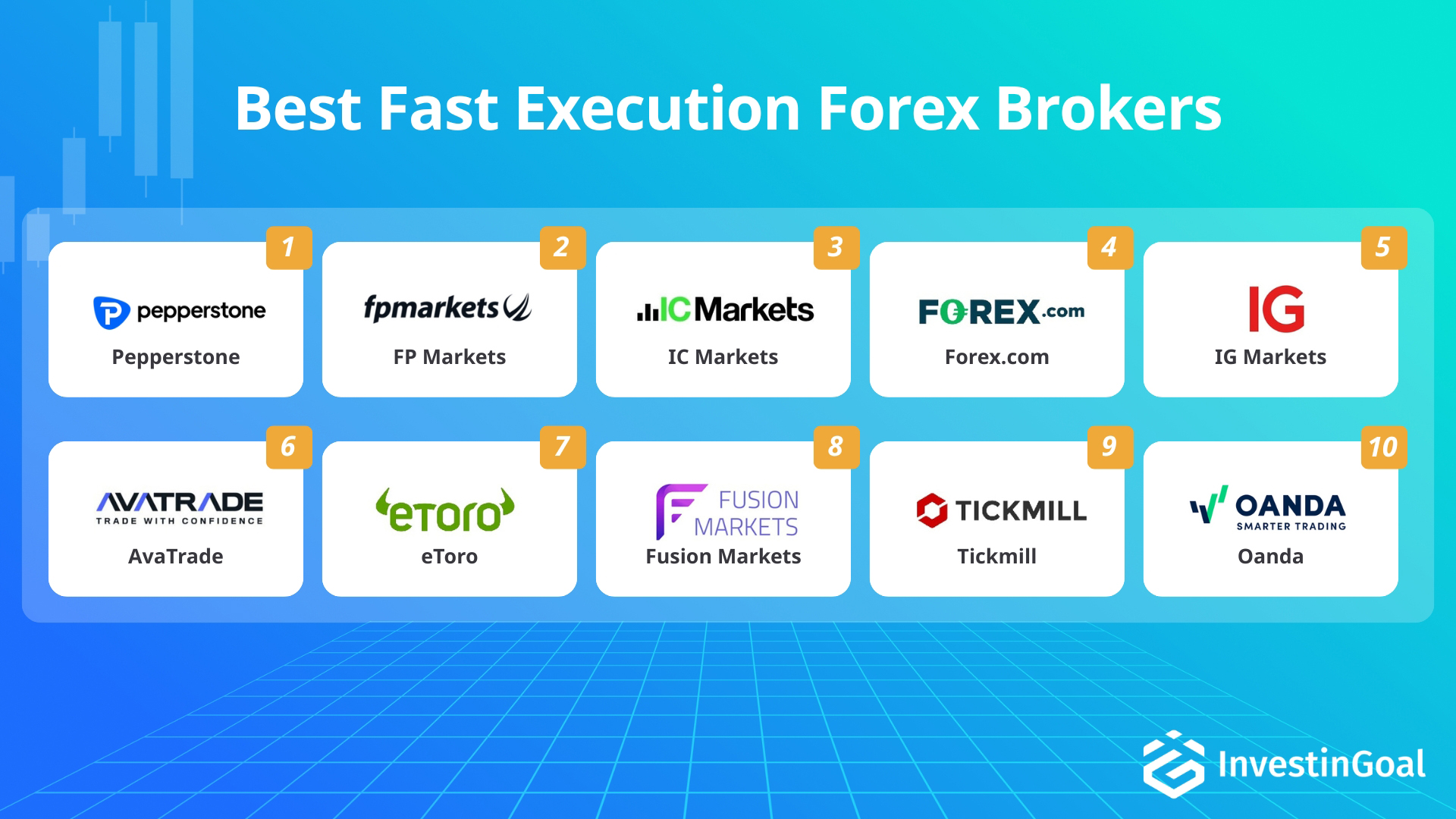
The best Forex brokers for fast execution are Pepperstone, FP Markets, IC Markets and Forex.com.
The most important criteria to consider when choosing the best Forex broker for fast execution are average execution speed/latency, execution model & infrastructure (no-dealing-desk/ECN-style routing + co-located servers), execution quality (deep liquidity, low slippage, minimal/no requotes), and all-in trading costs (tight spreads + fair commissions).
Pepperstone is the best fast execution Forex broker overall, thanks to offering very low latency execution, a no-dealing-desk/ECN-style setup and robust infrastructure, strong liquidity and slippage control, and tight all-in pricing (raw spreads + commission on Razor).
Next in line after Pepperstone, the best fast execution Forex brokers for low-latency execution, strong infrastructure/routing, high execution quality, and competitive pricing include FP Markets, IC Markets, and Forex.com. FP Markets features co-located low-latency infrastructure and fast routing designed for scalpers/EAs. IC Markets showcases sub-40ms average execution with an ECN-style environment built for high-frequency strategies. Forex.com provides millisecond-grade execution reporting with a focus on execution quality transparency (speed, slippage, and price improvement). Fast-execution rankings are infrastructure-specific, whereas rankings of the best forex brokers consider broader, general factors such as overall trading costs, platform and tools, execution speed, minimum deposit, and customer support.

Pepperstone
(best fast execution Forex broker overall)
Pepperstone is the best fast execution Forex broker overall thanks to most orders being filled in under 30 ms, Equinix data-center infrastructure in New York and London (like Equinix NY4 and LD4), and no-dealing-desk ECN-style order routing. Pepperstone is an exceptional option for scalpers and algorithmic traders (for example, EA users on MetaTrader 4/5 or cTrader) because its sub-30 ms execution shortens the time from signal to fill, which helps traders get filled closer to the intended price during fast moves. Pepperstone’s sub-30 ms execution provides traders with minimal latency between order placement and confirmation.
-
Regulations:
-
Avg. EUR/USD Spread:
-
Platforms:
Pepperstone Features
The features of Pepperstone are listed below.
- Pepperstone fills most orders in under 30 milliseconds using Equinix data centers in New York and London.
- Pepperstone uses a no dealing desk execution model with ECN style routing and deep liquidity to reduce slippage and requotes.
- Pepperstone Razor account delivers EUR/USD spreads around 0.0 to 0.3 pips with a $7 per lot round turn commission.
- Pepperstone supports MT4, MT5, cTrader, and TradingView.
- Pepperstone has no minimum deposit requirement.
- Pepperstone is regulated by ASIC, FCA, CySEC, DFSA, and SCB.
Pepperstone Pros and Cons
Advantages of Pepperstone
The advantages of Pepperstone are listed below.
- Stable raw spreads (0,10 pips on EUR/USD on average)
- Caters for algorithmic trading
- Has won over 30 Forex industry awards
Disadvantages of Pepperstone
The disadvantages of Pepperstone are listed below.
- The demo account is not unlimited
About Pepperstone
Pepperstone is a global forex and CFD broker founded in 2010 in Melbourne, Australia. Pepperstone offers trading on currencies, commodities, indices, stocks, and cryptocurrencies through MetaTrader and cTrader platforms. Pepperstone is regulated by multiple authorities including ASIC, FCA, and CySEC. Pepperstone is known for competitive spreads, fast execution, and extensive educational resources. Pepperstone serves clients in over 160 countries worldwide. The Pepperstone CEO is Tamas Szabo.

FP Markets
(best fast execution Forex broker for IRESS)
FP Markets is the second best fast execution Forex broker for IRESS due to its Equinix NY4/LD4 server cluster, millisecond-level order processing that is typically well under 100 ms, and the IRESS platform for direct market access trading. FP Markets is an outstanding choice for IRESS users since the IRESS DMA setup pairs with low-latency routing from NY4/LD4, so traders can place and confirm orders quickly while using market depth, order types, and other advanced execution tools. The Equinix NY4/LD4 co-location of FP Markets helps traders with faster routing to liquidity, which can reduce slippage for active manual trading and EA-driven order flow.
-
Regulations:
-
Avg. EUR/USD Spread:
-
Platforms:
FP Markets Features
The features of FP Markets are listed below.
- FP Markets delivers low latency execution from Equinix NY4 and LD4 server clusters with fills typically well below 100 milliseconds.
- FP Markets allows scalping and hedging with no restrictions and no dealer intervention.
- FP Markets Raw ECN account averages around 0.2 pips on EUR/USD with a $6 per lot round turn commission.
- FP Markets supports MT4, MT5, cTrader, TradingView, and the IRESS platform for DMA share trading.
- FP Markets minimum deposit is $100.
- FP Markets is regulated by ASIC and CySEC.
FP Markets Pros and Cons
Advantages of FP Markets
The advantages of FP Markets are listed below.
- Broad Instrument Offering
- Competitive Spreads
- Multiple Trading Platforms
Disadvantages of FP Markets
The disadvantages of FP Markets are listed below.
- High Fees for International Withdrawals
- Outdated Platform Design
About FP Markets
FP Markets is an Australian-based global forex and CFD broker founded in 2005. FP Markets offers trading on over 10,000 instruments including forex, stocks, indices, commodities, and cryptocurrencies. FP Markets provides MetaTrader 4, MetaTrader 5, and proprietary platforms. FP Markets is regulated by multiple authorities including ASIC, CySEC, and FSA. FP Markets is known for tight spreads, fast execution, and extensive educational resources. The FP Markets CEO is Craig Allison.

IC Markets
(best fast execution Forex broker for VPS traders)
IC Markets is the third best fast execution Forex broker for VPS traders thanks to average execution under 40 ms, Equinix NY4 trade servers, and <1 ms latency to major VPS providers (such as BeeksFX or ForexVPS). IC Markets is an excellent option for VPS-based algorithmic trading because the near-zero server-to-VPS latency keeps EAs physically close to the trade server, so orders reach liquidity faster and fills stay more consistent when robots fire frequent trades. IC Markets’ under-40 ms execution improves traders with more consistent order matching during London/New York overlap and other high-volume periods.
-
Regulations:
-
Avg. EUR/USD Spread:
-
Platforms:
IC Markets Features
The features of IC Markets are listed below.
- IC Markets averages under 40 milliseconds execution with trade servers in the Equinix NY4 data center in New York.
- IC Markets reports under 1 millisecond latency to major VPS providers for low latency algorithmic trading setups.
- IC Markets runs a no dealing desk environment with market execution and no minimum distance for order placement.
- IC Markets Raw account offers spreads from 0.0 pips with commissions around $7 per lot round turn on MT4 and MT5 and about $6 on cTrader.
- IC Markets supports MT4, MT5, cTrader, and TradingView.
- IC Markets minimum deposit is $200.
IC Markets Pros and Cons
Advantages of IC Markets
The advantages of IC Markets are listed below.
- Low-latency trading environment
- Institutional level liquidity
- MT4, MT5, cTrader platforms are all available
Disadvantages of IC Markets
The disadvantages of IC Markets are listed below.
- Small amount of educational tools for new traders
- Small range of tradable assets compared to other CFD/Forex brokers
About IC Markets
IC Markets is a global forex and CFD broker founded in 2007 and based in Sydney, Australia. IC Markets offers trading on over 2,250 instruments including currencies, commodities, indices, stocks, and cryptocurrencies. IC Markets provides MetaTrader 4, MetaTrader 5, and cTrader platforms. IC Markets is regulated by multiple authorities including ASIC and CySEC. IC Markets is known for its ECN execution model and low spreads. The IC Markets CEO is Andrew Budzinski.

Forex.com
(best fast execution Forex broker for US clients)
Forex.com is the fourth best fast execution Forex broker for US clients because of its 0.003–0.04 second average execution speed, a no-dealing-desk agency execution model, and CFTC/NFA-regulated access for US traders. Forex.com is a great choice for US-based traders since its execution reporting and >99% of trades executed in under 1 second support quick confirmations and show how fills compare to the requested price during news spikes. Forex.com’s 3–40 ms execution provides traders with quick market-order fills and fewer delayed orders when prices jump.
-
Regulations:
-
Avg. EUR/USD Spread:
-
Platforms:
Forex.com Features
The features of Forex.com are listed below.
- Forex.com reports average execution around 3 to 40 milliseconds with over 99% of trades executed in under 1 second.
- Forex.com publishes an execution scorecard covering speed, slippage, and price improvement.
- Forex.com minimum deposit is $100 for most account types.
- Forex.com is regulated by CFTC and NFA, FCA, IIROC, ASIC, and Japan FSA.
- Forex.com supports Web Trader, Advanced Trading Platform, MT4, MT5, TradingView integration, and NinjaTrader support.
- Forex.com prices EUR/USD around 1.0 pip on the Standard account and around 0.2 pips plus commission on the Commission account for an all in cost near 0.8 to 0.9 pips.
Forex.com Pros and Cons
Advantages of Forex.com
The advantages of Forex.com are listed below.
- Regulatory Assurance
- Low Forex Fees
- Comprehensive Educational Resources
Disadvantages of Forex.com
The disadvantages of Forex.com are listed below.
- Limited Product Portfolio
- Higher Spreads on Standard Accounts
- No Guaranteed Stop-Loss Orders for U.S. Clients
About Forex.com
FOREX.com is a global forex and CFD broker founded in 2001, offering trading on currencies, commodities, indices, stocks, and cryptocurrencies. FOREX.com provides proprietary platforms alongside MetaTrader 4 and 5. FOREX.com is regulated by multiple top-tier authorities including FCA, ASIC, and CFTC. FOREX.com is known for competitive spreads, fast execution, and extensive educational resources. FOREX.com serves over 450,000 clients worldwide. The FOREX.com’s parent company “StoneX Group Inc.” CEO is Sean O’Connor.

IG Markets
(best fast execution Forex broker for market variety)
IG is the fifth best fast execution Forex broker for market variety through 31 ms average execution, Best Execution technology designed to avoid manual intervention on at-quote orders, and access to 17,000+ markets (such as FX pairs, indices, shares, and commodities). The 31 ms average execution of IG places it among the strong options for market variety because it keeps entry/exit speed consistent when rotating between markets, which is useful for momentum and intraday strategies. IG’s 31 ms execution offers traders fast entries and exits without platform-level lag when placing orders across a very large instrument list.
-
Regulations:
-
Avg. EUR/USD Spread:
-
Platforms:
IG Markets Features
The features of IG Markets are listed below.
- IG execution speed is around 30 milliseconds on average in independent comparisons.
- IG applies best execution practices with automated pricing and no manual intervention on at quote orders.
- IG has no required minimum deposit, while card deposits commonly start around $250 and bank transfers can be funded from $0.
- IG supports its proprietary platform, MT4, ProRealTime, L2 Dealer for DMA shares, and TradingView integration.
- IG averages about 0.9 pips on EUR/USD on standard pricing and offers Direct pricing with spreads near 0.1 pips plus commission.
- IG is regulated by FCA, BaFin, FINMA, ASIC, and MAS.
IG Markets Pros and Cons
Advantages of IG Markets
The advantages of IG Markets are listed below.
- Low spreads from 0.6 pips on Forex
- Wide range of financial instruments
- 40 years of experience in the Forex industry
Disadvantages of IG Markets
The disadvantages of IG Markets are listed below.
- No copy trading features
- No social trading features
About IG Markets
IG Markets is a global online trading provider founded in 1974, offering access to over 17,000 financial markets including forex, stocks, indices, commodities, and cryptocurrencies. IG Markets provides proprietary trading platforms alongside MetaTrader 4 and ProRealTime. IG Markets is regulated by multiple top-tier authorities worldwide, including the FCA and ASIC. IG Markets is known for competitive spreads, extensive educational resources, and innovative features like weekend trading. The IG Markets’ parent company “IG Group” CEO is Breon Corcoran.

AvaTrade
(best fast execution Forex broker for FX options)
AvaTrade is the sixth best fast execution Forex broker for FX options thanks to 0.15–0.20 second average execution, a stable multi-server infrastructure designed for consistent order handling, and the dedicated AvaOptions platform for FX options strategies. AvaTrade is a solid choice for FX options traders because AvaOptions supports hedging and multi-leg positioning while keeping order processing around 150–200 ms, so traders can adjust hedges and strikes quickly when volatility and pricing shift. The 0.15–0.20 second execution of AvaTrade helps traders with more predictable fills when placing FX trades tied to options positioning around higher-volatility events.
-
Regulations:
-
Avg. EUR/USD Spread:
-
Platforms:
AvaTrade Features
The features of AvaTrade are listed below.
- AvaTrade average execution speed is around 0.15 to 0.20 seconds for many orders.
- AvaTrade uses multiple server centers to keep execution stable during volatile market conditions.
- AvaTrade runs commission free pricing with EUR/USD around a 0.9 pip average spread on the standard account.
- AvaTrade minimum deposit is $100.
- AvaTrade supports MT4, MT5, WebTrader, AvaTradeGO, and AvaOptions.
- AvaTrade is regulated by the Central Bank of Ireland, ASIC, Japan FSA, Abu Dhabi FSRA, and South Africa FSCA.
AvaTrade Pros and Cons
Advantages of AvaTrade
The advantages of AvaTrade are listed below.
- Tight fixed spreads from 0.6 pips (0.9 pips for retail traders)
- The mobile apps are well designed
- Can be connected to ZuluTrade and Duplitrade
Disadvantages of AvaTrade
The disadvantages of AvaTrade are listed below.
- High inactivity fees
- The demo account is limited to 30 days
About AvaTrade
AvaTrade is a global forex and CFD broker founded in 2006 and headquartered in Dublin, Ireland. AvaTrade offers trading on currencies, commodities, indices, stocks, bonds, ETFs, and cryptocurrencies. AvaTrade provides proprietary platforms alongside MetaTrader 4 and 5. AvaTrade is regulated by multiple authorities including CySEC, ASIC, and FSA. AvaTrade serves over 300,000 clients worldwide. AvaTrade is known for competitive spreads and extensive educational resources. The AvaTrade CEO is David Dryzin since 2016.

eToro
(best fast execution Forex broker for copy trading)
eToro is the seventh best fast execution Forex broker for copy trading due to 14–15 ms average execution, a proprietary platform designed to execute copied trades at scale, and infrastructure built to keep trade confirmations fast. eToro’s 14–15 ms execution provides traders with near-instant trade confirmation on both manual and copied orders, so copied positions can be opened within milliseconds of the copied trader’s action. eToro is a very good option for copy trading since its 15 ms fills help copied positions open and close with minimal lag when the trader you copy enters or exits, reducing the chance of getting a worse fill.
-
Regulations:
-
Avg. EUR/USD Spread:
-
Platforms:
eToro Features
The features of eToro are listed below.
- eToro averages about 14 to 15 milliseconds execution time on its proprietary platform.
- eToro executes copy trades automatically for copiers through the same platform execution engine.
- eToro minimum first deposit is commonly $50 in many regions and $200 in other regions.
- eToro charges no commission and prices EUR/USD around a 1.0 pip average spread.
- eToro is regulated by CySEC, FCA, and ASIC.
- eToro provides a $100,000 virtual portfolio mode for practice trading on the eToro platform.
eToro Pros and Cons
Advantages of eToro
The advantages of eToro are listed below.
- Great copy trading and social trading features
- Wide range of asset classes
- It allows to buy fractional stocks from $10
Disadvantages of eToro
The disadvantages of eToro are listed below.
- The eToro spreads can be high
- Offers only USD accounts
- Transferring cryptocurrencies to other platforms can be hard
About eToro
eToro is a global multi-asset investment platform founded in 2007, offering trading on stocks, ETFs, Crypto CFDs, commodities, and forex. eToro provides a proprietary web and mobile platform with social trading features. eToro is regulated by multiple authorities including FCA, ASIC, and CySEC. eToro is known for its user-friendly interface, copy trading functionality, and commission-free stock trading. eToro serves over 30 million users worldwide. The eToro CEO and co-founder is Yoni Assia.

Fusion Markets
(best fast execution Forex broker for low commissions)
Fusion Markets is the eighth best fast execution Forex broker for low commissions thanks to 37 ms average execution, a $4.50 round-turn commission per 100k on its ZERO (raw) account, and no-dealing-desk market execution with no requotes. Fusion Markets is a good choice for cost-focused scalpers because raw EUR/USD spreads around 0.1–0.3 pips combined with fast 37 ms fills can keep total trading costs (spread + commission) low and limit how much slippage impacts rapid entries. Fusion Markets’ 37 ms execution improves traders with low-latency fills that support rapid entries for scalping and EA-based trading.
-
Regulations:
-
Avg. EUR/USD Spread:
-
Platforms:
Fusion Markets Features
The features of Fusion Markets are listed below.
- Fusion Markets reports average execution speed around 37 milliseconds.
- Fusion Markets uses market execution with no dealing desk routing and no requotes.
- Fusion Markets ZERO account averages about 0.1 to 0.3 pips on EUR/USD with a $4.50 per 100k round turn commission.
- Fusion Markets supports MT4, MT5, cTrader, and TradingView.
- Fusion Markets has no minimum deposit requirement.
- Fusion Markets is regulated through ASIC and the VFSC.
Fusion Markets Pros and Cons
Advantages of Fusion Markets
The advantages of Fusion Markets are listed below.
- Low Trading Costs
- Zero Spread Accounts
- Excellent Customer Support
Disadvantages of Fusion Markets
The disadvantages of Fusion Markets are listed below.
- Limited Product Selection
- Basic Educational Resources
About Fusion Markets
Fusion Markets is an Australian-based forex and CFD broker founded in 2019. Fusion Markets offers trading on over 90 currency pairs, stocks, indices, commodities, and cryptocurrencies. Fusion Markets provides MetaTrader 4, MetaTrader 5, and cTrader platforms. Fusion Markets is regulated by ASIC and VFSC. Fusion Markets is known for low trading costs, no minimum deposit, and copy trading services. The Fusion Markets CEO is Phil Horner.

Tickmill
(best fast execution Forex broker for high-volume pricing)
Tickmill is the ninth best fast execution Forex broker for high-volume pricing thanks to 0.20 second average execution with a no-requote policy, Raw Spread pricing where EUR/USD is often 0.0–0.1 pips, and commissions from $4 per round-turn (dropping to $2 on the VIP tier for $50k+ balances). Tickmill is a good option for high-volume traders because the Raw/VIP structure reduces cost per lot, and 0.20 s fills help maintain steadier entry and exit timing when you trade frequently or scale position size. The 0.20 second average execution of Tickmill helps traders with quicker fills and fewer delays during peak liquidity, such as the London/New York overlap.
-
Regulations:
-
Avg. EUR/USD Spread:
-
Platforms:
Tickmill Features
The features of Tickmill are listed below.
- Tickmill reports average execution time around 0.20 seconds with no requotes.
- Tickmill routes orders with market execution through liquidity providers to keep fills fast and consistent.
- Tickmill Raw account averages around 0.0 to 0.1 pips on EUR/USD with a $4 per lot round turn commission.
- Tickmill minimum deposit is $100.
- Tickmill is regulated by FCA, CySEC, FSCA, Labuan FSA, and Seychelles FSA.
- Tickmill offers up to 1:30 leverage for EU and UK retail clients and up to 1:500 or higher via offshore entities.
Tickmill Pros and Cons
Advantages of Tickmill
The advantages of Tickmill are listed below.
- Regulatory Trust
- Competitive Pricing
- Comprehensive Platform Support
Disadvantages of Tickmill
The disadvantages of Tickmill are listed below.
- Limited Asset Variety
- Higher Costs on Classic Account
- Discontinued Features
About Tickmill
Tickmill is a global multi-asset broker founded in 2014, offering trading on forex, CFDs, stocks, indices, commodities, and cryptocurrencies. Tickmill provides MetaTrader 4, MetaTrader 5, and proprietary platforms. Tickmill is regulated by multiple authorities including FCA, CySEC, and FSCA. Tickmill is known for low spreads, fast execution, and extensive educational resources. Tickmill serves over 500,000 clients worldwide. The Tickmill CEO is Sudhanshu Agarwal.

Oanda
(best fast execution Forex broker for API trading)
OANDA is the tenth best fast execution Forex broker for API trading because of sub-12 ms average execution (with some fills measured around 1–2 ms), the proprietary v20 execution engine, and robust APIs designed for automation. The sub-12 ms average execution of OANDA positions it as one of the good options for API trading since the v20 engine can handle high order rates, allowing API systems to place, modify, and close orders with minimal latency. OANDA’s sub-12 ms execution provides traders with near-instant fills that are critical for latency-sensitive API trading, helping reduce slippage when strategies depend on fast quote-to-trade conversion.
-
Regulations:
-
Avg. EUR/USD Spread:
-
Platforms:
Oanda Features
The features of Oanda are listed below.
- OANDA execution speed is recorded under 12 milliseconds on average with some fills around 1 to 2 milliseconds.
- OANDA uses a proprietary v20 trading engine with a no requote execution approach.
- OANDA has no minimum deposit requirement.
- OANDA supports OANDA Trade, MT4, MT5, TradingView integration, and trading APIs.
- OANDA Standard pricing averages around 1.2 to 1.3 pips on EUR/USD, while OANDA Core pricing offers around 0.1 to 0.2 pips plus about $5 per 100k commission.
- OANDA is regulated by CFTC and NFA, FCA, IIROC, ASIC, MAS, and Japan JFSA.
Oanda Pros and Cons
Advantages of Oanda
The advantages of Oanda are listed below.
- Comprehensive Platforms
- Robust Education
- Highly Regulatory Trust
Disadvantages of Oanda
The disadvantages of Oanda are listed below.
- Higher Spreads
- Proprietary Platform Limitations
- Inactivity Fees
About Oanda
OANDA is a global multi-asset broker founded in 1996, offering trading on forex, CFDs, commodities, indices, and cryptocurrencies. OANDA provides proprietary platforms and API solutions. OANDA is regulated by multiple authorities including FCA, ASIC, and MAS. OANDA is known for competitive spreads, fast execution, and currency data services. OANDA serves both retail and institutional clients worldwide. The Oanda Chief Executive Officer is Gavin Bambury since August 2019.
Comparison of the best best fast execution forex brokers
The table that compares the best best fast execution forex brokers is shown below.
| Broker | Average order execution latency (ms) | Trading server data-center location | Execution model | All-in EUR/USD trading cost (pips) | Tier-1 regulator licenses |
|---|---|---|---|---|---|
| Pepperstone | <30 ms | Equinix (New York, London) | No dealing desk (ECN-style order routing) | 0.86 pips (Razor: 0.16 + $7 round-turn commission) | FCA, ASIC |
| FP Markets | <100 ms (order of milliseconds) | Equinix NY4, Equinix LD4 | ECN (Raw account) | 0.8 pips (Raw: 0.2 + $6 round-turn commission) | ASIC, CySEC |
| IC Markets | <40 ms | Equinix NY4 (New York) | No dealing desk (ECN) | 0.6 pips (Raw) | ASIC, CySEC |
| Forex.com | 3–40 ms | N/A | No dealing desk (agency) | 0.8–0.9 pips (Commission account) | CFTC/NFA, FCA, IIROC, ASIC, FSA (Japan) |
| IG | 31 ms | N/A | No dealing desk (most products) | 0.8 pips (Direct pricing) | FCA, BaFin, FINMA, ASIC, MAS |
| AvaTrade | 150–200 ms | Multiple data centers (Europe, Asia, etc.) | N/A | 0.9 pips (standard); 0.6 pips (pro) | Central Bank of Ireland, ASIC, FSA (Japan), FSRA (Abu Dhabi) |
| eToro | 14–15 ms | N/A | Market maker | 1.0 pips | FCA, CySEC, ASIC |
| Fusion Markets | 37 ms | N/A | No dealing desk (market execution) | 0.6–0.7 pips (ZERO) | ASIC |
| Tickmill | 150–200 ms | N/A | Hybrid agency (market execution) | 0.5 pips or less (Raw) | FCA, CySEC |
| OANDA | <12 ms | N/A | N/A | 0.6–0.7 pips (Core) | CFTC/NFA, IIROC, FCA, ASIC, MAS, JFSA |
Warning
CFDs are complex instruments and come with a high risk of losing money rapidly due to leverage. Between 74-89% of retail investor accounts lose money when trading CFDs. You should consider whether you can afford to take the high risk of losing your money.
The best fast execution broker with low spreads is Tickmill. Tickmill stands out here with raw EUR/USD spreads around 0.0–0.1 pips, about a $4 per round-turn lot commission on its Raw account, and average execution around 0.20s with a no-requote policy. These low spreads and tight commissions at Tickmill can reduce trading costs per entry, while its no-requote execution helps keep fills consistent when you’re trying to capture small price moves.
Brokers that excel for low-spread, fast execution trading usually combine near-zero raw pricing, low all-in commissions, and reliably quick order processing. A similar alternative to Tickmill is IC Markets for sub-40ms execution, spreads from 0.0 pips with EUR/USD averaging 0.1 pips on Raw, and low commissions on Raw accounts. Fusion Markets offers 37ms execution, near-zero EUR/USD spreads (0.1–0.3 pips) on ZERO, and a low $4.50 per 100k round-turn commission that make it an alternative to Tickmill, and it is often featured among the best low spread Forex broker rankings.
The best fast execution broker with MT4 is Pepperstone. Pepperstone is ideal for this setup because it supports MT4, fills most orders in under 30ms, and offers Razor pricing with very tight raw spreads near 0.0–0.3 pips on majors. That combination from Pepperstone lets MT4 traders run fast-click strategies or EAs with less delay, while the Razor spreads can help keep trading friction low.
MT4 traders look for native platform access, low-latency fills, and consistently tight pricing in the best MT4 fast-execution Forex brokers. IC Markets is an alternative to Pepperstone thanks to MT4 support, average execution under 40ms, and Raw Spread accounts with spreads from 0.0 pips. FP Markets also competes with Pepperstone, since it pairs MT4 with Equinix NY4/LD4 infrastructure for low-latency execution and Raw ECN spreads from 0.0 pips with a low round-turn commission, and it is often included among the best MT4 Forex brokers.
The best fast execution broker for scalping is Pepperstone. Pepperstone fits scalpers well because it allows scalping without strategy restrictions, executes most orders in under 30ms, and uses ECN-style routing with deep liquidity to help reduce slippage. Those execution and liquidity advantages at Pepperstone can make a real difference when scalpers need quick fills and minimal price deviation on frequent entries and exits.
Top scalping brokers usually allow unrestricted short-term trading, provide very fast execution, and support infrastructure that helps manage slippage. IC Markets offers similar features to Pepperstone like no dealing-desk intervention, average execution under 40ms, and free VPS for eligible traders to further cut latency, and it is frequently listed among the top scalping Forex brokers. A similar alternative to Pepperstone is FP Markets for Equinix NY4/LD4 co-location, zero strategy restrictions, and no minimum stop-distance for rapid in-and-out trades.
The best fast execution broker for CFD trading is IG. IG is strong for CFDs thanks to access to 17,000+ markets, fast execution around 30ms in tests, and powerful proprietary tools alongside MT4 support. IG’s breadth of CFD markets can make it easier to diversify, while its fast execution and solid platform tooling help traders react quickly to moves across multiple asset classes.
The strongest CFD brokers typically offer wide product coverage, dependable speed, and platforms that are built for active risk management. Pepperstone is an alternative to IG because it delivers fast CFD execution with most orders under 30ms, provides Razor pricing with near-zero spreads on majors, and supports multiple CFD-ready platforms (MT4/MT5/cTrader/TradingView). IC Markets also stacks up against IG, focusing on institutional-grade liquidity for CFD trading, averaging execution under 40ms, and offering Raw Spread pricing from 0.0 pips on major FX CFDs, and it is often featured among the best CFD trading platforms.
The best fast execution broker for stocks trading is IG. IG leads this category with share trading and DMA tools (including L2 Dealer), very broad market access with extensive share selection, and fast execution around 30ms in tests. These stock-focused features at IG can benefit active equity traders by improving price discovery via DMA tools, while broad access and quick fills support timely entries around news and volatility.
Broad share coverage, DMA-style tools, and fast fills are often featured in the best stock trading brokers. FP Markets offers IRESS for DMA-style share trading, low-latency Equinix NY4/LD4 connectivity, and ASIC/CySEC regulation that make it an alternative to IG, and it is frequently mentioned among the top stock brokers for active share traders. eToro offers similar features to IG like commission-free real stock trading in supported regions, very fast execution around 14–15ms in tests, and an all-in-one multi-asset platform for stock-focused traders.
The criteria for choosing the best Fast Execution Forex brokers are listed below.
- Execution latency: Prioritize brokers that publish (or can demonstrate via live/demo testing) sub-50 ms average order execution, because milliseconds materially affect fills for scalping and EAs. Examples of low-latency benchmarks in this category include Pepperstone (most orders <30 ms), IC Markets (average <40 ms), OANDA (often <12 ms), and eToro (14–15 ms) versus slower 150–200 ms environments such as AvaTrade or Tickmill.
- Co-located infrastructure: Select brokers with trading servers in tier-1 financial data centers (e.g., Equinix NY4/LD4) and direct cross-connectivity to liquidity venues. IC Markets (Equinix NY4), FP Markets (Equinix NY4/LD4), and Pepperstone (Equinix hubs in New York/London) are examples where proximity reduces round-trip latency and stabilizes fills in fast markets.
- No-dealing-desk routing: Prefer an agency/ECN-style, no-dealing-desk execution pathway that routes orders into a deep liquidity pool with market execution (rather than manual dealer intervention). This structure is central to the fast-execution proposition at Pepperstone and IC Markets, and FP Markets, particularly for short-horizon strategies.
- Slippage control: Evaluate execution quality beyond speed by checking for no-requote policies, price improvement mechanisms, and transparent reporting. com explicitly emphasizes execution scorecards and millisecond fills (e.g., 3–40 ms windows) and IG emphasizes “best execution” processes—features that matter when spreads widen and liquidity thins.
- All-in trading costs: For fast execution trading, choose raw-spread + low-commission pricing where the all-in cost stays competitive at high turnover. Compare structures such as Pepperstone Razor (0.0–0.3 pips + $7/lot round-turn), FP Markets Raw (from 0.0 pips + $6 round-turn), IC Markets Raw (from 0.0 pips + $6–$7 round-turn), Fusion Markets ZERO (0.1–0.3 pips + $4.50 per 100k round-turn), or Tickmill Raw (0.0–0.1 pips + $4 round-turn), and avoid “cheap spread” claims that become expensive after commissions.
- Algorithmic tooling: If you use EAs, bots, or latency-sensitive discretionary trading, require robust platform support—MT4/MT5, cTrader, TradingView integrations where available—and low-latency enablers like VPS hosting (e.g., IC Markets offers VPS options. Pepperstone/FP Markets/Fusion Markets support multiple pro platforms) so execution speed is preserved from strategy signal to order routing.
- Regulatory safeguards: Use regulation as an execution-quality and counterparty-risk filter. Multi-jurisdiction, tier-1 oversight (e.g., FCA/ASIC/CySEC/CFTC-NFA) and client protections (segregation, negative balance protection where applicable) reduce operational risk while you pursue high-frequency fills. Examples of strongly regulated entities in this set include IG, Forex.com, OANDA, Pepperstone, and IC Markets.
You evaluate slippage by recording at least 100 live fills and calculating (executed price − expected price) in pips, then reporting the median, the 95th-percentile “worst-case,” and the % of positive vs negative slippage.
Slippage is the gap between the price you intend (quote or trigger) and the price you actually receive, and it rises with volatility, thin liquidity, and market orders. To isolate broker execution quality from your own internet latency, place the test from a VPS or device geographically close to the broker’s matching infrastructure (many low-latency brokers co-locate in Equinix hubs such as NY4/LD4).
Prefer brokers that publish execution transparency: average execution speed, fill rate, and price improvement (positive slippage) rather than only “no requotes.” For example, some brokers disclose sub-second execution rates and millisecond averages, while others state that most orders execute in 30ms and provide a >99% fill rate. Treat “average execution speed” as server-side (after order receipt) and still measure your end-to-end time.
Finally, segment your slippage by order type: market orders (spread + slippage), limit orders (price improvement is possible), and stop orders (most vulnerable to gaps). Run the same protocol during London/New York overlap and during news releases to capture regime changes. A concise definition of what is slippage helps ensure consistent interpretation of results.
You can test real execution speed by timing 50–100 small live orders (e.g., 0.01 lots) and computing the milliseconds between “order sent” and “deal executed” using platform timestamps, then repeating the test in both liquid and volatile sessions.
Start with one highly liquid instrument (EUR/USD) and one order type (market orders) so results are comparable. Export evidence from your platform: MetaTrader journals show send/confirm times, and MetaTrader 5 can log deal times to the millisecond; cTrader exposes execution stats in its trade history. Avoid relying on demo fills for speed claims—demo execution can be emulated and may not route to liquidity providers.
Separate network latency from broker processing by measuring ping to the trade server and, if possible, running the test from a VPS near the broker’s data center (many fast-execution venues are co-located in Equinix NY4/LD4 or similar). Log rejects, requotes, and partial fills as “failures,” because they matter as much as raw milliseconds for scalping and algorithmic trading.
Finally, compare your measured distribution to the broker’s published server-side benchmarks (e.g., “most orders 30ms,” “average under 40ms,” or “0.003s average”), and confirm results over at least two separate trading days to avoid one-off market conditions.
The platform tools that best support fast execution with a forex broker are one-click/quick-trade order entry, hotkeys, depth-of-market (DOM), and algorithmic/API execution, because they reduce human, UI, and routing latency.
In MetaTrader 5 (MetaQuotes), enabling One Click Trading places orders instantly without opening the full order dialog, which is critical when you are reacting to sub-second price changes. In cTrader (Spotware), Quick Trade provides one-click order creation and position management directly from Market Watch or the chart, and DOM lets you place orders against visible liquidity at multiple price levels.
For systematic traders, prioritize native automation: MT4/MT5 Expert Advisors, cTrader Automate (cBots), or broker APIs (REST/FIX) so strategies submit orders without manual delay. Pair this with a low-latency VPS located near the broker’s servers (often in financial data centers such as Equinix NY4/LD4) to minimize network hops.
Operationally, prefer platforms that let you pre-set volume, default stop-loss/take-profit, and order templates; shaving one confirmation click can matter more than a few milliseconds of server speed. If you trade from charts via TradingView or similar integrations, confirm that the integration supports chart-trading (not just analysis) and that orders route to the same low-latency venue.
Finally, favor server-side risk controls (attached SL/TP, stop-limit, bracket/OCO where available) so protection persists if your terminal disconnects. Reliable order execution and risk controls are core features of a Forex trading platform.
You compare trading costs when choosing a fast execution forex broker by converting everything to an all-in cost per standard lot: average spread (pips) + round-turn commission (USD ÷ pip value) + expected slippage (pips) + overnight swap/financing.
For EUR/USD, the pip value for 1 standard lot (100,000 units) is about $10, so a $7 round-turn commission equals 0.7 pips, and a $4.50 round-turn commission equals 0.45 pips. Use this to normalize pricing across account types (“spread-only” vs “raw + commission”), since the economically relevant comparison is the all-in cost per lot.
Use at least a 30-day average spread measured during your own trading window (e.g., London/New York overlap), not an advertised minimum.
Then verify the actual fee schedule for your platform and broker entity: for example, some venues charge commissions from $3.50 per side on a Razor-style FX CFD account, while others publish $2.25 per side, and some Raw accounts publish $3 per side.
Next, quantify slippage as a cost by averaging your realized slippage in pips from a live sample (market and stop orders separately), because thin liquidity or news can dominate spread differences. Finally, add swaps—the interest-rate differential cost/benefit of holding overnight—and any conversion or withdrawal fees as part of Forex trading costs, then multiply your all-in pips by expected monthly lots to get a definitive budget.