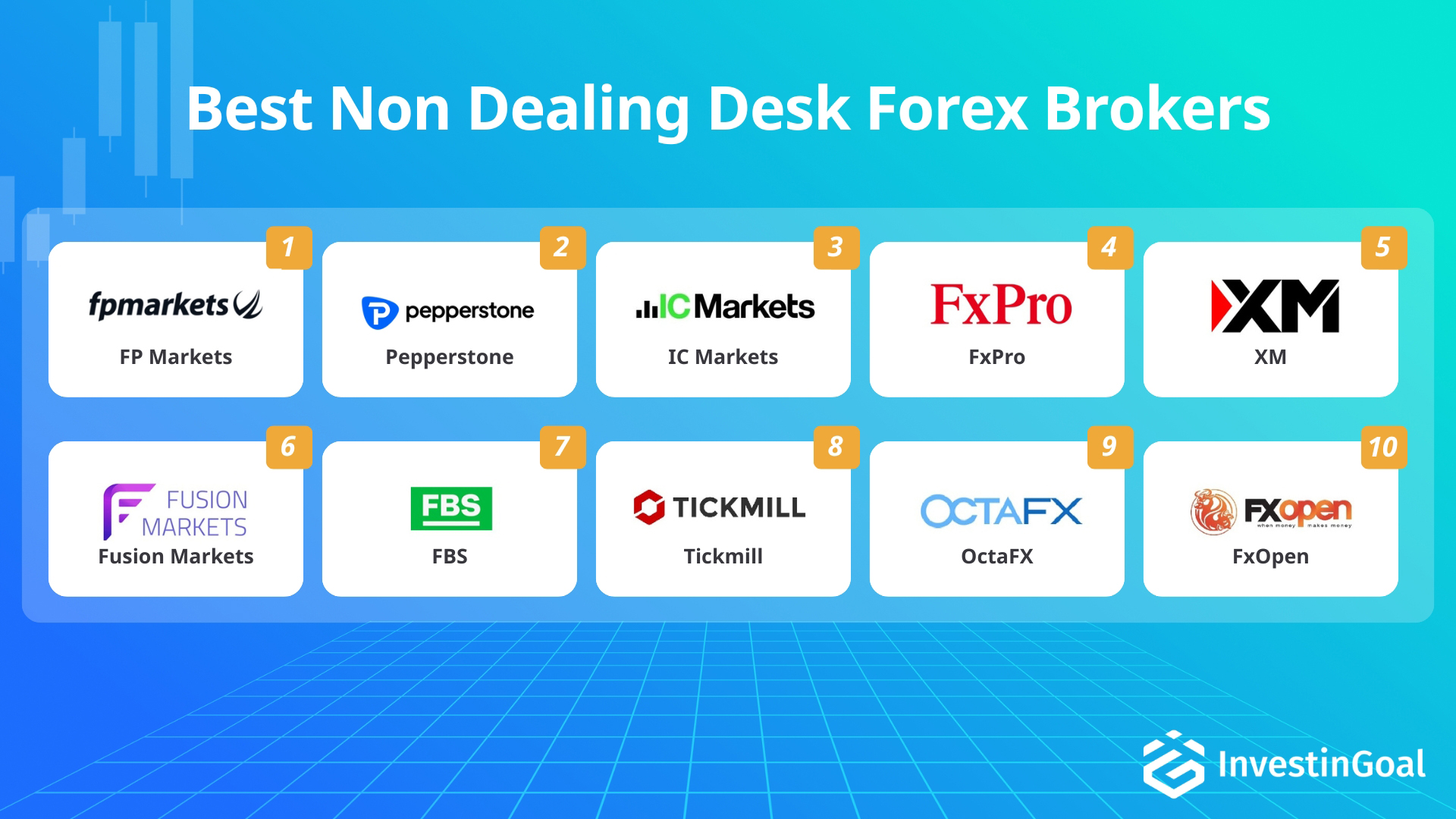
The best Forex brokers for No Dealing Desk (NDD) trading are FP Markets, Pepperstone, IC Markets and FxPro.
The most important criteria to consider when choosing the best Forex broker for No Dealing Desk (NDD) trading are execution quality (true NDD/ECN/STP + speed/slippage control), trading costs (raw spreads + commissions / all-in cost), regulation & client safety (top-tier oversight, fund protections), and platform & tooling (MT4/MT5/cTrader/TradingView + VPS/infrastructure).
FP Markets is the best No Dealing Desk (NDD) trading Forex broker overall, thanks to how it offers true NDD/ECN execution with deep liquidity and low-latency infrastructure, very competitive pricing via raw spreads + low commissions, strong multi-jurisdiction regulation, and a broad platform stack (MT4/MT5, cTrader, TradingView) plus trading tools like VPS support.
Ranked just behind FP Markets, the best No Dealing Desk (NDD) trading Forex brokers for execution quality, low trading costs, regulatory strength, and platform choice include Pepperstone, IC Markets, and FxPro. Pepperstone showcases very fast NDD execution and consistently ultra-tight pricing, plus a wide choice of platforms including TradingView. IC Markets includes deep aggregated liquidity and near-zero raw spreads that suit scalping and algorithmic trading. FxPro facilitates fast NDD-style execution, strong regulation, multiple professional platforms (including cTrader/MT5 with depth-of-market), and broad market coverage. Some of the leading NDD providers—such as Pepperstone, IC Markets, and FP Markets—are also widely regarded among the best forex brokers overall thanks to low all-in trading costs, rapid execution, and strong multi-platform support.

FP Markets
(best NDD Forex broker overall)
FP Markets is the best Non Dealing Desk (NDD) Forex broker thanks to raw ECN pricing routed straight to top-tier liquidity providers, Equinix NY server connectivity for fast execution via MT4/MT5/cTrader, and EUR/USD spreads from 0.0 pips with about a $6 round-turn commission on its Raw account. FP Markets is an exceptional option for overall NDD forex trading because its direct-market-access execution keeps dealer intervention out of order handling, which helps reduce requotes and keeps pricing aligned with live market conditions. The raw ECN pricing of FP Markets provides traders with transparent bid/ask quotes and consistently low all-in trading costs on major pairs.
-
Regulations:
-
Avg. EUR/USD Spread:
-
Platforms:
FP Markets Features
The features of FP Markets are listed below.
- FP Markets runs a Non Dealing Desk model that routes orders directly to liquidity providers with no dealer intervention.
- FP Markets offers Raw ECN pricing with EUR/USD spreads from 0.0 pips and about $6 per lot round turn commission on the Raw account.
- FP Markets connects traders to Equinix NY servers for fast execution and low latency fills.
- FP Markets supports MT4, MT5, cTrader, WebTrader, IRESS, and TradingView chart trading.
- FP Markets is regulated by ASIC and CySEC, with additional licenses across other jurisdictions.
- FP Markets minimum deposit is typically 100 AUD, about 70 USD, for Standard and Raw accounts.
FP Markets Pros and Cons
Advantages of FP Markets
The advantages of FP Markets are listed below.
- Broad Instrument Offering
- Competitive Spreads
- Multiple Trading Platforms
Disadvantages of FP Markets
The disadvantages of FP Markets are listed below.
- High Fees for International Withdrawals
- Outdated Platform Design
About FP Markets
FP Markets is an Australian-based global forex and CFD broker founded in 2005. FP Markets offers trading on over 10,000 instruments including forex, stocks, indices, commodities, and cryptocurrencies. FP Markets provides MetaTrader 4, MetaTrader 5, and proprietary platforms. FP Markets is regulated by multiple authorities including ASIC, CySEC, and FSA. FP Markets is known for tight spreads, fast execution, and extensive educational resources. The FP Markets CEO is Craig Allison.

Pepperstone
(best NDD Forex broker for scalping)
Pepperstone is the second best Non Dealing Desk (NDD) Forex broker due to its 30 ms average execution speed, Razor account pricing that averages around 0.09 pips on EUR/USD plus $7 per round-turn lot, and deep liquidity routing designed to minimize requotes. Pepperstone is an outstanding choice for scalping (for example, high-frequency intraday scalping) since its low-latency, no-dealing-desk execution can process frequent entries and exits quickly, which helps scalpers capture small moves without delays that can distort entry and exit prices. Pepperstone’s 30 ms execution speed provides traders with faster fills and less price drift between click and execution in fast markets.
-
Regulations:
-
Avg. EUR/USD Spread:
-
Platforms:
Pepperstone Features
The features of Pepperstone are listed below.
- Pepperstone uses a No Dealing Desk model that routes orders to a deep liquidity pool to reduce requotes.
- Pepperstone average execution speed is about 30 milliseconds for fast market fills.
- Pepperstone Razor account averages about 0.09 pips on EUR/USD plus a $7 per lot round turn commission.
- Pepperstone supports MT4, MT5, cTrader, and TradingView integration for chart based trading.
- Pepperstone is regulated by ASIC and FCA, with additional regulation including CySEC, BaFin, DFSA, SCB, CMA, and FSA.
- Pepperstone has no minimum deposit requirement, so Pepperstone minimum deposit is effectively $0.
Pepperstone Pros and Cons
Advantages of Pepperstone
The advantages of Pepperstone are listed below.
- Stable raw spreads (0,10 pips on EUR/USD on average)
- Caters for algorithmic trading
- Has won over 30 Forex industry awards
Disadvantages of Pepperstone
The disadvantages of Pepperstone are listed below.
- The demo account is not unlimited
About Pepperstone
Pepperstone is a global forex and CFD broker founded in 2010 in Melbourne, Australia. Pepperstone offers trading on currencies, commodities, indices, stocks, and cryptocurrencies through MetaTrader and cTrader platforms. Pepperstone is regulated by multiple authorities including ASIC, FCA, and CySEC. Pepperstone is known for competitive spreads, fast execution, and extensive educational resources. Pepperstone serves clients in over 160 countries worldwide. The Pepperstone CEO is Tamas Szabo.

IC Markets
(best NDD Forex broker for algo trading)
IC Markets is the third best Non Dealing Desk (NDD) Forex broker because of its liquidity aggregation from up to 25 tier-1 providers, low-latency execution supported by Equinix NY4/LD5 infrastructure (often under 0.1 seconds), and raw EUR/USD spreads averaging 0.1 pips plus $3.50 per side commission. IC Markets is an excellent option for algo trading thanks to its data-center infrastructure and ECN-style pricing stream, which helps automated systems send and receive orders quickly while avoiding dealing-desk filtering. IC Markets’ aggregation from up to 25 liquidity providers provides traders with deeper liquidity, tighter spreads, and more consistent fills during news and volatility spikes.
-
Regulations:
-
Avg. EUR/USD Spread:
-
Platforms:
IC Markets Features
The features of IC Markets are listed below.
- IC Markets runs a true Non Dealing Desk environment with pricing aggregated from up to 25 tier 1 liquidity providers.
- IC Markets uses low latency infrastructure in Equinix NY4 and LD5 data centers for rapid execution.
- IC Markets Raw Spread account averages about 0.1 pips on EUR/USD plus $3.50 per side commission per lot.
- IC Markets supports MT4, MT5, and cTrader, with optional social trading tools like ZuluTrade.
- IC Markets is regulated by ASIC and CySEC, with additional licenses in other jurisdictions.
- IC Markets minimum deposit is $200 or equivalent for IC Markets Standard and Raw accounts.
IC Markets Pros and Cons
Advantages of IC Markets
The advantages of IC Markets are listed below.
- Low-latency trading environment
- Institutional level liquidity
- MT4, MT5, cTrader platforms are all available
Disadvantages of IC Markets
The disadvantages of IC Markets are listed below.
- Small amount of educational tools for new traders
- Small range of tradable assets compared to other CFD/Forex brokers
About IC Markets
IC Markets is a global forex and CFD broker founded in 2007 and based in Sydney, Australia. IC Markets offers trading on over 2,250 instruments including currencies, commodities, indices, stocks, and cryptocurrencies. IC Markets provides MetaTrader 4, MetaTrader 5, and cTrader platforms. IC Markets is regulated by multiple authorities including ASIC and CySEC. IC Markets is known for its ECN execution model and low spreads. The IC Markets CEO is Andrew Budzinski.

FxPro
(best NDD Forex broker for multi-asset trading)
FxPro is the fourth best Non Dealing Desk (NDD) Forex broker thanks to its 2,100+ instrument lineup for multi-asset CFD trading (Forex, indices, commodities, stocks, and crypto CFDs), no-requote market execution with 12 ms average execution speed, and Depth of Market access on cTrader/MT5 for more transparent pricing. The 2,100+ instrument lineup of FxPro ranks it among the great choices for multi-asset NDD forex trading because it lets traders switch between markets without changing brokers or execution model, keeping order handling consistent across products. FxPro’s 2,100+ instrument lineup provides traders with broader diversification across CFDs while keeping execution rules consistent when moving between asset classes.
-
Regulations:
-
Avg. EUR/USD Spread:
-
Platforms:
FxPro Features
The features of FxPro are listed below.
- FxPro executes trades with no dealing desk intervention and no requotes on its market execution setup.
- FxPro reports average execution speeds around 12 milliseconds for fast order handling.
- FxPro cTrader and MT5 provide Depth of Market access for more transparent pricing visibility.
- FxPro Standard accounts average about 1.4 to 1.5 pips on EUR/USD with no commission.
- FxPro raw style accounts on cTrader or MT5 Raw plus price EUR/USD around 0.4 to 0.5 pips plus about $7 round trip commission.
- FxPro minimum deposit is $100 to open a FxPro trading account.
FxPro Pros and Cons
Advantages of FxPro
The advantages of FxPro are listed below.
- Regulated and Trusted Forex broker
- Diverse Trading Platforms
- Wide Range of Instruments
Disadvantages of FxPro
The disadvantages of FxPro are listed below.
- Inactivity Fee
- Limited Educational Resources
- No Guaranteed Stop-Loss Orders
About FxPro
FxPro is a global online broker founded in 2006, offering trading on forex, CFDs, stocks, indices, commodities, and cryptocurrencies. FxPro provides multiple trading platforms including MetaTrader 4, MetaTrader 5, cTrader, and its proprietary FxPro Platform. FxPro is regulated by multiple authorities including FCA, CySEC, SCB, FSC and KNN. FxPro serves clients in over 170 countries and has won numerous industry awards. The FxPro CEO is Charalambos Psimolophitis.

XM
(best NDD Forex broker for trading education)
XM is the fifth best Non Dealing Desk (NDD) Forex broker through its no-requote market execution policy (with 99.4% of trades executed in under 1 second), a $5 minimum deposit on Micro/Standard accounts, and integrated education/research features alongside trading platforms like MetaTrader 4 and MetaTrader 5 plus the XM Trading App. XM is a strong option for trading education because the low entry point and non-expiring demo access let newer traders practice under market execution conditions, with educational tools that explain platform features, risk management, and trade planning. The no-requote market execution of XM helps traders with faster order fills and fewer rejected orders, so trades are executed at the best available market price at that moment.
-
Regulations:
-
Avg. EUR/USD Spread:
-
Platforms:
XM Features
The features of XM are listed below.
- XM executes trades with market execution and a no requote policy for an NDD like order flow.
- XM reports 99.4% of trades execute in under one second for rapid fills.
- XM Standard accounts average about 1.7 to 2.0 pips on EUR/USD with no commission.
- XM Zero account targets EUR/USD spreads around 0.1 to 0.2 pips with about $7 round turn commission.
- XM supports MT4, MT5, and the XM Trading App for web and mobile trading.
- XM minimum deposit is $5 for XM Micro and XM Standard accounts.
XM Pros and Cons
Advantages of XM
The advantages of XM are listed below.
- There’s a wide range of account types
- The demo account at XM is unlimited
- Wide range of educational resources
Disadvantages of XM
The disadvantages of XM are listed below.
- No social trading features available
- The account availability changes depending on the location of the trader
- High minimum deposit to invest in securities ($10000 for the XM Shares account)
About XM
XM is a global forex and CFD broker founded in 2009, offering trading on currencies, commodities, indices, stocks, and cryptocurrencies. XM provides MetaTrader 4, MetaTrader 5, and proprietary platforms. XM is regulated by multiple authorities including CySEC, ASIC, and IFSC. XM is known for competitive spreads, extensive educational resources, and multilingual customer support. XM serves over 5 million clients from 196 countries. XM offers various account types and a no-requote policy.

Fusion Markets
(best NDD Forex broker for low commissions)
Fusion Markets is the sixth best Non Dealing Desk (NDD) Forex broker for its $4.50 per standard lot round-trip commission on its ECN account, raw EUR/USD spreads averaging about 0.11 pips (often 0.0–0.2 pips in liquid sessions), and true ECN order routing with no fixed minimum deposit. Fusion Markets’ $4.50 round-trip commission helps traders with lower per-trade costs, which lowers the break-even distance in pips on every trade and benefits high-volume strategies the most. Fusion Markets is a solid choice for low commissions since the discounted commission schedule reduces all-in trading costs, making it easier for frequent traders to keep total fees predictable.
-
Regulations:
-
Avg. EUR/USD Spread:
-
Platforms:
Fusion Markets Features
The features of Fusion Markets are listed below.
- Fusion Markets runs an ECN based Non Dealing Desk model that streams raw spreads from external liquidity providers.
- Fusion Markets Zero account posts EUR/USD raw spreads commonly in the 0.0 to 0.2 pips range during liquid sessions.
- Fusion Markets average raw spread on EUR/USD is about 0.11 pips with a $4.50 per lot round trip commission.
- Fusion Markets supports MT4, MT5, cTrader, and TradingView integration for chart trading.
- Fusion Markets is regulated by ASIC and also operates entities registered in offshore jurisdictions for international clients.
- Fusion Markets has no fixed minimum deposit, so Fusion Markets minimum deposit is $0.
Fusion Markets Pros and Cons
Advantages of Fusion Markets
The advantages of Fusion Markets are listed below.
- Low Trading Costs
- Zero Spread Accounts
- Excellent Customer Support
Disadvantages of Fusion Markets
The disadvantages of Fusion Markets are listed below.
- Limited Product Selection
- Basic Educational Resources
About Fusion Markets
Fusion Markets is an Australian-based forex and CFD broker founded in 2019. Fusion Markets offers trading on over 90 currency pairs, stocks, indices, commodities, and cryptocurrencies. Fusion Markets provides MetaTrader 4, MetaTrader 5, and cTrader platforms. Fusion Markets is regulated by ASIC and VFSC. Fusion Markets is known for low trading costs, no minimum deposit, and copy trading services. The Fusion Markets CEO is Phil Horner.

FBS
(best NDD Forex broker for cent accounts)
FBS is the seventh best Non Dealing Desk (NDD) Forex broker thanks to its Cent account with a $10 minimum deposit and cent-denominated balances, NDD/STP execution where 95% of orders are filled within 0.4 seconds, and EUR/USD spreads that are commonly around 1.0 pip under standard pricing. FBS is a very good option for cent accounts because cent-based balances allow very small position sizing, so beginners can test live execution and risk control with minimal drawdown exposure. The Cent account structure of FBS protects traders from oversized exposure by allowing micro-lot sizing and smaller monetary swings while learning trade management.
-
Regulations:
-
Avg. EUR/USD Spread:
-
Platforms:
FBS Features
The features of FBS are listed below.
- FBS uses an NDD STP execution model that routes client orders to liquidity providers.
- FBS fills about 95% of orders in 0.4 seconds or less for quick execution.
- FBS provides MT4 and MT5 as the primary trading platforms for FBS clients.
- FBS Standard account typically shows EUR/USD spreads around 1.0 pip with no commission.
- FBS minimum deposit is $10 for the FBS Cent account and $100 for the FBS Standard account.
- FBS is regulated by CySEC and ASIC, with additional licensing for global operations.
FBS Pros and Cons
Advantages of FBS
The advantages of FBS are listed below.
- Low minimum deposit
- User-Friendly Platforms
- 90 international awards
Disadvantages of FBS
The disadvantages of FBS are listed below.
- Limited Financial Instruments
About FBS
FBS is a global forex and CFD broker founded in 2009, offering trading on currencies, commodities, indices, stocks, and cryptocurrencies. FBS provides MetaTrader 4, MetaTrader 5, and proprietary platforms. FBS is regulated by multiple authorities including CySEC, ASIC, and IFSC. FBS serves over 27 million clients in 150+ countries. FBS is known for low minimum deposits, extensive educational resources, and copy trading services.

Tickmill
(best NDD Forex broker for FIX API)
Tickmill is the eighth best Non Dealing Desk (NDD) Forex broker because of FIX API connectivity, STP/ECN execution with 0.15-second average execution time, and Pro account raw spreads from 0.0 pips with a $6 round-turn commission. Tickmill is a good choice for FIX API trading since direct, programmatic connectivity can reduce latency and platform overhead, allowing automated strategies to submit orders and receive confirmations more efficiently. Tickmill’s FIX API connectivity provides traders with lower-latency routing and more granular control over order types, execution messages, and trade reporting.
-
Regulations:
-
Avg. EUR/USD Spread:
-
Platforms:
Tickmill Features
The features of Tickmill are listed below.
- Tickmill operates a strict No Dealing Desk STP ECN execution policy with no manual intervention.
- Tickmill average execution time is about 0.15 seconds for low latency trade fills.
- Tickmill Pro account offers spreads from 0.0 pips with a $6 per lot round turn commission.
- Tickmill Classic account pricing starts around 1.6 pips on EUR/USD with no commission.
- Tickmill supports MT4, MT5, and web trading options including TradingView powered access.
- Tickmill minimum deposit is $100 to open a Tickmill live account.
Tickmill Pros and Cons
Advantages of Tickmill
The advantages of Tickmill are listed below.
- Regulatory Trust
- Competitive Pricing
- Comprehensive Platform Support
Disadvantages of Tickmill
The disadvantages of Tickmill are listed below.
- Limited Asset Variety
- Higher Costs on Classic Account
- Discontinued Features
About Tickmill
Tickmill is a global multi-asset broker founded in 2014, offering trading on forex, CFDs, stocks, indices, commodities, and cryptocurrencies. Tickmill provides MetaTrader 4, MetaTrader 5, and proprietary platforms. Tickmill is regulated by multiple authorities including FCA, CySEC, and FSCA. Tickmill is known for low spreads, fast execution, and extensive educational resources. Tickmill serves over 500,000 clients worldwide. The Tickmill CEO is Sudhanshu Agarwal.

OctaFX
(best NDD Forex broker for copy trading)
OctaFX is the ninth best Non Dealing Desk (NDD) Forex broker due to its built-in copy trading service, market-execution STP routing with no requotes, and spread-only pricing where EUR/USD averages about 0.9 pips with a $25 minimum deposit to start. The built-in copy trading service of OctaFX places it among the good options for NDD copy trading because traders can follow strategy providers with automatic trade mirroring while still receiving market execution rather than dealer-set prices. OctaFX’s copy trading service provides traders with faster onboarding into strategy-following and clearer performance tracking, including provider stats that help compare risk and consistency before copying.
-
Regulations:
-
Avg. EUR/USD Spread:
-
Platforms:
OctaFX Features
The features of OctaFX are listed below.
- OctaFX runs an STP style Non Dealing Desk setup that offsets orders with liquidity providers.
- OctaFX uses market execution with no requotes on its trading accounts.
- OctaFX EUR/USD spreads typically start around 0.6 to 0.7 pips with an average around 0.9 pips and no commission.
- OctaFX supports MT4, MT5, and the OctaTrader platform for web and mobile trading.
- OctaFX minimum deposit is $25 for OctaFX live accounts.
- OctaFX offers CySEC regulation for European clients alongside additional licensing such as FSCA registration.
OctaFX Pros and Cons
Advantages of OctaFX
The advantages of OctaFX are listed below.
- Low Trading Costs
- Robust Educational Resources
- Multiple Trading Platforms
Disadvantages of OctaFX
The disadvantages of OctaFX are listed below.
- Limited Asset Range
- No VIP Discounts
- Restrictions on High-Frequency Trading
About OctaFX
Octa, formerly known as OctaFX, is a global forex and CFD broker founded in 2011. Octa offers trading on currencies, commodities, indices, stocks, and cryptocurrencies through MetaTrader 4, MetaTrader 5, and proprietary platforms. Octa is regulated by multiple authorities including CySEC. Octa is known for competitive spreads, extensive educational resources, and copy trading services. Octa serves clients in over 100 countries worldwide.

Fxopen
(best NDD Forex broker for TradingView)
FXOpen is the tenth best Non Dealing Desk (NDD) Forex broker thanks to its TradingView integration for chart-based execution into an ECN environment, true ECN/STP order handling with no requotes and visible market depth, and EUR/USD spreads that can reach 0.0–0.2 pips plus about $7 round-turn commission on standard ECN pricing. FXOpen is a good choice for TradingView trading because linking TradingView charts to an ECN account lets traders place and manage orders directly from the charting interface while keeping NDD execution and tight pricing. The TradingView integration of FXOpen improves traders’ workflow by enabling chart-to-order execution, faster decision-to-entry timing, and simpler trade management from a single interface.
-
Regulations:
-
Platforms:
Fxopen Features
The features of Fxopen are listed below.
- FXOpen operates a pure ECN STP model with no dealing desk intervention and no requotes.
- FXOpen offers TradingView integration so FXOpen clients can place trades directly from TradingView charts.
- FXOpen ECN accounts commonly show EUR/USD spreads around 0.0 to 0.2 pips during peak liquidity plus about $7 per lot round turn commission on standard ECN pricing.
- FXOpen supports MT4, MT5, and TradingView connectivity for FXOpen trading.
- FXOpen minimum deposit is $100 for FXOpen ECN accounts, while FXOpen Micro accounts can start from $1.
- FXOpen is regulated via group entities under top tier regulators including FCA, CySEC, and ASIC.
Fxopen Pros and Cons
Advantages of Fxopen
The advantages of Fxopen are listed below.
- Regulatory Oversight
- Diverse Trading Platforms
Disadvantages of Fxopen
The disadvantages of Fxopen are listed below.
- Higher Spreads on Forex
- Insufficient Educational Resources
About Fxopen
FXOpen is a global forex and CFD broker established in 2005, offering trading on currencies, commodities, indices, stocks, and cryptocurrencies. FXOpen provides MetaTrader 4, MetaTrader 5, TickTrader, and TradingView platforms. FXOpen is regulated by multiple authorities including FCA and CySEC. FXOpen is known for its ECN trading environment, low spreads, and fast execution. FXOpen offers various account types including ECN and STP. The FXOpen CEO is Alexey Stepanov.
Comparison of the best Non Dealing Desk (NDD) forex brokers
The table that compares the best Non Dealing Desk (NDD) forex brokers is shown below.
| Broker | Execution model (ECN/STP/NDD type) | EUR/USD all-in cost (raw/ECN account, in pips) | Reported execution speed (average latency, in ms) | Primary regulator (highest-tier entity) | Minimum deposit (USD) |
|---|---|---|---|---|---|
| FP Markets | ECN | 0.7 pips | N/A | ASIC | $70 |
| Pepperstone | NDD (ECN/STP) | 0.8 pips | 30 ms | FCA | $0 |
| IC Markets | ECN | 0.7 pips | 100 ms | ASIC | $200 |
| FxPro | NDD | 1.1 pips | 12 ms | FCA | $100 |
| XM | STP (NDD-like) | 0.9 pips | N/A | ASIC | $5 |
| Fusion Markets | ECN | 0.5 pips | N/A | ASIC | $0 |
| FBS | STP | 2.0 pips | 400 ms | ASIC | $10 |
| Tickmill | STP/ECN | 0.8 pips | 150 ms | FCA | $100 |
| OctaFX | STP | 0.9 pips | N/A | CySEC | $25 |
| FxOpen | ECN | 0.8 pips | N/A | FCA | $1 |
Warning
CFDs are complex instruments and come with a high risk of losing money rapidly due to leverage. Between 74-89% of retail investor accounts lose money when trading CFDs. You should consider whether you can afford to take the high risk of losing your money.
The best Non Dealing Desk Forex broker with MT4 is Pepperstone. Pepperstone stands out here thanks to MT4 paired with NDD execution into a deep liquidity pool, fast 30ms average execution with minimal requotes, and Razor pricing that keeps EUR/USD spreads very low. Those conditions from Pepperstone help MT4 traders get cleaner fills and better pricing, which is especially useful for scalping, EAs, and other speed-sensitive strategies.
MT4 NDD traders look for deep liquidity access, quick execution, and tight spreads in the best MT4 NDD Forex brokers. IC Markets offers similar features to Pepperstone like ECN-style NDD liquidity aggregation, ultra-low latency via Equinix NY4/LD5, and raw spreads around 0.1 pips on EUR/USD. FP Markets also competes well versus Pepperstone, offering MT4 with raw ECN/NDD pricing, fast execution through Equinix NY servers, and spreads from 0.0 pips with low commission, making it a frequent inclusion among the best Forex brokers with MT4 for traders focused on execution quality.
The best Non Dealing Desk Forex broker with MT5 is IC Markets. IC Markets is a top pick for MT5 because it combines no dealing desk execution with deep liquidity aggregation, very fast order handling via major data centers, and Raw pricing that can deliver near-zero spreads on majors. These strengths at IC Markets matter for MT5 traders who want efficient execution and lower trading costs when running active strategies or automation.
In general, the best NDD MT5 brokers offer deep liquidity access, quick execution, and pricing structures built around tight spreads. Pepperstone is a solid alternative to IC Markets, thanks to MT5 with NDD routing, strong execution quality with a high fill rate, and the Razor account’s ultra-competitive spreads. Tickmill offers a strict NDD/STP/ECN policy, Pro spreads from 0.0 pips with a $6/lot round turn commission, and no restrictions on scalping/algo trading that make it an alternative to IC Markets, and it is often ranked among the best MT5 FX brokers.
The best Non Dealing Desk Forex broker with cTrader is IC Markets. IC Markets fits cTrader traders well because it supports the platform with NDD liquidity aggregation, low-latency infrastructure in NY4/LD5 for fast fills, and raw spreads that stay very close to zero on major pairs. With those conditions at IC Markets, cTrader users can benefit from quicker executions and sharper pricing—two essentials for short-term trading and precision entries.
Deep liquidity access, low-latency execution, and consistently tight spreads are often featured in the best NDD cTrader brokers. Pepperstone is an alternative to IC Markets since it offers cTrader with NDD execution, is geared toward scalping/HFT with very fast execution, and has Razor pricing designed for tight spreads, frequently earning mentions as a top broker Forex cTrader for execution-focused traders. FxPro is another contender compared with IC Markets, providing cTrader with 12ms execution, Depth of Market for added transparency, and NDD execution with no requotes.
The best Non Dealing Desk Forex broker with low spread is Fusion Markets. Fusion Markets earns this spot for its extremely low all-in costs, with raw spreads often around 0.0–0.2, very low commission near $4.50 round trip, and pure NDD/ECN execution. Those cost advantages at Fusion Markets can directly improve net results for frequent traders by reducing the drag from spreads and commissions on every trade.
Low-spread NDD brokers typically focus on raw pricing, deep liquidity to keep quotes tight, and execution that limits hidden costs like slippage. A similar alternative to Fusion Markets is IC Markets for Raw spreads averaging about 0.1 pips on EUR/USD, deep liquidity aggregation that can reduce slippage, and low-latency infrastructure for fast execution. Pepperstone offers a Razor account built for very tight spreads, NDD routing into a deep liquidity pool, and strong execution quality that make it an alternative to Fusion Markets, and it is often cited as a lowest spread Forex broker.
The best Non Dealing Desk Forex broker with low minimum deposit is Pepperstone. Pepperstone is especially attractive here because it has a $0 minimum deposit, a strong top-tier regulation footprint, and support for MT4/MT5/cTrader from the start. This mix from Pepperstone lets new or budget-conscious traders begin with small funding while still accessing reputable oversight and mainstream trading platforms.
Low entry requirements, reliable execution, and broad platform access of the best low-minimum-deposit NDD Forex brokers are highly regarded by Forex traders. Fusion Markets is an alternative to Pepperstone, offering a $0 minimum deposit, MT4/MT5/cTrader availability, and low-cost ECN pricing through tight spreads plus low commission, which appeals to traders focused on Forex trading with low minimum deposit without sacrificing execution quality. XM also works as another option alongside Pepperstone, since it starts from a $5 minimum deposit on Micro/Standard accounts, provides very fast market execution with no requotes, and supports both MT4 and MT5.
The criteria for choosing the best Non Dealing Desk (NDD) Forex brokers are listed below.
- NDD execution model: Verify that the broker’s order-routing is genuinely NDD/ECN/STP (i.e., client orders are passed to external liquidity rather than internalized by a dealing desk). Prefer brokers that explicitly describe direct market access and deep liquidity aggregation—e.g., IC Markets streams pricing from up to 25 tier-1 liquidity providers, while Pepperstone and FP Markets emphasize no dealing-desk intervention and straight-through routing to liquidity venues.
- All-in trading costs: Quantify total cost (spread + commission) on the account you’ll actually use, benchmarking a liquid pair like EUR/USD. For example, compare raw-style structures such as Pepperstone Razor (0.09 pip average spread + $7 round turn = 0.7 pip), IC Markets Raw (0.1 pip + $3.50/side = 0.7 pip), FP Markets Raw (from 0.0 pips + $6 round turn = 0.6 pip), and Fusion Zero (0.11 pip + $4.50 round trip = 0.45 pip)—then repeat across your main traded instruments.
- Execution speed & slippage: Prioritize measurable execution quality—average execution latency, fill rate, and the practical likelihood of slippage during volatility. Pepperstone reports 30 ms execution and a 99.6% fill rate, FxPro cites 12 ms, Tickmill reports 0.15 s, XM highlights 99.4% of trades executed in <1 second, and FBS notes 95% of orders filled in ≤0.4 s; validate these claims by running the same strategy on a demo and then a small live account while monitoring slippage and rejected orders.
- Regulation & protections: Select the strongest regulatory entity available to you (e.g., FCA/ASIC/CySEC) and confirm client-fund safeguards such as segregation and compensation schemes where applicable. For instance, Tickmill’s FCA framework includes FSCS protection up to £85k for eligible UK accounts and CySEC coverage typically references €20k investor compensation, while Pepperstone and IC Markets combine multiple top-tier regulators across jurisdictions—choose the entity that maximizes enforceable protections.
- Platform & connectivity: Match the broker’s platform stack to your execution needs (manual, algorithmic, scalping, copy). Favor brokers offering institutional-style connectivity and tooling—e.g., FP Markets and Pepperstone provide MT4/MT5/cTrader (plus TradingView integrations), IC Markets supports MT4/MT5/cTrader with low-latency data-center infrastructure, and Tickmill offers pathways such as FIX API for advanced execution setups.
- Account access & testing: Use minimum deposit thresholds and demo constraints as a practical filter, especially if you plan to test execution with small capital first. Examples: Pepperstone and Fusion Markets advertise $0 minimum deposit, XM can start from $5, FXOpen offers micro access from $1 (with ECN typically $100), while IC Markets is typically $200 and many others sit around $100; prefer brokers with non-expiring or easily extendable demos (e.g., IC Markets/Fusion/FXPro) to evaluate spreads and fills over multiple market regimes.
- Strategy freedom & safeguards: Confirm that the broker’s NDD environment supports your methods without restrictions—scalping, hedging, EAs, and high-frequency execution. Tickmill explicitly allows scalping/hedging/arbitrage with no requotes, FXOpen and Pepperstone emphasize compatibility with automated trading, and FBS highlights negative balance protection—treat these policy statements as decision-critical if you trade around news, use EAs, or rely on tight risk controls.
You can verify a Non-Dealing-Desk (NDD) Forex broker is truly NDD by completing five checks: (1) read the broker’s Order Execution/Execution Policy and confirm market execution, no-requotes language, and explicit routing to external liquidity providers; (2) confirm the pricing model matches that routing (variable spreads, and—if “raw”—a separately disclosed commission); (3) ask whether any client flow is internalised (A-book vs B-book) and whether “last look” is used; (4) run a small-size execution test—trade 0.01–0.1 lots of EUR/USD in the London–New York overlap and around scheduled releases, and log requested vs filled prices; (5) validate governance: under best-execution regimes, firms must take sufficient steps to obtain best possible results and describe execution arrangements in an execution policy.
Context: STP-style NDD commonly aggregates multiple liquidity-provider quotes and may add a small spread markup; ECN-style NDD more often offers raw pricing plus commission and may expose depth-of-market. Concrete disclosures make verification easier: Pepperstone describes pricing sourced from third-party liquidity providers without a dealing desk, IC Markets states its pricing connector aggregates up to 25 price providers, and FP Markets reports Equinix NY4/LD4 hosting and sub-40 ms average order execution in a stated measurement window. Some brokers also disclose “hybrid” execution (market-making plus STP), which you should treat as “not purely NDD”.
The differences that matter most between Dealing Desk and Non-Dealing-Desk (NDD) Forex broker models are (1) counterparty structure, (2) price formation, (3) execution behaviour, (4) transparency, and (5) strategy constraints. A Dealing Desk (market-maker) broker can act as principal—internalising trades and managing its hedge—so fill quality can depend on internal pricing and risk controls. An NDD broker routes orders to external liquidity providers or execution venues.
Price formation differs because STP-style NDD aggregates quotes from multiple liquidity providers and may apply a small markup, while ECN-style NDD more often provides raw spreads plus an explicit commission. Execution behaviour is the practical distinction: dealing-desk flow is more prone to requotes or discretionary intervention in fast markets, while NDD market execution more commonly produces slippage that can be positive or negative. Transparency matters because NDD/ECN brokers more often describe routing and order handling in an execution policy, and best-execution rules require “sufficient steps” to obtain the best possible result across factors such as price, costs, and speed; in practical terms for NDD Forex brokers, “no dealing desk” means client orders are routed to external liquidity rather than internalized. Finally, strategy tolerance often tracks model choice: scalping and algorithmic trading typically fit more naturally with consistent market execution.
You choose a Non-Dealing-Desk Forex broker using ECN vs STP vs NDD differences by treating NDD as the umbrella term and then selecting the routing style that fits your objectives. STP (straight-through processing) routes orders through liquidity providers (often via a bridge) and the broker commonly earns via a spread markup. ECN (electronic communication network) is usually the more transparent NDD variant: you typically receive raw spreads and pay an explicit commission, and some venues expose Level-II depth of market.
Selection rules are pragmatic. If you scalp, run MetaTrader Expert Advisors, or trade higher volume, prioritise ECN-style accounts with consistently low all-in cost on EUR/USD (spread plus commission), low-latency infrastructure, and clear disclosure of liquidity aggregation (for example, a broker stating it aggregates pricing from up to 25 price providers). If you trade smaller size and value simplicity, an STP account with tight variable spreads and no separate commission can be rational, as long as the markup is explicit and stable. Regardless of label, screen for “hybrid execution” or internalisation disclosures, because some brokers combine market-making with STP, which changes conflict-of-interest and slippage expectations. Finally, verify regulation and read the execution policy so you can map the broker’s terminology (ECN, STP, DMA) to its actual order-routing behaviour. The differences between ECN and STP are concisely explained in ECN vs STP.
You evaluate liquidity providers behind a Non-Dealing-Desk (NDD) Forex broker by focusing on three measurable dimensions: (1) breadth and independence of liquidity sources, (2) aggregation and routing design, and (3) execution outcomes. Start by asking what types of liquidity providers (tier-1 banks, non-bank market makers, ECNs) feed the broker’s pricing and whether the broker will disclose the number or identity of sources. More, independent sources generally improve quote competition and depth.
Next, assess the broker’s routing stack: does it describe an aggregator/price connector, smart order routing, and platform bridges (MT4/MT5/cTrader) to the liquidity pool? In FX markets, a bank or non-bank market maker typically serves as the Forex liquidity provider, streaming two-way quotes and filling orders across venues. Infrastructure disclosures are a proxy for seriousness: IC Markets states its pricing connector aggregates up to 25 price providers, and FP Markets reports execution hosted in Equinix NY4/LD4 with an average order processing time under 40 milliseconds in a stated measurement window. Finally, verify outcomes with your own logs: track average spread, slippage distribution (positive vs negative), fill rate, and behaviour around scheduled news. If the broker cannot describe its liquidity sourcing, or discloses hybrid market-making, treat “deep liquidity” claims as unproven.