Trading 212 is best suited to investors and beginners who want a simple, low-cost way to buy real shares and ETFs, with only light CFD use. It stands out for commission-free investing, fractional shares, a polished mobile app, an unlimited demo and FCA protections through the UK entity. It is a weaker choice for active forex or CFD traders and more demanding users because spreads are wide, advanced trading tools are limited, and there is no SIPP or phone support.
How we review
Led by Filippo Ucchino, broker expert and CEO at InvestinGoal, we test brokers directly and assess them through a methodical review system. That includes live checks of the platform experience, account setup, tools, pricing structure, and key trading features, supported by research into official broker materials and regulatory records. We then evaluate each broker across the categories that matter most to traders, from safety and costs to platforms, markets, mobile trading, education, and support. Learn more about InvestinGoal methodology.
Why trust InvestinGoal
Trust comes from transparency and consistency. Our reviews are written by specialists, fact-checked before publication, and updated when important broker details change. We show both positives and negatives, explain who a broker is best suited for, and avoid reducing the review to generic marketing claims. That gives readers a clearer basis for comparing brokers and making decisions with confidence. Learn more about why you can trust InvestinGoal.
In this Trading 212 review, we break down pros and cons, regulation nd security, fees, platforms, markets, account features, and trading conditions, so you can decide faster and with more confidence. Trading 212 is also part of our selection of the best online brokers for trading and investing. The tabs below let you jump directly to the factor most important to your decision.
My take after testing Trading 212: I’ve been using Trading 212 since back when they were mainly a CFD broker, and it’s changed a lot. These days, it’s one of the providers I send people who want to start investing without overthinking it. Not for active trading, just for buying stocks and ETFs and holding them. The commission-free model still catches me off guard sometimes. I remember when every trade cost £10. Fractional shares, ISA accounts, practice mode, it’s all there. FSCS protection too. If you just want to put £500 a month into a couple of index funds, this does the job without fuss. The CFD platform hasn’t kept up, though. Charts feel basic. No real depth. And everything runs through app support or contact forms, no phone line. Many can easily get used to it, but I know people who won’t touch a broker without phone support. Fair enough.

Filippo Ucchino
Co-Founder and CEO of InvestinGoal - Introducing Broker
What type of broker is Trading 212?
Trading 212 is a market maker for CFDs and an agency broker for shares and ETFs. It operates a dealing desk for CFD execution (acting as principal) and routes Invest/ISA orders directly to execution venues on an agency basis. Since 2021, the broker hedges CFD exposure with external counterparties.
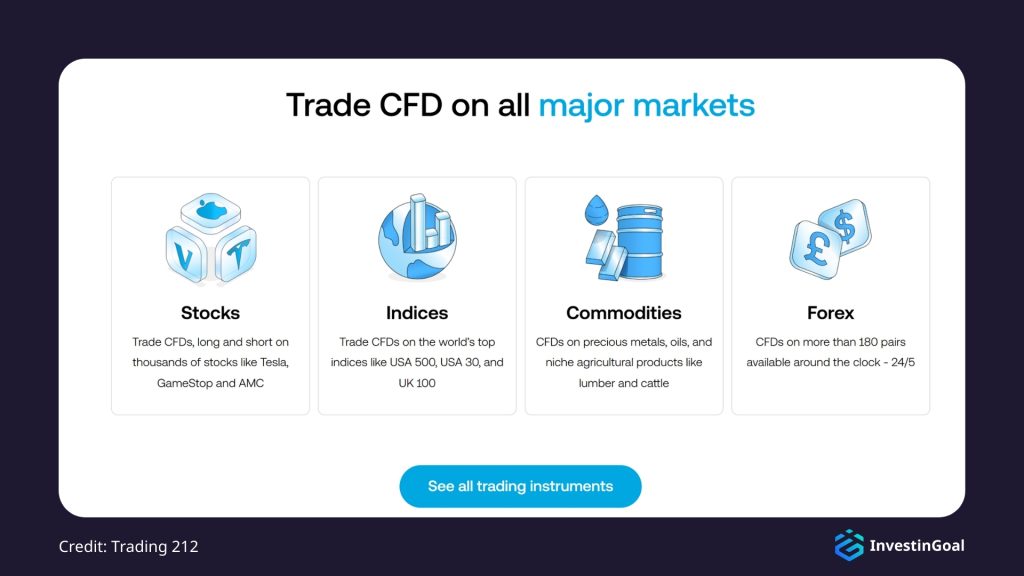
Trading 212 is a multi-asset platform offering 10,000+ real stocks and ETFs plus 6,000+ CFDs across forex (180+ pairs), indices, commodities, cryptocurrencies, bonds, and futures. This breadth positions it beyond forex-only or crypto-focused brokers, though options and mutual funds are absent.
Trading 212 serves retail clients exclusively, with no institutional or HFT services. It offers three account types: Invest (commission-free stocks/ETFs), ISA (tax-efficient), and CFD (leveraged derivatives). A professional tier exists for clients meeting ESMA criteria (portfolio >€500k, 10+ quarterly trades, or financial sector experience) but remains retail-focused.
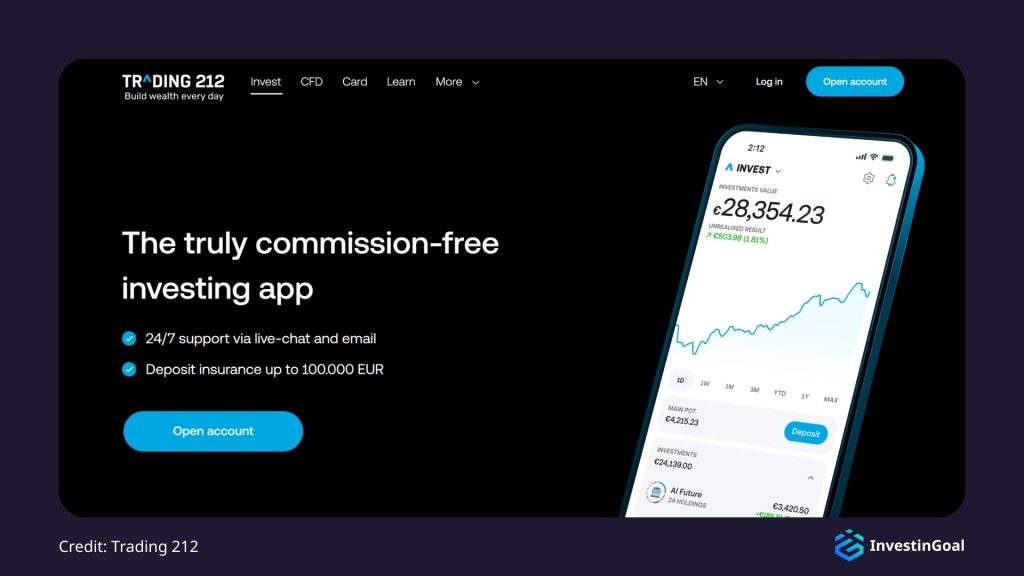
Yes, Trading 212 is a legitimate broker. It operates through Trading 212 UK Ltd., Trading 212 Markets Ltd., and other subsidiaries under the Trading 212 group, founded around 2004 and operating continuously since then. Trading 212 UK Ltd. is incorporated in 2013 with registered office in London and is authorised and regulated by the Financial Conduct Authority (FCA) for investment services. The privately held group publishes audited financial statements and reports serving about 4.5 million users with funded accounts. Under FCA rules, client funds are segregated and retail clients receive negative-balance protection and compensation scheme coverage.
The advantages of Trading 212 are listed below.
- Zero Commission on Stocks and ETFs: Trading 212 offers commission-free trading on listed shares and exchange-traded funds, reducing cost barriers and keeping overall trading expenses low.
- Fractional Share Investing: Trading 212 supports buying fractions of expensive stocks from small amounts, giving access to large-cap shares without requiring full share prices.
- Competitive Interest on Uninvested Cash: Idle funds earn interest at competitive rates, credited daily, so uninvested cash generates returns rather than sitting dormant.
- Multi-Currency Account: Users can hold and transact in multiple currencies with modest conversion fees instead of full markups, reducing FX costs.
- No Inactivity or Withdrawal Fees: Trading 212 charges nothing for account dormancy or withdrawals, offering flexibility for intermittent investors.
- User-Friendly Interface: Intuitive web and mobile apps include pie portfolios, automated investing, and alerts to simplify portfolio management.
- Regulation and Investor Protection: Trading 212 is authorised under financial regulations with client assets protected under applicable compensation schemes.
- Fast Account Setup: Quick onboarding with multiple funding methods (bank transfers, cards) and fee-free deposits within set limits.
The main disadvantages of Trading 212 are listed below.
- No Pension Option: Does not offer a SIPP, limiting its utility for tax-efficient retirement planning.
- Customer Support Limitations: No phone support exists, which can make resolving urgent, complex issues difficult.
- Limited Asset Classes: Primarily focuses on stocks and ETFs; lacks mutual funds and bonds.
- High CFD/Forex Costs: While share trading is low-cost, Forex and CFD trading incur higher spreads and financing rates.
- Inability to Transfer Assets: You cannot directly transfer your portfolio to another broker; you must sell assets, withdraw cash, and repurchase.
- Limited Research and Education: Offers basic research tools, making it less suitable for deep, fundamental analysis.
- Account Types: No options for joint or child accounts.
Is Trading 212 regulated in UK?
Yes, Trading 212 is regulated in the UK by the Financial Conduct Authority (FCA). Trading 212 UK Ltd holds FRN 609146. UK retail clients receive FSCS coverage up to £85,000, segregated client funds, and FCA-mandated negative balance protection.
This applies to UK residents using Trading 212 UK Ltd. Outside the UK, the group operates via EU, German, and Australian entities:
- Trading 212 UK Ltd: FCA (UK) — FRN 609146
- Trading 212 Markets Ltd: CySEC (Cyprus) — Licence [number]
- FXFlat Bank GmbH: BaFin (Germany) — [Licence number]
- Trading 212 AU Pty Ltd: ASIC (Australia) — [AFSL number]
EU clients using the CySEC entity are covered by the Investor Compensation Fund up to €20,000; Australian clients have no compensation scheme.
| Broker |
 |
 |
 |
|---|---|---|---|
| Regulated in UK | Yes | Yes | Yes |
| Regulatory status in UK | Regulated | Regulated | Regulated |
| Tier 1 regulations held | ASIC, FCA, ESMA (CySEC, BaFin) | ASIC, FCA, ESMA (BaFin, CySEC) | ASIC, CFTC, FCA, JFSA, MAS, NFA |
| Tier 2 regulations held | N/A | CMA, DFSA | DFSA, FMA |
| Tier 3 regulations held | N/A | SCB | BMA |
Yes, Trading 212 is legal in the UK via Trading 212 UK Ltd, authorised and regulated by the FCA (FRN 609146). UK residents can open investing/trading accounts with the UK entity. Share dealing and Stocks & Shares ISAs are available; CFDs follow FCA leverage limits and negative-balance protection. Retail crypto-derivatives/crypto-CFDs are restricted, and options aren’t part of the offering. Verify on the FCA Register using the firm name or FRN 609146.
Yes, Trading 212 accepts UK traders through Trading 212 UK Ltd, which is authorised and regulated by the Financial Conduct Authority (FCA). This licence permits share dealing and CFD services across multiple markets under strict conduct rules.
UK clients benefit from segregated client accounts, negative balance protection, 30:1 forex leverage limits, and FSCS compensation up to the statutory threshold if Trading 212 becomes insolvent. They also have access to the Financial Ombudsman Service, commission-free share dealing, and compliance with the UK crypto-asset CFD ban.
No, Trading 212 does not accept U.S. traders because the broker is not authorized or registered with U.S. regulators and has chosen to exclude residents of the United States from its service area, meaning that Americans cannot open accounts and trade stocks, exchange-traded funds or contracts for difference through this platform.
Is Trading 212 safe in UK?
Trading 212 is safe because Trading 212 UK Ltd is FCA-authorised and holds client money in segregated accounts, ring-fenced from firm funds and reconciled daily. UK clients are protected under the Financial Services Compensation Scheme up to £85,000 (increased to £120,000). Trading 212 operates multi-layered IT security controls. FSCS covers firm failure only, not trading losses. Negative balance protection applies to some retail clients depending on jurisdiction. Trading 212 does not publish stop-out levels, excess-loss insurance, 2FA, biometric login, or external penetration testing frequency.
| Broker |
|
|
|
|---|---|---|---|
| Segregated client funds | Yes | Yes | Yes |
| Negative balance | Yes | Yes | Yes |
| Investor compensation scheme | Yes | Yes | Yes |
| Founded in | 2004 | 2010 | 1974 |
| Publicly traded | No | No | Yes |
The risks with Trading 212 are listed below.
- CFD complexity: CFDs are complex leveraged instruments that can cause rapid losses. 76–79% of retail accounts lose money trading CFDs with Trading 212, reflecting the difficulty of consistent profitability.
- Leverage risk: Trading 212 offers leverage up to 1:30 on forex (lower on other assets), amplifying gains and losses. Small adverse moves can exceed initial position investment, though negative balance protection prevents accounts going below zero.
- Market volatility: All trades face market risk from unpredictable price swings. Risk intensifies during economic uncertainty, earnings, or geopolitical events when prices move sharply in short timeframes.
- Overnight financing costs: Leveraged positions held overnight incur daily charges that accumulate over time, eroding profits or deepening losses—especially for long-term strategies.
- Order execution and slippage: During high volatility or low liquidity, orders may fill at different prices than requested, resulting in worse entry or exit points.
- Platform dependency: Trading 212 runs exclusively on its proprietary platform and apps. Technical issues, outages, or connectivity problems may block access to positions during critical moments.
| Broker |
|
|
|
|---|---|---|---|
| Risk percentage | 75–95% of retail investor accounts lose money when trading CFDs | 67% of retail investor accounts lose money when trading spread bets and CFDs with this provider. You should consider whether can afford to take the high risk of losing your money. |
What markets can you trade on Trading 212?
The markets you can trade on Trading 212 are listed below.
- Stocks (spot trading): 13,000+ global real shares via Invest and Stocks & Shares ISA accounts. Minimum trade: ~$1 equivalent.
- ETFs (spot trading): ETFs within 13,000+ global instruments via Invest and Stocks & Shares ISA accounts. Minimum trade: ~$1 equivalent.
- Currency pairs (CFDs): 180+ FX pairs. Minimum trade: 0.1 CFD contract.
- Stocks (CFDs): Thousands of global company share CFDs. Minimum trade: 0.1 CFD units.
- Indices (CFDs): Major global stock index CFDs including USA 500, UK 100. Minimum trade: based on platform’s minimum trade value settings.
- Commodities (CFDs): Precious metals and energy product CFDs. Minimum trade: determined by platform’s value-based order setting.
| Broker |
|
|
|
|---|---|---|---|
| Forex | Yes (CFDs) | Yes (CFDs) | Yes (CFDs, Options) |
| Indices | Yes (CFDs) | Yes (CFDs) | Yes (CFDs, Options) |
| Commodities | Yes (CFDs) | Yes (CFDs) | Yes (CFDs, Options) |
| Shares | Yes (Real, CFDs) | Yes (CFDs) | Yes (Real, CFDs, Options) |
| ETFs | Yes (Real) | Yes (CFDs) | Yes (Real, CFDs) |
| Cryptocurrencies | N/A | N/A | N/A |
The trading products not offered by Trading 212 are listed below.
- Bonds
- Commodities
- Cryptocurrencies
- Currency Pairs
- Futures
- Mutual funds
- Options
- Spread betting
No, you can’t buy real crypto on Trading 212 in the UK. Under its UK entity, Trading 212 offers crypto exposure only via CFDs, not underlying asset ownership. A “Crypto account” exists under the non-UK entity, allowing users to buy, hold, and sell crypto assets—but these are settled off-chain, not on the blockchain, and wallet transfers to external custody are not supported. UK clients may gain access to crypto ETNs (Bitcoin, Ethereum) once approved, though ETNs still don’t confer direct coin ownership.
Yes, you can trade real shares on Trading 212. Real-share dealing is available through the Invest or ISA accounts; the CFD account is separate. Trading 212 offers access to major venues including NYSE, Nasdaq, LSE, Xetra, and other European exchanges. Shares are held in segregated omnibus accounts with third-party custodians (e.g., Interactive Brokers); you retain beneficial ownership while the custodian is the registered holder.
Yes, Trading 212 offers fractional shares. Most equity instruments on the Invest and ISA accounts are eligible for fractional share trading. You can place orders by specifying a cash amount (e.g. in GBP or EUR) or by entering a fractional share quantity. The smallest permissible investment is $1 (or its equivalent in other supported currencies).
How cheap are spreads with Trading 212?
Trading 212 spreads are wide compared to the most competitive brokers, with all costs built into the spread. On EUR/USD, the Trading 212 spread is about 1.2 pips—relatively expensive versus low-cost alternatives. On SPX500 (USA 500), the Trading 212 spread is competitive at approximately 0.56 points. On XAU/USD (gold), the Trading 212 spread is high at around 88 pips.
Trading 212 uses a single pricing model with floating spreads across all accounts—there is no separate per-trade commission, so the spread represents the total trading cost.
The fees with Trading 212 are listed below.
- Spreads: CFD accounts: dynamic, varies with market conditions.
- Overnight fee: CFD positions held past trading day.
- Currency conversion: Invest/ISA accounts 0.15%; CFD accounts 0.5%.
- Inactivity: $0.
- Deposits: Bank transfer/instant transfer $0. Card, Google Pay, Apple Pay, OnlineBankingPL, Sofort $0 up to $2,000 total deposits, then 0.7%.
- Withdrawals: $0.
| Broker |
|
|
|
|---|---|---|---|
| Overnight fees | Yes | Yes | Yes |
| Inactivity fee | No | No | No |
| Deposit fees | Yes | No | No |
| Withdrawal fees | No | No | No |
| Currency conversion fee | Yes | Yes | Yes |
No, Trading 212 does not charge raw spread commissions. Trading costs at Trading 212 come from dynamic spreads, plus other applicable charges like the 0.5% FX fee when the instrument currency differs from the account currency (and overnight interest if held past the daily cutoff).
| Broker |
|
|
|
|---|---|---|---|
| Avg. EUR/USD spread (markup) | 1.20 pips | 1.10 pips | 1.26 pips |
| Avg. EUR/USD spread (raw) | N/A | 0.10 pips | N/A |
| Commission/lot | N/A | $6.00 (£4.50) Round Turn | N/A |
| All-in FX cost | $12.00 | $8.50 | $12.60 |
Trading 212’s overnight swaps for EUR/USD are high, being about 0.0092% per night (roughly 3.36% p.a.).
Overnight interest is applied daily at 22:00 GMT from Monday to Thursday, and triple swaps are charged on Wednesdays to cover the weekend. Swap fees don’t vary between account types because overnight financing applies only to CFD positions.
Trading 212 charges no commission on share CFDs; costs are embedded in the spread (bid-ask difference), which is dynamic and varies by share, liquidity, and market conditions.
- No fixed per-trade or per-share fee, no published minimum/maximum.
- Spreads vary by exchange (US, UK, EU shares) based on liquidity and volatility.
- No tiered discounts or VIP rebates to reduce spreads.
When the share currency differs from your account base currency, Trading 212 applies an FX fee of 0.5% on the profit/loss at position close. Positions held overnight incur financing interest (swap), depending on the instrument and direction (long/short).
Trading 212’s crypto CFD commissions are included in the spread. For non-CFD crypto, costs are also expressed via the spread, with an additional pricing tier: fee-free trading up to a cumulative $2,000, then 0.7% on further crypto trades. Crypto CFDs incur overnight financing; FX fees (e.g., 0.5%) may apply when instrument currency differs from the account base currency. CFD crypto trading in the UK is available to professional traders only.
Is Trading 212 good for trading?
Trading 212 is good for trading forex, CFD stocks, real stocks, CFD crypto, real crypto, demo trading, and mobile trading. Trading 212 is not good for algorithmic trading and copy trading.
Trading 212 supports forex trading. It offers 150 to 180+ currency pairs as CFDs, commission-free with costs via the spread, micro-lot sizes down to 0.001 lots, and hedging mode.
The platform offers stock CFDs and real stocks through its Invest account. They are commission-free, support fractional shares starting from £1/€1/$1, and provide real-time quotes across US, UK, and EU exchanges.
CFD and real crypto trading are available. They cover 8 to 15 cryptocurrencies, though UK retail clients face restrictions on crypto CFDs because of FCA rules.
The broker provides unlimited demo accounts with refillable funds and full-featured iOS and Android mobile apps.
Algorithmic trading is not supported because Trading 212 offers no public API, does not integrate MT4/MT5/cTrader, and prohibits automation.
Copy trading is unavailable because the platform lacks a live social trading network. The Pie/AutoInvest feature permits only static portfolio allocation imports and does not allow continuous mirroring of live trades.
Trading 212 is excellent for investing because it offers commission-free trading of real stocks and ETFs, access to 14 major global exchanges, fractional shares starting from £1/€1/$1, and automated recurring investing through AutoInvest Pies. The broker charges no custody, maintenance, or inactivity fees, and applies a competitive FX conversion rate of spot ± 0.15% on trades (with dividends converted without FX fees).
Trading 212 provides real stock and ETF ownership with shareholder voting rights in its Invest and Stocks & Shares ISA accounts. The investment universe includes ordinary shares, preferred shares, ETFs, ETPs/ETCs, REITs, and UK investment trusts across 14 major exchanges spanning the United States (NYSE, NASDAQ), United Kingdom (London Stock Exchange), Germany (Deutsche Börse Xetra), France (Euronext Paris), Netherlands (Euronext Amsterdam), Belgium (Euronext Brussels), Spain (Bolsa de Madrid), Italy (Borsa Italiana), Switzerland (SIX Swiss Exchange), and Austria (Wiener Börse). Trading commissions are £0/€0/$0 per trade, and the platform supports fractional trading for most instruments with a minimum order size of one unit of account currency. Recurring investments can be scheduled daily, weekly, every two weeks, monthly, every two months, or every six months through the AutoInvest Pies feature. The FX conversion cost of spot rate ± 0.15% applies to trades in foreign currencies, while dividend conversions to the primary account currency incur no FX fee.
Trading 212 is excellent for demo trading because it offers an unlimited demo account with no expiration date, uses real-time market data for all asset classes, provides full access to its complete instrument lineup, and allows users to reset or top up their virtual balance at any time.
Trading 212 delivers a comprehensive demo trading experience that closely replicates live market conditions. The practice account uses real-time pricing for forex and stocks without artificial delays, ensuring traders experience authentic market movements. Users can trade the broker’s entire range of instruments including stocks, ETFs, forex pairs, commodities, and crypto CFDs within the demo environment. The demo account features the same interface, spreads, and execution behavior as the live platform, with only unavoidable real-world differences present. The virtual balance can be reset or topped up whenever needed, and the account remains active indefinitely without any time restrictions or expiration dates.
eToro, XTB, IC Markets and XM are some good alternatives to Trading 212 as demo Forex brokers (https://investingoal.com/forex/broker/demo/).
Trading 212 is not a good fit for algo trading because the broker does not provide any algorithmic trading infrastructure or support. The platform lacks MetaTrader 4, MetaTrader 5, cTrader, and any other algo-enabled trading platforms, offers no native scripting capabilities, and does not provide a public API for automated strategy execution. Trading 212 prohibits several algo trading strategies including scalping, arbitrage, high-frequency trading, and price scraping, while offering no VPS services or co-location options at major data centers such as LD4, NY4, or Equinix. The broker only permits hedging and CFD shorting, which represent minimal functionality for algorithmic traders seeking to deploy automated strategies.
Good alternatives to Trading 212 for algo traders are Pepperstone, FP Markets, IC Markets and Roboforex, as listed in the algorithmic trading Forex brokers listicle.
Trading 212 is good for Forex trading because it offers a large selection of 180+ currency pairs, allows nano lot sizes down to 0.001 lots (100 units) for precise position sizing, and operates under top-tier regulation from the FCA (UK) and ASIC (Australia). Trading 212 is good and not excellent for Forex trading because scalping is not allowed, expert advisors and algorithmic trading are not supported, the EUR/USD spread averages approximately 1.8 pips which is relatively wide, and the platform does not offer industry-standard third-party platforms like MetaTrader 4, MetaTrader 5, or cTrader.
Trading 212 provides forex traders with a proprietary web and mobile platform that integrates TradingView charting technology, offering dozens of technical indicators, drawing tools, and an economic calendar. The broker supports hedging mode for traders who want to hold opposing positions simultaneously and includes a traders’ sentiment tool on the CFD side. The extensive range of over 180 currency pairs gives traders access to major, minor, and exotic forex pairs, while the nano lot minimum of 100 units makes the platform accessible for small account holders and those testing strategies. The main limitations for forex traders are the prohibition on scalping strategies, the absence of automated trading capabilities through expert advisors, the lack of MetaTrader platform options preferred by many professional traders, and spreads that are wider than competitors, with EUR/USD averaging around 1.8 pips.
Pepperstone, XM, AvaTrade and FP Markets are some good alternatives to Trading 212 as best overall Forex brokers.
Trading 212 is great for CFD stock trading because it offers zero-commission trading on share CFDs across around 10 major exchanges including US stocks, provides real-time market data with tick-by-tick pricing, supports fractional CFD trading down to 0.1 or 0.01 units depending on the instrument, and operates under tier-1 regulatory oversight from the FCA, ASIC, CySEC, BaFin, and FSC. Trading 212 is great and not excellent for CFD stock trading because it lacks third-party platform support such as MetaTrader 4, MetaTrader 5, or cTrader, prohibits scalping strategies, offers no official algorithmic trading capabilities or public API, and provides limited analysis tools with no stock screener, earnings calendar, or comprehensive fundamental data.
Trading 212 charges no commissions on share CFDs, with costs limited to spreads and overnight financing fees. The broker provides access to CFD stocks from approximately 10 major global exchanges and delivers real-time quotes with tick-by-tick pricing through its proprietary web and mobile platforms. Traders can open fractional positions as small as 0.1 or 0.01 of a share depending on the instrument, and the platform includes a client sentiment gauge showing trader positioning on CFD instruments alongside stock news feeds. However, the broker restricts scalping, does not support algorithmic trading through APIs or third-party platforms like MetaTrader, and offers minimal research tools for stock analysis, lacking both a stock screener and earnings calendar. Trading 212 does allow hedging through a dedicated hedging mode that keeps opposite positions separate and permits short-selling of CFD stocks.
Good alternatives to Trading 212 for CFD stock trading are IG Markets, Pepperstone, eToro and AvaTrade, as listed in the best stock CFD platforms listicle.
Trading 212 is a great broker for real stocks trading because it offers commission-free trading on real stocks and ETFs, provides access to over 13,000 stocks and ETFs across more than 10 exchanges including NYSE and NASDAQ with actual ownership, supports fractional shares with very low minimums, delivers real-time quotes and charts during market hours, and operates under robust regulation by the FCA alongside CySEC, BaFin, and FSC. Trading 212 is great and not excellent for buying real stocks because it lacks third-party platform support, offers no stock screener or earnings calendar, provides minimal fundamental analysis tools, does not support algorithmic trading through a public API, and restricts advanced trading strategies by prohibiting hedging and short-selling of real shares in its Invest account while offering only basic analysis features limited to news feeds.
Trading 212 delivers strong core stock trading capabilities with zero commissions on all real stock and ETF purchases, giving traders actual ownership of US shares listed on major exchanges like NYSE and NASDAQ. The broker stands out with its fractional share functionality that allows investors to buy portions of expensive stocks with very low minimum investments, and it provides real-time market data during trading hours. However, traders will find limitations when they seek advanced tools. The platform operates exclusively through Trading 212’s proprietary web and mobile applications without support for MetaTrader or other third-party platforms, offers no dedicated stock screener to filter investment opportunities, lacks an earnings calendar, provides minimal fundamental company data, and does not support algorithmic trading. The Invest account further restricts trading freedom by disallowing hedging and short-selling strategies, though scalping is permitted.
Good alternatives to Trading 212 for buying stocks are DEGIRO, eToro, XTB and Saxo Bank, as listed in the best brokers for stocks listicle.
Trading 212 is a great broker for CFD crypto trading because it charges zero commission on cryptocurrency CFD trades, provides real-time tick-by-tick market data available 24/7, allows fractional trading with a minimum position size of approximately €2, and operates under multiple tier-1 regulatory authorities including the FCA, CySEC, and BaFin. Trading 212 is great and not excellent for CFD crypto trading because it offers a limited selection of around 10 major cryptocurrencies, lacks crypto-specific regulatory oversight, and does not provide the extensive range of digital assets available at competing platforms. However, CFD crypto is not available to retail UK traders.
Trading 212 covers the essential CFD crypto trading needs with a cost-effective structure where all expenses are embedded in spreads and overnight financing rather than direct commissions. The platform supports fractional cryptocurrency CFD trading from approximately €2, making it accessible for traders with smaller capital allocations. Real-time market data updates continuously throughout the 24-hour crypto trading cycle. The broker operates under strict financial regulation from authorities in the United Kingdom, Cyprus, Germany, and Bulgaria, though these permissions do not include cryptocurrency-specific regulatory frameworks. The primary limitation remains the product range of roughly 10 major cryptocurrencies, which excludes many altcoins and newer digital assets that traders seeking broader market exposure might require.
eToro, NAGA, Pepperstone and AvaTrade are some good alternatives to Trading 212 as best CFD crypto brokers.
Trading 212 is a good option for real crypto trading. It offers commission-free trading with very low minimum investment requirements of around €2, real-time market data with 24/7 tick-by-tick quotes, and support for both buying crypto with fiat currency and selling crypto back to fiat. Trading 212 is good and not excellent for real crypto trading. It offers only 10–15 cryptocurrencies (far below competitors offering 60 or more), operates a custodial-only wallet system without private keys, does not allow users to send crypto to external wallets or receive crypto from external addresses, and does not support direct crypto-to-crypto transactions.
Trading 212 provides a basic but accessible crypto trading experience suitable for beginners and casual investors who want to hold popular cryptocurrencies within the platform. The broker markets its service as commission-free, though it applies charges through the bid-ask spread with approximately 1% markup in some regions. The fractional purchase capability allows users to invest small amounts, making crypto accessible to those with limited capital. However, the platform’s custodial structure means users have no control over private keys and cannot transfer cryptocurrency in or out of the platform, which effectively limits the service to speculative trading rather than full cryptocurrency ownership. Users who want to switch between different cryptocurrencies must first sell to fiat currency before purchasing a different coin, which adds friction and potential costs to portfolio rebalancing. Trading 212 operates under regulated entities including the FCA, CySEC, BaFin, and FSC for its brokerage services, though crypto-specific regulatory protections are not indicated.
eToro, Coinbase, Crypto.com and Binance are some good alternatives to Trading 212 as best crypto exchanges.
Trading 212 is a decent broker for copy trading because it offers a proprietary “Pies & AutoInvest” system that allows users to copy portfolios, charges no additional copy-trading commissions, and provides a straightforward way to import and share investment allocations. Trading 212 is decent and not excellent for copy trading because it does not support live trader-to-trader mirroring, lacks a signal marketplace or strategy subscription service, and offers no copy-specific risk management tools such as copy stop-loss or allocation caps tied to master traders.
Trading 212 operates its copy trading through the proprietary Pies & AutoInvest feature, which enables users to import published Pies containing pre-set portfolio allocations in a one-time transfer. The platform does not facilitate real-time mirroring of other traders’ live positions or provide a marketplace for subscribing to ongoing trading signals and strategies. Users benefit from zero additional copy-trading fees beyond standard trading costs. However, the platform lacks dedicated risk management controls for copy trading, offering only the standard risk tools available across the platform without specific features like automatic stop-loss mechanisms or percentage caps linked to copied portfolios.
eToro, ZuluTrade, AvaTrade and NAGA are some good alternatives to Trading 212 as best copy trading platforms.
What are the Trading 212 trading conditions?
The Trading 212 trading conditions are listed below.
- Pricing model: Invest and ISA accounts use zero commission with no ticket fees. CFD trading uses spread-based pricing with no explicit commission; costs are reflected in bid-ask spreads plus overnight interest. Spreads are variable and may widen during low liquidity or high volatility.
- Order size: Maximum order and position sizes vary by instrument. CFD trading uses dynamic “maximum remaining quantity” limits that adjust with market risk, liquidity, and volatility. Orders above thresholds are automatically restricted.
- Trading approaches: Hedging is supported on the CFD platform, allowing opposite positions on the same instrument. In hedging mode, position sizes cannot be modified directly. No explicit restrictions on scalping or algorithmic trading, though exposure controls may constrain high-frequency activity.
- Risk management: Negative balance protection prevents losses exceeding deposited funds. Client assets are held in segregated accounts with uninvested funds protected under financial compensation schemes up to defined limits.
- Order execution: Full order-book depth and detailed liquidity data are not published. Execution quality information is limited to indicative spreads and maximum trading quantities. Spreads widen during volatile periods and news events; detailed liquidity metrics are unavailable for assessment.
| Broker |
|
|
|
|---|---|---|---|
| Execution model | Market Maker | ECN/STP | Market Maker |
| Max. FX leverage | 1:30 | 1:30 | 1:30 |
| Min. FX trade size | 0,01 standard lots | 0,01 standard lots | 0,01 standard lots |
| Hedging allowed | Yes | Yes | Yes |
| Scalping allowed | No | Yes | Yes |
Trading 212 applies a market-maker execution model for CFDs. Trading 212 fills CFD orders as principal against Trading 212 quoted prices, with Trading 212 operating a dealing-desk style setup. Trading 212 executes trades internally and does not route CFD orders to external execution venues. Trading 212 requires that positions are opened and closed directly on the Trading 212 platform. Trading 212 keeps the execution model consistent across CFD accounts and mainly varies conditions through costs and client categorisation.
Trading 212’s trade execution is weaker than specialist low-latency CFD brokers. Trading 212 relies on a proprietary platform without the execution-speed profile of MT4 or MT5 environments, and does not support algorithmic trading via EAs. Trading 212 does not publish robust execution-speed distributions or slippage statistics for retail clients. Trading 212 is not a strong choice for trading volatile news, and is better treated as a simple platform where execution is acceptable only when timing precision is not critical.
Trading 212 max leverage in the UK is up to 1:30 for retail clients and higher for professional clients (where eligible). Leverage depends on client classification and instrument type, with fixed ratios per asset that cannot be manually adjusted. Trading 212 applies margin requirements with stop-out at around 25% (margin call at 45%).
The max leverage with Trading 212 for each asset class is listed below.
- Forex: 1:30 majors; 1:20 non-majors.
- Indices: 1:20 major; 1:10 non-major.
- Commodities: 1:20 gold; 1:10 other commodities.
- Shares (equities): 1:5 retail.
The minimum trade size at Trading 212 for CFD instruments is 0.1 contracts (i.e. 0.1 CFD) for many assets. In share investing (Invest/ISA) accounts, fractional shares are allowed so trades can start from small fractional quantities (e.g. 0.1 of a share or lower depending on the instrument). The maximum trade size is instrument-specific and will vary by stock, CFD, or forex pair. Trading 212 imposes limits on order size and position size to control risk; if you attempt an order above these limits you will receive a message that it exceeds the maximum allowed. Those limits adjust with market liquidity, volatility, and internal risk management considerations.
The types of trading orders available at Trading 212 are listed below.
- Market order
- Limit order
- Stop order
- Stop-limit order
- Trailing stop order
- Stop-loss order
- Take-profit order
Trading 212 does not offer conditional order groups such as one-cancels-the-other orders.
Trading 212 has variable slippage during spread-widening and thin liquidity, and can show bad fills when markets move quickly. Trading 212 does not publish slippage statistics, and frames execution quality through best-execution language rather than measured slippage reporting.
Order execution speed with Trading 212 is slow, and market orders usually execute within seconds under normal conditions. Best Execution reporting with Trading 212 focuses on execution venue quality rather than millisecond-level speed metrics. A guaranteed maximum execution latency is not provided in the regulatory disclosures.
A verifiable execution-speed statistic in milliseconds is not published by Trading 212. The percentage of orders filled in under one second is not published by Trading 212. A public dataset that enables classification of average execution latency against a millisecond benchmark is not provided by Trading 212.
What are Trading 212 account types?
The account types offered by Trading 212 are listed below.
- Invest (General/”GIA”): For investors wanting real asset ownership. Buy and hold actual shares and ETFs with dividend and voting rights. Commission-free trading except currency conversion fees. No fixed deposit limit.
- Stocks & Shares ISA: For eligible residents seeking tax-advantaged investing. Wraps over Invest service with gains, dividends, and interest exempt from capital gains and dividend tax. Annual contribution limit; ISA-approved instruments only.
- Cash ISA: For low-risk savers preferring high-interest savings under ISA rules. Cash balances earn interest with no account fees while retaining ISA tax advantages.
- CFD Account: For traders needing leverage and short positions. Contract for difference trading without underlying asset ownership. Leverage magnifies gains/losses. Overnight holding costs and spreads apply; $10 minimum funding.
- Professional (Pro) Account: For experienced traders wanting higher leverage with reduced regulatory protections. Requires qualifying criteria like trading history, portfolio size, or professional experience. CFD trading only.
- Demo/Practice Account: Practice account with virtual funds and simulated environment. Access to same instruments for learning and platform testing with no real risk.
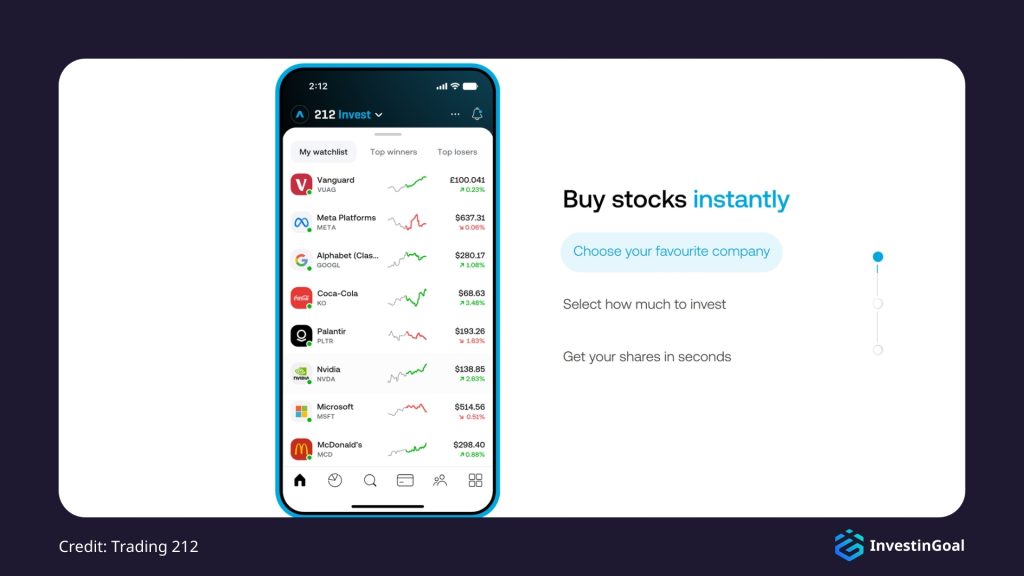
Trading 212’s most popular account is likely the Invest account, used primarily for commission-free trading of real stocks and ETFs without leverage. Trading 212 doesn’t publish usage statistics by account type, but the Invest account’s appeal to long-term investors and beginners—who avoid CFD complexity and risk—suggests it dominates. It offers fractional shares, multi-currency holdings, and zero commissions on stocks and ETFs, making it accessible for buy-and-hold strategies.
Yes, Trading 212 offers a demo account. The demo account is unlimited and does not expire, remaining available as a lifetime practice account even after opening a live account. Users can set and adjust their virtual balance up to €50,000 (or 50,000 in their chosen currency), with the ability to top up or reduce demo funds as needed. The demo account provides real-time market data using the same live price feeds as the live platform, with no artificial pricing or intentional delays. It offers full access to Trading 212’s complete instrument lineup with the same interface, pricing, spreads, and execution behavior as the live platform, though certain corporate actions such as dividends may not be simulated.
No, Trading 212 does not offer an Islamic (swap-free) account. Available account types are Invest, CFD, Stocks ISA, and Cash ISA—none provide swap-free options. CFD accounts incur overnight interest charges on positions held beyond one trading day. No special settings or requirements exist because the account type is unavailable. All users follow standard trading rules with no altered treatment of interest or swap fees for Muslim traders.
Yes, Trading 212 offers a Professional (Pro) account for CFDs (“Pro client” or “Professional CFD Account”). To qualify, clients must hold a CFD retail account with Trading 212 (UK) and meet at least 2 criteria: sufficient trading volume, relevant experience, and portfolio size. Compared with a retail account, the Professional account provides higher leverage but fewer regulatory protections (including loss of negative balance protection and certain investor rights).
Yes, Trading 212 does not offer corporate or business trading accounts. Their terms explicitly state accounts are for personal use only, and they do not accept deposits from business bank accounts. Trading 212 offers retail and professional client status (subject to eligibility), but no separate corporate account tier. This applies across all jurisdictions—accounts are limited to individuals. The retail vs professional distinction relates to leverage, margin and regulatory treatment, not business-entity status.
No, Trading 212 does not provide premium or upgraded features such as a Premium account for high volume traders. While Trading 212 provides low commission trading, it does not offer a VIP or genuinely separate premium-account category.
How to open an account with Trading 212?
The steps to open an account with Trading 212 are listed below.
- Start the registration: Open the account signup page, confirm the country of residence, and enter name, date of birth, email address, and phone number.
- Select the account type: Choose an available account category, such as an investing account or a tax-advantaged share account where eligibility applies.
- Provide tax and personal details: Enter tax residency information and provide additional details requested during onboarding, including financial status, employment, income, savings, and investment experience.
- Complete the suitability questionnaire: Answer questions about trading knowledge and risk awareness.
- Verify identity and address: Upload a government-issued identity document, complete a selfie or liveness check where required, and upload proof of address such as a utility bill or bank statement if requested.
- Accept terms and submit the application: Review and accept the terms and disclosures presented during signup and submit the application for review.
- Fund the account: Deposit money after approval using an available funding method such as bank transfer or payment card.
- Begin investing: Open the platform after the deposit is credited and place the first order.
The full setup usually takes around one working day, and the main variable is the time needed for verification checks and any follow-up review. The process is generally easy to complete, since the steps are fully digital and guided through the application and verification screens. The requirements typically include being at least 18 years old, providing accurate personal and tax information, and completing the suitability questions, and additional checks can be requested when verification standards require them. A Know Your Customer process is required, and it typically includes identity verification, proof of address where applicable, and, in some cases, additional documentation such as information related to source of wealth.
| Broker |
|
|
|
|---|---|---|---|
| Minimum deposit in UK | $1 | $0 | $0 |
| Demo trial available | Yes | Yes | Yes |
| Payment methods | Wire Transfer, Credit Card, Debit Card | Wire Transfer, Credit Card, Debit Card, Ewallets | Wire Transfer, Credit Card, Debit Card, Ewallets |
| Islamic account availability | No | Yes | No |
| Account base currencies | GBP, USD, EUR, CHF, DKK, NOK, PLN, SEK, CZK, RON, BGN, HUF, CAD, AUD | GBP, USD, EUR, CHF | AUD, EUR, GBP, HKD, SGD, USD |
Trading 212 minimum deposit (UK) is $1 for Invest and Stocks ISA accounts, and $10 for CFD accounts. The same minimums apply to subsequent deposits. No tier, status, subscription, or payment-method variations exist. Accounts accept multiple base currencies (GBP, USD, EUR, and others). The threshold solely defines the smallest funding amount to start trading—no perks or gating.
Trading 212 offers 14 account base currencies, which includes GBP, USD, EUR, CHF, DKK, NOK, PLN, SEK, CZK, RON, BGN, HUF, CAD, AUD. The wide range of account base currencies offered at Trading 212 supports multi-currency activity and helps traders limit conversion fees when they hold and trade in supported currencies.
The deposit methods supported by Trading 212 are listed below.
- Bank Transfer
- Instant Bank Transfer
- Debit Cards
- Credit Cards
- Apple Pay / Google Pay
- Local Online Banking Methods
The withdrawal methods supported by Trading 212 are listed below.
- Bank Wire Transfer
- Debit Cards
- Credit Cards
- eWallets
Deposits and withdrawals with Trading 212 are safe for UK clients because funds are protected by FCA regulation and segregated from company assets. Client money is held in segregated accounts at tier-one banks (JPMorgan, Barclays) under FCA CASS rules, with daily reconciliations. Client assets (stocks, ETFs) are held separately via third-party custodians under CASS 6 regulations. If Trading 212 fails, the Financial Services Compensation Scheme covers up to £85,000 per person. Security includes web application firewalls, vulnerability scanning, and mandatory two-factor authentication (2FA) before withdrawals. Identity verification is required, and funds must return to the original payment method up to the deposited amount. Withdrawals process within three business days; some limits apply until payment methods are fully verified.
What trading platforms does Trading 212 offer?
The trading platforms offered by Trading 212 are listed below.
- Trading 212 Web Platform: Multi-asset trading with integrated TradingView charting, basic and advanced chart tools, and browser compatibility across Windows/macOS/Linux. Available on web browsers and iOS/Android mobile browsers.
- Trading 212 Mobile App: Native app supporting trading, charting, fractional shares, Pies, and automatic investing with touch-first design. Available on iOS/Android only (no desktop version).
- Trading 212 Desktop Application: Downloadable app running the web platform in a dedicated window with equivalent functionality. Available on Windows/macOS (no mobile apps – use mobile app for mobile access).
| Broker |
|
|
|
|---|---|---|---|
| MT4 | No | Yes | Yes |
| MT5 | No | Yes | No |
| cTrader | No | Yes | No |
| TradingView | No | Yes | Yes |
| Proprietary platform | Yes | Yes | Yes |
| Copy trading platform | Yes | Yes | No |
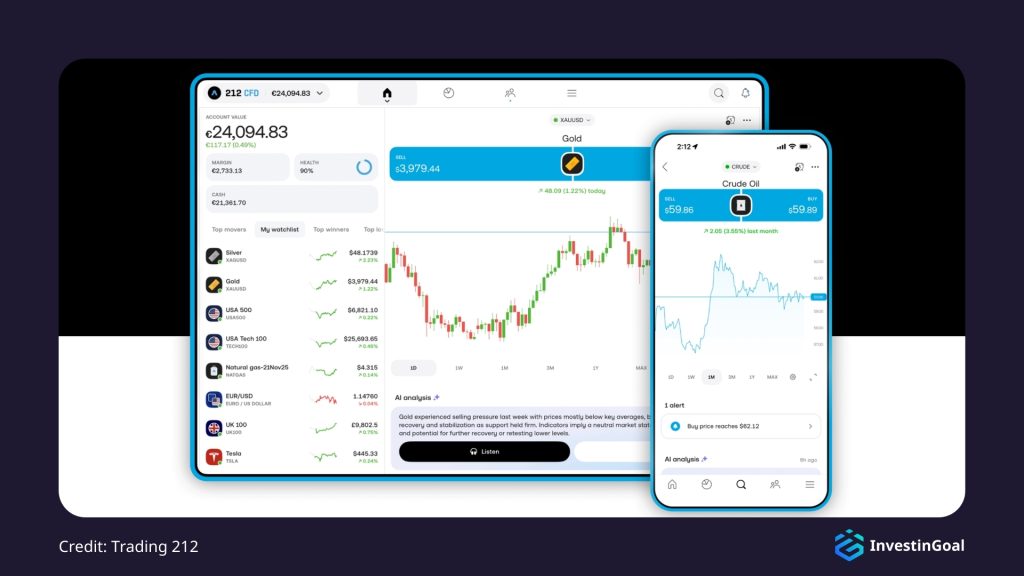
The charting tools available at Trading 212 are listed below.
- Technical indicators: 50+ built-in indicators (momentum, volatility, trend, volume). Users can add, adjust, and remove indicators directly from the chart interface.
- Drawing tools: Trendlines, measured-move tools, multi-point geometric shapes, text and label annotations, managed through object-tree interface.
- Chart timeframes: Minute-based intraday intervals plus daily, weekly, and monthly views.
- Platform quality: Advanced TradingView-based charting via web and mobile for Invest, ISA, and CFD accounts. Features include chart alerts, one-click trading, indicator layering, multi-chart viewing (split layouts/tabs on mobile, multiple windows with savable templates on web), visual customisation (indicator colours, themes, price scales, light/dark modes), and buy/sell price views for CFD accounts.
- Pricing: Charting tools included in standard accounts with no separate subscription fees or add-on charges.
The trading tools offered by Trading 212 are listed below.
- Order types & risk controls: Market, Limit, and Stop-Limit orders; Stop Loss settings for downside risk management.
- Market analytics widgets: Interactive charts with ~50 technical indicators and configurable settings within the chart interface.
- Market analysis tools: In-app financial newsfeed with instrument-specific headlines; AI Analysis feature summarising trends, sentiment, fundamentals, and risks.
- Alerts and notifications: Price alerts for selected instruments via push notifications or email, with in-app preference controls.
- Performance analytics: Portfolio and transaction-history tracking; manual data export for external analysis.
- Mobile-exclusive utilities: Watchlists, gesture-based trading, biometric login, and cross-device synchronisation.
| Broker |
|
|
|
|---|---|---|---|
| API support | Beta API | FIX API, cTrader API | REST API, Streaming API, FIX API |
| EAs support | No | Yes | Yes |
| Coding languages supported | N/A | MQL4, MQL5, cAlgo, Pinescript | MQL4 |
| VPS support | No | Yes | Yes |
No, Trading 212 does not provide a VPS service for its users.
Trading 212 offers trading and investing accounts, but it does not host or offer a virtual private server for client platforms or algorithmic trading.
No, Trading 212 does not include Autochartist. Trading 212 does not support MetaTrader platforms, where Autochartist is commonly offered, and it does not provide built-in third-party signal services such as Autochartist or Trading Central.
No, Trading 212 does not offer full TradingView integration.
Users cannot link a Trading 212 account directly to the TradingView terminal for order execution. Trading 212 has incorporated elements of TradingView charting (in its mobile app charts) rather than providing the full TradingView platform. Users access enhanced charting features inside the Trading 212 platform, but not a full TradingView interface. There is no requirement to hold a specific TradingView plan to use the charting features in Trading 212, and there are no additional fees tied to TradingView use via Trading 212. As a workaround, users may use external screeners or charting tools (such as the TradingView website) separately, and then execute trades through Trading 212’s native interface, whose charting tools include around 45 indicators and drawing tools.
No, Trading 212 does not permit algorithmic (algo) trading on live accounts. Trading 212 does not support MetaTrader 4, MetaTrader 5, cTrader, or provide FIX/WebSocket gateways for automated execution. VPS hosting, co-location, and low-latency infrastructure are not available.
How good is Trading 212 for mobile trading?
Trading212 is great for mobile trading because it offers a proprietary app available for both Android and iOS, includes complete account management features, provides a comprehensive set of technical indicators and chart drawing tools, integrates market analysis tools, and allows trading of over 1,800 instruments including forex, stocks, indices, commodities, and cryptocurrencies. Trading212 is great and not excellent for mobile trading due to the absence of mobile support for futures and options trading, which constrains access to the broker’s full product spectrum via the mobile platform.
The Trading212 mobile app enables seamless trading and investing with real-time price data, full access to all tradable assets, and a user-friendly interface powered by TradingView charting technologies. Traders can easily manage funds, switch between demo and live modes, and utilize dozens of technical indicators and drawing tools directly on their mobile devices. The app supports integrated economic calendars, news feeds, price alerts, and trending market sentiment features. The lack of futures and options on mobile remains a limitation for users seeking direct access to those markets via smartphone or tablet, despite the app covering a vast array of assets and offering advanced technical functionalities.
XTB, IG Markets, Pepperstone and AvaTrade are some good alternatives to Trading212 as best mobile trading apps.
| Broker |
|
|
|
|---|---|---|---|
| MT4 mobile | No | Yes | Yes |
| MT5 mobile | No | Yes | No |
| cTrader mobile | No | Yes | No |
| Proprietary mobile app | Yes | Yes | Yes |
The Trading 212 mobile app and desktop (web) version share core functionality but differ in layout, feature completeness, and interface polish. The mobile app offers fuller access to company fundamentals (financials, balance sheets, key ratios) that are harder to find or missing on desktop. The web version under-utilises screen space with lower information density and fewer shortcuts, making it feel more limited than the mobile app. Portfolio metrics (e.g. “return” calculations) sometimes show slight discrepancies due to recent update differences. The desktop/web interface lacks advanced configurability and workflow optimisation compared to dedicated platforms. Session handling differs: logging in on one platform may log out the other. Some community/social feed content also varies between versions. Both sync core account data, but the mobile app is currently more polished for most users, while the company works toward feature parity.
How good is Trading 212 to learn trading?
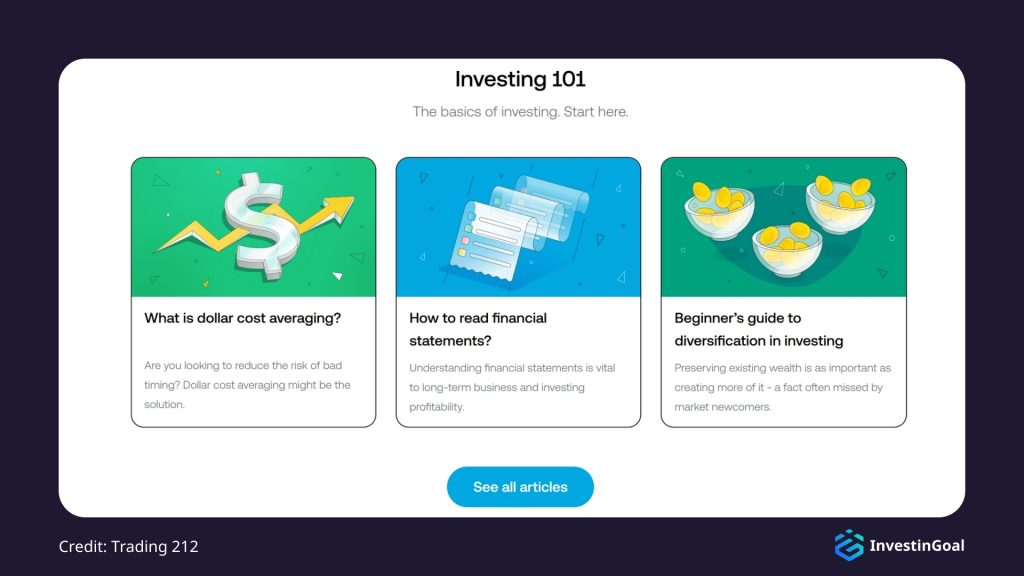
Trading 212 is good for learning trading because it offers an educational Learn section with training articles and tutorials, as well as an unlimited demo account for users to practice trading skills. Trading 212 is good and not excellent for learning trading due to several educational gaps, such as the lack of dedicated market outlooks, daily analysis series, webinars, podcasts, and cent/nano accounts.
Trading 212 provides a self-directed learning experience centered around its Learn section, where users can access articles covering essential investing concepts and platform tutorials. The broker supplements this with educational video content via its YouTube channel and in-app tutorials. The unlimited demo account allows beginners to trade in real market conditions with virtual funds at any time, making it easy to switch between practice and live trading for practical experience. Trading 212 does not offer structured courses, live webinars, or interactive live events, nor does it publish daily expert market analysis or run a podcast. The absence of cent/nano accounts may limit risk-minimized real-money practice for absolute beginners.
| Broker |
|
|
|
|---|---|---|---|
| Webinars | No | Yes | Yes |
| Tutorials | Yes | Yes | Yes |
| Glossary | No | No | Yes |
| Live analysis | No | Yes | Yes |
How good is Trading 212 customer care?
Trading 212 has great customer care because it offers live chat, email support, multilingual service, and does not charge any fees for customer support. Trading 212 has a great and not excellent customer care due to the absence of phone support and the lack of account-tier perks for customer care.
Trading 212 provides 24/7 customer service through live chat and email, allowing clients to receive assistance at any time. The live chat starts with a bot and can quickly connect users to a human agent. The platform and support channels are available in multiple languages to serve a global user base. All users can access support without any additional fees, but there is no phone support and account-tier-based customer care benefits are not provided.
| Broker |
|
|
|
|---|---|---|---|
| Support languages | English, German, Dutch, French, Spanish, Italian, Polish, Russian, Romanian, Chinese | English, Spanish, Russian, Chinese, Vietnamese, Arabic, Indonesian, Italian, French, Thai, German, Polish | English, Arabic, Chinese, Danish, Dutch, French, German, Italian, Japanese, Norwegian, Portuguese, Romanian, Russian, Spanish, Swedish |
| Phone support | No | Yes | Yes |
| Email support | Yes | Yes | Yes |
| Chat support | Yes | Yes | Yes |
| Support hours | Mon-Sun (00:00-24:00) | Mon-Fri (00:00-24:00) | Sat-Fri (08:00-22:00 GMT) |
What are the best alternatives to Trading 212?
The best alternatives to Trading 212 are Plus500, eToro, and Admirals.
- Plus500: Commission-free CFD trading with spreads from 0.6–0.8 pips; proprietary platform; 70+ currency pairs, 1,900 stock CFDs, and 18 crypto CFDs; top-tier regulation with negative balance protection and margin close-out.
- eToro: Social trading with CopyTrader; zero-commission stocks and ETFs; crypto and commodities exposure; segregated funds and investor compensation under robust regulation.
- Admirals: 3,200+ CFDs and 4,000 stocks; spread betting; low-cost Trade and Zero accounts; comprehensive education; strong regulation with negative balance protection.