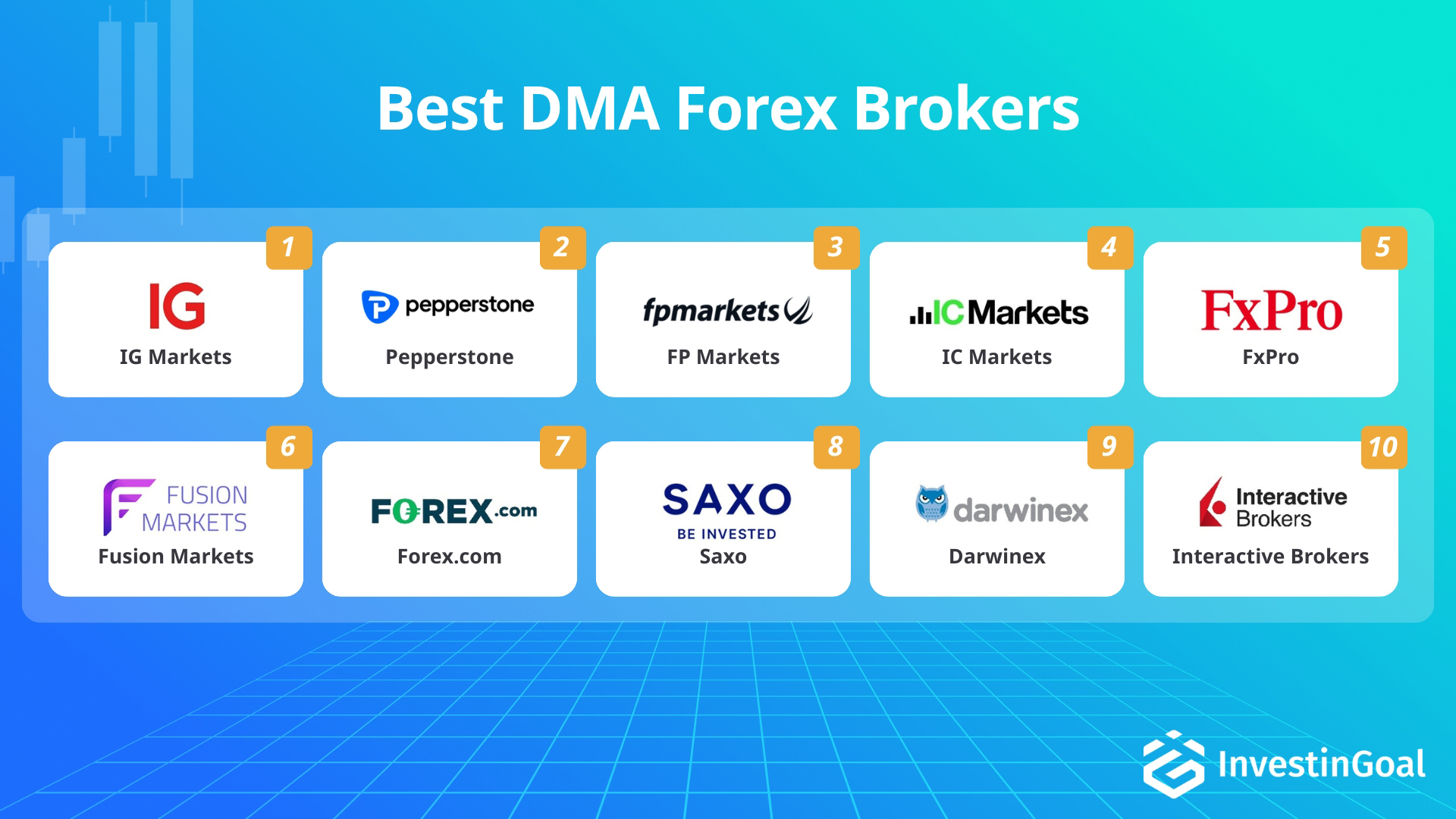
The best Forex brokers for direct market access (DMA) are IG, Pepperstone, FP Markets and IC Markets.
The most important criteria to consider when choosing the best Forex broker for direct market access (DMA) are true DMA/ECN-style execution and depth of liquidity, low all-in trading costs (raw spreads + commission), fast, reliable execution with no dealing-desk intervention/requotes, and strong regulation plus professional platform support (e.g., Level II/DOM, robust charting, MT4/MT5/cTrader options).
IG is the best direct market access (DMA) Forex broker overall, thanks to offering deep-liquidity DMA execution and pricing transparency, competitive raw spreads plus commission, reliable no-dealing-desk-style fills, and top-tier regulation with advanced platform support (including L2 Dealer for DMA).
Pepperstone, FP Markets, and IC Markets rank behind IG as the best direct market access (DMA) Forex brokers for raw pricing, execution quality, and professional trading tools. Some DMA brokers like Pepperstone, FP Markets, and IC Markets are also considered among the best Forex brokers overall thanks to low all-in trading costs, fast execution, and robust platforms and support. Pepperstone showcases DMA-style RAW/ECN routing with ultra-tight spreads and fast execution. FP Markets includes an ECN/DMA setup with raw spreads + commission and Level II/DOM-capable platforms (e.g., cTrader/IRESS). IC Markets facilitates a “true ECN” environment with a deep liquidity pool, consistently tight raw spreads, and very fast execution.

IG Markets
(Best DMA Forex broker overall)
IG is the best DMA Forex broker thanks to its Forex Direct service, Level-2 market depth via the L2 Dealer platform, and raw EUR/USD spreads averaging about 0.17 pips with commissions from $6 per standard lot. IG is an exceptional option for overall DMA trading because Forex Direct routes orders straight to external liquidity with no dealer intervention or requotes, giving high-volume traders transparent fills and predictable transaction costs. IG’s Forex Direct DMA model provides traders with conflict-free execution at bank-derived prices.
-
Regulations:
-
Avg. EUR/USD Spread:
-
Platforms:
IG Markets Features
The features of IG Markets are listed below.
- IG provides direct market access for forex through Forex Direct with orders executed from global banks and liquidity providers without dealer intervention.
- IG Forex Direct shows full market depth and streams raw spreads with EUR/USD averaging about 0.17 pips plus commissions from $6 per standard lot.
- IG supports DMA trading via the L2 Dealer platform and also offers MT4, MT5, ProRealTime, TradingView, and IG web and mobile platforms.
- IG standard CFD accounts stream spreads around 0.6 to 0.8 pips on EUR/USD with no commission.
- IG has no fixed minimum deposit and allows $0 funding via bank transfer with about $250 suggested for margin.
- IG is regulated by major authorities including FCA, ASIC, CFTC and NFA, MAS, FINMA, and DFSA.
IG Markets Pros and Cons
Advantages of IG Markets
The advantages of IG Markets are listed below.
- Low spreads from 0.6 pips on Forex
- Wide range of financial instruments
- 40 years of experience in the Forex industry
Disadvantages of IG Markets
The disadvantages of IG Markets are listed below.
- No copy trading features
- No social trading features
About IG Markets
IG Markets is a global online trading provider founded in 1974, offering access to over 17,000 financial markets including forex, stocks, indices, commodities, and cryptocurrencies. IG Markets provides proprietary trading platforms alongside MetaTrader 4 and ProRealTime. IG Markets is regulated by multiple top-tier authorities worldwide, including the FCA and ASIC. IG Markets is known for competitive spreads, extensive educational resources, and innovative features like weekend trading. The IG Markets’ parent company “IG Group” CEO is Breon Corcoran.

Pepperstone
(Best DMA Forex broker for algorithmic trading)
Pepperstone is the second best DMA Forex broker due to its Razor account’s direct routing to 20+ Tier-1 liquidity providers, Equinix NY4 co-located servers designed for low-latency execution, and raw spreads that can reach 0.0 pips with about $7 per 100k round-turn commission on MT4/MT5 (MetaTrader 4 and MetaTrader 5) (about $6 on cTrader). Pepperstone is an outstanding choice for algorithmic trading since MT4/MT5 Expert Advisors and cTrader automation (like cTrader Automate) can run on a no-requote execution stack, which helps systematic strategies keep slippage and spread costs low when orders fire rapidly. Pepperstone’s liquidity-routing model provides traders with fast, dealer-free fills that suit automated execution.
-
Regulations:
-
Avg. EUR/USD Spread:
-
Platforms:
Pepperstone Features
The features of Pepperstone are listed below.
- Pepperstone routes orders directly to a pool of Tier 1 liquidity providers with no dealing desk intervention for DMA style execution.
- Pepperstone Razor account offers spreads from 0.0 pips with typical EUR/USD around 0.1 to 0.3 pips plus about $7 per 100k round turn on MT4 and MT5 or about $6 on cTrader.
- Pepperstone hosts trading servers in Equinix data centers such as NY4 for low latency execution and minimal slippage.
- Pepperstone allows scalping and algorithmic trading with no requotes and no price manipulation.
- Pepperstone supports MT4, MT5, cTrader with Level II depth of market, TradingView connectivity, and copy trading integrations like Myfxbook AutoTrade and DupliTrade.
- Pepperstone is regulated by FCA, ASIC, CySEC, DFSA, SCB, and CMA.
Pepperstone Pros and Cons
Advantages of Pepperstone
The advantages of Pepperstone are listed below.
- Stable raw spreads (0,10 pips on EUR/USD on average)
- Caters for algorithmic trading
- Has won over 30 Forex industry awards
Disadvantages of Pepperstone
The disadvantages of Pepperstone are listed below.
- The demo account is not unlimited
About Pepperstone
Pepperstone is a global forex and CFD broker founded in 2010 in Melbourne, Australia. Pepperstone offers trading on currencies, commodities, indices, stocks, and cryptocurrencies through MetaTrader and cTrader platforms. Pepperstone is regulated by multiple authorities including ASIC, FCA, and CySEC. Pepperstone is known for competitive spreads, fast execution, and extensive educational resources. Pepperstone serves clients in over 160 countries worldwide. The Pepperstone CEO is Tamas Szabo.

FP Markets
(Best DMA Forex broker for exchange-traded shares)
FP Markets is the third best DMA Forex broker because of its IRESS platform that routes exchange-traded share orders directly to exchange order books, Raw account streaming interbank FX spreads around 0.0–0.2 pips, and roughly $7 per lot round-turn commission on raw pricing. FP Markets is an excellent pick for exchange-traded shares given that IRESS provides real order-book access and exchange-based pricing, so share traders can place limit orders that queue on the exchange rather than trading only against broker quotes. FP Markets’ IRESS DMA routing provides traders with transparent exchange execution and auditable fills.
-
Regulations:
-
Avg. EUR/USD Spread:
-
Platforms:
FP Markets Features
The features of FP Markets are listed below.
- FP Markets runs an ECN and DMA execution model with forex orders matched to liquidity providers with no dealing desk intervention.
- FP Markets Raw account streams interbank spreads with EUR/USD around 0.0 to 0.2 pips at peak liquidity plus about $7 per lot round turn commission.
- FP Markets offers direct market access for share trading through the IRESS platform with orders routed to exchange order books.
- FP Markets uses Equinix NY4 infrastructure for high speed execution and no requotes.
- FP Markets supports MT4, MT5, cTrader with Level 2 pricing, and IRESS for DMA shares.
- FP Markets sets a $100 minimum deposit and offers 10,000 plus instruments including 60 plus forex pairs and 2,000 plus share CFDs.
FP Markets Pros and Cons
Advantages of FP Markets
The advantages of FP Markets are listed below.
- Broad Instrument Offering
- Competitive Spreads
- Multiple Trading Platforms
Disadvantages of FP Markets
The disadvantages of FP Markets are listed below.
- High Fees for International Withdrawals
- Outdated Platform Design
About FP Markets
FP Markets is an Australian-based global forex and CFD broker founded in 2005. FP Markets offers trading on over 10,000 instruments including forex, stocks, indices, commodities, and cryptocurrencies. FP Markets provides MetaTrader 4, MetaTrader 5, and proprietary platforms. FP Markets is regulated by multiple authorities including ASIC, CySEC, and FSA. FP Markets is known for tight spreads, fast execution, and extensive educational resources. The FP Markets CEO is Craig Allison.

IC Markets
(Best DMA Forex broker for scalping)
IC Markets is the fourth best DMA Forex broker thanks to its 25+ liquidity-provider network, raw EUR/USD spreads that often sit at 0.0–0.1 pips with about $7 per lot round-trip commission on MT4/MT5 (about $6 on cTrader), and average execution speeds around 25 milliseconds from its Equinix NY4 infrastructure. The 25+ liquidity-provider network of IC Markets places it among the great options for scalping-focused DMA forex trading because raw 0.0–0.1-pip spreads plus 25 ms execution keep all-in costs low and reduce the chance of missed entries and exits. The deep liquidity pool of IC Markets helps traders with tighter spreads and more consistent fills during fast market conditions.
-
Regulations:
-
Avg. EUR/USD Spread:
-
Platforms:
IC Markets Features
The features of IC Markets are listed below.
- IC Markets sends client orders directly to 25 plus liquidity providers including banks and dark pool venues for DMA style execution.
- IC Markets offers raw interbank spreads with EUR/USD often 0.0 to 0.1 pips plus commissions around $7 per lot round trip on MT4 and MT5 or $6 on cTrader.
- IC Markets reports average execution speeds of about 25 milliseconds with servers co located in the Equinix NY4 data center.
- IC Markets supports scalping, news trading, and algorithmic trading with no restrictions and provides FIX API connectivity.
- IC Markets requires a $200 minimum deposit and offers 180 plus instruments across forex and CFDs.
- IC Markets is regulated by ASIC, CySEC, FSA Seychelles, and SCB Bahamas.
IC Markets Pros and Cons
Advantages of IC Markets
The advantages of IC Markets are listed below.
- Low-latency trading environment
- Institutional level liquidity
- MT4, MT5, cTrader platforms are all available
Disadvantages of IC Markets
The disadvantages of IC Markets are listed below.
- Small amount of educational tools for new traders
- Small range of tradable assets compared to other CFD/Forex brokers
About IC Markets
IC Markets is a global forex and CFD broker founded in 2007 and based in Sydney, Australia. IC Markets offers trading on over 2,250 instruments including currencies, commodities, indices, stocks, and cryptocurrencies. IC Markets provides MetaTrader 4, MetaTrader 5, and cTrader platforms. IC Markets is regulated by multiple authorities including ASIC and CySEC. IC Markets is known for its ECN execution model and low spreads. The IC Markets CEO is Andrew Budzinski.

FxPro
(Best DMA Forex broker for easy web trading)
FxPro is the fifth best DMA Forex broker because of its browser-based FxPro Trading Platform with market execution, cTrader/Raw+ pricing that pairs 0.0–0.3-pip raw spreads with about $7 per lot round-trip commission, and millisecond execution speeds reported at under 12 ms in testing. FxPro is a strong choice for easy web trading since the proprietary web platform keeps the workflow straightforward while still using no-requote market execution, so traders can place and manage orders quickly without relying on a desktop terminal. FxPro’s web trading platform helps traders with fast, no-requote order placement without a desktop install.
-
Regulations:
-
Avg. EUR/USD Spread:
-
Platforms:
FxPro Features
The features of FxPro are listed below.
- FxPro provides no dealing desk market execution with no requotes and liquidity aggregated from multiple providers for DMA like fills.
- FxPro Raw plus and cTrader accounts offer raw spreads with EUR/USD around 0.0 to 0.3 pips plus about $7 per lot round trip commission.
- FxPro cTrader shows depth of market and supports ECN style order placement with no dealer intervention.
- FxPro reports execution times in milliseconds with independent testing under 12 milliseconds on average.
- FxPro supports MT4, MT5, cTrader, and the FxPro Trading Platform.
- FxPro has a $100 minimum deposit and is regulated by FCA, CySEC, FSCA, and SCB.
FxPro Pros and Cons
Advantages of FxPro
The advantages of FxPro are listed below.
- Regulated and Trusted Forex broker
- Diverse Trading Platforms
- Wide Range of Instruments
Disadvantages of FxPro
The disadvantages of FxPro are listed below.
- Inactivity Fee
- Limited Educational Resources
- No Guaranteed Stop-Loss Orders
About FxPro
FxPro is a global online broker founded in 2006, offering trading on forex, CFDs, stocks, indices, commodities, and cryptocurrencies. FxPro provides multiple trading platforms including MetaTrader 4, MetaTrader 5, cTrader, and its proprietary FxPro Platform. FxPro is regulated by multiple authorities including FCA, CySEC, SCB, FSC and KNN. FxPro serves clients in over 170 countries and has won numerous industry awards. The FxPro CEO is Charalambos Psimolophitis.

Fusion Markets
(Best DMA Forex broker for low commissions)
Fusion Markets is the sixth best DMA Forex broker for its Zero Account commission of $4.50 per 100k round-turn, raw interbank spreads that are often 0.0–0.2 pips on EUR/USD, and an agency STP setup that passes orders to liquidity providers with no dealing desk. Fusion Markets is a solid option for low commissions because paying $4.50 round-turn can keep the all-in EUR/USD cost around 0.5–0.6 pips when spreads are 0.0–0.1, which makes frequent trading more viable when targeting smaller per-trade moves. Fusion Markets’ $4.50 round-turn pricing provides traders with lower transaction costs per standard lot.
-
Regulations:
-
Avg. EUR/USD Spread:
-
Platforms:
Fusion Markets Features
The features of Fusion Markets are listed below.
- Fusion Markets operates an agency model that passes all orders to liquidity providers with no dealing desk and no requotes.
- Fusion Markets Zero account provides raw spreads with EUR/USD often 0.0 to 0.2 pips plus $4.50 per 100k round turn commission.
- Fusion Markets Classic account offers spread only pricing with EUR/USD around 0.8 to 1.0 pips and no commission.
- Fusion Markets supports MT4, MT5, and cTrader for ECN style trading.
- Fusion Markets offers leverage up to 500 to 1 through its Vanuatu and Seychelles entities and applies Australian leverage limits under ASIC.
- Fusion Markets has no formal minimum deposit and provides demo accounts that can be made non expiring after funding a live account.
Fusion Markets Pros and Cons
Advantages of Fusion Markets
The advantages of Fusion Markets are listed below.
- Low Trading Costs
- Zero Spread Accounts
- Excellent Customer Support
Disadvantages of Fusion Markets
The disadvantages of Fusion Markets are listed below.
- Limited Product Selection
- Basic Educational Resources
About Fusion Markets
Fusion Markets is an Australian-based forex and CFD broker founded in 2019. Fusion Markets offers trading on over 90 currency pairs, stocks, indices, commodities, and cryptocurrencies. Fusion Markets provides MetaTrader 4, MetaTrader 5, and cTrader platforms. Fusion Markets is regulated by ASIC and VFSC. Fusion Markets is known for low trading costs, no minimum deposit, and copy trading services. The Fusion Markets CEO is Phil Horner.

Forex.com
(Best DMA Forex broker for in-platform research)
FOREX.com is the seventh best DMA Forex broker thanks to its DMA/STP Pro account with raw bank spreads and full market depth, commission tiers starting around $60 per million ($6 per standard lot) and dropping to about $20 per million ($2 per lot) for high volumes, and a proprietary web platform that integrates TradingView charting and research tools. FOREX.com is a very good choice for in-platform research because its web and mobile platforms combine TradingView-powered charts and built-in analysis tools with DMA functionality like depth-of-book pricing and 100,000-unit ticket sizing, so traders can analyze a setup and place a DMA ticket from the same screen. The DMA/STP Pro account of FOREX.com provides traders with transparent order-book visibility and volume-based commission pricing.
-
Regulations:
-
Avg. EUR/USD Spread:
-
Platforms:
Forex.com Features
The features of Forex.com are listed below.
- Forex.com offers a Direct Market Access account that streams raw bank liquidity prices with no spread markup and full market depth.
- Forex.com DMA commissions start at $60 per million traded which equals $6 per standard lot and can drop to about $20 per million for very high volume.
- Forex.com DMA account requires a 100,000 unit minimum trade size and orders in 100,000 increments.
- Forex.com Standard accounts typically average about 0.8 to 1.0 pips on EUR/USD with no commission.
- Forex.com supports its proprietary web and mobile platform with TradingView charting plus TradingView integration and MT4 and MT5.
- Forex.com has a $100 minimum deposit for most accounts and is regulated by CFTC and NFA, FCA, CySEC, IIROC, ASIC, MAS, and CIMA.
Forex.com Pros and Cons
Advantages of Forex.com
The advantages of Forex.com are listed below.
- Regulatory Assurance
- Low Forex Fees
- Comprehensive Educational Resources
Disadvantages of Forex.com
The disadvantages of Forex.com are listed below.
- Limited Product Portfolio
- Higher Spreads on Standard Accounts
- No Guaranteed Stop-Loss Orders for U.S. Clients
About Forex.com
FOREX.com is a global forex and CFD broker founded in 2001, offering trading on currencies, commodities, indices, stocks, and cryptocurrencies. FOREX.com provides proprietary platforms alongside MetaTrader 4 and 5. FOREX.com is regulated by multiple top-tier authorities including FCA, ASIC, and CFTC. FOREX.com is known for competitive spreads, fast execution, and extensive educational resources. FOREX.com serves over 450,000 clients worldwide. The FOREX.com’s parent company “StoneX Group Inc.” CEO is Sean O’Connor.

Saxo
(Best DMA Forex broker for multi-screen trading)
Saxo Bank is the eighth best DMA Forex broker due to its SaxoTraderPRO platform built for multi-monitor layouts, FX pricing aggregated from 25+ banks and ECN venues, and tiered EUR/USD spreads that run around 0.7–0.8 pips on Classic and can reach 0.4 pips on VIP. Saxo Bank is a good option for multi-screen trading because SaxoTraderPRO supports detachable windows across several monitors (charts, order tickets, and Level 2 data side by side) while letting you trade FX alongside stocks, options, and futures (like equities, vanilla options, and index futures) in one interface. Saxo Bank’s SaxoTraderPRO platform provides traders with clearer workflow across multiple screens and quicker navigation between markets and order tickets.
-
Regulations:
-
Avg. EUR/USD Spread:
-
Platforms:
Saxo Features
The features of Saxo are listed below.
- Saxo Bank aggregates quotes from 25 plus major banks and ECN venues and passes best bid and ask to clients with immediate hedging for DMA style pricing.
- Saxo Bank offers tiered forex spreads with EUR/USD around 0.7 to 0.8 pips on Classic, about 0.5 to 0.6 pips on Platinum, and about 0.4 pips on VIP.
- Saxo Bank provides direct market access for exchange traded products like stocks, futures, and options with live order book access on supported markets.
- Saxo Bank runs SaxoTraderGO and SaxoTraderPRO platforms with Level 2 data, advanced order types, and API access.
- Saxo Bank has no mandatory minimum deposit for many Classic accounts, requires $200,000 for Platinum, and about $1,000,000 for VIP.
- Saxo Bank is regulated as a Danish bank and supervised by authorities including the Danish FSA, FCA, ASIC, and MAS.
Saxo Pros and Cons
Advantages of Saxo
The advantages of Saxo are listed below.
- Regulation and Trust
- Extensive Product Range
- Advanced Trading Platform
Disadvantages of Saxo
The disadvantages of Saxo are listed below.
- High Minimum Deposits for Premium Accounts
- Lack of Spread Betting Options
- Custody Fees in Certain Regions
About Saxo
Saxo is a Danish investment bank and online trading platform founded in 1992. Saxo offers trading in forex, stocks, CFDs, futures, options, and other financial instruments across global markets. Saxo provides proprietary trading platforms and white-label solutions for institutional clients. Saxo is regulated by multiple authorities including the Danish FSA and UK FCA. Saxo serves retail and institutional clients in over 170 countries. The Saxo CEO and co-founder is Kim Fournais.

Darwinex
(Best DMA Forex broker for attracting investors)
Darwinex is the ninth best DMA Forex broker because of its DARWIN Exchange that turns strategies into investable assets, 100% DMA/STP execution with EUR/USD spreads averaging about 0.3 pips, and a low $5 per lot round-turn commission on raw pricing. The DARWIN ecosystem of Darwinex offers traders a scalable route to third-party capital without changing their core trading process. The DARWIN Exchange of Darwinex helps traders with a way to package a strategy into a DARWIN that investors can allocate to, while trades are replicated at market prices for transparent tracking.
-
Regulations:
-
Avg. EUR/USD Spread:
-
Platforms:
Darwinex Features
The features of Darwinex are listed below.
- Darwinex routes 100 percent of client trades via DMA and STP with no dealing desk and no spread markup.
- Darwinex charges a $5 per lot round turn commission and averages about 0.3 pips spread on EUR/USD.
- Darwinex hosts trading servers in Equinix LD4 London and passes both positive and negative slippage to clients.
- Darwinex supports MT4 and MT5 and offers API access for automated trading and integration.
- Darwinex requires a 500 initial deposit in USD, EUR, or GBP with subsequent top ups from 100.
- Darwinex is regulated by the FCA and also holds an EU license in Spain under the CNMV.
Darwinex Pros and Cons
Advantages of Darwinex
The advantages of Darwinex are listed below.
- Access to Seed Capital
- Flexible Trading Environment
- Advanced Risk Management Tools
Disadvantages of Darwinex
The disadvantages of Darwinex are listed below.
- Monthly Subscription Fees
- Not user-friendly
- Performance-Based Limitations
About Darwinex
Darwinex is a global broker and asset management company founded in 2012, offering trading on forex, CFDs, stocks, and other financial instruments. Darwinex provides MetaTrader 4, MetaTrader 5, and proprietary platforms. Darwinex is regulated by the FCA in the UK and CNMV in Spain. Darwinex is known for its unique DARWIN assets, which allow investors to copy successful traders’ strategies. Darwinex recently launched Darwinex Zero, a subscription-based trading platform. The Darwinex CEO is Juan Colón.

Interactive Brokers
(Best DMA Forex broker for multi-asset portfolios)
Interactive Brokers is the tenth best DMA Forex broker thanks to direct access to 17+ interbank FX dealers, spreads that can tighten to about 0.1 pips on EUR/USD with no spread markup, and tiered commissions around $40 per million round-turn that can drop to roughly $16 per million at higher volumes. Interactive Brokers is a good option for multi-asset portfolios because one account connects you to 150+ markets across 33+ countries, letting you combine spot FX with stocks, options, futures, and bonds while using Trader Workstation (TWS) for advanced order types and routing. Interactive Brokers’ multi-market DMA infrastructure helps traders with institution-style pricing and the ability to manage FX and other assets under one margin and risk view.
-
Regulations:
-
Avg. EUR/USD Spread:
-
Platforms:
Interactive Brokers Features
The features of Interactive Brokers are listed below.
- Interactive Brokers provides direct market access to spot FX by connecting clients to 17 plus interbank dealers with no spread markup.
- Interactive Brokers offers EUR/USD spreads as low as about 0.1 pips with tiered commissions around $40 per million round turn for typical volumes and as low as $16 per million for high volumes.
- Interactive Brokers provides Level II forex market data by subscription and SmartRouting for competitive fills and price improvement.
- Interactive Brokers supports Trader Workstation, Client Portal, mobile apps, and IBKR APIs for advanced order types and automation.
- Interactive Brokers has no minimum deposit and charges no inactivity fees on individual accounts.
- Interactive Brokers is regulated globally including SEC and CFTC and NFA in the US plus FCA, ASIC, MAS, IIROC, and SFC.
Interactive Brokers Pros and Cons
Advantages of Interactive Brokers
The advantages of Interactive Brokers are listed below.
- Low Trading Fees
- Advanced Trading Tools
- Wide Market Access
Disadvantages of Interactive Brokers
The disadvantages of Interactive Brokers are listed below.
- Not user-friendly
- No MetaTrader Support
- Additional Fees
About Interactive Brokers
Interactive Brokers is a global electronic broker founded in 1978, offering trading in stocks, options, futures, forex, bonds, ETFs, and cryptocurrencies across 150 markets in 33 countries. Interactive Brokers provides advanced trading platforms, low commissions, and access to a wide range of financial instruments. Interactive Brokers is known for its sophisticated technology and serves both retail and institutional clients. Interactive Brokers is regulated by multiple top-tier authorities worldwide. The CEO of the Interactive Brokers Group is Milan Galik.
Comparison of the best best DMA forex brokers
The table that compares the best best DMA forex brokers is shown below.
| Broker | Execution model (DMA/ECN/STP) | EUR/USD average raw spread (pips) | Round-turn commission (USD) | Market depth visibility (Level II/DOM) | Tier-1 regulation (primary regulators) |
|---|---|---|---|---|---|
| IG Markets | DMA (Forex Direct) via L2 Dealer, agency/NDD | 0.17 pips | $6 per 100k (as low as) | Yes (L2 Dealer full market depth) | FCA, ASIC, CFTC/NFA, MAS, FINMA |
| Pepperstone | RAW ECN, no-dealing-desk/agency (LP-routed) | 0.1–0.3 pips | $7 per 100k (MT4/MT5); $6 per 100k (cTrader) | Yes (cTrader Level II/DOM) | FCA, ASIC |
| FP Markets | ECN/DMA-style, no dealing desk | 0.1–0.2 pips | $7 per 100k (round-turn) | Yes (cTrader Level II/DOM) | ASIC |
| IC Markets | True ECN, agency/NDD (LP aggregation) | 0.0–0.1 pips | $7 per 100k (MT4/MT5); $6 per 100k (cTrader) | Yes (cTrader DOM) | ASIC |
| FxPro | NDD (ECN/STP-style) on cTrader/Raw+ | 0.0–0.3 pips | $7 per 100k (round-turn) | Yes (cTrader depth of market) | FCA, ASIC |
| Fusion Markets | Agency STP (no dealing desk, no requotes) | 0.0–0.2 pips | $4.50 per 100k (round-turn) | N/A | ASIC |
| FOREX.com | DMA (STP Pro) to bank LPs, agency-style | 0.0–0.1 pips | $60 per $1m (=$6 per 100k), tiered to $20 per $1m (=$2 per 100k) | Yes (DMA market depth) | CFTC/NFA, FCA, ASIC, MAS, IIROC |
| Saxo | DMA-style liquidity aggregation (bank/agency; spread-inclusive) | 0.7–0.8 pips | $0 (spread-only for FX) | Yes (SaxoTraderPRO Level 2 market data) | Danish FSA, FCA, ASIC, MAS, SFC |
| Darwinex | 100% DMA/STP, no dealing desk | 0.3 pips | $5 per 100k (round-turn) | Yes (MT5 DOM / API) | FCA |
| Interactive Brokers | Agency model (interbank dealers), no spread markup | 0.1–0.3 pips | $40 per $1m (=$4 per 100k), tiered to $16 per $1m (=$1.60 per 100k) | Yes (TWS Depth window; FX Level II subscription) | SEC, CFTC/NFA, FCA, IIROC, ASIC, MAS |
Warning
CFDs are complex instruments and come with a high risk of losing money rapidly due to leverage. Between 74-89% of retail investor accounts lose money when trading CFDs. You should consider whether you can afford to take the high risk of losing your money.
The best DMA Forex broker for algo trading is IC Markets. IC Markets stands out for FIX API connectivity, 25ms average execution from NY4 Equinix, and full support for EAs/algos with no strategy restrictions. The FIX access and low-latency setup at IC Markets help automated systems route orders efficiently, while the lack of trading limitations lets strategies run continuously without interruptions.
Low-latency infrastructure, automation-friendly platforms/APIs, and deep execution tools are often featured in algo trading brokers and frequently highlighted in rankings of the best automated trading brokers for systematic traders. A similar alternative to IC Markets is Pepperstone for MT4/MT5 EA support, cTrader with Level II depth of market, and Equinix co-location for fast execution. Interactive Brokers offers multi-language IBKR APIs for automation, institutional-style FX pricing with no spread markup, and advanced order types plus market-depth features in TWS that make it an alternative to IC Markets.
The best DMA Forex broker with low spread is Fusion Markets. Fusion Markets is known for raw spreads often around 0.0–0.2 pips on EUR/USD (Zero account), a very low $4.50 per 100k round-turn commission, and pure agency STP execution with no dealing desk or requotes. Those tight raw spreads and low commissions at Fusion Markets reduce all-in trading costs, while the STP model helps keep pricing clean for frequent entries and exits.
Low-spread traders look for raw pricing, sharp commissions, and conflict-free execution in the best low-spread Forex brokers. IC Markets offers similar features to Fusion Markets like raw spreads often 0.0–0.1 pips on EUR/USD, low commissions ($6–$7/lot round-turn depending on platform), and 25+ liquidity providers to keep spreads tight. A similar alternative to Fusion Markets is Pepperstone for Razor spreads from 0.0 pips (often 0.1–0.3), low commissions ($6–$7/lot round-turn depending on platform), and a deep liquidity pool (20+ providers) aimed at competitive pricing, making it a strong candidate for a broker with lowest spread.
The best DMA Forex broker with fast execution speed is IC Markets. IC Markets delivers 25ms average execution, runs on NY4 Equinix co-located infrastructure, and connects to deep liquidity (25+ providers) for efficient fills. The co-location and multi-provider liquidity at IC Markets can lower delay and improve fill quality, which matters most when trading volatile moves or time-sensitive setups.
Co-located servers, true market execution, and enough liquidity to reduce slippage are often featured in fast-execution brokers and frequently highlighted in rankings of the best fast execution FX brokers for latency-sensitive traders. Pepperstone offers Equinix data-center co-location, rapid execution with no dealer intervention, and a deep liquidity pool designed to minimize delays and slippage that make it an alternative to IC Markets. FxPro offers similar features to IC Markets like very fast execution reported in milliseconds (including sub-12ms testing), market execution with no requotes, and a cTrader/Raw+ configuration that supports DMA-like routing.
The best DMA Forex broker for CFD trading is IG. IG shines for its 17,000+ markets, strong execution transparency (including DMA via Forex Direct and NDD CFD accounts), and broad platform access such as MT4/MT5, L2 Dealer, TradingView, and ProRealTime. The large instrument range and platform flexibility at IG make it easier to diversify CFD strategies, while transparent execution options help traders understand how orders are handled.
A huge product list, robust platforms, and reliable execution models across asset classes are often featured in CFD brokers. Saxo Bank offers similar features to IG like a massive multi-asset lineup (40,000+ instruments), direct market access across many exchange-traded products, and professional platforms like SaxoTraderGO/PRO. FOREX.com offers a broad CFD catalogue (including thousands of share CFDs), multiple pricing/execution models (DMA/STP Pro plus other account types), and a strong global regulation footprint that make it an alternative to IG and a frequent pick among the best brokers for CFD trading.
The best DMA Forex broker for scalping is Pepperstone. Pepperstone is favored for explicitly allowing scalping, Razor low spreads (often 0.1–0.3) with no dealing desk, and fast execution supported by Equinix co-location plus deep liquidity. Tight spreads and rapid execution at Pepperstone can improve all-in cost and reduce missed fills, which are critical when trades last seconds to minutes.
Low spreads, fast market execution, and minimal restrictions on high-frequency styles are often featured in scalping brokers. IC Markets offers similar features to Pepperstone like no restrictions on scalping/news trading, raw spreads often 0.0–0.1, and fast execution (25ms) via NY4 co-location, which is why it’s often cited as the best Forex broker for scalping by active traders. A similar alternative to Pepperstone is Fusion Markets for ultra-low all-in costs (raw spreads 0.0–0.2 plus $4.50/100k round-turn), pure agency STP with no requotes, and consistently tight pricing that suits high-turnover trading.
The criteria for choosing the best DMA Forex brokers are listed below.
- Agency execution model: Verify a verifiable DMA/ECN/STP workflow with no dealing-desk intervention and market execution (no requotes). For example, IG Forex Direct provides DMA-style routing with 17 pips average EUR/USD plus commission (as low as $6 per lot), while Darwinex emphasizes routed STP execution with a $5/lot round-turn commission.
- All-in trading cost: Compare brokers using average raw spread + round-turn commission on EUR/USD. For instance, Fusion Markets Zero charges about $4.50 per 100k round-turn, Pepperstone Razor commonly pairs 1–0.3 pip raw spreads with $6–$7 per 100k, and FOREX.com DMA/STP Pro uses tiered commissions of $60 per million down to $20 per million.
- Liquidity & market depth: Prefer brokers aggregating Tier-1 liquidity providers and offering Level II / depth-of-market. Examples include IC Markets (25+ liquidity providers), Pepperstone with cTrader Level II DOM, Saxo Bank (25+ banks/venues), Interactive Brokers, and IG via L2 Dealer.
- Execution speed & slippage: Demand co-location in Equinix hubs (e.g., NY4/LD4) and ensure slippage is transparently passed through. For example, IC Markets cites execution speeds around 25 ms, while Pepperstone and FP Markets emphasize NY4
- Regulation & client protection: Prioritize segregated funds under top-tier regulators such as FCA (e.g., IG, Darwinex) and ASIC (e.g., Pepperstone, IC Markets), plus multi-regulator groups like com (StoneX) and Interactive Brokers.
- Institutional trading tooling: Select platforms with depth-of-market and FIX/API Examples include IG L2 Dealer, cTrader at Pepperstone/FP Markets/FxPro, SaxoTraderPRO, and Interactive Brokers TWS + IBKR API.
- Account constraints: Check minimum trade increments, minimum deposits, and pricing tier thresholds. For example, com DMA often requires 100,000-unit trade sizes, Saxo Bank tiers include Platinum $200k and VIP $1m, and minimum deposits may range from $100 (FP Markets) to $200 (IC Markets) or 500 (Darwinex).
When choosing DMA Forex brokers, you compare DMA vs ECN vs STP execution by separating the access you receive (DMA), the matching venue (ECN), and the routing workflow (STP).
DMA (Direct Market Access) is access-oriented: you should receive market-derived pricing with market execution (no requotes) and, when supported, Depth of Market/Level II liquidity so your limit orders can interact with visible bids and offers. ECN (Electronic Communication Network) is venue-oriented: orders are matched within an electronic network of market participants, typically with variable spreads, explicit commissions, and possible price improvement. STP (Straight-Through Processing) is workflow-oriented: your broker automatically routes your order to one or more liquidity providers and may hedge it back-to-back; the STP label alone does not guarantee ECN-like transparency or the absence of internalization.
To compare them, read the broker’s Order Execution/Best Execution policy and verify: (1) agency/no-dealing-desk language versus a dealing desk, (2) disclosed liquidity venues/providers and any last-look or rejection rules, (3) pricing as raw spread + commission (not just “from 0.0”), and (4) slippage symmetry (both positive and negative slippage can occur) when assessing ECN vs STP.
You should verify five non-negotiables: (1) regulation and legal entity, (2) agency/NDD execution disclosures, (3) total all-in cost, (4) execution-quality and risk controls, and (5) operational frictions.
(1) Regulation: confirm the exact entity you contract with and its supervisor (e.g., FCA/ASIC/CySEC), plus client-money segregation and (where offered) negative-balance protection. (2) Execution: read the Order Execution/Best Execution policy for market execution (no requotes), no dealing desk, disclosed liquidity venues/providers, and any last-look or rejection rules. (3) Cost: compute “average spread + round-turn commission” for your pair and ticket size; as a reality check, liquid-pair DMA/ECN pricing often combines 0.0–0.3 pip raw spreads with roughly $4.50–$7 per 100k round-turn commission; also verify minimum trade size/increments, overnight swaps/financing, and non-trading fees (withdrawals, inactivity).
(4) Execution quality: confirm that both positive and negative slippage can occur, and that the broker benchmarks price, costs, speed, and likelihood of execution. (5) Operations: ensure the platform supports Depth of Market (e.g., cTrader/MT5), your strategy (EAs, scalping, API/FIX), and that leverage, margin call/stop-out, and funding/withdrawal times match your risk plan.
You evaluate slippage by measuring the pip difference between the price you intended to trade and the price actually filled, then comparing the distribution and symmetry (positive vs negative) across a standardized sample.
Operationally: (1) run the same test on each broker—same instrument (e.g., EUR/USD), same order type (market), same size, and the same time windows (liquid sessions and a volatile window). (2) For every trade, record the quote at click time (bid/ask), the executed price, and the execution timestamp; compute slippage in pips (buy: fill − ask, sell: bid − fill). (3) Report median slippage, 95th-percentile worst slippage, rejection rate, and the share of price improvement versus negative slippage.
A healthy DMA/agency setup tends to show two-sided slippage (some better, some worse), while persistent one-sided negative slippage or frequent rejections is a red flag—details that clarify slippage meaning in real trading conditions. Finally, cross-check your results against any broker-published execution/slippage statistics or best-execution reporting, because best execution is evaluated on factors like price, costs, speed, and likelihood of execution.
You confirm it by proving there is no dealing desk and that orders are routed/hedged to external liquidity (agency or “riskless principal”), with revenue primarily from commissions rather than client losses.
Check the broker’s Order Execution policy and legal disclosures for: (1) explicit “no dealing desk” or “agency/matched principal” language and an explanation of back-to-back hedging to liquidity providers; (2) market execution (no requotes) instead of “instant execution”/requote mechanics; (3) transparent raw pricing plus a stated commission, and (if offered) Level II/Depth of Market; (4) a statement that both positive and negative slippage can occur (symmetric slippage), rather than slippage that is systematically worse for you; and (5) conflict-of-interest disclosures that show the firm is not incentivized to profit from your losses.
Important nuance: in OTC spot FX/CFDs the broker may still be the legal counterparty, even in DMA mode, but a genuine DMA/agency model will hedge your trades externally and disclose how execution venues and best-execution factors are selected, rather than operating as a Market Maker broker.