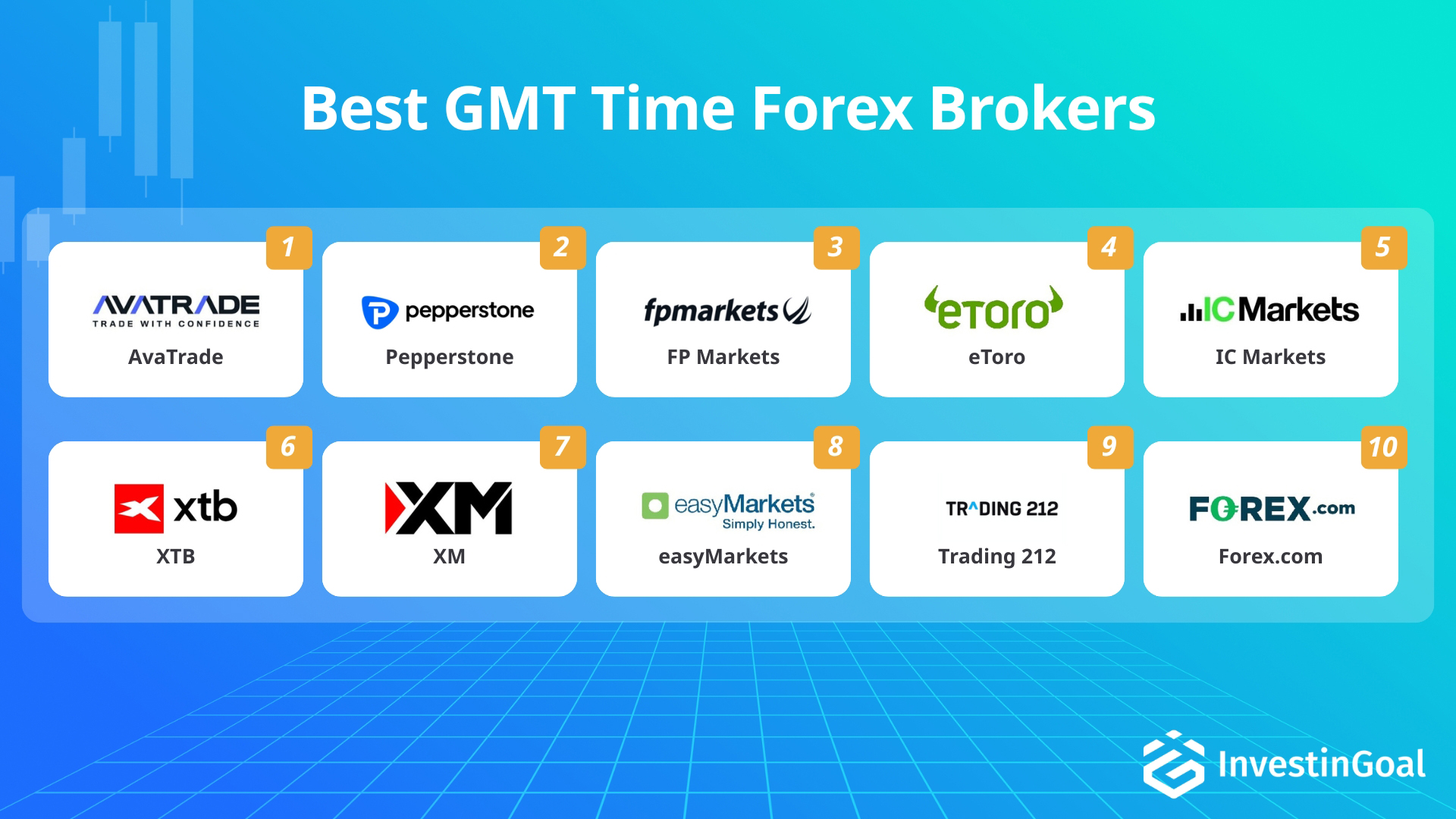
The best Forex brokers for GMT time (GMT+0, GMT+1 and GMT+2) are AvaTrade, Pepperstone, FP Markets and eToro.
The most important criteria to consider when choosing the best Forex broker for GMT time (GMT+0, GMT+1 and GMT+2) are server-time setup (fixed GMT vs. DST-adjusted “New York close”), platform/charting support (MT4/MT5/cTrader/TradingView and time-display options), total trading costs (spreads/commissions and rollover clarity), and trust & accessibility (regulation, minimum deposit, and demo availability).
AvaTrade is the best GMT time (GMT+0, GMT+1 and GMT+2) Forex broker overall, thanks to offering fixed GMT+0 server time (no DST shifts), strong platform coverage, straightforward and competitive pricing, and solid multi-jurisdiction regulation with a relatively accessible entry point.
Ranked just behind AvaTrade, the best GMT time (GMT+0, GMT+1 and GMT+2) Forex brokers for server-time alignment, platform flexibility, low trading costs, and strong regulation/accessibility include Pepperstone, FP Markets, and eToro.
Pepperstone showcases DST-adjusted GMT+2/GMT+3 (“New York close”) timing across major platforms and is known for very tight spreads on its low-cost accounts.
FP Markets features GMT+2/GMT+3 New York-close timing with a wide platform lineup (including TradingView) and highly competitive “raw” pricing for cost-focused traders.
eToro includes a GMT+2 base server time with user-adjustable time display and stands out for social/copy trading on a widely regulated, beginner-friendly platform. Some of these brokers—AvaTrade, Pepperstone, and eToro—are also regarded among the best forex brokers overall due to low trading costs, robust platforms and tools, fast execution, and responsive customer support.

Pepperstone
(Best GMT server Forex broker overall)
Pepperstone is the best GMT Time Forex broker thanks to its DST‑adjusted GMT+2/GMT+3 server time, New York‑close daily candles that end at 00:00 server time, and Razor pricing with EUR/USD averaging about 0.1 pips plus commission. Pepperstone is an excellent choice for a best‑overall GMT server setup because the platform shifts from GMT+2 in winter to GMT+3 in summer, keeping the daily close and swap cut‑off aligned to the 5 pm New York market close many FX traders reference. Pepperstone’s DST‑adjusted GMT+2/GMT+3 server time helps traders with consistent 5‑day chart structure and reliable end‑of‑day timing for technical analysis.
-
Regulations:
-
Avg. EUR/USD Spread:
-
Platforms:
Pepperstone Features
The features of Pepperstone are listed below.
- Pepperstone uses GMT+2 server time and switches to GMT+3 during US daylight savings to keep New York close timing.
- Pepperstone closes the daily candle at 00:00 server time to match the 5 pm New York market close.
- Pepperstone applies daily rollover at the New York close aligned 00:00 server time.
- Pepperstone supports MT4, MT5, cTrader, and TradingView with the same server clock.
- Pepperstone is regulated by the FCA, ASIC, CySEC, DFSA, and SCB among others.
- Pepperstone Razor account averages about 0.1 pips on EUR/USD with a low per lot round turn commission.
Pepperstone Pros and Cons
Advantages of Pepperstone
The advantages of Pepperstone are listed below.
- Stable raw spreads (0,10 pips on EUR/USD on average)
- Caters for algorithmic trading
- Has won over 30 Forex industry awards
Disadvantages of Pepperstone
The disadvantages of Pepperstone are listed below.
- The demo account is not unlimited
About Pepperstone
Pepperstone is a global forex and CFD broker founded in 2010 in Melbourne, Australia. Pepperstone offers trading on currencies, commodities, indices, stocks, and cryptocurrencies through MetaTrader and cTrader platforms. Pepperstone is regulated by multiple authorities including ASIC, FCA, and CySEC. Pepperstone is known for competitive spreads, fast execution, and extensive educational resources. Pepperstone serves clients in over 160 countries worldwide. The Pepperstone CEO is Tamas Szabo.

IC Markets
(Best GMT server Forex broker for unlimited demo)
IC Markets is the second best GMT Time Forex broker due to its GMT+2 server clock that switches to GMT+3 during daylight saving, unlimited demo accounts that do not expire, and rollover swaps applied at 00:00 server time to match the New York close cycle. IC Markets is a top choice for unlimited demo use since the same GMT+2/GMT+3 New York‑close structure on MT4, MT5, and cTrader lets you forward‑test strategies on time‑consistent candles without a demo time limit. IC Markets’ GMT+2/GMT+3 server clock provides traders with predictable rollover timing, so overnight swap charges hit at the same timestamp each trading day.
-
Regulations:
-
Avg. EUR/USD Spread:
-
Platforms:
IC Markets Features
The features of IC Markets are listed below.
- IC Markets uses GMT+2 server time and shifts to GMT+3 during US daylight savings for New York close alignment.
- IC Markets applies rollover swaps at 00:00 server time to match the end of the forex trading day.
- IC Markets supports MT4, MT5, and cTrader across desktop, web, and mobile.
- IC Markets is regulated by ASIC and CySEC and also operates additional global entities in other jurisdictions.
- IC Markets minimum deposit is $200 across account types.
- IC Markets Raw Spread pricing averages about 0.1 pips on EUR/USD with a per lot round turn commission that varies by platform.
IC Markets Pros and Cons
Advantages of IC Markets
The advantages of IC Markets are listed below.
- Low-latency trading environment
- Institutional level liquidity
- MT4, MT5, cTrader platforms are all available
Disadvantages of IC Markets
The disadvantages of IC Markets are listed below.
- Small amount of educational tools for new traders
- Small range of tradable assets compared to other CFD/Forex brokers
About IC Markets
IC Markets is a global forex and CFD broker founded in 2007 and based in Sydney, Australia. IC Markets offers trading on over 2,250 instruments including currencies, commodities, indices, stocks, and cryptocurrencies. IC Markets provides MetaTrader 4, MetaTrader 5, and cTrader platforms. IC Markets is regulated by multiple authorities including ASIC and CySEC. IC Markets is known for its ECN execution model and low spreads. The IC Markets CEO is Andrew Budzinski.

FP Markets
(Best GMT server Forex broker for IRESS)
FP Markets is the third best GMT Time Forex broker for its New York‑close GMT+2/GMT+3 server time, trading hours published in GMT+2 (and GMT+3 in summer) for straightforward session planning, and rollover swaps charged at 00:00 server time. FP Markets is an ideal pick for IRESS‑focused traders because the GMT+2/GMT+3 server setting produces five full daily candles per week (no extra weekend candle), which helps keep end‑of‑day analysis and rollover rules standardized. FP Markets’ New York‑close GMT+2/GMT+3 server time offers traders clean daily candle formation with the day ending at midnight server time.
-
Regulations:
-
Avg. EUR/USD Spread:
-
Platforms:
FP Markets Features
The features of FP Markets are listed below.
- FP Markets uses GMT+2 server time and shifts to GMT+3 during daylight saving months for New York close charts.
- FP Markets ends the trading day at 00:00 server time to align with the 5 pm New York close.
- FP Markets supports MT4, MT5, cTrader, and TradingView integration.
- FP Markets is regulated by ASIC and CySEC.
- FP Markets minimum deposit is $100 for Standard and Raw accounts.
- FP Markets Raw account averages about 0.1 pips on EUR/USD with roughly a $6 to $7 per lot round turn commission.
FP Markets Pros and Cons
Advantages of FP Markets
The advantages of FP Markets are listed below.
- Broad Instrument Offering
- Competitive Spreads
- Multiple Trading Platforms
Disadvantages of FP Markets
The disadvantages of FP Markets are listed below.
- High Fees for International Withdrawals
- Outdated Platform Design
About FP Markets
FP Markets is an Australian-based global forex and CFD broker founded in 2005. FP Markets offers trading on over 10,000 instruments including forex, stocks, indices, commodities, and cryptocurrencies. FP Markets provides MetaTrader 4, MetaTrader 5, and proprietary platforms. FP Markets is regulated by multiple authorities including ASIC, CySEC, and FSA. FP Markets is known for tight spreads, fast execution, and extensive educational resources. The FP Markets CEO is Craig Allison.

eToro
(Best GMT Forex broker for copy trading)
eToro is the fourth best GMT Time Forex broker because of its GMT+2 base server time, a time‑display setting adjustable from GMT‑11 to GMT+13 for global monitoring, and a built‑in copy trading network that runs on that fixed execution clock. eToro is an excellent choice for copy trading since executions and rollovers stay anchored to the GMT+2 server while you can display timestamps in your local timezone, making it easier to follow copied traders without manual time conversions. eToro’s GMT+2 base server time helps traders with consistent session cut‑offs and swap calculations even when the on‑screen timezone is customized.
-
Regulations:
-
Avg. EUR/USD Spread:
-
Platforms:
eToro Features
The features of eToro are listed below.
- eToro uses a GMT+2 server time as its default platform baseline.
- eToro lets users change the displayed time zone from GMT minus 11 to GMT plus 13 while eToro keeps execution timing on GMT+2.
- eToro applies daily swaps based on its GMT+2 schedule with swaps appearing around 23:00 GMT.
- eToro is regulated by the FCA, CySEC, ASIC, and additional regulators depending on region.
- eToro minimum deposit is typically $50 for most regions.
- eToro typically prices EUR/USD around 1.0 pip with no added trading commission on forex.
eToro Pros and Cons
Advantages of eToro
The advantages of eToro are listed below.
- Great copy trading and social trading features
- Wide range of asset classes
- It allows to buy fractional stocks from $10
Disadvantages of eToro
The disadvantages of eToro are listed below.
- The eToro spreads can be high
- Offers only USD accounts
- Transferring cryptocurrencies to other platforms can be hard
About eToro
eToro is a global multi-asset investment platform founded in 2007, offering trading on stocks, ETFs, Crypto CFDs, commodities, and forex. eToro provides a proprietary web and mobile platform with social trading features. eToro is regulated by multiple authorities including FCA, ASIC, and CySEC. eToro is known for its user-friendly interface, copy trading functionality, and commission-free stock trading. eToro serves over 30 million users worldwide. The eToro CEO and co-founder is Yoni Assia.

XTB
(Best GMT Forex broker for xStation)
XTB is the fifth best GMT Time Forex broker through its GMT+1 (CET) server time that moves to GMT+2 in summer, xStation 5 charting that follows the broker’s server clock, and swaps charged around midnight CET on that schedule. XTB is a strong option for xStation trading because the CET‑based server time tracks European daylight saving, so daily candle closes and rollover timing stay consistent for traders who plan around Central European market hours. XTB’s GMT+1/GMT+2 (DST) server time improves traders’ ability to time entries and holds around the daily close without constant timezone recalculations.
-
Regulations:
-
Avg. EUR/USD Spread:
-
Platforms:
XTB Features
The features of XTB are listed below.
- XTB uses a GMT+1 server time on xStation as its default setting.
- XTB shifts its clock with European daylight savings so XTB runs at GMT+2 in summer.
- XTB runs trading on its proprietary xStation 5 platform on web, desktop, and mobile.
- XTB has no minimum deposit requirement for starting an account.
- XTB is regulated by the FCA and CySEC and also by other authorities such as the KNF and FSCA depending on entity.
- XTB typically averages about 0.5 to 0.6 pips on EUR/USD with no standard forex commission.
XTB Pros and Cons
Advantages of XTB
The advantages of XTB are listed below.
- No minimum deposit
- Wide selection of assets
- Competitive trading costs
Disadvantages of XTB
The disadvantages of XTB are listed below.
- Small withdrawal fee
- No social or copy trading
- XTB demo account is limited to 30 days
About XTB
XTB is a global forex and CFD broker founded in 2002 and headquartered in Poland. XTB offers trading on over 2,000 instruments including currencies, stocks, indices, commodities, and cryptocurrencies. XTB provides the proprietary xStation platform and is regulated by multiple authorities including FCA, CySEC, and KNF. XTB is listed on the Warsaw Stock Exchange and serves over 897,500 clients worldwide. The XTB CEO is Omar Arnaout since March 2017.

XM
(Best GMT server Forex broker for micro-lot trading)
XM is the sixth best GMT Time Forex broker thanks to its GMT+2 server time that shifts to GMT+3 during summer, micro‑lot trading access from a $5 minimum deposit, and New York‑close daily candles that end at 00:00 server time. XM is an excellent choice for micro‑lot trading because the GMT+2/GMT+3 DST adjustment keeps the trading day aligned to the 5 pm New York rollover while you size positions in micro lots to fine‑tune risk per trade. XM’s GMT+2/GMT+3 server time helps traders track swaps at 00:00 platform time, which matters when holding small positions overnight.
-
Regulations:
-
Avg. EUR/USD Spread:
-
Platforms:
XM Features
The features of XM are listed below.
- XM uses GMT+2 server time in winter and shifts to GMT+3 in summer for New York close daily candles.
- XM applies rollover swaps at 00:00 server time aligned to the market day end.
- XM supports MT4 and MT5 on desktop, web, and mobile.
- XM minimum deposit starts from $5 on Micro and Standard accounts.
- XM offers an unlimited demo account with no expiration.
- XM typically offers about 0.8 pips on EUR/USD on standard pricing and near zero spreads on commission accounts.
XM Pros and Cons
Advantages of XM
The advantages of XM are listed below.
- There’s a wide range of account types
- The demo account at XM is unlimited
- Wide range of educational resources
Disadvantages of XM
The disadvantages of XM are listed below.
- No social trading features available
- The account availability changes depending on the location of the trader
- High minimum deposit to invest in securities ($10000 for the XM Shares account)
About XM
XM is a global forex and CFD broker founded in 2009, offering trading on currencies, commodities, indices, stocks, and cryptocurrencies. XM provides MetaTrader 4, MetaTrader 5, and proprietary platforms. XM is regulated by multiple authorities including CySEC, ASIC, and IFSC. XM is known for competitive spreads, extensive educational resources, and multilingual customer support. XM serves over 5 million clients from 196 countries. XM offers various account types and a no-requote policy.

EasyMarkets
(Best GMT Forex broker for dealCancellation)
easyMarkets is the seventh best GMT Time Forex broker due to its fixed GMT+0 server time with no daylight‑saving shifts, the dealCancellation feature for reversing a trade within a defined window, and forex rollover tracked on a pure GMT clock (with rollover occurring at 22:00 GMT). easyMarkets is an ideal pick for dealCancellation since a constant GMT+0 platform clock makes it straightforward to track both the cancellation window and the overnight rollover without seasonal time changes. easyMarkets’ fixed GMT+0 server time protects traders from DST‑related drift in candle timestamps and rollover planning.
-
Regulations:
-
Avg. EUR/USD Spread:
-
Platforms:
EasyMarkets Features
The features of EasyMarkets are listed below.
- easyMarkets uses a GMT+0 server time across its proprietary platform and MT4 and MT5 with no daylight savings shifts.
- easyMarkets closes daily candles at 00:00 GMT which can create a small Sunday candle on GMT based charts.
- easyMarkets applies rollover around 22:00 GMT which matches the 5 pm New York close.
- easyMarkets offers its proprietary Web Trader and mobile app plus MT4 and MT5 access.
- easyMarkets minimum deposit is $25 for a standard account.
- easyMarkets typically keeps EUR/USD fixed near 0.8 to 1.0 pips on standard platforms while easyMarkets MT5 can offer variable spreads from about 0.3 pips.
EasyMarkets Pros and Cons
Advantages of EasyMarkets
The advantages of EasyMarkets are listed below.
- Innovative Risk Management Tools
- User-Friendly Platform
- Regulatory Trust
Disadvantages of EasyMarkets
The disadvantages of EasyMarkets are listed below.
- Limited Tradeable Symbols
- Higher Spreads on Some Accounts
- Outdated User Experience
About EasyMarkets
EasyMarkets is a global forex and CFD broker founded in 2001, offering trading on currencies, commodities, indices, cryptocurrencies, and stocks. EasyMarkets provides proprietary web and mobile platforms alongside MetaTrader 4 and 5. EasyMarkets is regulated by multiple authorities including CySEC and ASIC. EasyMarkets is known for innovative features like dealCancellation and fixed spreads. EasyMarkets serves clients worldwide and has received numerous industry awards. The EasyMarkets CEO is Nikos Antoniades.

AvaTrade
(Best GMT Forex broker for fixed spreads)
AvaTrade is the eighth best GMT Time Forex broker for its GMT+0 server time that stays constant year‑round, fixed spreads on major pairs like EUR/USD around 0.9 pips with no commission, and swap calculations performed at 00:00 GMT on the broker’s servers. AvaTrade is an excellent choice for fixed‑spread trading because its GMT+0 clock does not change for daylight saving, so chart time and rollover calculations remain consistent week to week. AvaTrade’s GMT+0 server time provides traders with a stable timezone reference on MT4/MT5 charts, reducing confusion when comparing GMT‑based setups across brokers.
-
Regulations:
-
Avg. EUR/USD Spread:
-
Platforms:
AvaTrade Features
The features of AvaTrade are listed below.
- AvaTrade uses a GMT+0 server time year round with no daylight savings shifts.
- AvaTrade applies rollover swaps at 00:00 GMT on its servers.
- AvaTrade runs MT4 and MT5 plus AvaTrade WebTrader and the AvaTradeGO app.
- AvaTrade is regulated by the Central Bank of Ireland, ASIC, FSCA, BVI authorities, Japan FSA, and other regulators.
- AvaTrade minimum deposit is about $100 for a live account.
- AvaTrade typically offers fixed spreads around 0.9 pips on EUR/USD with no commission.
AvaTrade Pros and Cons
Advantages of AvaTrade
The advantages of AvaTrade are listed below.
- Tight fixed spreads from 0.6 pips (0.9 pips for retail traders)
- The mobile apps are well designed
- Can be connected to ZuluTrade and Duplitrade
Disadvantages of AvaTrade
The disadvantages of AvaTrade are listed below.
- High inactivity fees
- The demo account is limited to 30 days
About AvaTrade
AvaTrade is a global forex and CFD broker founded in 2006 and headquartered in Dublin, Ireland. AvaTrade offers trading on currencies, commodities, indices, stocks, bonds, ETFs, and cryptocurrencies. AvaTrade provides proprietary platforms alongside MetaTrader 4 and 5. AvaTrade is regulated by multiple authorities including CySEC, ASIC, and FSA. AvaTrade serves over 300,000 clients worldwide. AvaTrade is known for competitive spreads and extensive educational resources. The AvaTrade CEO is David Dryzin since 2016.

Trading 212
(Best GMT Forex broker for $1 deposit)
Trading 212 is the ninth best GMT Time Forex broker because of its GMT+2 base server time, an interface setting that lets you view times from GMT‑11 to GMT+13 without changing trading hours, and an ultra‑low $1 minimum deposit. Trading 212 is a strong option for a $1 deposit account since the platform keeps the underlying clock on GMT+2 for session rules and swaps while letting new traders display timestamps in their local timezone for simpler monitoring. Trading 212’s GMT+2 base server time helps traders with consistent open/close cut‑offs used for daily resets and swap calculations.
-
Regulations:
-
Avg. EUR/USD Spread:
-
Platforms:
Trading 212 Features
The features of Trading 212 are listed below.
- Trading 212 uses GMT+2 as the default server time for its platform.
- Trading 212 lets users change the displayed time zone from GMT minus 11 to GMT plus 13 while Trading 212 keeps the underlying server timing on GMT+2.
- Trading 212 runs on a proprietary web and mobile platform with no MT4 or MT5.
- Trading 212 minimum deposit is $1 to start.
- Trading 212 offers an unlimited practice mode that can be reset.
- Trading 212 typically prices EUR/USD around 0.8 pips with no commission on the spread only model.
Trading 212 Pros and Cons
Advantages of Trading 212
The advantages of Trading 212 are listed below.
- User-Friendly Interface
- No Commission Trading
- Wide Range of Assets
Disadvantages of Trading 212
The disadvantages of Trading 212 are listed below.
- Limited Research Tools
- High Forex Spreads
- Lack of Advanced Features
About Trading 212
Trading 212 is a global online broker founded in 2004, offering commission-free trading on stocks, ETFs, forex, and CFDs. Trading 212 provides proprietary web and mobile platforms. Trading 212 is regulated by multiple authorities including FCA, CySEC, and FSC. Trading 212 is known for its user-friendly interface, educational resources, and fractional share investing. Trading 212 serves over 2 million clients worldwide. The Trading 212 CEO is Mukid Chowdhury since 2024.

Forex.com
(Best GMT Forex broker for US traders)
Forex.com is the tenth best GMT Time Forex broker thanks to its GMT+0 server time on proprietary platforms and MT4, rollover that occurs at 22:00 GMT (the 5 pm New York cutoff) on that GMT clock, and US regulation for forex trading via the CFTC and NFA. Forex.com is an excellent choice for US traders because a GMT+0 server eliminates daylight‑saving ambiguity, and the New York close rollover appears at a consistent 22:00 GMT timestamp for planning swaps and end‑of‑day execution. Forex.com’s GMT+0 server time offers traders a no‑DST benchmark for chart timestamps and rollover timing across regions.
-
Regulations:
-
Avg. EUR/USD Spread:
-
Platforms:
Forex.com Features
The features of Forex.com are listed below.
- Forex.com uses a GMT+0 server time by default on its platforms.
- Forex.com applies rollover at 22:00 GMT which corresponds to the 5 pm New York close.
- Forex.com is regulated in the US by the CFTC and NFA and also by regulators such as the FCA and others in major regions.
- Forex.com offers its proprietary web, desktop, and mobile platforms plus MT4 and MT5 in some regions.
- Forex.com minimum deposit is typically $100 for a standard account.
- Forex.com Standard pricing averages about 1.3 pips on EUR/USD while Forex.com commission pricing can reach roughly 0.2 to 0.4 pips plus a per 100k commission.
Forex.com Pros and Cons
Advantages of Forex.com
The advantages of Forex.com are listed below.
- Regulatory Assurance
- Low Forex Fees
- Comprehensive Educational Resources
Disadvantages of Forex.com
The disadvantages of Forex.com are listed below.
- Limited Product Portfolio
- Higher Spreads on Standard Accounts
- No Guaranteed Stop-Loss Orders for U.S. Clients
About Forex.com
FOREX.com is a global forex and CFD broker founded in 2001, offering trading on currencies, commodities, indices, stocks, and cryptocurrencies. FOREX.com provides proprietary platforms alongside MetaTrader 4 and 5. FOREX.com is regulated by multiple top-tier authorities including FCA, ASIC, and CFTC. FOREX.com is known for competitive spreads, fast execution, and extensive educational resources. FOREX.com serves over 450,000 clients worldwide. The FOREX.com’s parent company “StoneX Group Inc.” CEO is Sean O’Connor.
Comparison of the best GMT time forex brokers
The table that compares the best GMT time forex brokers is shown below.
| Broker | Server time zone (GMT offset) | DST adjustment policy | Rollover cut-off time | EUR/USD all-in trading cost | Tier-one regulators |
|---|---|---|---|---|---|
| AvaTrade | GMT+0 | No DST (fixed) | 00:00 GMT | 0.9 pips | Central Bank of Ireland, ASIC, Japan FSA |
| Pepperstone | GMT+2→GMT+3 (seasonal) | Adjusts for DST (GMT+2→GMT+3) | 00:00 server time | 1.0–1.3 pips | FCA, ASIC, CySEC, DFSA |
| FP Markets | GMT+2→GMT+3 (seasonal) | Adjusts for DST (GMT+2→GMT+3) | 00:00 server time | 1.1–1.2 pips | ASIC, CySEC |
| eToro | GMT+2 | No DST (fixed) | 23:00 GMT | 1.0 pips | FCA, CySEC, ASIC |
| IC Markets | GMT+2→GMT+3 (seasonal) | Adjusts for DST (GMT+2→GMT+3) | 00:00 server time | 0.6–0.7 pips | ASIC, CySEC |
| XTB | GMT+1→GMT+2 (seasonal) | Adjusts for DST (GMT+1→GMT+2) | 00:00 CET (GMT+1) | 0.5–0.6 pips | FCA, CySEC, KNF |
| XM | GMT+2→GMT+3 (seasonal) | Adjusts for DST (GMT+2→GMT+3) | 00:00 server time | 0.8 pips | CySEC, ASIC, DFSA |
| easyMarkets | GMT+0 | No DST (fixed) | 22:00 GMT | 0.8–1.0 pips | CySEC, ASIC |
| Trading 212 | GMT+2 | No DST (fixed) | 00:00 GMT+2 (server time) | 0.8 pips | FCA, CySEC |
| Forex.com | GMT+0 | No DST (fixed) | 22:00 GMT | 1.3 pips | CFTC/NFA, FCA, IIROC/CIRO, JFSA, ASIC |
Warning
CFDs are complex instruments and come with a high risk of losing money rapidly due to leverage. Between 74-89% of retail investor accounts lose money when trading CFDs. You should consider whether you can afford to take the high risk of losing your money.
The best Forex broker with GMT+0 server time is Forex.com. Forex.com stands out for GMT+0 server time year-round, strong multi-jurisdiction regulation (including US CFTC/NFA), and commission pricing with 0.2–0.4 pip spreads on EUR/USD (plus commission). The consistent GMT+0 timing at Forex.com helps traders keep chart sessions uniform, while its heavy regulation adds trust and the tight pricing structure can reduce transaction costs for active strategies.
Top GMT+0 brokers typically combine stable server time without DST surprises, solid regulatory oversight, and competitive pricing. A similar alternative to Forex.com is AvaTrade for its GMT+0 server time with no DST shifts, fixed 0.9 pip EUR/USD spreads, and multi-regulated profile (e.g., Ireland CBI, ASIC). easyMarkets is another substitute for Forex.com, offering GMT+0 server time across platforms, fixed spreads typically 0.8–1.0 pips on EUR/USD, plus beginner risk tools like dealCancellation/guaranteed stop-loss.
The best Forex broker with GMT+2 server time is IC Markets. IC Markets is a top pick for GMT+2 NY-close server time (switching to GMT+3 in DST), raw spreads around 0.1 pip avg on EUR/USD (plus low commission), and MT4/MT5 plus cTrader for algo and scalping. That NY-close candle structure at IC Markets keeps daily charts cleaner, and the raw pricing plus pro platforms can help systematic and short-term traders execute with lower friction.
NY-close charting, very tight raw spreads, and automation-friendly platforms are what GMT+2 traders look for in the best GMT+2 Forex brokers. Pepperstone is an alternative to IC Markets because it provides GMT+2 (and GMT+3 in DST) aligned to 5pm NY close, Razor pricing near 0.1 pip avg EUR/USD (plus commission), and MT4/MT5 with cTrader and TradingView. FP Markets also stacks up well versus IC Markets, pairing GMT+2/GMT+3 NY-close candles with raw spreads around 0.1 pip avg on EUR/USD (plus commission) and MT4/MT5, cTrader, and TradingView.
The best Forex broker with GMT+3 server time is Pepperstone. Pepperstone earns that spot for switching to GMT+3 during DST for NY-close daily candles, very low Razor spreads (0.1 pip avg EUR/USD + commission), and multiple pro platforms (cTrader/MT4/MT5/TradingView). With Pepperstone, traders get chart timing that aligns better with the NY-close structure in DST, and the tight Razor costs plus platform choice can be an edge for precision entries and automation.
NY-close chart timing in DST, ultra-competitive spreads, and pro-grade execution are often featured in the best GMT+3 Forex brokers. IC Markets offers similar features to Pepperstone like its GMT+3 switch during DST for NY-close charts, ultra-tight raw spreads (0.1 pip avg EUR/USD + commission), and deep-liquidity ECN-style execution. A similar alternative to Pepperstone is XM for its move to GMT+3 during summer for NY-close daily candles, a minimum deposit as low as $5, and low-spread account options (around 0.0–0.1 pips on Zero/Ultra Low structures).
The best GMT Forex broker with low spreads is IC Markets. IC Markets leads on raw spreads around 0.1 pip avg on EUR/USD, a low-commission model, and MT4/MT5 plus cTrader with fast execution. Those low raw spreads at IC Markets can materially cut trading costs over time, and combining them with quick execution and robust platforms is especially useful for frequent traders.
Low-spread GMT brokers usually pair near-zero raw pricing, reliable liquidity and execution, and platform flexibility for different trading styles. Pepperstone is a solid alternative to IC Markets due to Razor spreads near 0.0–0.1 pip avg on EUR/USD, a low-cost liquidity-backed structure, and cTrader plus MT4/MT5 and TradingView, and it is frequently featured among the best FX brokers with low spread for cost-focused traders. FP Markets offers a Raw account near 0.1 pip avg on EUR/USD, ECN-style pricing with commission, and a broad platform lineup (MT4/MT5/cTrader/TradingView) that make it an alternative to IC Markets.
The best GMT Forex broker for high-frequency traders is Pepperstone. Pepperstone is well-suited for HFT-style activity with a low-latency trading setup, very tight Razor pricing (near-zero spreads + commission), and NY-close server timing (GMT+2/GMT+3 DST) for clean daily structure. The combination of low latency and sharp pricing at Pepperstone can help reduce slippage and cost per trade, while the NY-close timing keeps daily sessions more consistent for fast rule-based systems.
Low-latency execution, deep liquidity with tight spreads, and automation-ready platforms in the best high-frequency Forex brokers are highly regarded by Forex traders. IC Markets offers ECN-style execution with deep liquidity, ultra-low raw spreads (0.1 pip avg EUR/USD + commission), and MT4/MT5 plus cTrader that make it an alternative to Pepperstone. FP Markets is another credible option alongside Pepperstone, providing an ECN-style environment, tight raw spreads (0.1 pip avg EUR/USD + commission), and MT4/MT5 with cTrader and TradingView supported by NY-close timing (GMT+2/GMT+3 DST) and often listed among the best high-frequency trading platforms.
The criteria for choosing the best GMT Time Forex brokers are listed below.
- Server time zone: Verify the broker’s server clock matches your analytical standard: AvaTrade, easyMarkets, and Forex.com run GMT+0 year-round (no offset), while Pepperstone, FP Markets, IC Markets, and XM typically run GMT+2 and shift to GMT+3 during S. DST to preserve New York close charting. XTB uses GMT+1 (CET) (typically shifting to GMT+2 in summer), and eToro/Trading 212 use GMT+2 by default.
- DST adjustment: Choose a broker whose daylight-savings policy fits your strategy: for New York close (5pm NY) daily candles, prioritize DST-adjusting setups like Pepperstone/FP Markets/IC Markets/XM (GMT+2 → GMT+3), which standardize the daily close at 00:00 server time and typically avoid “extra” weekend candles. For a fixed, DST-free reference, prioritize GMT+0 brokers like AvaTrade/easyMarkets/Forex.com.
- Rollover cut-off: Confirm the broker’s swap/rollover timestamp and ensure it aligns with your holding-period rules. AvaTrade applies rollover at 00:00 GMT. Pepperstone/FP Markets/IC Markets/XM apply rollover at 00:00 server time (mapped to 5pm New York via GMT+2/3). EasyMarkets/Forex.com apply rollover at 22:00 GMT (which corresponds to 5pm New York in winter, even though charts are GMT+0).
- Platform time controls: Prefer brokers whose platform behavior matches your workflow. MetaTrader server time is fixed by the broker (common with AvaTrade, Pepperstone, FP Markets, IC Markets, XM), while eToro and Trading 212 let you change display time (e.g., GMT−11 to GMT+13) without changing the underlying GMT+2 trading clock. IC Markets cTrader can allow time-zone customization while settlement remains on the broker’s GMT+2/3
- Total trading costs: Compute an all-in cost benchmark on liquid majors (e.g., EUR/USD) using spread + commission. ECN-style pricing like Pepperstone Razor (1 pip average plus commission), FP Markets Raw (0.1 pip plus $6–$7/lot round turn), and IC Markets Raw (0.1 pip plus $7/lot round turn on MT4/5 or $6 on cTrader) is structurally different from spread-only models such as XTB (0.5–0.6 pips), AvaTrade (0.9 pip fixed), Trading 212 (0.8 pip), eToro (1.0 pip), and Forex.com (about 1.3 pips on Standard or 0.2–0.4 pips plus $5/100k on commission pricing).
- Regulatory strength: Prioritize brokers with tier-one oversight for operational robustness. Examples include Pepperstone (e.g., FCA/ASIC/CySEC), IC Markets (e.g., ASIC/CySEC), XTB (e.g., FCA/CySEC plus additional EU oversight), and Forex.com with U.S. regulatory coverage (CFTC/NFA). Treat heavier regulation as a core selection constraint before optimizing chart-time preferences.
- Account onboarding terms: Match funding and testing constraints to your plan: compare minimum deposits (e.g., XM $5, Trading 212 $1, easyMarkets $25, eToro $50, AvaTrade/FP Markets/Forex.com $100, IC Markets $200, Pepperstone no fixed minimum though $200 is commonly recommended, XTB $0 minimum) and demo policies (e.g., AvaTrade 30 days, XTB 30 days, FP Markets expires after 30 days inactivity, while IC Markets/eToro/Trading 212 are positioned as unlimited demos).
The differences you should consider between GMT and UTC are that UTC is the time standard and GMT is a time-zone name; for everyday scheduling (including Forex charting) they both mean UTC+0, and the practical mismatch is ≤1 second because UTC is occasionally adjusted by leap seconds.
UTC (Coordinated Universal Time) is an atomic-clock-based scale kept close to Earth-rotation time by inserting a leap second when needed; the International Earth Rotation and Reference Systems Service (IERS) publishes those decisions. GMT (Greenwich Mean Time) historically referred to mean solar time at the Greenwich meridian, but in modern market infrastructure it is mostly used as a synonym label for the UTC+0 time zone.
For MetaTrader 4/5 (MT4/MT5), cTrader, TradingView, and broker back-office systems, that leap-second nuance is effectively irrelevant: candles, sessions, and rollovers are defined in minutes/hours. Treat “GMT” and “UTC” as interchangeable unless you are working with sub-second timestamps (institutional tick feeds, FIX logs, latency measurement).
To check if GMT time Forex brokers adjust server time for daylight saving, you should verify whether the broker’s server offset changes by exactly 1 hour on DST transition weekends (for “New York close” charting, most commonly GMT+2 → GMT+3). If the offset is fixed (for example, GMT+0 year-round), the broker does not adjust.
In MetaTrader 4/5 (MT4/MT5), the Market Watch time and chart timestamps are server time and cannot be changed; cTrader may let you change display time, but execution stamps and settlement still use server time. Compare the server timestamp to a trusted UTC clock and compute the offset (server time − UTC). Repeat on the first trading day after the US DST switch (typically Sunday in March and Sunday in November): an adjusting broker will show the one-hour shift and the daily candle will still close at 00:00 server time (aligned to the 5:00 pm New York end-of-day). Because US and European DST switch on different weekends, you may see a one-hour offset change even when your local clock has not changed yet (or vice versa).
In practice, Pepperstone, FP Markets, IC Markets, and XM use the GMT+2 (winter) / GMT+3 (summer) convention, while GMT+0 setups such as AvaTrade remain constant; CET/CEST setups (GMT+1 → GMT+2) track European DST.
To check the swap conditions when selecting GMT time Forex brokers, you should record four definitive items per instrument: swap long, swap short, the rollover timestamp (typically 5:00 pm New York), and the triple-swap day (usually Wednesday for spot FX).
In MetaTrader 4/5 (MT4/MT5), right-click the symbol in Market Watch → Specification to see swap type (points or account currency) plus swap long/short. In cTrader, open the instrument’s Symbol/Details panel to read long/short swap and day-by-day financing; on proprietary platforms, look for “contract specs,” “financing,” or “overnight fee.”
Interpret the time zone correctly: on “New York close” servers (commonly GMT+2 in winter and GMT+3 in summer), rollover is usually shown as 00:00 server time; on GMT+0 servers, the same rollover appears around 22:00 GMT in winter and 21:00 GMT in US DST. Confirm policy exceptions that change the effective cost, verify the swap meaning in your broker’s terms, and check whether hedged positions are charged swap on both legs; examples include swap-free/Islamic accounts (often time-limited) and index/commodity CFDs that use daily funding formulas instead of spot FX T+2. As reference points, Pepperstone/FP Markets/IC Markets/XM typically use the GMT+2→GMT+3 convention, while AvaTrade/easyMarkets/Forex.com commonly run GMT+0 year-round.
When choosing GMT-time Forex brokers, the GMT time zone locations most compatible with your trading hours are those whose GMT offset minimizes conversions from your local clock; for a trader in Kyiv, that is typically GMT+2 in winter and GMT+3 in summer, with GMT+0 as the best alternative if you plan strictly in UTC.
Use session overlap windows in GMT as the anchor. The London–New York overlap is roughly 13:00–17:00 GMT, which corresponds to 15:00–19:00 in Kyiv during winter (UTC+2) and 16:00–20:00 in summer (UTC+3); this is commonly the highest-liquidity intraday window for major FX pairs. The Sydney–Tokyo overlap is about 00:00–07:00 GMT, which becomes 02:00–09:00 (winter) or 03:00–10:00 (summer) in Kyiv, suiting Asia-session strategies.
If you trade daily candles or carry systems, prioritize a “New York close” server time (commonly GMT+2→GMT+3) so rollover occurs at 00:00 server time; if you prefer fixed reference points and simpler global coordination, a constant GMT+0 server keeps charts aligned to UTC. Geographically, that maps to GMT+0 (United Kingdom/Portugal), GMT+1 (Central Europe), GMT+2 (Eastern Europe/South Africa), and GMT+3 (Turkey/Qatar).