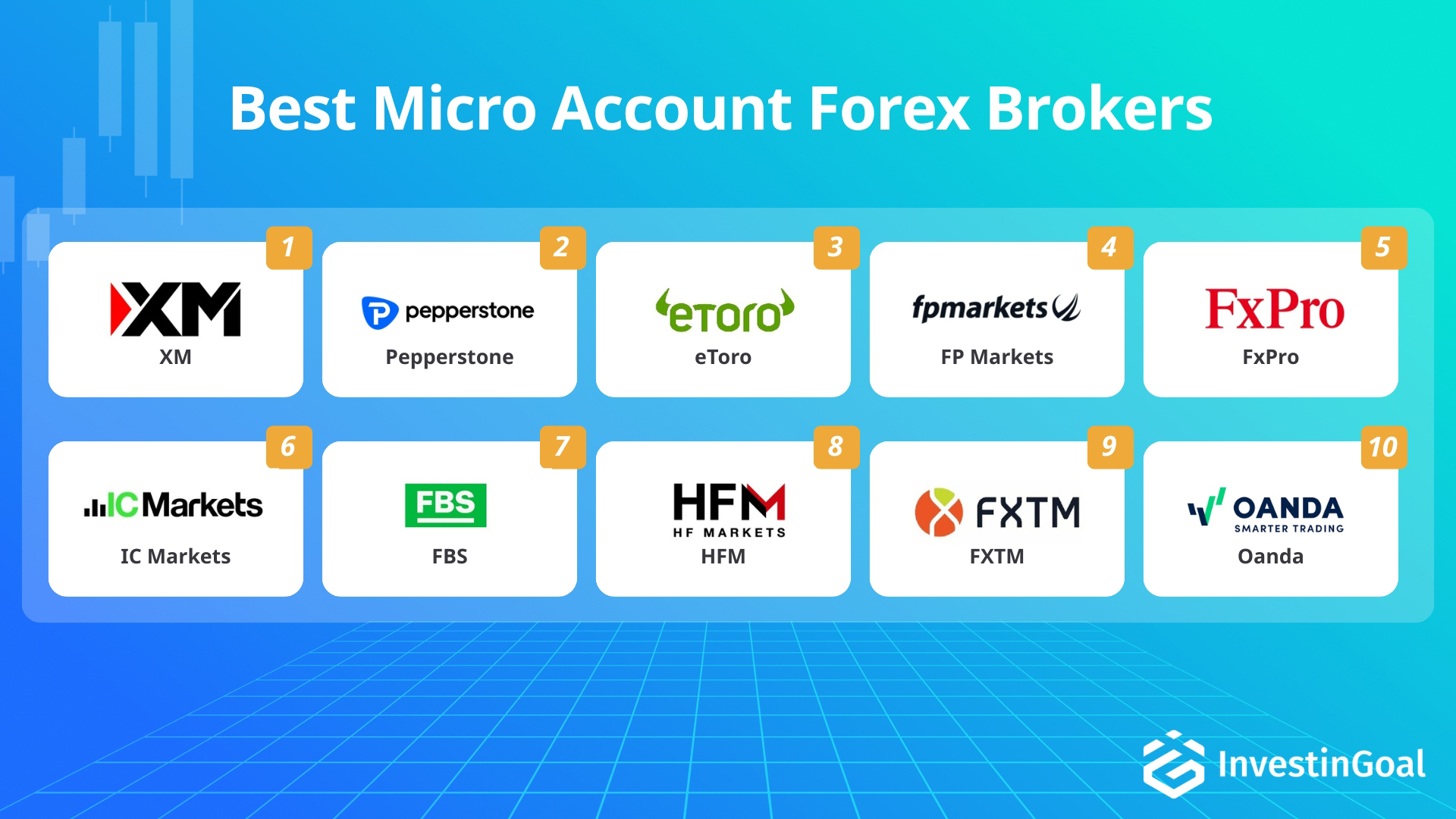
The best Forex brokers for micro-lot trading are XM, Pepperstone, eToro and FP Markets.
The most important criteria to consider when choosing the best Forex broker for micro-lot trading are micro-lot position sizing / micro-friendly account structure, minimum deposit requirements, all-in trading costs (spreads and commissions), and regulation + client protections and platform/demo quality.
XM is the best micro-lot trading Forex broker overall, thanks to offering micro-lot position sizing / micro-friendly account structure, minimum deposit requirements, all-in trading costs (spreads and commissions), and regulation + client protections and platform/demo quality.
Pepperstone, eToro, and FP Markets are the top micro-lot trading Forex brokers for micro-lot flexibility, low minimum deposits, and competitive pricing after XM. Pepperstone showcases micro-lot trading with no mandatory minimum deposit plus a choice between spread-only and raw-spread-style pricing across multiple advanced platforms. eToro includes a very low minimum deposit in many regions, an easy proprietary platform, and social/copy trading with an unlimited demo account. FP Markets provides micro-lot trading with Standard vs Raw pricing options, competitive spreads, and a broad platform lineup including MT4/MT5, cTrader, and TradingView connectivity. Micro-lot rankings focus on position sizing, account structure, and entry costs, whereas broader essentials such as trading costs (spreads and commissions), platform and tools, execution speed, minimum deposit, and customer support are the criteria used to evaluate the best forex brokers.

XM
(Best micro account Forex broker overall)
XM is the best micro account Forex broker thanks to its Micro Account contract sizing where 1 lot = 1,000 units, a $5 minimum deposit, and commission-free trading with EUR/USD spreads starting around 0.8 pips. XM is an ideal pick for small-account risk control because a 1-lot EUR/USD trade on the Micro Account is about $0.10 per pip, keeping position sizing realistic for beginners. XM’s 1,000-unit lot structure helps traders with precise exposure control on every micro trade.
-
Regulations:
-
Avg. EUR/USD Spread:
-
Platforms:
XM Features
The features of XM are listed below.
- XM Micro Account defines 1 lot as 1,000 units, so a 1 lot EUR/USD move equals about $0.10 per pip.
- XM Micro Account minimum deposit is $5.
- XM Micro Account charges no commission and uses variable spreads that start around 0.8 pips on EUR/USD.
- XM supports micro trading on MetaTrader 4 and MetaTrader 5 across desktop, web, and mobile, plus the XM mobile app.
- XM offers a free demo account with up to $100,000 virtual funds and allows up to 5 demo accounts per client.
- XM is regulated by multiple authorities including CySEC and ASIC, plus additional regulators across other regions.
XM Pros and Cons
Advantages of XM
The advantages of XM are listed below.
- There’s a wide range of account types
- The demo account at XM is unlimited
- Wide range of educational resources
Disadvantages of XM
The disadvantages of XM are listed below.
- No social trading features available
- The account availability changes depending on the location of the trader
- High minimum deposit to invest in securities ($10000 for the XM Shares account)
About XM
XM is a global forex and CFD broker founded in 2009, offering trading on currencies, commodities, indices, stocks, and cryptocurrencies. XM provides MetaTrader 4, MetaTrader 5, and proprietary platforms. XM is regulated by multiple authorities including CySEC, ASIC, and IFSC. XM is known for competitive spreads, extensive educational resources, and multilingual customer support. XM serves over 5 million clients from 196 countries. XM offers various account types and a no-requote policy.

Pepperstone
(Best micro account Forex broker for TradingView traders)
Pepperstone is the second best micro account Forex broker due to TradingView integration, micro-lot trading from 0.01 lots, and Razor account pricing with EUR/USD spreads as low as 0.0–0.3 pips plus a $7 round-turn commission per 1.0 lot. Pepperstone is a top pick for TradingView traders because you can analyze on TradingView charts and execute 0.01-lot trades without jumping between platforms. Pepperstone’s TradingView integration provides traders with a faster chart-to-order workflow for micro-position entries and exits.
-
Regulations:
-
Avg. EUR/USD Spread:
-
Platforms:
Pepperstone Features
The features of Pepperstone are listed below.
- Pepperstone supports micro lot trading from 0.01 lots on its accounts.
- Pepperstone Standard account has no commission and typically prices EUR/USD around a 1 pip markup versus raw spreads.
- Pepperstone Razor account offers raw spreads as low as 0.0–0.3 pips on EUR/USD with about $7 per round-turn lot commission.
- Pepperstone has no mandatory minimum deposit requirement.
- Pepperstone supports MetaTrader 4, MetaTrader 5, cTrader, and TradingView connectivity.
- Pepperstone offers demo accounts, with MT4/MT5 demos typically lasting 60 days and cTrader demos available without a set expiry.
Pepperstone Pros and Cons
Advantages of Pepperstone
The advantages of Pepperstone are listed below.
- Stable raw spreads (0,10 pips on EUR/USD on average)
- Caters for algorithmic trading
- Has won over 30 Forex industry awards
Disadvantages of Pepperstone
The disadvantages of Pepperstone are listed below.
- The demo account is not unlimited
About Pepperstone
Pepperstone is a global forex and CFD broker founded in 2010 in Melbourne, Australia. Pepperstone offers trading on currencies, commodities, indices, stocks, and cryptocurrencies through MetaTrader and cTrader platforms. Pepperstone is regulated by multiple authorities including ASIC, FCA, and CySEC. Pepperstone is known for competitive spreads, fast execution, and extensive educational resources. Pepperstone serves clients in over 160 countries worldwide. The Pepperstone CEO is Tamas Szabo.

eToro
(Best micro account Forex broker for copy trading)
eToro is the third best micro account Forex broker because of its CopyTrader social-copy system, minimum deposits that can be as low as $10 in many regions (often $100 for first deposits), and an unlimited demo account funded with $100,000 virtual money. eToro is a strong choice for copy trading since CopyTrader lets you allocate small amounts and automatically mirror another trader’s forex positions in real time inside the same web/mobile platform. eToro’s CopyTrader system provides traders with automated position mirroring that can keep decision-making simple when starting with limited capital.
-
Regulations:
-
Avg. EUR/USD Spread:
-
Platforms:
eToro Features
The features of eToro are listed below.
- eToro supports small account access via low minimum deposits that can be as low as $10 in some regions, with first-time deposits often around $100 depending on country.
- eToro enables fractional trading so eToro users can take very small positions instead of standard lot sizing.
- eToro provides CopyTrader, so eToro users can copy other traders directly inside the platform.
- eToro offers an unlimited demo account funded with $100,000 virtual balance.
- eToro uses a proprietary web and mobile platform rather than MT4 or MT5 for retail clients.
- eToro EUR/USD spreads typically start around 1 pip with trading costs embedded in the spread and no forex commission.
eToro Pros and Cons
Advantages of eToro
The advantages of eToro are listed below.
- Great copy trading and social trading features
- Wide range of asset classes
- It allows to buy fractional stocks from $10
Disadvantages of eToro
The disadvantages of eToro are listed below.
- The eToro spreads can be high
- Offers only USD accounts
- Transferring cryptocurrencies to other platforms can be hard
About eToro
eToro is a global multi-asset investment platform founded in 2007, offering trading on stocks, ETFs, Crypto CFDs, commodities, and forex. eToro provides a proprietary web and mobile platform with social trading features. eToro is regulated by multiple authorities including FCA, ASIC, and CySEC. eToro is known for its user-friendly interface, copy trading functionality, and commission-free stock trading. eToro serves over 30 million users worldwide. The eToro CEO and co-founder is Yoni Assia.

FP Markets
(Best micro account Forex broker for platform variety)
FP Markets is the fourth best micro account Forex broker thanks to its platform variety (MT4, MT5, cTrader, and TradingView), micro-lot trading from 0.01 lots, and Raw account spreads from 0.0 pips with a $6 round-turn commission per 1.0 lot. FP Markets is a go-to option for platform variety because you can switch between MT4/MT5 for EAs, cTrader for depth-of-market tools, and TradingView for charting while still placing 0.01-lot micro trades. FP Markets’ multi-platform access helps traders with flexibility to match their micro-account setup to the interface and tools they prefer.
-
Regulations:
-
Avg. EUR/USD Spread:
-
Platforms:
FP Markets Features
The features of FP Markets are listed below.
- FP Markets supports micro lot trading from 0.01 lots on both Standard and Raw accounts.
- FP Markets Standard account charges no commission and lists spreads from about 1.0 pip on EUR/USD, with typical averages around 1.1–1.2 pips.
- FP Markets Raw account offers spreads from 0.0 pips with a $6 per round-turn lot commission.
- FP Markets minimum deposit is typically $100 for MT4/MT5 accounts.
- FP Markets supports MetaTrader 4, MetaTrader 5, cTrader, and TradingView integration.
- FP Markets is regulated by ASIC and CySEC, with additional registration in other regions such as South Africa’s FSCA.
FP Markets Pros and Cons
Advantages of FP Markets
The advantages of FP Markets are listed below.
- Broad Instrument Offering
- Competitive Spreads
- Multiple Trading Platforms
Disadvantages of FP Markets
The disadvantages of FP Markets are listed below.
- High Fees for International Withdrawals
- Outdated Platform Design
About FP Markets
FP Markets is an Australian-based global forex and CFD broker founded in 2005. FP Markets offers trading on over 10,000 instruments including forex, stocks, indices, commodities, and cryptocurrencies. FP Markets provides MetaTrader 4, MetaTrader 5, and proprietary platforms. FP Markets is regulated by multiple authorities including ASIC, CySEC, and FSA. FP Markets is known for tight spreads, fast execution, and extensive educational resources. The FP Markets CEO is Craig Allison.

FxPro
(Best micro account Forex broker for algorithmic strategies)
FxPro is the fifth best micro account Forex broker thanks to its multi-platform algorithmic support (MT4/MT5 EAs and cTrader), micro-lot trading from 0.01 lots, and Raw+ pricing with 0.0–0.3 pip spreads on majors plus a $7 round-turn commission per 1.0 lot. FxPro is a strong choice for algorithmic strategies because you can run EAs or cBots on micro positions and keep execution consistent across platforms as you refine a system. FxPro’s algorithmic-platform coverage helps traders with live testing and scaling of automated strategies without needing standard-lot exposure.
-
Regulations:
-
Avg. EUR/USD Spread:
-
Platforms:
FxPro Features
The features of FxPro are listed below.
- FxPro supports micro lot trading from 0.01 lots across FxPro platforms and account types.
- FxPro Standard account offers floating EUR/USD spreads from about 1.2 pips with no commission.
- FxPro Raw+ account delivers near-zero spreads with a $7 per round-turn lot commission.
- FxPro has no fixed minimum deposit for its Standard account.
- FxPro supports MetaTrader 4, MetaTrader 5, cTrader, and the FxPro Edge web platform.
- FxPro is regulated by major authorities including the FCA and CySEC, plus additional regulators in other regions.
FxPro Pros and Cons
Advantages of FxPro
The advantages of FxPro are listed below.
- Regulated and Trusted Forex broker
- Diverse Trading Platforms
- Wide Range of Instruments
Disadvantages of FxPro
The disadvantages of FxPro are listed below.
- Inactivity Fee
- Limited Educational Resources
- No Guaranteed Stop-Loss Orders
About FxPro
FxPro is a global online broker founded in 2006, offering trading on forex, CFDs, stocks, indices, commodities, and cryptocurrencies. FxPro provides multiple trading platforms including MetaTrader 4, MetaTrader 5, cTrader, and its proprietary FxPro Platform. FxPro is regulated by multiple authorities including FCA, CySEC, SCB, FSC and KNN. FxPro serves clients in over 170 countries and has won numerous industry awards. The FxPro CEO is Charalambos Psimolophitis.

IC Markets
(Best micro account Forex broker for raw spreads)
IC Markets is the sixth best micro account Forex broker because of its Raw Spread account averaging about 0.1 pips on EUR/USD, micro-lot sizing from 0.01 lots, and a transparent $3.50-per-side commission ($7 round-turn) per 1.0 lot. IC Markets is a top choice for raw spreads since near-zero pricing can keep a 0.01-lot EUR/USD trade’s total cost around a few cents, reducing fee drag on small-account trading. IC Markets’ raw-spread pricing helps traders with ultra-low transaction costs on micro positions.
-
Regulations:
-
Avg. EUR/USD Spread:
-
Platforms:
IC Markets Features
The features of IC Markets are listed below.
- IC Markets supports micro lot trading from 0.01 lots on both Standard and Raw Spread accounts.
- IC Markets Raw Spread account averages about 0.1 pips on EUR/USD with a $7 per round-turn lot commission.
- IC Markets Standard account typically averages around 1.0 pip on EUR/USD with no commission.
- IC Markets standard minimum deposit is $200 for live accounts.
- IC Markets supports MetaTrader 4, MetaTrader 5, and cTrader with no strategy restrictions for IC Markets micro-lot trading.
- IC Markets is regulated by ASIC and CySEC, with additional entities regulated offshore for other regions.
IC Markets Pros and Cons
Advantages of IC Markets
The advantages of IC Markets are listed below.
- Low-latency trading environment
- Institutional level liquidity
- MT4, MT5, cTrader platforms are all available
Disadvantages of IC Markets
The disadvantages of IC Markets are listed below.
- Small amount of educational tools for new traders
- Small range of tradable assets compared to other CFD/Forex brokers
About IC Markets
IC Markets is a global forex and CFD broker founded in 2007 and based in Sydney, Australia. IC Markets offers trading on over 2,250 instruments including currencies, commodities, indices, stocks, and cryptocurrencies. IC Markets provides MetaTrader 4, MetaTrader 5, and cTrader platforms. IC Markets is regulated by multiple authorities including ASIC and CySEC. IC Markets is known for its ECN execution model and low spreads. The IC Markets CEO is Andrew Budzinski.

FBS
(Best micro account Forex broker for cent trading)
FBS is the seventh best micro account Forex broker thanks to its Cent Account with balances denominated in cents, a $1 minimum deposit, and optional leverage that can reach 1:1000 (and higher in some regions). FBS is a standout for cent trading because the cent format (e.g., $10 shown as 1,000 cents) makes it easier to size trades in very small increments and practice live with tightly controlled exposure. FBS’s cent-denominated structure helps traders with fine-grained position sizing that reduces the chance of oversizing a trade on a small balance.
-
Regulations:
-
Avg. EUR/USD Spread:
-
Platforms:
FBS Features
The features of FBS are listed below.
- FBS Cent Account uses a cent-denominated balance so FBS traders can manage very small risk increments.
- FBS Cent Account minimum deposit is $1.
- FBS Standard account minimum deposit is $5 and FBS supports micro lot trading from 0.01 lots.
- FBS offers very high leverage in some jurisdictions, with FBS leverage reaching up to 1:1000 or higher depending on the entity.
- FBS typically prices EUR/USD from around 1.0–1.1 pips on Cent and Standard accounts with no commission.
- FBS supports MetaTrader 4 and MetaTrader 5, and FBS also offers the FBS Trader mobile app.
FBS Pros and Cons
Advantages of FBS
The advantages of FBS are listed below.
- Low minimum deposit
- User-Friendly Platforms
- 90 international awards
Disadvantages of FBS
The disadvantages of FBS are listed below.
- Limited Financial Instruments
About FBS
FBS is a global forex and CFD broker founded in 2009, offering trading on currencies, commodities, indices, stocks, and cryptocurrencies. FBS provides MetaTrader 4, MetaTrader 5, and proprietary platforms. FBS is regulated by multiple authorities including CySEC, ASIC, and IFSC. FBS serves over 27 million clients in 150+ countries. FBS is known for low minimum deposits, extensive educational resources, and copy trading services.

HFM
(Best micro account Forex broker for free tools)
HFM is the eighth best micro account Forex broker due to its free trading tools (such as Autochartist and Trading Central), a Micro Account that can be opened with about $5, and commission-free pricing with EUR/USD spreads from roughly 1.2 pips. HFM is an excellent fit for traders who want free tools because you can combine micro-lot trading (0.01 lots) with built-in analysis and idea-generation features without paying extra subscription fees. HFM’s free-tool suite helps traders with more informed trade planning on micro accounts by adding structured signals and market analysis.
-
Regulations:
-
Avg. EUR/USD Spread:
-
Platforms:
HFM Features
The features of HFM are listed below.
- HFM offers a dedicated Micro Account that supports micro lot trading from 0.01 lots.
- HFM Micro Account minimum deposit is $5, with some listings showing HFM has removed a hard minimum in recent updates.
- HFM Micro Account has no commission and HFM costs are included in the spread.
- HFM Micro Account EUR/USD spreads start from about 1.2 pips under normal conditions.
- HFM supports MetaTrader 4 and MetaTrader 5 for HFM Micro Account trading on desktop, web, and mobile.
- HFM is regulated by multiple authorities including the FCA and CySEC, plus additional regulators in other regions.
HFM Pros and Cons
Advantages of HFM
The advantages of HFM are listed below.
- High Leverage Options
- Low Minimum Deposit
- Wide Range of Trading Instruments
Disadvantages of HFM
The disadvantages of HFM are listed below.
- Higher Trading Costs
- Limited Educational Resources
About HFM
HFM, formerly known as HotForex, is a global multi-asset broker founded in 2010. HFM offers trading on forex, stocks, commodities, indices, and cryptocurrencies through MetaTrader and proprietary platforms. HFM is regulated by multiple authorities including FCA, CySEC, and FSCA. HFM is known for competitive spreads, fast execution, and extensive educational resources. HFM serves over 3.5 million clients worldwide. The HF Markets Group CEO is George Koumantaris.

FXTM
(Best micro account Forex broker for education)
FXTM is the ninth best micro account Forex broker because of its education-first offering, a $10 minimum deposit for the Micro account, and MetaTrader 4/5 access for executing 0.01-lot trades on a small balance. FXTM is a solid option for education since you can learn a concept and apply it immediately on MT4 or MT5 with micro trades, while EUR/USD spreads on the Micro account start around 1.5 pips. FXTM’s education focus helps traders with a clearer feedback loop between lessons, execution, and results on small deposits.
-
Regulations:
-
Avg. EUR/USD Spread:
-
Platforms:
FXTM Features
The features of FXTM are listed below.
- FXTM Micro Account is designed for small balances and FXTM commonly uses cent denomination on this account in many regions.
- FXTM Micro Account minimum deposit is $10.
- FXTM Micro Account EUR/USD spreads start from about 1.5 pips and FXTM charges no commission on this account.
- FXTM offers higher leverage on micro accounts in some jurisdictions, while FXTM leverage is lower under stricter regulators.
- FXTM supports MetaTrader 4 and MetaTrader 5 for FXTM Micro Account trading.
- FXTM is regulated by major authorities including the FCA and CySEC, plus additional regulators in other regions.
FXTM Pros and Cons
Advantages of FXTM
The advantages of FXTM are listed below.
- User-Friendly Platform
- Fast Customer Support
- Low Minimum Deposit
Disadvantages of FXTM
The disadvantages of FXTM are listed below.
- Withdrawal Fees
- Limited Product Range
- Inactivity Fees
About FXTM
FXTM, also known as ForexTime, is a global forex and CFD broker founded in 2011. FXTM offers trading on currencies, commodities, indices, stocks, and cryptocurrencies through MetaTrader 4, MetaTrader 5, and proprietary platforms. FXTM is regulated by multiple authorities including CySEC, FCA, and FSC Mauritius. FXTM is known for low spreads, fast execution, and extensive educational resources. FXTM serves over 2 million clients worldwide. The FXTM CEO is Nicholas Defteras.

Oanda
(Best micro account Forex broker for 1-unit trades)
OANDA is the tenth best micro account Forex broker thanks to 1-unit trade sizing (no round-lot requirements), a $0 minimum deposit policy, and spread-only pricing with EUR/USD typically around 1.0 pip (with an optional commission model for lower raw spreads). OANDA is an ideal pick for 1-unit trades because you can set an exact position size like 1, 50, or 1,000 units, which makes risk per trade easier to calibrate when your account is small. OANDA’s 1-unit sizing helps traders with granular exposure control so position size, stops, and risk limits can be matched to a precise dollar amount.
-
Regulations:
-
Avg. EUR/USD Spread:
-
Platforms:
Oanda Features
The features of Oanda are listed below.
- OANDA has a $0 minimum deposit policy, so OANDA accounts can be funded with any amount.
- OANDA supports position sizing down to 1 unit of base currency, so OANDA enables nano-scale trading below micro lots.
- OANDA standard pricing typically averages about a 1.0 pip EUR/USD spread with no commission.
- OANDA offers a commission model with EUR/USD spreads around 0.1–0.2 pips plus roughly $5 per side commission in eligible pricing tiers.
- OANDA offers an unlimited demo account with configurable virtual balance for OANDA platform practice.
- OANDA supports OANDA Trade plus MetaTrader 4 and MetaTrader 5 in supported regions, and OANDA also integrates with TradingView for execution.
Oanda Pros and Cons
Advantages of Oanda
The advantages of Oanda are listed below.
- Comprehensive Platforms
- Robust Education
- Highly Regulatory Trust
Disadvantages of Oanda
The disadvantages of Oanda are listed below.
- Higher Spreads
- Proprietary Platform Limitations
- Inactivity Fees
About Oanda
OANDA is a global multi-asset broker founded in 1996, offering trading on forex, CFDs, commodities, indices, and cryptocurrencies. OANDA provides proprietary platforms and API solutions. OANDA is regulated by multiple authorities including FCA, ASIC, and MAS. OANDA is known for competitive spreads, fast execution, and currency data services. OANDA serves both retail and institutional clients worldwide. The Oanda Chief Executive Officer is Gavin Bambury since August 2019.
Comparison of the best best micro account forex brokers
The table that compares the best best micro account forex brokers is shown below.
| Broker | Minimum deposit (USD) | Minimum trade size | EUR/USD typical spread (pips) | Commission per 1.0 lot round-turn (USD) | Tier-1 regulators for the account-holding entity |
|---|---|---|---|---|---|
| XM | $5 | 0.01 lots | 1.0-1.7 pips | $0 | CySEC, ASIC |
| Pepperstone | $0 | 0.01 lots | 1.1-1.3 pips | $0 | FCA, ASIC, CySEC, BaFin |
| eToro | $10 | 0.01 lots | 1.0-2.0 pips | $0 | FCA, ASIC, CySEC |
| FP Markets | $100 | 0.01 lots | 1.1-1.2 pips | $0 | ASIC, CySEC |
| FxPro | $0 | 0.01 lots | 1.2 pips | $0 | FCA, CySEC |
| IC Markets | $200 | 0.01 lots | 1.0 pips | $0 | ASIC, CySEC |
| FBS | $1 | 0.01 lots | 1.0-1.5 pips | $0 | CySEC |
| HFM | $0 | 0.01 lots | 1.2-1.5 pips | $0 | FCA, CySEC |
| FXTM | $10 | 0.01 lots | 1.5 pips | $0 | FCA, CySEC |
| OANDA | $0 | 1 unit | 1.0 pips | $0 | CFTC/NFA, FCA, ASIC, JFSA, MAS, IIROC/CIRO |
Warning
CFDs are complex instruments and come with a high risk of losing money rapidly due to leverage. Between 74-89% of retail investor accounts lose money when trading CFDs. You should consider whether you can afford to take the high risk of losing your money.
The best Micro account Forex broker for beginners is XM. XM stands out with its Micro Account sizing (1 lot = 1,000 units), a low $5 minimum deposit, and MT4/MT5 plus a free demo up to $100,000. The smaller contract size and cheap entry point offered by XM help new traders keep risk tight while practicing strategies on familiar platforms before scaling up.
Beginner Micro-account traders look for small position sizing, low deposits, and strong demo/platform support in the best Micro account Forex brokers. HFM is a solid alternative to XM thanks to its Micro Account availability, spread-only pricing with no commissions, and MT4/MT5 plus demo access (including no-expiry options in some cases). OANDA is another option alongside XM, largely because it has a $0 minimum deposit, allows trades down to 1 unit, and backs it up with an unlimited demo and MT4/MT5 support, which also makes it a frequent inclusion among the best FX brokers for beginners.
The best Micro account Forex broker with a low minimum deposit is OANDA. OANDA is compelling here because it has a $0 minimum deposit, supports minimum trade sizes as low as 1 unit, and uses tight spread-only pricing (around 1.0 pip typical on EUR/USD). With OANDA, you can start with virtually any budget and still keep your exposure tiny, while the spread-only model makes it easier to understand trading costs.
In this category, the strongest choices generally deliver near-zero entry cost, the ability to trade very small sizes, and straightforward pricing. A similar alternative to OANDA is FBS for its $1 Cent Account minimum deposit, cent-denominated balance that enables nano-lot sizing, and MT4/MT5 availability. HFM offers micro-lot trading from 0.01, a Micro Account from $5 (with a $0 minimum listed update), and spread-only pricing on MT4/MT5 that make it an alternative to OANDA.
In this category, the strongest choices generally deliver near-zero entry cost, the ability to trade very small sizes, and straightforward pricing. A similar alternative to OANDA is FBS for its $1 Cent Account minimum deposit, cent-denominated balance that enables nano-lot sizing, and MT4/MT5 availability. HFM offers micro-lot trading from 0.01, a Micro Account from $5 (with a $0 minimum listed update), and spread-only pricing on MT4/MT5 that make it an alternative to OANDA and a common pick among the best brokers with minimum deposit.
The best Micro account Forex broker with high leverage is FBS. FBS leads in this context with very high leverage up to 1:1000–1:3000 (depending on jurisdiction), a $1 Cent Account for ultra-small trading, and MT4/MT5 support. The high leverage provided by FBS can magnify buying power, while the cent-based setup helps traders keep position sizes small as they learn to manage risk.
Huge leverage caps, small entry requirements, and reliable platforms from the best high-leverage Micro account Forex brokers are highly regarded by Forex traders. FXTM offers similar features to FBS like leverage up to 1:1000 (jurisdiction-dependent), a $10 minimum deposit Micro setup, and MT4/MT5 support with cent-style micro trading, which often places it among the highest leverage Forex brokers. IC Markets is another alternative to FBS, offering micro-lot trading from 0.01 and multiple platforms (MT4/MT5/cTrader), plus offshore entity options (e.g., Seychelles/SCB Bahamas) for non-EU regions.
The best Micro account Forex broker with low spreads is IC Markets. IC Markets is strong for cost-sensitive traders thanks to its Raw Spread account averaging about 0.1 pip on EUR/USD, micro-lot trading from 0.01, and access to MT4/MT5/cTrader. Those tight raw spreads from IC Markets can reduce friction on frequent trades, and the small minimum lot size helps you test spread advantages without oversized exposure.
Low-spread Micro brokers usually focus on raw or near-raw pricing, support for micro-lot sizing, and fast, popular platforms. Pepperstone is a practical alternative to IC Markets, as its Razor account delivers raw spreads around 0.0–0.3 pips on EUR/USD, supports 0.01 lots, and doesn’t require a mandatory minimum deposit. FP Markets is another option versus IC Markets, since its Raw account targets very low spreads (0.0–0.2 pips on EUR/USD plus commission), supports micro-lots from 0.01, and offers platform variety including MT4/MT5/cTrader/TradingView, and it is often mentioned among the Forex brokers with lowest spreads.
The best Micro account Forex broker with MT4 is XM. XM fits MT4-focused Micro traders with its dedicated Micro Account, MT4/MT5 availability, and a low $5 minimum deposit. The MT4 support and accessible deposit level at XM make it easier to run common MT4 tools (like EAs and indicators) while keeping trade size and funding requirements modest.
The top MT4 Micro brokers usually provide full MT4 support, micro-lot flexibility, and account conditions that keep costs and entry barriers low. Pepperstone is an alternative to XM thanks to MT4 access, 0.01 micro-lot trading across accounts, and the Razor option for tighter pricing, which is why it is often featured among the best Forex brokers with MT4. A similar alternative to XM is IC Markets for MT4 support, micro-lots from 0.01, and a Raw Spread account aimed at very low spread trading.
The criteria for choosing the best Micro Account Forex brokers are listed below.
- Minimum deposit: Set a strict funding ceiling (e.g., ≤$10–$50) and choose brokers whose account-opening rules match that constraint. For instance, FBS supports micro-style entry with $1 (Cent) and $5 (Standard), while HFM may list a Micro Account around $5 (and may show $0 minimum in some policies).
- Trade-size granularity: Require 01 lots (1,000 units) at minimum (and preferably unit-based sizing) so you can calibrate risk precisely. XM defines micro-lot sizing where 1 lot = 1,000 units, making EUR/USD $0.10 per pip at that size, while OANDA allows position sizes down to 1 unit, enabling “nano” exposure for controlled live testing.
- All-in trading costs: Quantify costs per micro-lot on a benchmark pair (commonly EUR/USD) by combining spread + commission (if any). As a reference point, IC Markets advertises raw pricing around 1 pips average plus $7 round-turn per 1.0 lot ($0.07 for 0.01 lots), whereas spread-only models around 1.0–1.5 pips translate to roughly $0.10–$0.15 per 0.01 lots.
- Regulatory safeguards: Prefer brokers operating under top-tier supervision and verify which legal entity will hold your account. Prioritize oversight such as FCA, ASIC, CySEC, and (where applicable for U.S. accounts) CFTC with NFA
- Platform breadth: Match platforms to your workflow: require MetaTrader (MT4/MT5) if you use Expert Advisors, cTrader if you rely on depth-of-market, and consider direct TradingView connectivity if your decision-making is chart-centric; for example, Pepperstone offers MT4/MT5 + cTrader + TradingView integration.
- Execution quality: Favor brokers that explicitly support market execution, ECN/NDD-style routing, and strategies like scalping and algorithmic trading, because micro accounts are disproportionately harmed by slippage and requotes.
- Risk protection: Require negative balance protection, clear margin/stop-out rules, and the ability to use hedging where relevant. Additionally, treat very high leverage (e.g., 1:1000–1:3000) as a risk amplifier and cap effective leverage and position size accordingly.
- Demo realism: Use a demo to validate that micro trading is viable under your exact constraints, set the demo balance to $50–$200, trade 01 lots (or smaller units), and observe spreads during liquid vs. volatile sessions. For example, eToro provides a $100,000 virtual account, while other brokers commonly offer demos that are time-limited (e.g., 60 days) unless extended.
To change a micro account to a standard account, you almost always open a new Standard account (new account ID) and transfer funds; you do not “convert” the existing Micro login in place. For example, XM requires you to open an additional Standard account rather than changing the Micro account type.
This is because “Micro” vs “Standard” is defined by the account’s contract specification (how a lot is defined), pricing model, and leverage profile, and platforms like MT4/MT5 treat those as separate account identities. Practically: (1) in your broker portal, open an additional/new account and select Standard (choose platform, base currency, leverage); (2) close or reduce open positions on the Micro account—open trades cannot be migrated between account IDs; (3) request an internal balance transfer (or withdraw and re-deposit) into the new Standard account; (4) add the new login to your platform and verify symbol specifications (contract size, margin rate).
Variation: some brokers only permit an “account type change” before any live trading occurs; once there is trading history, a new account is required.
The features that separate a micro account from other account types are smaller trade units, lower per-pip monetary value, and often lower funding/margin thresholds—sometimes implemented via cent-denominated accounting. In most FX specifications, a micro lot is 0.01 lots and equals about 1,000 units of the base currency; on EUR/USD that is about $0.10 per pip, versus about $10 per pip for a 1.00 standard lot (100,000 units).
Implementation differs by broker and platform configuration. A “Micro” contract-size account may redefine what “1.00 lot” means inside the account (e.g., 1 lot = 1,000 units), so the on-screen lot number is larger while the notional exposure is small. A Cent account displays balance and P/L in cents (e.g., $10 shown as 1,000¢), a format common among Forex trading account types, enabling very fine P/L increments without changing the market mechanics. Micro tiers are commonly spread-only (no per-lot commission) and may have wider spreads than Raw/ECN accounts, while execution and tools (MT4/MT5, stop-loss, limit orders) are usually the same.
Variation: some providers go beyond micro lots by supporting unit-based sizing down to 1 unit on their native platform.
Micro account lot sizes affect risk and position sizing by shrinking exposure linearly: 0.01 lot (1,000 units) makes EUR/USD move about $0.10 per pip, so it represents roughly $5 of price risk, compared with roughly $500 on 1.00 standard lot.
You size positions with standard risk mathematics: Risk($) = Stop-loss(pips) × PipValue($/pip), so Lots = Risk / (Stop-loss × PipValue per 1.00 lot). Micro sizing, therefore, lets you keep risk at a fixed percentage of equity (e.g., 1–2%) even on small balances while still using realistic stop distances, rather than forcing an “all-or-nothing” trade size. It also makes scaling—adding or reducing in 0.01-lot increments—feasible without materially changing total risk.
Key variations: pip value depends on the currency pair, price, and your account currency (JPY pairs use a 0.01 pip). Cent accounting changes the reporting unit, not the underlying notional. Micro sizing is not a substitute for leverage discipline: many small positions can sum to a large notional and trigger margin calls if volatility widens spreads or reduces free margin. Traders should understand what is lot size in Forex to correctly compute pip values and risk.
The margin for 0.01 lot is calculated as: Required margin = (Contract size × 0.01 × Market price × conversion into your account currency) ÷ Leverage.
Example (USD account, EUR/USD): if EUR/USD = 1.10 and 1.00 standard lot = 100,000 EUR, then 0.01 lot = 1,000 EUR and the notional is 1,000 × 1.10 = $1,100. With 1:100 leverage, the required margin is $11.00; with 1:30 leverage, the required margin is $36.67.
Critical variation: if your broker uses a “Micro” contract definition where 1.00 lot = 1,000 units, then 0.01 lot = 10 units; you plug that smaller contract size into the same formula, making margin 100× smaller than the standard-contract example at the same price and leverage. Brokers can also apply higher margin (lower effective leverage) for illiquid pairs, weekends, or around major macro releases, so you should confirm the symbol specification in MT4/MT5 (contract size, margin rate) or the broker’s margin calculator before sizing.