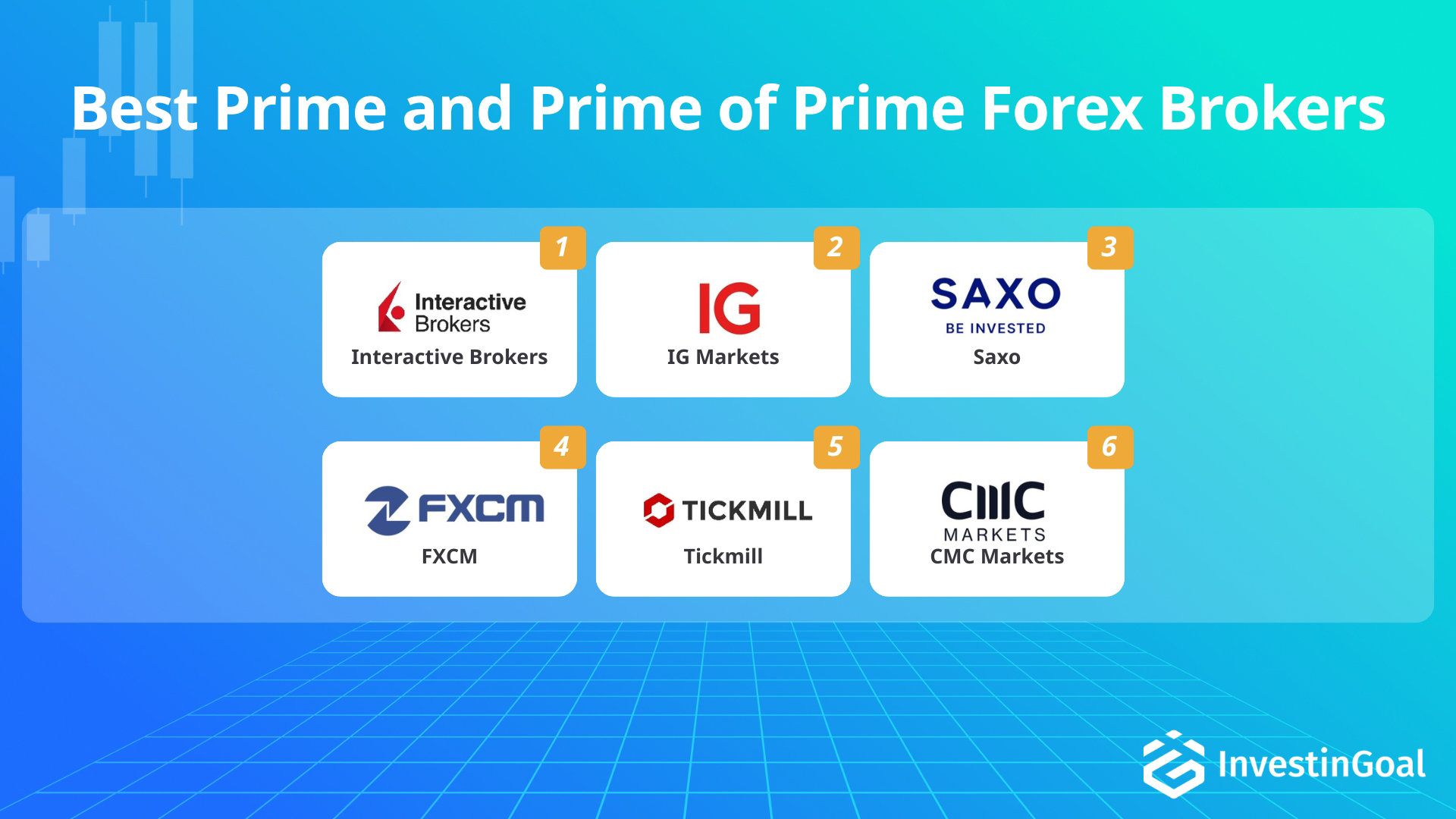
The best Forex brokers for prime brokerage and prime-of-prime services are Interactive Brokers (IBKR), IG (IG Group), Saxo Bank (Saxo) and FXCM.
The most important criteria to consider when choosing the best Forex broker for prime brokerage and prime-of-prime services are depth of institutional liquidity and execution quality, breadth of prime services (execution, clearing/custody, securities lending/financing), accessibility and cost (minimums, spreads/commissions, margin terms), and regulatory strength & operational resilience (technology, risk controls, support).
Interactive Brokers (IBKR) is the best prime brokerage and prime-of-prime services Forex broker overall, thanks to offering depth of institutional liquidity and execution quality, breadth of prime services (execution, clearing/custody, securities lending/financing), accessibility and cost (minimums, spreads/commissions, margin terms), and regulatory strength & operational resilience (technology, risk controls, support).
Ranked just behind Interactive Brokers (IBKR), the best prime brokerage and prime-of-prime services Forex brokers for institutional liquidity depth, technology, and reliability include IG (IG Group), Saxo Bank (Saxo), and FXCM. IG (IG Group) showcases prime-of-prime access via IG Prime, multi-asset DMA/CFD solutions, and broad global regulatory coverage. Saxo Bank (Saxo) features deep liquidity (25+ Tier-1 sources), low-latency execution, and institutional platforms/white-label capabilities. FXCM facilitates wholesale FX/CFD liquidity via FXCM Pro, “clearing-only” prime options, and an execution stack built for algorithmic and high-volume trading. Some prime-of-prime providers, such as IG and Saxo, are also regarded among the best forex brokers overall due to competitive pricing, advanced platforms and tools, fast execution, and responsive customer support.

Interactive Brokers
(Best prime brokerage Forex broker overall)
Interactive Brokers is the best prime and prime-of-prime Forex broker overall thanks to its full-service prime brokerage stack (trade execution, custody, securities lending, and capital introduction via the Hedge Fund Marketplace), no AUM minimums, and FX pricing aggregated from 17 interbank dealers. Interactive Brokers is a top choice for smaller hedge funds and professional FX traders since it was ranked #1 for hedge funds under $50 million AUM and combines High Touch prime relationship managers with institutional EUR/USD pricing of about 0.25 pips raw (roughly 0.65 pips all-in after about $4 per 100k round-turn commissions), which keeps financing, execution, and reporting scalable as volume grows. Interactive Brokers’ full-service prime brokerage stack provides traders with institutional-grade execution, custody, and securities-lending financing under automated risk controls.
-
Regulations:
-
Avg. EUR/USD Spread:
-
Platforms:
Interactive Brokers Features
The features of Interactive Brokers are listed below.
- Interactive Brokers is a direct prime broker that provides trade execution, custody, and securities lending for smaller hedge funds and professional traders.
- Interactive Brokers was ranked the number 1 prime broker for hedge funds with under $50 million in AUM.
- Interactive Brokers offers High Touch prime services with dedicated relationship managers and personalized support.
- Interactive Brokers has no AUM minimums for prime brokerage access.
- Interactive Brokers has a $0 minimum deposit policy.
- Interactive Brokers prices EUR USD at about 0.25 pips raw and about 0.65 pips all in with about $4 per 100k round turn commission, based on quotes aggregated from 17 interbank dealers.
Interactive Brokers Pros and Cons
Advantages of Interactive Brokers
The advantages of Interactive Brokers are listed below.
- Low Trading Fees
- Advanced Trading Tools
- Wide Market Access
Disadvantages of Interactive Brokers
The disadvantages of Interactive Brokers are listed below.
- Not user-friendly
- No MetaTrader Support
- Additional Fees
About Interactive Brokers
Interactive Brokers is a global electronic broker founded in 1978, offering trading in stocks, options, futures, forex, bonds, ETFs, and cryptocurrencies across 150 markets in 33 countries. Interactive Brokers provides advanced trading platforms, low commissions, and access to a wide range of financial instruments. Interactive Brokers is known for its sophisticated technology and serves both retail and institutional clients. Interactive Brokers is regulated by multiple top-tier authorities worldwide. The CEO of the Interactive Brokers Group is Milan Galik.

IG Markets
(Best prime-of-prime Forex broker for crypto CFDs)
IG is the second best prime and prime-of-prime Forex broker due to IG Prime’s institutional liquidity and synthetic prime framework, Tier-1 bank-sourced multi-asset depth, and 24/5 pricing on major cryptocurrency CFDs. IG is a strong choice for crypto CFD traders because IG Prime streams near-round-the-clock liquidity across FX, indices, commodities, and crypto and supports institutional connectivity (FIX API and other API options alongside MT4), which helps systematic desks execute and hedge crypto exposure without building their own bank liquidity network. IG’s IG Prime institutional liquidity framework provides traders with credit-intermediated crypto CFD execution that can remain resilient during volatile markets.
-
Regulations:
-
Avg. EUR/USD Spread:
-
Platforms:
IG Markets Features
The features of IG Markets are listed below.
- IG provides prime brokerage and prime of prime services through IG Prime for hedge funds, family offices, brokers, and other institutions.
- IG offers Synthetic prime via CFDs and direct market access for multi asset trading.
- IG streams 24 by 5 pricing on major FX pairs, indices, commodities, and cryptocurrencies.
- IG has no set minimum AUM requirements for IG Prime access.
- IG supports MetaTrader 4 and API connectivity including FIX API and REST for institutional workflows.
- IG lists EUR USD spreads from 0.6 pips on standard accounts and about 0.2 to 0.3 pips raw plus commission on Forex Direct DMA accounts.
IG Markets Pros and Cons
Advantages of IG Markets
The advantages of IG Markets are listed below.
- Low spreads from 0.6 pips on Forex
- Wide range of financial instruments
- 40 years of experience in the Forex industry
Disadvantages of IG Markets
The disadvantages of IG Markets are listed below.
- No copy trading features
- No social trading features
About IG Markets
IG Markets is a global online trading provider founded in 1974, offering access to over 17,000 financial markets including forex, stocks, indices, commodities, and cryptocurrencies. IG Markets provides proprietary trading platforms alongside MetaTrader 4 and ProRealTime. IG Markets is regulated by multiple top-tier authorities worldwide, including the FCA and ASIC. IG Markets is known for competitive spreads, extensive educational resources, and innovative features like weekend trading. The IG Markets’ parent company “IG Group” CEO is Breon Corcoran.

Saxo
(Best prime-of-prime Forex broker for FX options)
Saxo is the third best prime and prime-of-prime Forex broker because Saxo Prime offers FX options alongside spot, forwards, and NDFs, liquidity aggregated from 25+ Tier-1 providers, and low-latency execution through co-located venues such as NY4 and LD4 with smart order routing. Saxo is a top choice for FX options since its prime setup keeps option pricing and hedging inside the same institutional liquidity and margin framework, enabling efficient spot-option hedging and multi-leg execution without minimum AUM or monthly volume commitments. Saxo’s FX-prime product suite provides traders with dependable FX options liquidity and execution quality backed by deep aggregation.
-
Regulations:
-
Avg. EUR/USD Spread:
-
Platforms:
Saxo Features
The features of Saxo are listed below.
- Saxo provides prime of prime services via Saxo Prime with liquidity from 25 plus Tier 1 providers and FX products including spot, forwards, NDFs, and options.
- Saxo uses co located data centers including NY4 and LD4 plus smart order routing for low latency execution.
- Saxo has no minimum AUM or monthly volume commitments for institutional clients.
- Saxo offers access to 70,000 plus instruments via a single margin account.
- Saxo Classic accounts have a $0 minimum deposit, while Saxo Platinum requires $200,000 and Saxo VIP requires $1 million.
- Saxo averages about 1.1 pips on EUR USD for Classic and about 0.9 to 1.0 pips for Platinum and VIP tiers.
Saxo Pros and Cons
Advantages of Saxo
The advantages of Saxo are listed below.
- Regulation and Trust
- Extensive Product Range
- Advanced Trading Platform
Disadvantages of Saxo
The disadvantages of Saxo are listed below.
- High Minimum Deposits for Premium Accounts
- Lack of Spread Betting Options
- Custody Fees in Certain Regions
About Saxo
Saxo is a Danish investment bank and online trading platform founded in 1992. Saxo offers trading in forex, stocks, CFDs, futures, options, and other financial instruments across global markets. Saxo provides proprietary trading platforms and white-label solutions for institutional clients. Saxo is regulated by multiple authorities including the Danish FSA and UK FCA. Saxo serves retail and institutional clients in over 170 countries. The Saxo CEO and co-founder is Kim Fournais.

FXCM
(Best prime-of-prime Forex broker for trade clearing)
FXCM is the fourth best prime and prime-of-prime Forex broker thanks to its FXCM Pro/FXCM Prime clearing-only prime service, direct market access liquidity connected to major interbank venues, and institutional trading technology integrations such as FlexTrade MaxxTrader with pre-trade risk checks. FXCM is a leading choice for trade clearing because its clearing-only model lets brokers and funds clear trades with Tier-1 banks through FXCM’s credit lines, shortening onboarding and removing the need to secure a direct bank prime relationship for settlement. FXCM’s clearing-only prime service helps traders with streamlined settlement and credit intermediation across Tier-1 counterparties.
-
Regulations:
-
Avg. EUR/USD Spread:
-
Platforms:
FXCM Features
The features of FXCM are listed below.
- FXCM provides prime of prime liquidity via FXCM Pro for smaller brokers, small hedge funds, prop trading firms, and regional banks.
- FXCM offers a clearing only prime service that lets clients clear trades with Tier 1 banks through FXCM credit lines.
- FXCM integrates FlexTrade MaxxTrader EMS for low latency execution, smart order routing, and pre trade risk checks.
- FXCM operates infrastructure in data centers including NY4, LD4, and TY3 for global execution.
- FXCM minimum deposit is typically $50 for retail accounts and about $50,000 for institutional accounts.
- FXCM prices EUR USD at about 0.8 pips on standard accounts and can average about 0.2 to 0.3 pips under its pricing model.
FXCM Pros and Cons
Advantages of FXCM
The advantages of FXCM are listed below.
- Regulation and Trust
- Advanced Trading Tools
- Competitive Spreads for Active Traders
Disadvantages of FXCM
The disadvantages of FXCM are listed below.
- Limited Range of Instruments
- Average Pricing Structure
About FXCM
FXCM is a global forex and CFD broker founded in 1999, offering trading on currencies, commodities, indices, stocks, and cryptocurrencies. FXCM provides MetaTrader 4 and proprietary trading platforms. FXCM is regulated by multiple authorities including FCA, ASIC, and CySEC. FXCM is known for competitive spreads, extensive educational resources, and copy trading services. FXCM recently launched a sister platform called Tradu. The FXCM parent company “Stratos Group” CEO is Brendan Callan.

Tickmill
(Best prime-of-prime Forex broker for MT5 scalping)
Tickmill is the fifth best prime and prime-of-prime Forex broker for MT5 scalping thanks to Tickmill Prime’s aggregated Tier-1 and non-bank HFT liquidity, full MetaTrader 5 support for EAs, and Raw pricing that can reach 0.0–0.1 pips on EUR/USD plus about $6 per round-turn lot. Tickmill is a top choice for MT5 scalpers since it combines low-latency infrastructure in London, New York, and Tokyo with explicit support for scalping and algorithmic trading, which reduces the spread-and-speed drag that can erase edge on short-horizon strategies. Tickmill’s aggregated prime-of-prime liquidity improves traders’ fill quality with deep pools and tight spreads suited to rapid MT5 execution.
-
Regulations:
-
Avg. EUR/USD Spread:
-
Platforms:
Tickmill Features
The features of Tickmill are listed below.
- Tickmill provides prime of prime liquidity via Tickmill Prime for brokers, money managers, hedge funds, and professional traders.
- Tickmill aggregates Tier 1 bank liquidity, non bank HFT liquidity, and ECN streams to build deep liquidity pools.
- Tickmill advertises spreads as low as 0.0 pips on major forex pairs for Tickmill Prime clients.
- Tickmill offers white label solutions including customized MetaTrader 4 platforms for brokers.
- Tickmill Raw accounts price EUR USD at about 0.0 to 0.1 pips plus a $6 per round turn lot commission.
- Tickmill requires a $100 minimum deposit on both Tickmill Classic and Tickmill Raw Spread accounts.
Tickmill Pros and Cons
Advantages of Tickmill
The advantages of Tickmill are listed below.
- Regulatory Trust
- Competitive Pricing
- Comprehensive Platform Support
Disadvantages of Tickmill
The disadvantages of Tickmill are listed below.
- Limited Asset Variety
- Higher Costs on Classic Account
- Discontinued Features
About Tickmill
Tickmill is a global multi-asset broker founded in 2014, offering trading on forex, CFDs, stocks, indices, commodities, and cryptocurrencies. Tickmill provides MetaTrader 4, MetaTrader 5, and proprietary platforms. Tickmill is regulated by multiple authorities including FCA, CySEC, and FSCA. Tickmill is known for low spreads, fast execution, and extensive educational resources. Tickmill serves over 500,000 clients worldwide. The Tickmill CEO is Sudhanshu Agarwal.

CMC Markets
(Best prime-of-prime Forex broker for share CFD APIs)
CMC Markets is the sixth best prime and prime-of-prime Forex broker because CMC Markets Connect delivers Prime Derivatives access to 9,000+ CFDs including thousands of single-stock CFDs, FIX API connectivity for automated share-CFD execution, and flexible collateral and clearing options. CMC Markets is a strong choice for share CFD APIs since its institutional FIX/API stack lets brokerages, funds, and fintechs integrate single-stock CFD pricing and execution into their own systems, supporting automated order routing, hedging, and scalable back-office workflows. CMC Markets’ Prime Derivatives liquidity hub provides traders with programmatic access to deep single-stock CFD liquidity that can plug into existing prime-broker arrangements.
-
Regulations:
-
Avg. EUR/USD Spread:
-
Platforms:
CMC Markets Features
The features of CMC Markets are listed below.
- CMC Markets provides prime brokerage and liquidity services via CMC Markets Connect for asset managers, hedge funds, banks, broker dealers, and prop trading firms.
- CMC Markets Connect offers access to 9,000 plus CFDs and 300 plus FX pairs via a single connection.
- CMC Markets provides Prime Derivatives with institutional GUI and API access to thousands of single stock CFDs.
- CMC Markets Connect supports FIX API integration and lets clients custody collateral with CMC Markets or clear via their own prime brokers.
- CMC Markets quotes EUR USD from about 0.5 pips on Next Generation with typical 0.7 to 0.9 pips averages, while CMC Markets FX Active can reach 0.0 to 0.3 pips plus commission for qualifying clients.
- CMC Markets has no minimum deposit requirement for retail accounts.
CMC Markets Pros and Cons
Advantages of CMC Markets
The advantages of CMC Markets are listed below.
- Regulatory Trust
- Low Trading Costs
- Extensive Trading Platform
Disadvantages of CMC Markets
The disadvantages of CMC Markets are listed below.
- Complex Fee Structure
- Limited Funding Options
About CMC Markets
CMC Markets is a global online financial trading company founded in 1989 and headquartered in London. CMC Markets offers trading on forex, indices, commodities, cryptocurrencies, and shares through CFDs and spread betting. CMC Markets provides proprietary and MetaTrader platforms for desktop, web, and mobile. CMC Markets is regulated by multiple authorities including FCA, ASIC, and BaFin. CMC Markets is listed on the London Stock Exchange. The CMC Markets CEO is Lord Peter Cruddas.
Comparison of the best prime and prime of prime forex brokers
The table that compares the best prime and prime of prime forex brokers is shown below.
| Broker | Tier-1 regulators supervising the prime/PoP entity | Capital backing type | Disclosed liquidity sources count | EUR/USD all-in trading cost benchmark | Institutional onboarding minimum |
|---|---|---|---|---|---|
| Interactive Brokers | SEC/CFTC, FCA, MAS | publicly traded | 17 major interbank dealers | 0.65 pips all-in (0.25 pips raw + $4 per 100k round-turn) | $0 (no AUM minimums stated) |
| IG | FCA, FINMA, BaFin, ASIC, MAS | publicly listed (FTSE-250) | N/A | 0.85 pips average (peak times); Forex Direct: 0.2–0.3 pips + commission | N/A (no set AUM minimum stated; $0 via bank transfer) |
| Saxo Bank | FCA, ASIC, Japan FSA, MAS, FINMA (7 Tier-1 total) | bank | 25+ Tier-1 providers | 1.1 pips average (Classic); 0.9–1.0 pips (Platinum/VIP); raw 0.2–0.3 pips | N/A (no minimum AUM stated; $0 Classic; $200,000 Platinum; $1,000,000 VIP) |
| FXCM | FCA, ASIC | N/A | N/A | 0.8 pips average; 0.2–0.3 pips often reported (no commission) | $50,000 (institutional account example); $50 retail |
| Tickmill | FCA (Tickmill Prime via FCA-regulated UK entity) | N/A | N/A | 0.0–0.1 pips + $6 per lot round-turn (0.6 pips all-in) | N/A (retail $100) |
| CMC Markets | FCA, BaFin, ASIC, MAS | publicly listed (London Stock Exchange) | N/A | 0.7–0.9 pips typical (from 0.5); FX Active: 0.0–0.3 pips + commission | N/A (institutional minimum not disclosed; retail £0) |
Warning
CFDs are complex instruments and come with a high risk of losing money rapidly due to leverage. Between 74-89% of retail investor accounts lose money when trading CFDs. You should consider whether you can afford to take the high risk of losing your money.
The best Prime and Prime of Prime broker for crypto is IG. IG fits this niche with 24/5 crypto pricing via its prime setup, multi-asset access including crypto CFDs, and Tier-1 bank liquidity relationships through IG Prime. Those advantages at IG can translate into steadier pricing conditions, the ability to hedge crypto exposure with other markets, and deeper liquidity support when trading crypto-linked instruments.
Top Prime and Prime of Prime brokers for crypto usually offer reliable liquidity, crypto-linked product access, and institutional-grade infrastructure. A similar alternative to IG is Saxo Bank for multi-asset access with crypto-linked products, deep liquidity from 25+ Tier-1 providers, and bank-grade regulation. FXCM offers similar features to IG like crypto CFDs for eligible clients, MT4 or Trading Station, and prime-of-prime style liquidity access via FXCM Pro.
FXCM offers similar features to IG like crypto CFDs for eligible clients, MT4 or Trading Station, and prime-of-prime style liquidity access via FXCM Pro, and it is often included among the best crypto brokers.
The best Prime and Prime of Prime broker for small hedge funds is Interactive Brokers (IBKR). IBKR earns the top spot with its #1 ranking for hedge funds under $50m AUM, no AUM minimums, and “High Touch” prime services with dedicated relationship support. With IBKR, smaller funds can access prime-style support without hitting asset thresholds, while relationship coverage can help smooth onboarding, execution needs, and operational workflows.
Deep liquidity, institutional access without steep minimums, and service models built for professional operations are often featured for small hedge funds in the best Prime and Prime of Prime brokers. IG (IG Prime) is an alternative to IBKR thanks to prime/prime-of-prime style liquidity, synthetic prime via CFDs, and no set minimum AUM requirements. Saxo Bank (Saxo Prime) offers FX prime brokerage with 25+ liquidity providers, low-latency execution via major data centers, and no stated minimum AUM or monthly volume commitments that make it an alternative to IBKR.
The best Prime and Prime of Prime broker for CFD trading is CMC Markets. CMC Markets is compelling for this use case with 9,000+ CFDs via CMC Connect, institutional-style connectivity such as FIX/API, and the Next Generation platform built for CFD workflows. These strengths at CMC Markets give active CFD traders broad market coverage, more professional routing/connectivity options, and a platform designed to manage fast-moving multi-asset positions.
Strong Prime and Prime of Prime CFD brokers usually combine a large CFD lineup, solid execution connectivity, and platforms optimized for derivatives trading. IG is a practical alternative to CMC Markets since it offers a large multi-asset CFD range, MT4 plus proprietary platforms, and a DMA-style Forex Direct option for eligible clients, and it often appears in rankings of the best CFD trading brokers for multi-asset traders. Tickmill can also work as an alternative to CMC Markets, particularly because it provides 600+ CFD instruments, a Raw Spread option with near-zero spreads plus commission, and support for MT4/MT5.
The best Prime and Prime of Prime broker with a low minimum deposit is Interactive Brokers (IBKR). IBKR leads here with a $0 minimum deposit policy, paper trading for practice, and very low FX commissions with institutional-style pricing. Those features at IBKR let traders start without upfront funding pressure, test strategies in a simulated environment, and keep trading costs tighter as volume grows.
Zero minimum funding, practice modes, and cost-efficient pricing of the best low-minimum-deposit Prime and Prime of Prime brokers are highly valued by traders. A similar alternative to IBKR is Saxo Bank for its $0 minimum deposit on the Classic account, SaxoTraderGO/SaxoTraderPRO platforms, and multi-asset trading from one margin account. CMC Markets is also a viable alternative to IBKR, given its no minimum deposit to open an account, a free demo account, and broad multi-asset CFD access through its platform and institutional arm, and it is often listed among the best low minimum deposit brokers.
The criteria for choosing the best Prime and Prime of Prime (PoP) Forex brokers are listed below.
- Tier-1 Regulation: Verify that the legal entity providing prime/PoP services is supervised by Tier-1 regulators (FCA, ASIC, MAS, FINMA, SEC/CFTC) and enforces segregated client funds. For example, profiles like Interactive Brokers and Saxo Bank (7 Tier-1 licences) set a higher governance baseline.
- Capital Strength: Prefer bank-owned or publicly listed prime/PoP providers with demonstrable balance-sheet resilience (e.g., Saxo Bank, IG Group, CMC Markets) because institutional risk is materially lower when backed by regulatory capital and audited financial reporting.
- Liquidity Network: Select brokers that aggregate deep liquidity pools, e.g., Saxo Prime (25+ Tier-1 providers), Interactive Brokers (17 interbank dealers), and Tickmill Prime (non-bank HFT + ECN), and require evidence of depth and redundancy on core FX pairs.
- Execution Infrastructure: Prioritize co-located data centers (NY4/LD4/TY3), FIX connectivity, smart order routing, and pre-trade risk controls, illustrated by FXCM Pro, FlexTrade MaxxTrader, and institutional offerings from IG Prime and CMC Markets Connect.
- Prime Service Stack: Map your needs to the broker’s deliverables, e.g., clearing/credit intermediation, custody/collateral handling, securities lending, and capital introduction. Using capabilities such as Interactive Brokers, Hedge Fund Marketplace, FXCM Prime (clearing-only), and CMC Connect.
- Cost Transparency: Demand an itemized total-cost model (spreads, commissions, financing, markups) and validate the all-in cost using benchmarks such as 65 pip all-in, $4 per $100k round-turn, or 0.0–0.1 pip + $6 per round-turn lot across brokers like Interactive Brokers, IG, and Tickmill.
- Onboarding Terms: Align with your AUM, volume, and collateral profile by auditing minimums, margin terms, and tier thresholds, including “no minimum AUM”, $200k Platinum, $1m VIP, and funding expectations around $50k (e.g., IBKR, IG Prime, Saxo Prime, FXCM).
- Multi-Asset Coverage: If cross-asset, prioritize unified margining and breadth, e.g., Interactive Brokers (150+ exchanges, 8,500+ symbols), Saxo (70,000+ instruments), and CMC Connect (9,000+ CFDs, 300+ FX pairs).
The core difference between a prime broker and a prime-of-prime broker is that a prime broker is the balance-sheet provider that gives you direct clearing/custody and financing, while a prime-of-prime (PoP) is an intermediary that uses its own prime relationships to extend pass-through access to liquidity and leverage.
A prime broker—usually an investment bank or broker-dealer—bundles clearing and settlement, custody, margin loans, securities lending/stock-borrow, and consolidated reporting into a master account, so your hedge fund can execute with multiple brokers while netting collateral and risk in one place. A PoP sits between you and tier-1 liquidity providers: it aggregates bank and non-bank streams, performs credit intermediation and pre-trade risk checks, and then routes and clears trades under its umbrella, typically with lower onboarding thresholds but with an extra layer of counterparty exposure and an all-in markup (spread, commission, or swap) versus raw pricing. In FX markets, PoPs are widely described as credit intermediaries connecting smaller funds and brokers to tier-one liquidity, and some providers also offer “synthetic prime” exposure via OTC derivatives when cash prime access is constrained. Operationally, the prime broker relationship is account-centric (master account, collateral schedules), while the PoP relationship is access-centric (liquidity + tech + credit in one contract), consistent with the Prime and Prime of Prime definition, which distinguishes account-centric prime brokerage from access-centric PoP arrangements.
Hedge funds evaluate Prime and Prime-of-Prime brokers for financing and execution support by scoring them on four pillars: counterparty strength, financing economics, execution quality, and operational resilience.
For counterparty strength, you validate the specific regulated entity, its capital position, and the robustness of custody/segregation and default-management terms. For financing, you compare the margin rate (spread over a benchmark), haircut and margin methodology (including portfolio or cross-margining), availability and pricing of securities lending/stock-borrow, and collateral eligibility (cash, Treasuries, equities) including rehypothecation limits. For execution, you test liquidity depth and venue access, FIX/API connectivity, typical spreads, slippage, reject rates, and latency, ideally backed by independent transaction-cost analysis and post-trade reporting. For fees, you normalise all charges—trade execution, clearing/settlement, stock lending costs, and financing rates—onto a single “all-in” schedule. PoP due diligence adds upstream-prime dependency: you ask who provides credit/liquidity, how pre-trade risk controls work, and whether order handling uses last-look or symmetric price checks. In practice, many funds diversify across multiple primes to reduce concentration risk and may add a PoP for FX access when direct prime thresholds are impractical; examples include Interactive Brokers for accessible prime infrastructure, IG Prime for synthetic prime and custody, and CMC Connect for multi-asset liquidity via API.
You can verify liquidity provider quality before picking Prime and Prime-of-Prime brokers by demanding transparency on liquidity sources, testing execution outcomes, and validating governance and disclosures.
First, request a written execution policy that names (or at least categorises) upstream liquidity providers and venues (Tier-1 banks, non-bank market makers, ECNs), clarifies whether the broker internalises risk, and discloses order-handling practices such as last look, reject logic, and typical decision windows. The FX Global Code treats last look as a risk-control that must be transparent, with clear client disclosures on how acceptance/rejection decisions are made and what fill ratios to expect.
Second, run a controlled pilot: compare time-weighted average spreads, top-of-book and deeper depth, fill ratios, partial fills, slippage distribution, and latency across regimes (news, rollover, illiquid sessions). Ask for markout statistics (e.g., 1s/5s/30s post-fill) and the proportion of trades rejected or re-priced, then perform transaction-cost analysis to separate market impact from broker markup. Third, validate the credit and routing chain: confirm whether you face a prime broker directly or a PoP, and whether the PoP’s upstream prime relationships are diversified. Finally, triangulate with observable disclosure: Interactive Brokers cites FX quotes from 17 major dealers, while Saxo’s institutional offering describes aggregated liquidity from 15+ providers and venues in NY4/LD4—use such statements to cross-check what you see in your own fills. In institutional FX, banks and non-banks that stream executable prices and fill orders for brokers—via prime or PoP channels—are commonly referred to as the liquidity provider for broker.
Prime and Prime-of-Prime brokers make money mainly from intermediation: prime brokers are paid for balance-sheet financing and securities finance, while prime-of-primes are paid for packaging liquidity, credit, and technology access.
A prime broker’s largest revenue drivers are typically (1) financing spreads on margin loans, repos, and synthetic financing such as total-return swaps, and (2) securities lending/stock-borrow spreads and rebates linked to short-sale proceeds. Around that core, the prime broker may charge execution commissions, clearing/settlement fees (including give-ups), custody fees, and platform/data fees; the economics can also be improved where rehypothecation of client collateral is contractually permitted. Synthetic prime structures explicitly price this intermediation: the hedge fund receives the asset’s total return while paying the prime broker fees and interest on embedded leverage.
A PoP earns less from pure balance-sheet scale and more from distribution. It sources liquidity and credit from upstream primes and liquidity providers, then adds an all-in markup (wider spread, per-million commission, and/or swap/rollover markup) and charges for access services such as FIX connectivity, bridge hosting, co-location, and pre-trade risk controls. Because the PoP is your contractual counterparty, its credit-line costs and risk appetite directly shape your pricing, margin requirements, and the stability of trading conditions during volatility.
You estimate total trading costs across Prime and Prime-of-Prime brokers by converting every charge into one all-in number (e.g., $/million FX notional or basis points of equity exposure): effective spread + commissions/fees + slippage/market impact + financing/borrow.
First, map explicit fees from the term sheet: execution commission (per million/per share), clearing and settlement (including give-ups), custody, market data, FIX connectivity, and any minimum-volume or account-maintenance fees. Second, measure realised trading frictions from a pilot using arrival-price or mid-quote benchmarks: average realised spread, latency-driven slippage, partial fills, and reject rates; if last look is used, include the opportunity cost of rejections and re-quotes because fill ratio becomes a cost input, not just a KPI. Third, add carry and financing: margin interest on debit balances, stock-borrow fees and hard-to-borrow specials, FX swap/rollover points, and the spread you pay on collateral transformation (if applicable). Finally, normalise into a comparable unit (pips or $/million for FX; bps for equities) and annualise financing; if you run multiple strategies, compute a notional-weighted average. As a sanity check, reconcile published schedules with live data—for example, Interactive Brokers publishes transparent FX commissions with no quote markups—then re-run the calculation during stressed liquidity, when PoP markups and margin requirements typically widen.