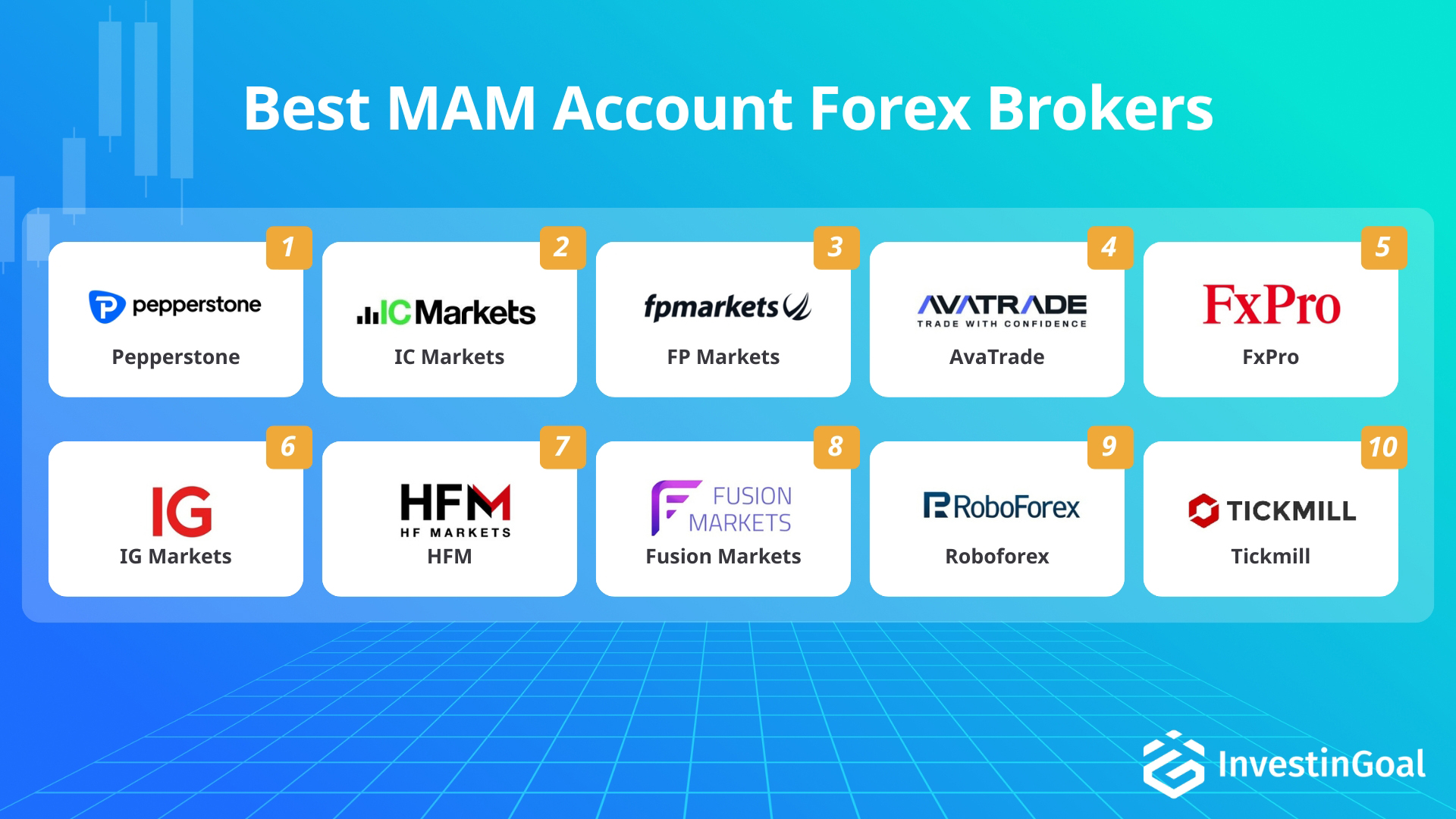
The best Forex brokers for MAM/PAMM are Pepperstone, IC Markets, FP Markets and AvaTrade.
The most important criteria to consider when choosing the best Forex broker for MAM/PAMM are MAM/PAMM platform features and allocation flexibility, trading costs (spreads/commissions), execution quality and platform/tech support, and regulation plus investor/client protections & reporting transparency.
Pepperstone is the best MAM/PAMM Forex broker overall, thanks to offering MAM/PAMM platform features and allocation flexibility, trading costs (spreads/commissions), execution quality and platform/tech support, and regulation plus investor/client protections & reporting transparency.
Ranked just behind Pepperstone, the best MAM/PAMM FX brokers for MAM/PAMM platform strength, pricing, execution/platform support, and regulation/investor safeguards include IC Markets, FP Markets, and AvaTrade. IC Markets showcases ultra-fast ECN-style execution, multi-platform MAM support (MT4/MT5/cTrader) and very tight raw pricing. FP Markets features highly flexible allocation models, stronger investor-facing monitoring/reporting options, and competitive raw-spread pricing. AvaTrade enables a globally regulated, manager-friendly MAM/PAMM setup with flexible allocation options and real-time performance visibility for investors. Some of the best MAM/PAMM brokers—such as Pepperstone, IC Markets, and FP Markets—are also considered the best forex brokers overall because they combine low pricing, rapid execution, mature platforms/tools, and reliable customer support.

Pepperstone
(Best MAM account Forex broker overall)
Pepperstone is the best MAM account Forex broker overall thanks to its MT4/MT5‑integrated MAM/PAMM with customizable management/performance fees and automated high‑water‑mark calculations, micro‑lot trade sizing for proportional allocations, and Razor pricing that can run near 0.0‑pip spreads plus about $7 per round lot. Pepperstone is a top pick for money managers running diversified client books because the high‑water‑mark fee logic automates performance-fee billing on new net profits while the master terminal lets one execute and allocate the same trade across multiple linked accounts in one step. Pepperstone’s MT4/MT5‑integrated MAM/PAMM provides traders with centralized execution and automated P/L plus fee distribution across all sub‑accounts.
-
Regulations:
-
Avg. EUR/USD Spread:
-
Platforms:
Pepperstone Features
The features of Pepperstone are listed below.
- Pepperstone supports MAM and PAMM accounts for approved professional money managers with trade allocation across multiple sub accounts from one interface.
- Pepperstone lets managers set performance fees, management fees, or commissions with automated high water mark fee calculations.
- Pepperstone integrates its MAM with MT4 and MT5 and supports micro lot trading for proportional allocation on smaller accounts.
- Pepperstone is regulated by FCA, ASIC, CySEC, DFSA, CMA, and SCB among others.
- Pepperstone Razor pricing offers spreads near 0.0 pips plus about $7 per round lot commission.
- Pepperstone leverage reaches 1:30 under FCA ASIC CySEC rules and can be higher under offshore entities.
Pepperstone Pros and Cons
Advantages of Pepperstone
The advantages of Pepperstone are listed below.
- Stable raw spreads (0,10 pips on EUR/USD on average)
- Caters for algorithmic trading
- Has won over 30 Forex industry awards
Disadvantages of Pepperstone
The disadvantages of Pepperstone are listed below.
- The demo account is not unlimited
About Pepperstone
Pepperstone is a global forex and CFD broker founded in 2010 in Melbourne, Australia. Pepperstone offers trading on currencies, commodities, indices, stocks, and cryptocurrencies through MetaTrader and cTrader platforms. Pepperstone is regulated by multiple authorities including ASIC, FCA, and CySEC. Pepperstone is known for competitive spreads, fast execution, and extensive educational resources. Pepperstone serves clients in over 160 countries worldwide. The Pepperstone CEO is Tamas Szabo.

IC Markets
(Best MAM account Forex broker for algo traders)
IC Markets is the second best MAM account Forex broker for algo traders due to its sub‑1ms, Tier‑1 liquidity execution built for scalping and HFT allocation, MAM support across MT4, MT5, and cTrader (including FIX API bridging), and no minimum AUM requirement to launch a MAM. IC Markets is a leading option for latency‑sensitive EA managers because its ECN/NDD model pairs fast fills with raw pricing (about 0.1‑pip EUR/USD plus roughly $7 round‑turn commission), helping keep replication and slippage consistent across every client account. IC Markets’ sub‑1ms execution helps traders with synchronized entries and exits when allocating the same strategy to many sub‑accounts.
-
Regulations:
-
Avg. EUR/USD Spread:
-
Platforms:
IC Markets Features
The features of IC Markets are listed below.
- IC Markets provides a MAM and PAMM solution built for algorithmic and high frequency trading with Tier 1 liquidity and sub 1ms latency.
- IC Markets supports MAM across MT4, MT5, and cTrader and also supports FIX API bridging for custom integration.
- IC Markets requires no minimum AUM to start a MAM.
- IC Markets MAM allocation supports balance, equity, lot size, and equal risk methods with an unlimited number of sub accounts.
- IC Markets Raw Spread pricing averages about 0.1 pips on EUR/USD with a $7 round turn commission per lot.
- IC Markets typically runs MAM accounts under offshore entities such as SCB Bahamas or FSA Seychelles rather than FCA ESMA frameworks.
IC Markets Pros and Cons
Advantages of IC Markets
The advantages of IC Markets are listed below.
- Low-latency trading environment
- Institutional level liquidity
- MT4, MT5, cTrader platforms are all available
Disadvantages of IC Markets
The disadvantages of IC Markets are listed below.
- Small amount of educational tools for new traders
- Small range of tradable assets compared to other CFD/Forex brokers
About IC Markets
IC Markets is a global forex and CFD broker founded in 2007 and based in Sydney, Australia. IC Markets offers trading on over 2,250 instruments including currencies, commodities, indices, stocks, and cryptocurrencies. IC Markets provides MetaTrader 4, MetaTrader 5, and cTrader platforms. IC Markets is regulated by multiple authorities including ASIC and CySEC. IC Markets is known for its ECN execution model and low spreads. The IC Markets CEO is Andrew Budzinski.

FP Markets
(Best MAM account Forex broker for white-label services)
FP Markets is the third best MAM account Forex broker for white-label services thanks to its white‑label‑ready PAMM/MAM infrastructure for branded managed‑account programs, multi‑model allocation (equity %, lot volume, or risk ratio) to match different strategy styles, and investor dashboards that show real‑time performance and P/L. FP Markets is a top choice for asset managers building a branded offering because the broker can provide the managed-account plumbing (allocation, reporting, and automation) while also supporting pro-grade connectivity like VPS hosting and FIX API for execution‑sensitive strategies. FP Markets’ white‑label‑ready PAMM/MAM infrastructure provides traders with a turnkey managed‑account backend that reduces the operational work of launching and scaling a MAM service.
-
Regulations:
-
Avg. EUR/USD Spread:
-
Platforms:
FP Markets Features
The features of FP Markets are listed below.
- FP Markets offers a MAM and PAMM program with multiple allocation models including equity percentage, lot volume, and risk ratio.
- FP Markets assigns dedicated support for MAM clients and supports custom setup for professional money managers.
- FP Markets provides an investor dashboard that shows live results and P/L without revealing the underlying trades.
- FP Markets supports VPS services and FIX API connectivity for low latency execution for managed strategies.
- FP Markets allows white labeling of its PAMM infrastructure for independent asset managers.
- FP Markets Raw account pricing can reach 0.0 pips on EUR/USD with a $6 round turn commission per lot.
FP Markets Pros and Cons
Advantages of FP Markets
The advantages of FP Markets are listed below.
- Broad Instrument Offering
- Competitive Spreads
- Multiple Trading Platforms
Disadvantages of FP Markets
The disadvantages of FP Markets are listed below.
- High Fees for International Withdrawals
- Outdated Platform Design
About FP Markets
FP Markets is an Australian-based global forex and CFD broker founded in 2005. FP Markets offers trading on over 10,000 instruments including forex, stocks, indices, commodities, and cryptocurrencies. FP Markets provides MetaTrader 4, MetaTrader 5, and proprietary platforms. FP Markets is regulated by multiple authorities including ASIC, CySEC, and FSA. FP Markets is known for tight spreads, fast execution, and extensive educational resources. The FP Markets CEO is Craig Allison.

AvaTrade
(Best MAM account Forex broker for platform variety)
AvaTrade is the fourth best MAM account Forex broker for platform variety through its multi-platform lineup (MT4, MT5, WebTrader, AvaTradeGO, and AvaOptions), MT4/MT5 MAM/PAMM allocation with balance-, equity-, or lot-based methods, and unlimited sub-account management with 0.01‑lot minimum trade sizing. AvaTrade is a top pick for managers serving clients with different workflows because you can run MAM execution on MetaTrader while investors monitor balances and P/L through the interface they prefer under a broker regulated in 9 jurisdictions. AvaTrade’s multi-platform lineup offers traders flexible access to their managed‑account workflow across desktop, web, and mobile.
-
Regulations:
-
Avg. EUR/USD Spread:
-
Platforms:
AvaTrade Features
The features of AvaTrade are listed below.
- AvaTrade provides PAMM and MAM accounts that allocate trades by client balance, proportional lot size, or equity percentage.
- AvaTrade supports automated management on MetaTrader using Expert Advisors on MT4 and MT5.
- AvaTrade allows unlimited sub accounts under a single manager account.
- AvaTrade supports sub group creation so AvaTrade managers can run separate strategies for different client groups.
- AvaTrade supports micro lot trading with a 0.01 lot minimum trade size on AvaTrade managed accounts.
- AvaTrade offers a $100 minimum deposit for most regions.
AvaTrade Pros and Cons
Advantages of AvaTrade
The advantages of AvaTrade are listed below.
- Tight fixed spreads from 0.6 pips (0.9 pips for retail traders)
- The mobile apps are well designed
- Can be connected to ZuluTrade and Duplitrade
Disadvantages of AvaTrade
The disadvantages of AvaTrade are listed below.
- High inactivity fees
- The demo account is limited to 30 days
About AvaTrade
AvaTrade is a global forex and CFD broker founded in 2006 and headquartered in Dublin, Ireland. AvaTrade offers trading on currencies, commodities, indices, stocks, bonds, ETFs, and cryptocurrencies. AvaTrade provides proprietary platforms alongside MetaTrader 4 and 5. AvaTrade is regulated by multiple authorities including CySEC, ASIC, and FSA. AvaTrade serves over 300,000 clients worldwide. AvaTrade is known for competitive spreads and extensive educational resources. The AvaTrade CEO is David Dryzin since 2016.

FxPro
(Best MAM account Forex broker for allocation flexibility)
FxPro is the fifth best MAM account Forex broker for allocation flexibility because of its six allocation methods (including proportional by equity, proportional by balance, fixed lot, equal risk, and margin-based allocation), built‑in performance‑fee configuration for automated fee handling, and MT4/MT5 master control that can scale across an unlimited number of sub‑accounts. FxPro is a top choice for managers who need consistent risk targeting across uneven client balances since equal‑risk and margin‑based allocation can standardize exposure without manual position-by-position calculations. FxPro’s multi-method allocation engine helps traders with granular control over exactly how each trade is split across managed accounts.
-
Regulations:
-
Avg. EUR/USD Spread:
-
Platforms:
FxPro Features
The features of FxPro are listed below.
- FxPro offers MAM access on MetaTrader so FxPro managers control multiple client accounts from one master login.
- FxPro MAM supports proportional by equity, proportional by balance, fixed lot, equal risk, and margin based allocation methods.
- FxPro allows managers to set a performance fee percentage that FxPro calculates and allocates automatically.
- FxPro MAM can handle an unlimited number of investor accounts.
- FxPro requires a $1,000 minimum investment per managed account for FxPro MAM and PAMM participation.
- FxPro cTrader pricing averages about 0.3 to 0.4 pips on EUR/USD plus a $6 to $7 round lot commission.
FxPro Pros and Cons
Advantages of FxPro
The advantages of FxPro are listed below.
- Regulated and Trusted Forex broker
- Diverse Trading Platforms
- Wide Range of Instruments
Disadvantages of FxPro
The disadvantages of FxPro are listed below.
- Inactivity Fee
- Limited Educational Resources
- No Guaranteed Stop-Loss Orders
About FxPro
FxPro is a global online broker founded in 2006, offering trading on forex, CFDs, stocks, indices, commodities, and cryptocurrencies. FxPro provides multiple trading platforms including MetaTrader 4, MetaTrader 5, cTrader, and its proprietary FxPro Platform. FxPro is regulated by multiple authorities including FCA, CySEC, SCB, FSC and KNN. FxPro serves clients in over 170 countries and has won numerous industry awards. The FxPro CEO is Charalambos Psimolophitis.

IG Markets
(Best MAM account Forex broker for institutional reporting)
IG is the sixth best MAM account Forex broker for institutional reporting thanks to its IG Prime back‑office that produces detailed per‑account reports (orders, P/L, and costs), block‑trade execution that can allocate one fill across multiple client accounts via L2 Dealer or MT4 MAM tooling, and a large‑scale, multi‑regulated operating model designed for professional asset managers. IG is a top choice for compliance-heavy desks because the reporting stack supports audit trails at the sub‑account level while still enabling portfolio-style execution when you need identical pricing across managed accounts. IG’s IG Prime back‑office provides traders with audit-ready reporting and portfolio-level transparency for managed FX accounts.
-
Regulations:
-
Avg. EUR/USD Spread:
-
Platforms:
IG Markets Features
The features of IG Markets are listed below.
- IG provides a managed accounts service for asset managers via IG Prime with multi account trading infrastructure rather than a public PAMM portal.
- IG enables block trade execution across multiple IG client accounts at the same price with proportional allocation.
- IG provides back office reporting so IG managers can review order history, P/L, and account level details across sub accounts.
- IG is regulated by major authorities including FCA, NFA CFTC, BaFin, ASIC, MAS, and FINMA.
- IG has no strict minimum deposit for bank transfers and commonly requires about $250 for card or PayPal deposits.
- IG forex pricing averages about 0.8 to 1.0 pips on EUR/USD with no separate commission.
IG Markets Pros and Cons
Advantages of IG Markets
The advantages of IG Markets are listed below.
- Low spreads from 0.6 pips on Forex
- Wide range of financial instruments
- 40 years of experience in the Forex industry
Disadvantages of IG Markets
The disadvantages of IG Markets are listed below.
- No copy trading features
- No social trading features
About IG Markets
IG Markets is a global online trading provider founded in 1974, offering access to over 17,000 financial markets including forex, stocks, indices, commodities, and cryptocurrencies. IG Markets provides proprietary trading platforms alongside MetaTrader 4 and ProRealTime. IG Markets is regulated by multiple top-tier authorities worldwide, including the FCA and ASIC. IG Markets is known for competitive spreads, extensive educational resources, and innovative features like weekend trading. The IG Markets’ parent company “IG Group” CEO is Breon Corcoran.

HFM
(Best MAM account Forex broker with MAM rankings)
HFM is the seventh best MAM account Forex broker with MAM rankings thanks to its public PAMM performance leaderboard showing returns and drawdown metrics, automated profit allocation with high‑water‑mark success‑fee calculations, and a choice between PAMM Premium (around 1.3 pips on EUR/USD) and PAMM Premium Plus (about 0.4 pip plus $8 per lot commission) pricing. HFM is a top choice for investors who want to screen managers before committing capital because the ranking page makes it easier to compare track records and filter strategies using performance and risk signals. HFM’s public PAMM performance leaderboard provides traders with transparent manager-selection data when choosing a managed forex account.
-
Regulations:
-
Avg. EUR/USD Spread:
-
Platforms:
HFM Features
The features of HFM are listed below.
- HFM runs a PAMM program with a public performance ranking that lets HFM investors compare managers by returns and drawdown.
- HFM PAMM allocates trades proportionally and automatically splits P/L between HFM managers and investors.
- HFM requires $250 minimum deposit for an HFM PAMM Manager account.
- HFM offers PAMM Premium Plus pricing with spreads from about 0.4 pips and an $8 per lot commission.
- HFM offers PAMM Premium pricing with spreads from about 1.3 pips and no commission.
- HFM provides unlimited duration demo accounts on HFM MT4 and MT5.
HFM Pros and Cons
Advantages of HFM
The advantages of HFM are listed below.
- High Leverage Options
- Low Minimum Deposit
- Wide Range of Trading Instruments
Disadvantages of HFM
The disadvantages of HFM are listed below.
- Higher Trading Costs
- Limited Educational Resources
About HFM
HFM, formerly known as HotForex, is a global multi-asset broker founded in 2010. HFM offers trading on forex, stocks, commodities, indices, and cryptocurrencies through MetaTrader and proprietary platforms. HFM is regulated by multiple authorities including FCA, CySEC, and FSCA. HFM is known for competitive spreads, fast execution, and extensive educational resources. HFM serves over 3.5 million clients worldwide. The HF Markets Group CEO is George Koumantaris.

Fusion Markets
(Best MAM account Forex broker for ultra-low costs)
Fusion Markets is the eighth best MAM account Forex broker for ultra-low costs due to Zero account pricing that often runs 0.0–0.2 pip EUR/USD spreads plus $4.50 per round‑turn lot, a disclosed 0.1‑pip MAM execution markup on managed-account trades, and MetaFX MT4 MAM features like unlimited sub‑accounts and partial closes across all linked accounts. Fusion Markets is a top choice for cost-sensitive money managers because holding all‑in trading friction near 0.55 pips can reduce transaction drag on high‑turnover strategies when the same trades are replicated across many client accounts. Fusion Markets’ Zero account pricing helps traders with lower transaction costs per lot, which can improve net performance in MAM portfolios.
-
Regulations:
-
Avg. EUR/USD Spread:
-
Platforms:
Fusion Markets Features
The features of Fusion Markets are listed below.
- Fusion Markets offers a MAM solution on MT4 using the MetaFX MAM plugin for multi account trade management.
- Fusion Markets supports partial position closes across all Fusion Markets sub accounts from the master account.
- Fusion Markets imposes no limit on the number of client accounts in the Fusion Markets MAM.
- Fusion Markets adds a 0.1 pip execution fee on Fusion Markets MAM trades.
- Fusion Markets typically requires about $5,000 balance per Fusion Markets managed sub account.
- Fusion Markets Zero account pricing is typically 0.0 to 0.2 pips on EUR/USD with a $4.50 round turn commission per lot.
Fusion Markets Pros and Cons
Advantages of Fusion Markets
The advantages of Fusion Markets are listed below.
- Low Trading Costs
- Zero Spread Accounts
- Excellent Customer Support
Disadvantages of Fusion Markets
The disadvantages of Fusion Markets are listed below.
- Limited Product Selection
- Basic Educational Resources
About Fusion Markets
Fusion Markets is an Australian-based forex and CFD broker founded in 2019. Fusion Markets offers trading on over 90 currency pairs, stocks, indices, commodities, and cryptocurrencies. Fusion Markets provides MetaTrader 4, MetaTrader 5, and cTrader platforms. Fusion Markets is regulated by ASIC and VFSC. Fusion Markets is known for low trading costs, no minimum deposit, and copy trading services. The Fusion Markets CEO is Phil Horner.

Roboforex
(Best MAM account Forex broker for investor risk controls)
RoboForex is the ninth best MAM account Forex broker for investor risk controls because of its RAMM (Risk Allocation Management Model) settings that let investors scale trade impact or cap risk per strategy, public RAMM/CopyFX rankings that publish performance statistics for due diligence, and low entry options such as a $10 minimum deposit plus cent accounts for small allocations. RoboForex is a top choice for investors who want managed-style exposure with guardrails since RAMM can automatically adjust copied volumes to the investor’s chosen risk level even if the manager trades with higher leverage. RoboForex’s RAMM risk-allocation settings protect traders from outsized drawdowns by enforcing investor-defined risk limits on each followed strategy.
-
Regulations:
-
Avg. EUR/USD Spread:
-
Platforms:
Roboforex Features
The features of Roboforex are listed below.
- RoboForex provides managed style solutions through RoboForex CopyFX and RoboForex RAMM rather than a classic MAM label.
- RoboForex RAMM lets investors set risk limits so RoboForex automatically scales copied trade sizes to the chosen risk level.
- RoboForex RAMM lets strategy providers earn up to 50% performance fee on RoboForex investor profits.
- RoboForex publishes ranking lists for RoboForex CopyFX traders and RoboForex RAMM strategies.
- RoboForex minimum deposit is $10 for most RoboForex account types and RoboForex also offers cent accounts.
- RoboForex Prime pricing can reach about 0.1 pip spreads with a $2 per lot commission on RoboForex Prime accounts.
Roboforex Pros and Cons
Advantages of Roboforex
The advantages of Roboforex are listed below.
- Diverse Trading Platforms
- Wide Range of Instruments
- Low Minimum Deposit
Disadvantages of Roboforex
The disadvantages of Roboforex are listed below.
- Limited Educational Resources
- Higher Spreads on Some Accounts
- Regulatory Concerns
About Roboforex
RoboForex is a global forex and CFD broker founded in 2009, offering trading on currencies, stocks, indices, commodities, and cryptocurrencies. RoboForex provides MetaTrader 4, MetaTrader 5, and proprietary platforms. RoboForex is regulated by the Financial Services Commission (FSC) of Belize. RoboForex is known for competitive spreads, extensive educational resources, and multiple account types. RoboForex serves over 4.5 million clients worldwide. The RoboForex CEO is Andrei Dziarnovich.

Tickmill
(Best MAM account Forex broker for simple MT4 setup)
Tickmill is the tenth best MAM account Forex broker for simple MT4 setup thanks to its straightforward MT4 MAM terminal with proportional balance/equity allocation, the ability to manage an unlimited number of sub‑accounts from one master, and low‑cost Pro account conditions (raw spreads from 0.0 pips plus about $4 round‑turn commission per lot). Tickmill is a top choice for managers who want a no-frills deployment because the balance/equity allocation methods cover the core MAM use-case and Expert Advisors can run on the master account to automate trade replication. Tickmill’s MT4 MAM terminal helps traders with simple, consistent trade distribution across managed accounts without complex configuration.
-
Regulations:
-
Avg. EUR/USD Spread:
-
Platforms:
Tickmill Features
The features of Tickmill are listed below.
- Tickmill offers a MAM program on MT4 where Tickmill managers trade an unlimited number of sub accounts from one master account.
- Tickmill MAM allocation supports proportional by balance and proportional by equity methods.
- Tickmill allows Expert Advisors on the Tickmill MAM master account for automated multi account execution.
- Tickmill specifies about $5,000 minimum equity to open a Tickmill MAM setup.
- Tickmill Pro account pricing starts from 0.0 pips with a $2 per side commission per lot.
- Tickmill requires about $100 minimum deposit to open Tickmill Pro or Tickmill Classic accounts.
Tickmill Pros and Cons
Advantages of Tickmill
The advantages of Tickmill are listed below.
- Regulatory Trust
- Competitive Pricing
- Comprehensive Platform Support
Disadvantages of Tickmill
The disadvantages of Tickmill are listed below.
- Limited Asset Variety
- Higher Costs on Classic Account
- Discontinued Features
About Tickmill
Tickmill is a global multi-asset broker founded in 2014, offering trading on forex, CFDs, stocks, indices, commodities, and cryptocurrencies. Tickmill provides MetaTrader 4, MetaTrader 5, and proprietary platforms. Tickmill is regulated by multiple authorities including FCA, CySEC, and FSCA. Tickmill is known for low spreads, fast execution, and extensive educational resources. Tickmill serves over 500,000 clients worldwide. The Tickmill CEO is Sudhanshu Agarwal.
Comparison of the best MAM account forex brokers
The table that compares the best MAM account forex brokers is shown below.
| Broker | Tier-1 regulator coverage for MAM/PAMM | MAM allocation methods supported | EUR/USD all-in cost per 1.0 lot (pips) | Minimum managed-account entry requirement (USD) | Investor reporting tooling |
|---|---|---|---|---|---|
| Pepperstone | 2 (FCA, ASIC) | N/A | 0.3 pips | N/A | N/A |
| IC Markets | 1 (ASIC) | 4 (balance-%, equity-%, lot, equal-risk) | 0.8 pips | $0 | No (no built-in dashboard) |
| FP Markets | 1 (ASIC) | 3 (equity-%, lot, risk ratio) | 0.6 pips | N/A | Yes (live dashboard) |
| AvaTrade | 3 (Central Bank of Ireland, ASIC, FSA Japan) | 3 (balance-%, proportional lot, equity-%) | 0.9 pips | N/A | Yes (real-time monitoring) |
| FxPro | 3 (FCA, CySEC, FSCA) | 6 (equity-%, balance-%, fixed lot, equal-risk, margin-based, 1 not specified) | 1.0 pips | $1000 | N/A |
| IG | 6 (FCA, NFA/CFTC, BaFin, ASIC, MAS, FINMA) | 1 (proportional by account size) | 0.8 pips | N/A | Yes (back-office reports) |
| HFM | 1 (FCA) | 1 (proportional allocation) | 1.2 pips | $250 | Yes (public rankings, dashboards) |
| Fusion Markets | 1 (ASIC) | 3 (percentage, equity, fixed lot) | 0.55 pips | $5000 | N/A |
| RoboForex | 0 (none mentioned) | 1 (risk-scaled allocation via RAMM) | 0.3 pips | $10 | Yes (rankings, monitoring) |
| Tickmill | 1 (FCA) | 2 (balance-%, equity-%) | 0.5 pips | $5000 | No (no public investor portal) |
Warning
CFDs are complex instruments and come with a high risk of losing money rapidly due to leverage. Between 74-89% of retail investor accounts lose money when trading CFDs. You should consider whether you can afford to take the high risk of losing your money.
The best MAM account broker for beginners is HFM. HFM stands out thanks to its PAMM performance rankings for choosing managers, a very low $5 Micro minimum deposit, and unlimited MT4/MT5 demo accounts. These beginner-friendly tools at HFM make it easy to compare managers before committing, start with minimal capital, and practice strategies risk-free until you’re comfortable.
Easy manager selection, low starting costs, and safe practice tools are often featured in the best MAM brokers for beginners. AvaTrade is an alternative to HFM because it’s heavily regulated, keeps entry accessible with a $100 minimum deposit, and supports MT4/MT5 MAM with real-time investor monitoring. RoboForex is another option versus HFM, since its RAMM model lets investors cap or scale risk, it starts from a $10 minimum deposit, and it provides public rankings for CopyFX/RAMM strategies, which aligns with what many traders look for in the best Forex brokers for beginners.
The best MAM account Forex broker with MT4 is Pepperstone. Pepperstone delivers MT4 MAM/PAMM integration, customizable fees with a high-water-mark structure, and Razor pricing with near-0.0 spreads plus commission. These Pepperstone features suit MT4 money managers who want streamlined allocation, performance-fee alignment, and consistently tight pricing for active trading.
Top MT4 MAM brokers usually prioritize fast execution, flexible account structuring, and low trading costs. A similar alternative to Pepperstone is IC Markets for MT4 MAM with sub-1ms execution, no minimum AUM to start a MAM, and Raw Spread pricing with very low spreads plus commission. Tickmill offers similar features to Pepperstone like an MT4 MAM for unlimited sub-accounts, balance/equity allocation options, and Pro account spreads from 0.0 with low commission, which is why it’s often considered among the best Forex brokers with MT4 for MetaTrader-focused traders.
The best MAM account Forex broker with MT5 is IC Markets. IC Markets offers MT5 MAM support, ultra-fast execution for algo/HFT styles, and no minimum AUM requirement to launch a MAM. These strengths from IC Markets help MT5 managers run automated strategies efficiently, reduce latency-related slippage, and get started without needing a large asset base.
MT5 MAM traders look for robust platform support, manager-friendly fee logic, and dependable oversight in the best MT5 MAM Forex brokers. Pepperstone is an alternative to IC Markets because it combines MT5 MAM/PAMM integration with flexible high-water-mark fee structures and strong multi-jurisdiction regulation. FP Markets offers an MT5-focused MAM setup, multiple allocation models, and an investor dashboard for real-time performance monitoring that make it an alternative to IC Markets and a frequent pick among the best MT5 FX brokers.
The best MAM account broker for CFD is IG. IG excels with a massive CFD lineup (17,000+ instruments), block trades that can be allocated across multiple accounts in an institutional MAM-style approach, and top-tier regulation with strong financial backing. Those IG advantages let managers diversify across markets, execute at scale more efficiently, and inspire confidence for clients focused on CFDs.
Broad product range, reliable execution infrastructure, and professional-grade allocation flexibility of the best CFD MAM brokers are highly regarded by CFD traders. FP Markets is an alternative to IG since it offers thousands of CFDs across asset classes, MAM/PAMM with flexible allocation methods, and FIX API/VPS support for advanced execution. Pepperstone is also compelling compared with IG, offering multi-platform access (MT4/MT5/cTrader/TradingView), low-cost conditions suited to active CFD trading, and MAM/PAMM proportional allocation down to micro-lots, often appearing among the best CFD brokers for traders seeking MAM-ready CFD access.
The best MAM account Forex broker with low minimum deposit is HFM. HFM keeps barriers low with a $5 Micro minimum deposit, a low $100 entry point on its Premium account, and a long-running PAMM program backed by transparent manager rankings. These HFM conditions are ideal when you want to test MAM investing with small amounts, upgrade account types as you scale, and choose managers using clear performance data.
Low-deposit MAM brokers are usually defined by minimal funding requirements, accessible investment structures, and tools that support cautious risk-taking. RoboForex offers similar features to HFM like a $10 minimum deposit, investor-side risk controls through RAMM, and strategy rankings for selection. Pepperstone is another competitor to HFM, offering no strict minimum deposit for live accounts, MT4/MT5 MAM/PAMM support, and demo accounts for practice before committing real funds.
Low-deposit MAM brokers are usually defined by minimal funding requirements, accessible investment structures, and tools that support cautious risk-taking. RoboForex offers similar features to HFM like a $10 minimum deposit, investor-side risk controls through RAMM, and strategy rankings for selection. Pepperstone is another competitor to HFM, offering no strict minimum deposit for live accounts, MT4/MT5 MAM/PAMM support, and demo accounts for practice before committing real funds, and it is often listed among the best low minimum deposit FX broker.
The criteria for choosing the best MAM Account Forex brokers are listed below.
- Regulatory perimeter: Prefer brokers that run MAM under tier-1 supervision (e.g., Financial Conduct Authority, Australian Securities and Investments Commission, Cyprus Securities and Exchange Commission). For example, Pepperstone offers MAM support across multiple regulated entities (including FCA/ASIC/CySEC/Dubai Financial Services Authority), while FxPro and IG emphasize top-tier oversight for professional setups. If a MAM is provided via offshore entities such as Securities Commission of The Bahamas or Financial Services Authority Seychelles, treat it as a different risk tier and require explicit confirmation of client money segregation and investor-protection terms.
- Allocation & fee engine: Require (i) at least 3–4 allocation modes (equity-%, balance-%, fixed lot, risk-normalized) and (ii) automated fee calculation (performance fee, management fee, and/or commission) with high-water-mark logic to prevent double-charging. Pepperstone supports performance/management fees with high-water-mark calculations, while FxPro offers six allocation methods including “equal risk.” AvaTrade and Tickmill illustrate scalability: AvaTrade permits unlimited sub-accounts and 01-lot micro-allocation, whereas Tickmill focuses on balance/equity proportional allocation for straightforward governance. HFM is a useful benchmark for investor alignment because PAMM “success fees” are typically paid only on new net profits.
- Execution & liquidity: Prioritize non-dealing-desk/ECN-style execution, depth of liquidity, and low latency suitable for multi-account block trading. IC Markets targets Tier-1 liquidity with sub-1 ms latency, which is material for scalping or news strategies executed across many sub-accounts. Validate this criterion by reviewing execution statistics (fills/slippage), testing with demos, and confirming VPS/FIX support for latency-sensitive portfolios.
- Platforms & integrations: Choose a broker whose MAM stack matches your operational tooling: MT4/MT5 for MAM plug-ins, optional cTrader for alternative execution, and institutional rails (VPS and FIX API) for automated portfolios. IC Markets supports MT4/MT5/cTrader MAM and FIX API bridging, while FP Markets combines MT platforms with VPS/FIX support and optional white-label managed-account infrastructure. Fusion Markets uses an MT4-based MetaFX MAM plug-in and highlights advanced order controls (e.g., partial closes across sub-accounts).
- All-in trading costs: Quantify total transaction cost per 0 lot on EUR/USD (spread + commission + MAM markup) and model it against expected monthly turnover. Examples: Pepperstone’s Razor pricing can be 0.0-pip spread plus $7 round-turn commission; IC Markets’ Raw Spread pricing averages 0.1 pip with $7 round-turn; Tickmill’s Pro account pairs 0.0-pip spreads with $4 round-turn commissions. Fusion Markets adds a disclosed 0.1-pip MAM execution fee on top of its Zero account (0.0–0.2 pip + $4.50 round-turn). For spread-only models, AvaTrade’s EUR/USD averages 0.9 pip, while HFM’s PAMM Premium is 1.3 pips versus 0.4 pip + $8/lot on Premium Plus.
- Investor transparency tools: Require client-facing reporting that is real-time or near-real-time (equity curve, open exposure, drawdown, fee accrual) plus exportable statements for audit. FP Markets provides an investor dashboard for live monitoring; AvaTrade supports real-time performance monitoring; IG’s back-office reporting is oriented toward professional compliance workflows. HFM and RoboForex stand out for selection controls—HFM publishes public manager rankings, while RoboForex’s RAMM framework lets investors cap risk per strategy. If the broker lacks an integrated investor dashboard, require an equivalent third-party reporting layer before onboarding capital.
- Minimums & scalability: Align broker thresholds with your AUM and client profile, then confirm that allocation works down to micro-lot granularity. Illustrative constraints include $5,000 combined equity to open a Tickmill MAM, $5,000 minimum per “slave” account under Fusion Markets’ MAM, and $1,000 minimum investment per managed account at FxPro; HFM sets a $250 manager-capital minimum for PAMM manager accounts. By contrast, retail account entry points can be low (e.g., $100 at AvaTrade, $200 at IC Markets, AUD 100 at FP Markets), but MAM/PAMM programs often impose higher practical minima—so select the broker whose thresholds match your target investor segment.
The difference between a MAM account and a PAMM account is that a MAM allocates each trade into multiple segregated client accounts, whereas a PAMM allocates results by each investor’s percentage share of a managed pool.
In a MAM (Multi-Account Manager), you keep an individual trading account at the broker, and the manager’s master order is distributed into sub-accounts using rules such as balance-, equity-, fixed-lot, or risk-based allocation. This supports differentiated risk profiles, separate reporting per client, and flexible fee schedules. Performance fees are commonly calculated with a high-water mark so fees apply only to new net profits, and micro-lot sizing (e.g., 0.01 lots) makes proportional allocation feasible even for smaller accounts.
In a PAMM (Percent Allocation Management Module), the manager trades a master account, and your profit/loss is computed from your percentage of the managed capital. PAMM is operationally simpler (one strategy block), but it is typically less configurable than MAM in how trades are allocated across investors.
Both models are usually implemented via a limited power of attorney: the manager can trade but should not be able to withdraw your funds, and your deposits/withdrawals change your allocation ratio over time. Choose MAM for customization; choose PAMM for standardised pooling, aligning with the PAMM account meaning of proportional allocation to each investor’s share.
To verify real trading spreads before picking a MAM account Forex broker, you should measure the all-in trading cost—live bid-ask spread plus commission converted into pips—on the exact account type you would use, over 3–5 trading days and during your usual trading hours. Prefer the account’s real average, not a ‘from 0.0’ marketing quote.
- Open a demo or small live account that matches the pricing model (raw/ECN vs standard) and platform, then test with the managed-account layer enabled; for example, Fusion Markets discloses an added fixed markup on MAM trades.
- Log bid and ask quotes for each target instrument (at least once per second) and collect ≥1,000 observations per instrument; compute the median and 95th-percentile spread, not just the minimum.
- Convert commissions: all-in cost (pips) = average spread (pips) + (round-turn commission ÷ pip value). For EUR/USD, 1 standard lot is about $10 per pip, so a $7 round-turn commission is 0.7 pips.
- Repeat sampling at the European open, the major session overlap, daily rollover, and around scheduled macro news; also compare requested vs executed prices to quantify slippage.
- Cross-check against independent trackers such as Myfxbook and the broker’s published average spreads, and control for latency (e.g., VPS). Accurate cost analysis depends on a clear understanding of the spread in Forex.
The trading account types you should consider when choosing MAM Forex brokers are: (1) the MAM master/sub-account structure, (2) the pricing account you run under that MAM, and (3) any required variants (swap-free, demo, professional).
First, confirm the broker offers a true Multi-Account Manager framework (n: a master account that allocates into client sub-accounts, with allocation modes such as balance, equity, fixed lot, or risk; micro-lot sizing (0.01); automated fee handling (performance and/or management fees), ideally using a high-water-mark methodology; and investor-facing reporting (statements or dashboards) with an auditable trade history.
Second, choose the cost model. A raw-spread/ECN-style account (tight spreads plus per-lot commission) is usually preferable for high-turnover execution (scalping, algorithmic trading), while a spread-only standard account can be adequate for low-frequency portfolios.
Third, add variants only if needed: swap-free (Islamic) terms, a demo that matches live pricing, and (where available) a professional classification if you require higher leverage—recognising this can change protections if the managed-account service is offered by the legal entity you will actually onboard with. Platform compatibility (MT4/MT5 versus cTrader) is part of the same account-type decision.
Pepperstone illustrates this layered selection by pairing a MAM module with multiple allocation methods that align with common Forex trading account types, 0.01-lot minimums, and configurable fees.
The money you need to start investing with MAM Forex brokers is typically $1,000–$5,000. Some brokers accept $100–$200, but many MAM programs require $5,000 per managed sub-account.
Your binding minimum is the maximum of: (1) the broker’s deposit minimum for the account type, (2) the MAM program’s minimum per investor account (if any), and (3) the money manager’s own minimum, which is usually set to match the strategy’s drawdown tolerance.
Concrete program thresholds include Tickmill’s commonly cited $5,000 minimum to open a MAM account and Fusion Markets’ $5,000 minimum deposit per managed slave account. By contrast, some brokers state no formal minimum deposit but still recommend around $1,000 to avoid margin and lot-rounding constraints; for example, FxPro,”forex broker”] recommends an initial $1,000 for smoother position sizing.
For capital planning, treat historical maximum drawdown as binding: if the manager has ever drawn down 20%, capitalise so that a similar drawdown would not force liquidation under margin rules. Budget for fees too: performance fees (often 10–30%) are typically charged only on new highs under a high-water mark, and trading costs (spread plus commission) scale with volume. Micro-lot allocation (0.01 lots) helps, but it does not eliminate stop-out risk in volatility.