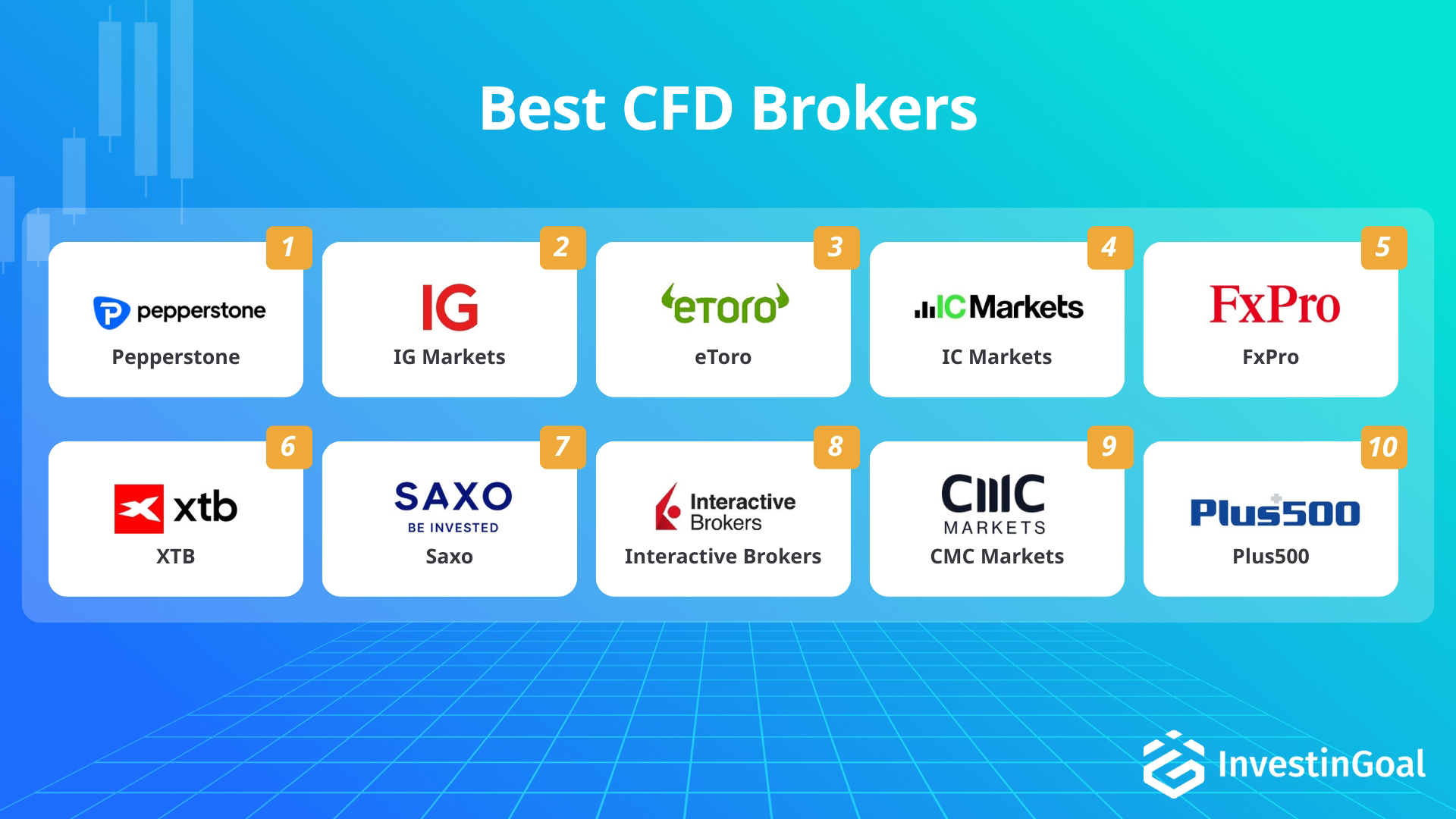
The best Forex brokers for CFD trading are Pepperstone, IG, eToro and IC Markets.
The most important criteria to consider when choosing the best Forex broker for CFD trading are trading costs (spreads/commissions), platform quality & execution speed, regulation and overall trust/safety, and market range plus trading tools (research, copy/algo support, usability).
Pepperstone is the best CFD trading Forex broker overall, thanks to offering very low trading costs, fast and reliable execution with multiple top-tier platforms, strong multi-jurisdiction regulation, and a well-rounded overall package (market coverage plus trader-focused tools).
Ranked just behind Pepperstone, the best CFD trading Forex brokers for cost, platform/execution quality, trust, and overall offering include IG, eToro, and IC Markets. IG showcases exceptional trust and regulation, one of the broadest market selections, and best-in-class proprietary web/mobile platforms plus strong research. eToro includes a highly beginner-friendly platform built around social/copy trading, with strong multi-asset access (especially crypto and stocks/ETFs in many regions). IC Markets supports institutional-style tight pricing and execution, with excellent backing for algorithmic trading through MT4/MT5, cTrader, and TradingView connectivity.
Some of these leaders, including IG, eToro, and IC Markets, are also widely regarded among the top Forex brokers overall thanks to low trading costs, fast execution, and strong customer support.

Pepperstone
(Best CFD Forex broker overall)
Pepperstone is the best CFD Forex broker thanks to low-cost Razor pricing, fast execution speeds, and a platform suite that spans MT4/MT5, cTrader, and TradingView. Pepperstone is an elite option for low-cost, high-speed Forex CFD trading because its Razor account pricing can average about 0.1-pip raw EUR/USD spreads and roughly 0.8 pips all-in after commission, which lowers the barrier to testing Razor pricing on a live account. Pepperstone’s low-cost Razor pricing helps traders with lower transaction costs, which can materially improve net results for scalpers and other high-turnover strategies.
-
Regulations:
-
Avg. EUR/USD Spread:
-
Platforms:
Pepperstone Features
The features of Pepperstone are listed below.
- Pepperstone Razor account averages about 0.1 pips raw on EUR/USD with roughly 0.8 pips all in after commission.
- Pepperstone supports MT4, MT5, cTrader, TradingView, and a proprietary web and mobile platform.
- Pepperstone is built for fast execution with institutional grade liquidity for low latency trading.
- Pepperstone has no minimum deposit requirement to open an account.
- Pepperstone is regulated by top tier authorities including the FCA and ASIC.
- Pepperstone offers forex and CFD markets across indices, commodities, shares, and cryptocurrencies.
Pepperstone Pros and Cons
Advantages of Pepperstone
The advantages of Pepperstone are listed below.
- Stable raw spreads (0,10 pips on EUR/USD on average)
- Caters for algorithmic trading
- Has won over 30 Forex industry awards
Disadvantages of Pepperstone
The disadvantages of Pepperstone are listed below.
- The demo account is not unlimited
About Pepperstone
Pepperstone is a global forex and CFD broker founded in 2010 in Melbourne, Australia. Pepperstone offers trading on currencies, commodities, indices, stocks, and cryptocurrencies through MetaTrader and cTrader platforms. Pepperstone is regulated by multiple authorities including ASIC, FCA, and CySEC. Pepperstone is known for competitive spreads, fast execution, and extensive educational resources. Pepperstone serves clients in over 160 countries worldwide. The Pepperstone CEO is Tamas Szabo.

IG Markets
(Best CFD Forex broker for widest markets)
IG is the second best CFD Forex broker due to nearly 20,000 tradable instruments, strong trust credentials as a long-established publicly traded firm, and a feature-rich proprietary web and mobile platform. IG is an exceptional choice for the widest markets because its nearly 20,000-instrument catalog covers forex (pairs like EUR/USD), indices (such as the S&P 500 and DAX), shares (e.g., Apple and Tesla stock CFDs), commodities (like gold and oil), and crypto CFDs (where permitted), and still keeps core FX pricing competitive, EUR/USD is typically about 0.9–1.0 pips, or around 0.75 pips all-in on eligible DMA. IG’s nearly 20,000-instrument coverage provides traders with breadth, so they can hedge across asset classes and rotate into the most liquid markets without opening multiple accounts.
-
Regulations:
-
Avg. EUR/USD Spread:
-
Platforms:
IG Markets Features
The features of IG Markets are listed below.
- IG offers nearly 20,000 instruments across forex, stocks, indices, commodities, and more.
- IG is regulated by eight Tier 1 regulators including the FCA and ASIC.
- IG standard pricing averages about 0.9 to 1.0 pips on EUR/USD.
- IG Forex Direct delivers roughly 0.75 pips all in on EUR/USD for eligible accounts.
- IG provides a best in class proprietary web platform and mobile app with advanced charting and tools.
- IG supports MT4 with a limited range of about 80 instruments.
IG Markets Pros and Cons
Advantages of IG Markets
The advantages of IG Markets are listed below.
- Low spreads from 0.6 pips on Forex
- Wide range of financial instruments
- 40 years of experience in the Forex industry
Disadvantages of IG Markets
The disadvantages of IG Markets are listed below.
- No copy trading features
- No social trading features
About IG Markets
IG Markets is a global online trading provider founded in 1974, offering access to over 17,000 financial markets including forex, stocks, indices, commodities, and cryptocurrencies. IG Markets provides proprietary trading platforms alongside MetaTrader 4 and ProRealTime. IG Markets is regulated by multiple top-tier authorities worldwide, including the FCA and ASIC. IG Markets is known for competitive spreads, extensive educational resources, and innovative features like weekend trading. The IG Markets’ parent company “IG Group” CEO is Breon Corcoran.

eToro
(Best CFD Forex broker for copy trading)
eToro is the third best CFD Forex broker because of its CopyTrader copy-trading network, a beginner-friendly social platform, and 7,400+ tradable symbols including about 55 forex pairs and 100+ crypto pairs. eToro is an outstanding option for copy trading since its CopyTrader system lets you automatically replicate experienced traders’ positions from the web or mobile app, so beginners can follow a track record and risk profile without building a strategy from scratch. eToro’s CopyTrader copy-trading network offers traders a hands-off way to mirror portfolios, with costs remaining spread-only so fees are mostly embedded in the spread (EUR/USD typically near 1.0 pip).
-
Regulations:
-
Avg. EUR/USD Spread:
-
Platforms:
eToro Features
The features of eToro are listed below.
- eToro CopyTrader lets users automatically copy other traders in real time.
- eToro offers over 7,400 tradeable symbols including about 55 forex pairs.
- eToro typically prices EUR/USD around 1.0 pip with spread only costs and no CFD commissions.
- eToro uses a proprietary web and mobile platform only with no MT4 or MT5 access.
- eToro minimum deposit is about $50 in many regions and can be higher by country.
- eToro offers over 100 crypto pairs where permitted, with restrictions in some jurisdictions.
eToro Pros and Cons
Advantages of eToro
The advantages of eToro are listed below.
- Great copy trading and social trading features
- Wide range of asset classes
- It allows to buy fractional stocks from $10
Disadvantages of eToro
The disadvantages of eToro are listed below.
- The eToro spreads can be high
- Offers only USD accounts
- Transferring cryptocurrencies to other platforms can be hard
About eToro
eToro is a global multi-asset investment platform founded in 2007, offering trading on stocks, ETFs, Crypto CFDs, commodities, and forex. eToro provides a proprietary web and mobile platform with social trading features. eToro is regulated by multiple authorities including FCA, ASIC, and CySEC. eToro is known for its user-friendly interface, copy trading functionality, and commission-free stock trading. eToro serves over 30 million users worldwide. The eToro CEO and co-founder is Yoni Assia.

IC Markets
(Best CFD Forex broker for scalping strategies)
IC Markets is the fourth best CFD Forex broker for its raw-spread, low-latency execution, deep support for MT4/MT5, cTrader, and TradingView, and consistently tight all-in pricing on major pairs. IC Markets is an excellent choice for scalping strategies because its Raw Spread account pricing can show near-zero EUR/USD spreads and deliver about 0.62–0.72 pips all-in after commission, which helps scalpers keep more of each small price move. The raw-spread, low-latency execution of IC Markets helps traders with tighter effective pricing and fewer slippage surprises, especially in fast-moving sessions.
-
Regulations:
-
Avg. EUR/USD Spread:
-
Platforms:
IC Markets Features
The features of IC Markets are listed below.
- IC Markets Raw accounts deliver about 0.6 to 0.7 pips all in on EUR/USD after commissions.
- IC Markets supports MT4, MT5, cTrader, and TradingView connectivity.
- IC Markets is optimized for algorithmic trading with infrastructure designed for low latency execution.
- IC Markets offers over 3,500 CFDs across forex, indices, commodities, stocks, and crypto CFDs.
- IC Markets minimum deposit is $200.
- IC Markets offers leverage up to 1:500 via its offshore entity while EU and Australia leverage is capped by regulation.
IC Markets Pros and Cons
Advantages of IC Markets
The advantages of IC Markets are listed below.
- Low-latency trading environment
- Institutional level liquidity
- MT4, MT5, cTrader platforms are all available
Disadvantages of IC Markets
The disadvantages of IC Markets are listed below.
- Small amount of educational tools for new traders
- Small range of tradable assets compared to other CFD/Forex brokers
About IC Markets
IC Markets is a global forex and CFD broker founded in 2007 and based in Sydney, Australia. IC Markets offers trading on over 2,250 instruments including currencies, commodities, indices, stocks, and cryptocurrencies. IC Markets provides MetaTrader 4, MetaTrader 5, and cTrader platforms. IC Markets is regulated by multiple authorities including ASIC and CySEC. IC Markets is known for its ECN execution model and low spreads. The IC Markets CEO is Andrew Budzinski.

FxPro
(Best CFD Forex broker for platform variety)
FxPro is the fifth best CFD Forex broker thanks to its multi-platform lineup (MT4, MT5, cTrader, and FxPro Edge), access to 2,200+ CFD instruments, and execution data showing over 83% of market orders filled at the requested price or a more favorable price. The multi-platform lineup of FxPro places it among the great options for platform variety, since traders can pick the right interface, MetaTrader (like MT4/MT5) for EAs, cTrader for depth-of-market trading, or FxPro Edge for quick web trading, without opening separate accounts. FxPro’s multi-platform lineup helps traders with flexibility, so they can test and run different Forex CFD workflows under the same broker login.
-
Regulations:
-
Avg. EUR/USD Spread:
-
Platforms:
FxPro Features
The features of FxPro are listed below.
- FxPro supports MT4, MT5, cTrader, and the proprietary FxPro Edge platform.
- FxPro offers over 2,200 CFD instruments across forex, indices, commodities, equities, and crypto.
- FxPro reports more than 83% of market orders filled at the requested price or better in its execution stats.
- FxPro standard account pricing averages about 1.6 pips on EUR/USD.
- FxPro cTrader pricing can bring EUR/USD to roughly 1.3 pips all in on average.
- FxPro minimum deposit is $100.
FxPro Pros and Cons
Advantages of FxPro
The advantages of FxPro are listed below.
- Regulated and Trusted Forex broker
- Diverse Trading Platforms
- Wide Range of Instruments
Disadvantages of FxPro
The disadvantages of FxPro are listed below.
- Inactivity Fee
- Limited Educational Resources
- No Guaranteed Stop-Loss Orders
About FxPro
FxPro is a global online broker founded in 2006, offering trading on forex, CFDs, stocks, indices, commodities, and cryptocurrencies. FxPro provides multiple trading platforms including MetaTrader 4, MetaTrader 5, cTrader, and its proprietary FxPro Platform. FxPro is regulated by multiple authorities including FCA, CySEC, SCB, FSC and KNN. FxPro serves clients in over 170 countries and has won numerous industry awards. The FxPro CEO is Charalambos Psimolophitis.

XTB
(Best CFD Forex broker for in-platform education)
XTB is the sixth best CFD Forex broker through its xStation 5 platform with in-platform education, a Trading Academy with 200+ lessons and webinars, and 7,000+ instruments across forex, indices, commodities, stock CFDs, and ETF CFDs. XTB’s xStation 5 platform with in-platform education provides traders with a structured learning path, linking lessons to practical steps like setting stop-losses and sizing positions in Forex CFDs. XTB is a good choice for in-platform education because xStation 5 learning modules and built-in trading tools (like advanced charting and sentiment data) let newer traders learn a concept and immediately apply it without switching apps.
-
Regulations:
-
Avg. EUR/USD Spread:
-
Platforms:
XTB Features
The features of XTB are listed below.
- XTB provides xStation 5 as its only trading platform with a strong web and mobile experience.
- XTB offers over 7,000 CFD instruments including 2,000 plus stock CFDs and 170 plus ETF CFDs.
- XTB minimum deposit is $0 for most account types.
- XTB typical EUR/USD spread is about 0.9 to 1.0 pips on the standard account.
- XTB does not support MetaTrader platforms.
- XTB provides 200 plus educational lessons and frequent webinars through its academy.
XTB Pros and Cons
Advantages of XTB
The advantages of XTB are listed below.
- No minimum deposit
- Wide selection of assets
- Competitive trading costs
Disadvantages of XTB
The disadvantages of XTB are listed below.
- Small withdrawal fee
- No social or copy trading
- XTB demo account is limited to 30 days
About XTB
XTB is a global forex and CFD broker founded in 2002 and headquartered in Poland. XTB offers trading on over 2,000 instruments including currencies, stocks, indices, commodities, and cryptocurrencies. XTB provides the proprietary xStation platform and is regulated by multiple authorities including FCA, CySEC, and KNF. XTB is listed on the Warsaw Stock Exchange and serves over 897,500 clients worldwide. The XTB CEO is Omar Arnaout since March 2017.

Saxo
(Best CFD Forex broker for premium multi-asset trading)
Saxo is the seventh best CFD Forex broker because of its institutional-grade multi-asset access to 70,000+ instruments, the SaxoTraderGO/PRO platform suite with advanced analytics, and bank-level regulation with tiered accounts (Classic, Platinum, VIP). Saxo is a good option for premium multi-asset trading since it combines 190+ FX pairs with thousands of stock, index, and commodity CFDs, plus tools like Level 2 data and customizable workspaces that make monitoring margin and portfolio risk more precise. The institutional-grade multi-asset access of Saxo offers traders diversification and hedging options, so they can offset currency exposure with index or commodity CFDs when correlations shift.
-
Regulations:
-
Avg. EUR/USD Spread:
-
Platforms:
Saxo Features
The features of Saxo are listed below.
- Saxo offers over 70,000 instruments including a massive CFD and multi asset product range.
- Saxo provides SaxoTraderGO and SaxoTraderPRO with institutional grade tools and workflow.
- Saxo integrates TradingView for trading through TradingView charts with Saxo as the broker.
- Saxo Classic account minimum deposit is $0 with higher tiers requiring about $200,000 for Platinum and about $1,000,000 for VIP.
- Saxo EUR/USD average spread is about 1.1 pips on Classic, about 1.0 pips on Platinum, and about 0.9 pips on VIP.
- Saxo is regulated by multiple top tier authorities across major financial centers.
Saxo Pros and Cons
Advantages of Saxo
The advantages of Saxo are listed below.
- Regulation and Trust
- Extensive Product Range
- Advanced Trading Platform
Disadvantages of Saxo
The disadvantages of Saxo are listed below.
- High Minimum Deposits for Premium Accounts
- Lack of Spread Betting Options
- Custody Fees in Certain Regions
About Saxo
Saxo is a Danish investment bank and online trading platform founded in 1992. Saxo offers trading in forex, stocks, CFDs, futures, options, and other financial instruments across global markets. Saxo provides proprietary trading platforms and white-label solutions for institutional clients. Saxo is regulated by multiple authorities including the Danish FSA and UK FCA. Saxo serves retail and institutional clients in over 170 countries. The Saxo CEO and co-founder is Kim Fournais.

Interactive Brokers
(Best CFD Forex broker for advanced API traders)
Interactive Brokers is the eighth best CFD Forex broker thanks to its professional platforms and API ecosystem (TWS, Client Portal, and APIs), agency-style pricing with low commissions, and access to 150+ markets across 33 countries. Interactive Brokers is a very good option for advanced API traders because its APIs and algorithmic order types enable automated execution and risk management, with FX pricing that can work out to about 0.65 pips all-in on EUR/USD including commissions for frequent rebalancing. Interactive Brokers’ professional platforms and API ecosystem help traders with systematic execution and custom integration, which makes it easier to route orders directly from your own models, backtests, or risk dashboards.
-
Regulations:
-
Avg. EUR/USD Spread:
-
Platforms:
Interactive Brokers Features
The features of Interactive Brokers are listed below.
- Interactive Brokers delivers about 0.5 to 0.6 pips all in on EUR/USD during liquid times after commissions.
- Interactive Brokers provides access to 150 plus markets across 33 countries.
- Interactive Brokers offers Trader Workstation for advanced trading plus a web portal and mobile app for simpler workflows.
- Interactive Brokers supports powerful APIs for automation and third party integrations.
- Interactive Brokers has no minimum deposit requirement for most account types.
- Interactive Brokers CFD availability depends on jurisdiction and is not offered to US residents.
Interactive Brokers Pros and Cons
Advantages of Interactive Brokers
The advantages of Interactive Brokers are listed below.
- Low Trading Fees
- Advanced Trading Tools
- Wide Market Access
Disadvantages of Interactive Brokers
The disadvantages of Interactive Brokers are listed below.
- Not user-friendly
- No MetaTrader Support
- Additional Fees
About Interactive Brokers
Interactive Brokers is a global electronic broker founded in 1978, offering trading in stocks, options, futures, forex, bonds, ETFs, and cryptocurrencies across 150 markets in 33 countries. Interactive Brokers provides advanced trading platforms, low commissions, and access to a wide range of financial instruments. Interactive Brokers is known for its sophisticated technology and serves both retail and institutional clients. Interactive Brokers is regulated by multiple top-tier authorities worldwide. The CEO of the Interactive Brokers Group is Milan Galik.

CMC Markets
(Best CFD Forex broker for FX pair variety)
CMC Markets is the ninth best CFD Forex broker due to its huge FX pair selection of 330+ forex pairs, the Next Generation platform with 80+ indicators and integrated Reuters news, and low spread-only pricing with EUR/USD typically around 0.65 pips. The huge FX pair selection of CMC Markets establishes it as one of the reliable choices for FX pair variety, so traders can express relative-value views across crosses and fine-tune hedges beyond the major pairs. CMC Markets’ huge FX pair selection provides traders with broader cross-hedging and relative-value opportunities, for example building paired positions across EUR/GBP and GBP/USD from one platform.
-
Regulations:
-
Avg. EUR/USD Spread:
-
Platforms:
CMC Markets Features
The features of CMC Markets are listed below.
- CMC Markets averages about 0.65 pips on EUR/USD on its standard spread only pricing.
- CMC Markets offers nearly 12,000 CFDs across forex, shares, indices, commodities, ETFs, and crypto.
- CMC Markets runs the Next Generation platform with advanced charting, pattern tools, and integrated news.
- CMC Markets has no minimum deposit requirement.
- CMC Markets supports MT4 with a limited subset of instruments of roughly 50 markets.
- CMC Markets offers guaranteed stop loss orders on supported markets for gap risk control.
CMC Markets Pros and Cons
Advantages of CMC Markets
The advantages of CMC Markets are listed below.
- Regulatory Trust
- Low Trading Costs
- Extensive Trading Platform
Disadvantages of CMC Markets
The disadvantages of CMC Markets are listed below.
- Complex Fee Structure
- Limited Funding Options
About CMC Markets
CMC Markets is a global online financial trading company founded in 1989 and headquartered in London. CMC Markets offers trading on forex, indices, commodities, cryptocurrencies, and shares through CFDs and spread betting. CMC Markets provides proprietary and MetaTrader platforms for desktop, web, and mobile. CMC Markets is regulated by multiple authorities including FCA, ASIC, and BaFin. CMC Markets is listed on the London Stock Exchange. The CMC Markets CEO is Lord Peter Cruddas.

Plus500
(Best CFD Forex broker for simple mobile trading)
Plus500 is the tenth best CFD Forex broker for its simple proprietary mobile-first platform, a broad menu of roughly 2,800 CFD instruments, and a low-friction setup with an unlimited demo and typical minimum deposits around $100. Plus500 is a good option for simple mobile trading because its streamlined mobile interface includes built-in Insights plus upgraded charting with 100+ indicators, which works well for occasional CFD traders who want straightforward order entry on a phone. The simple proprietary mobile-first platform of Plus500 helps traders with fast navigation and straightforward risk controls, with features like guaranteed stops on supported markets and spread-only pricing so costs are mainly reflected in the spread (EUR/USD often near 1.3 pips).
-
Regulations:
-
Avg. EUR/USD Spread:
-
Platforms:
Plus500 Features
The features of Plus500 are listed below.
- Plus500 uses a proprietary web and mobile platform designed for simple CFD trading.
- Plus500 offers about 2,800 CFD instruments across forex, shares, indices, commodities, ETFs, and crypto CFDs.
- Plus500 minimum deposit is typically about $100 and can be lower in some regions such as €50 by card.
- Plus500 EUR/USD spread averages about 1.2 to 1.3 pips on its standard account.
- Plus500 provides an unlimited demo account with seamless switching between demo and live modes.
- Plus500 offers guaranteed stop orders on supported instruments with a spread premium.
Plus500 Pros and Cons
Advantages of Plus500
The advantages of Plus500 are listed below.
- Well-regulated CFD provider
- Over 2000 tradable CFDs
- Unlimited demo account offered
Disadvantages of Plus500
The disadvantages of Plus500 are listed below.
- Limited Regulatory Protections for Professionals
- Inactivity fees
- Limited deposit methods
About Plus500
Plus500 is a global fintech company founded in 2008, offering online Futures trading services in different markets such as Agriculture, Cryptocurrencies, Metals, Commodities, Forex, Interest Rates, Energy and Equity Indices. Plus500 provides proprietary web and mobile trading platforms. Plus500 is regulated by multiple top-tier authorities including FCA, ASIC, and CySEC. Plus500 is listed on the London Stock Exchange and is a constituent of the FTSE 250 Index. The Plus500 CEO is David Zruia since April 2020.
Comparison of the best CFD brokers
The table that compares the best CFD brokers is shown below.
| Broker | All-in EUR/USD cost (pips) | Total CFD instruments (count) | MetaTrader 4 availability (Yes/No) | Tier-1 regulator count (number) | Minimum deposit (USD) |
|---|---|---|---|---|---|
| Pepperstone | 0.8 pips | N/A | Yes | N/A | $0 |
| IG | 0.9–1.0 pips | 20,000 | Yes (limited 80 instruments) | 8 | N/A (as low as £1) |
| eToro | 1.0 pips | 7,400 | No | N/A | $50 |
| IC Markets | 0.62 pips | 3,500 | Yes | 2 | $200 |
| FxPro | 1.6 pips | 2,200 | Yes | N/A | $100 |
| XTB | 0.9–1.0 pips | 7,000 | No | N/A | $0 |
| Saxo | 1.1 pips | 70,000 | N/A | N/A | $0 |
| Interactive Brokers | 0.65 pips | 8,500 | N/A | N/A | $0 |
| CMC Markets | 0.65 pips | 12,000 | Yes (subset 50 instruments) | N/A | $0 |
| Plus500 | 1.3 pips | 2,800 | N/A | N/A | $100 |
Warning
CFDs are complex instruments and come with a high risk of losing money rapidly due to leverage. Between 74-89% of retail investor accounts lose money when trading CFDs. You should consider whether you can afford to take the high risk of losing your money.
The best CFD broker for beginners is Plus500. Plus500 stands out for its super-simple proprietary platform, a free unlimited demo account, and top-tier regulation backed by a public listing. These strengths from Plus500 help new traders learn the basics in a low-friction environment, practice indefinitely without risking funds, and trade with added peace of mind from strong oversight.
An intuitive interface, demo portfolios for practice, and learning resources are often featured in the best beginner-friendly CFD brokers. eToro is an alternative to Plus500 because it offers CopyTrader copy-trading, a beginner-friendly web/mobile experience, and a virtual portfolio demo for safe practice. XTB is another option versus Plus500, especially since its xStation 5 is easy to navigate, it supports a $0 minimum deposit, and, as one of the most trusted forex brokers for beginners, it provides structured education through its Trading Academy.
The best CFD broker with high leverage is IC Markets. IC Markets is good here thanks to leverage up to 1:500 via its offshore entity, raw-spread accounts designed for very low all-in costs, and broad platform support across MT4/MT5/cTrader/TradingView. This mix at IC Markets can suit leverage-focused traders by enabling larger market exposure, keeping trading costs competitive, and letting them execute through the platform workflow they prefer.
The best high-leverage CFD brokers usually pair access to higher leverage with reliable execution and pricing that doesn’t punish active trading. A similar alternative to IC Markets is Pepperstone, often cited among the best forex brokers with high leverage, for high leverage outside EU/UK rules, Razor pricing with tight all-in costs, and a fast-execution setup with MT4 support. FxPro offers similar features to IC Markets like MT4/MT5/cTrader availability, a no-dealing-desk style execution focus, and flexible account types including Raw+ options.
The best CFD broker for mobile trading apps is IG. IG earns this spot with a best-in-class mobile app, advanced charting and order tools, and a huge market range of around 20,000 instruments. These IG advantages benefit mobile-first traders by making analysis and execution practical on a small screen while still providing plenty of instruments to diversify strategies.
Mobile-first traders look for strong charting, smooth order tickets, and a platform layout that stays consistent across devices in the best mobile CFD brokers. CMC Markets is an alternative to IG because its Next Generation mobile closely mirrors the web platform, it has robust mobile charting and order controls, and it offers a wide CFD lineup of roughly 12,000 markets. XTB is another alternative to IG, with a user-friendly xStation 5 mobile app, rich built-in analysis features, and solid education resources embedded in the trading experience, making it a frequent inclusion among the best apps for forex trading.
The best CFD broker for stocks is Saxo. Saxo is compelling for stock-focused CFD trading thanks to tens of thousands of single-stock CFDs, pro-grade SaxoTraderGO/PRO platforms, and access to real stocks/ETFs alongside CFDs. Those features can help equity traders find more opportunities across regions and sectors, use advanced tools for execution and analysis, and switch between CFD trading and investing depending on their approach.
The best stock-CFD brokers usually offer broad share coverage, professional-grade platforms, and pricing structures that stay efficient for frequent trading. Interactive Brokers is an alternative to Saxo since it provides massive global market access, very low commissions with a tight pricing model, and, as one of the best stock trading platforms, powerful Trader Workstation functionality. IG offers a very large share-CFD offering inside about 20,000 markets, strong research/tools, and high-trust multi-tier regulation that make it an alternative to Saxo.
The best CFD broker for crypto is eToro. eToro works especially well for crypto traders thanks to 100+ crypto pairs (plus some crypto ETFs), the ability to trade as a CFD or buy the underlying where available, and CopyTrader social investing. These eToro capabilities can suit different styles, active CFD speculation, longer-term holding where permitted, or learning by following experienced traders through copy features.
Crypto CFD traders look for 24/7 access, a solid selection of coins, and a fast, stable platform in the best crypto CFD brokers. CMC Markets offers similar features to eToro like 24/7 crypto CFD trading, a large overall product set of around 12,000 CFDs, and the feature-rich Next Generation platform. Plus500 is another alternative to eToro, offering crypto CFDs in a simple proprietary app with spread-only pricing (no commissions) and a free unlimited demo to test crypto strategies before going live. Investors who want spot trading and custody can evaluate fees, coin availability, and mobile tools offered by cryptocurrency exchanges.
The best CFD broker with MT4 is Pepperstone. Pepperstone stands out for MT4 availability alongside multiple platform choices, Razor account pricing built for tight all-in costs, and a strong focus on fast execution. This Pepperstone setup can help MT4 traders run their preferred workflows, keep costs controlled for active strategies, and benefit from quick order handling in faster markets.
The best MT4 CFD brokers usually combine stable MT4 access with competitive pricing and execution quality that supports active trading. IC Markets is an alternative to Pepperstone because it offers MT4 raw-spread account options, a broader platform suite (MT4/MT5/cTrader), and earns frequent mentions among the best MetaTrader 4 forex brokers thanks to its ultra-competitive all-in costs for frequent traders. FxPro is also a credible alternative to Pepperstone, since it supports MT4 alongside MT5/cTrader, emphasizes execution quality, and provides platform-linked account flexibility for different trading styles.
The criteria for choosing the best CFD brokers are listed below.
- Trading costs: Quantify all-in trading costs per instrument and per account type. Benchmark average EUR/USD pricing across brokers (e.g., CMC Markets 0.65 pips, IC Markets 0.62–0.72 pips, Pepperstone Razor 0.8 pips, IG 0.9–1.0 pips / 0.75 pips on Forex Direct, Plus500 1.3 pips, FxPro 1.6 pips). Then extend the same discipline to non-FX CFDs (index spreads, stock-CFD commissions, overnight financing).
- Market breadth: Match your strategy to the broker’s CFD universe in your region. If you need extreme product coverage, prioritize large instrument catalogs (e.g., Saxo 70,000, IG 20,000, CMC Markets 12,000, XTB 7,000, eToro 7,400, IC Markets 3,500, Plus500 2,800). If your edge depends on currency breadth, compare FX-pair depth (e.g., CMC Markets 330+ FX pairs and Saxo 190+ currency pairs).
- Platform stack: Choose the broker whose platform ecosystem fits your workflow and constraints. If you require MetaTrader (MT4/MT5) automation, prioritize Pepperstone, IC Markets, FxPro (IG supports MT4 with a narrower set). If you need cTrader, compare IC Markets and FxPro. If you rely on TradingView, prioritize Pepperstone, IC Markets, Saxo. For proprietary platforms, evaluate IG web/mobile, XTB xStation 5, CMC Next Generation, Plus500 app, and confirm API / custom-indicator support (e.g., Interactive Brokers).
- Execution quality: Require evidence of execution robustness under stress and test it yourself on demo with time-stamped logs. Favor low-latency routing and minimal slippage if you scalp or run EAs (e.g., IC Markets (ECN-style liquidity), Pepperstone (fast execution), Interactive Brokers (agency routing)). Where available, use fill-quality statistics (e.g., FxPro).
- Risk safeguards: Verify mechanical protections and order controls in the exact entity you will open under: negative balance protection, margin closeout rules, and stop functionality. If you trade gap-risk products (indices, volatile equities, crypto), prioritize guaranteed stop-loss capability (e.g., CMC Markets, Plus500) and robust stop-loss / take-profit structures (e.g., eToro).
- Licensing footprint: Prefer brokers with multi-jurisdiction top-tier licensing and corporate transparency, because this affects client-money rules and complaint channels. Examples include publicly listed brokers (IG, CMC Markets, XTB, Plus500) and bank-grade models (Saxo Bank). For global oversight, compare Tier-1 regulator breadth (e.g., IG, Interactive Brokers).
- Account accessibility: Align minimum deposit and access terms with your capital plan, then verify funding/withdrawal friction and platform access. Minimum deposits range from $0 at several brokers (Pepperstone, XTB, Saxo, CMC Markets, Interactive Brokers, and IG $1 in some regions) to higher thresholds (IC Markets $200, FxPro $100, Plus500 $100, and eToro $50+ depending on location). Use these figures to avoid over-committing capital before validating spreads, execution, and platform fit.
The main differences between CFDs and futures are that a contract for difference (CFD) is an over-the-counter (OTC) agreement with your CFD broker as counterparty (often without a fixed expiry), whereas a futures contract is a standardized, exchange-traded derivative cleared through a central clearinghouse with set expiries.
CFDs mirror an underlying price and are typically offered across multiple asset classes (forex, indices, commodities, and share CFDs), but the broker controls quoting, margin, and execution, which introduces broker counterparty and pricing-model risk.
Futures are listed on regulated venues (e.g., CME Group) with standardized contract size, tick value, and settlement terms. Positions are marked-to-market and margined daily, and the clearinghouse becomes the effective counterparty, generally reducing bilateral counterparty risk.
Cost mechanics differ. CFDs typically charge a spread and/or commission plus overnight financing (“swap”) on leveraged positions. Futures charge exchange/broker fees and embed financing in the futures curve (cost of carry), so holding costs and benefits often appear as roll yield when you move between expiries.
Risk management differs too. CFD margin and negative-balance rules depend on jurisdiction and broker policy, while futures use exchange/clearinghouse margin with potentially frequent variation-margin calls. Market transparency also differs: futures have centralized order books and volume, while CFD liquidity and pricing are broker-dependent.
To compare spreads, commissions, and swaps across CFD brokers, you should convert them into one all-in cost per instrument and holding period. All-in (pips) = average spread + commission-in-pips + (swap per day × days)/pip value.
Start with a benchmark instrument (commonly EUR/USD) and the exact account type. Use average spreads from normal trading hours, not “from 0.0” minima, because variable spreads widen in news, illiquid sessions, and around rollovers. Convert commissions into pips using pip value. For EUR/USD, 1 standard lot has a $10 pip value, so a $6 round-turn commission equals 0.6 pips, a $7 round-turn equals 0.7 pips.
Then add financing (the carry cost). Record both long and short swap rates, apply the broker’s rollover conventions (FX commonly applies a triple-swap on one weekday), and multiply by your expected holding days to reflect how swap in trading determines the financing cost.
Finally, translate pips into money. All-in cash cost = all-in pips × pip value × your lot size, and repeat for indices, stock CFDs, and commodities where financing and commissions can dominate. Include non-trading frictions (currency conversion, inactivity fees, rebates). Grasping the basics, what does spread mean in forex, will keep your cost model consistent. As anchors, typical EUR/USD all-in costs range from 0.62–0.72 pips on raw-spread accounts at some brokers to 1.3–1.6 pips on spread-only models at others.
Yes, regulations are important when choosing a CFD broker because they determine your legal protections, the broker’s conduct standards, and the leverage and risk controls you will actually receive.
Prefer brokers supervised by top-tier authorities (e.g., the UK Financial Conduct Authority (FCA), Australia’s ASIC, Singapore’s MAS, or EU regulators applying ESMA standards), because these regimes typically require client-money segregation, capital adequacy, complaints handling, and periodic reporting.
For retail CFD trading in much of Europe, ESMA-style product intervention sets leverage caps (e.g., 30:1 on major FX down to 2:1 on the most volatile underlyings), a margin close-out rule, standardized risk warnings, and negative balance protection, so you should not be liable for losses beyond your CFD account balance.
Because global brands run multiple legal entities, verify which entity will hold your account and whether you are being pushed into “professional” status that can remove protections and increase risk. Treat regulatory status as non-negotiable. Counterparty risk is best controlled by assessing the standing and track records of forex broker regulators across relevant jurisdictions.
To compare trading platforms offered by different CFD brokers, you should score each platform against your strategy’s requirements across execution, analytics, automation, product coverage, and operational resilience, then choose the highest-fit platform.
Execution features are primary. Check order types (market/limit/stop, trailing stops, partial fills), slippage controls, and whether tools like guaranteed stop-loss orders exist on supported markets. Confirm depth-of-market, and any direct-market-access (DMA) style routing where available.
Automation and integration matter most for systematic trading. MetaTrader 4/5 (MT4/MT5) support Expert Advisors and custom indicators, cTrader supports cBots via cTrader Automate, TradingView integrations let you trade from TradingView charts when your broker supports it.
Next, assess analytics and workflow. Compare charting (indicators, multi-timeframe, templates), backtesting/strategy testing, watchlists, alerts, and built-in research/news. Proprietary platforms vary widely (e.g., IG web, CMC Next Generation, XTB xStation, SaxoTraderGO/PRO, IBKR Trader Workstation). Traders should consider latency, uptime, and availability of deep liquidity when selecting a platform for Forex trading, as these factors directly affect order quality.
Finally, validate platform-market fit with concrete broker checks. Some brokers offer MT4/MT5 plus cTrader and TradingView, others are proprietary-only, and social platforms emphasize copy trading over automation. Test on demo for latency, mobile parity, VPS compatibility, stability under volatility, and whether the platform exposes the exact instruments you plan to trade.