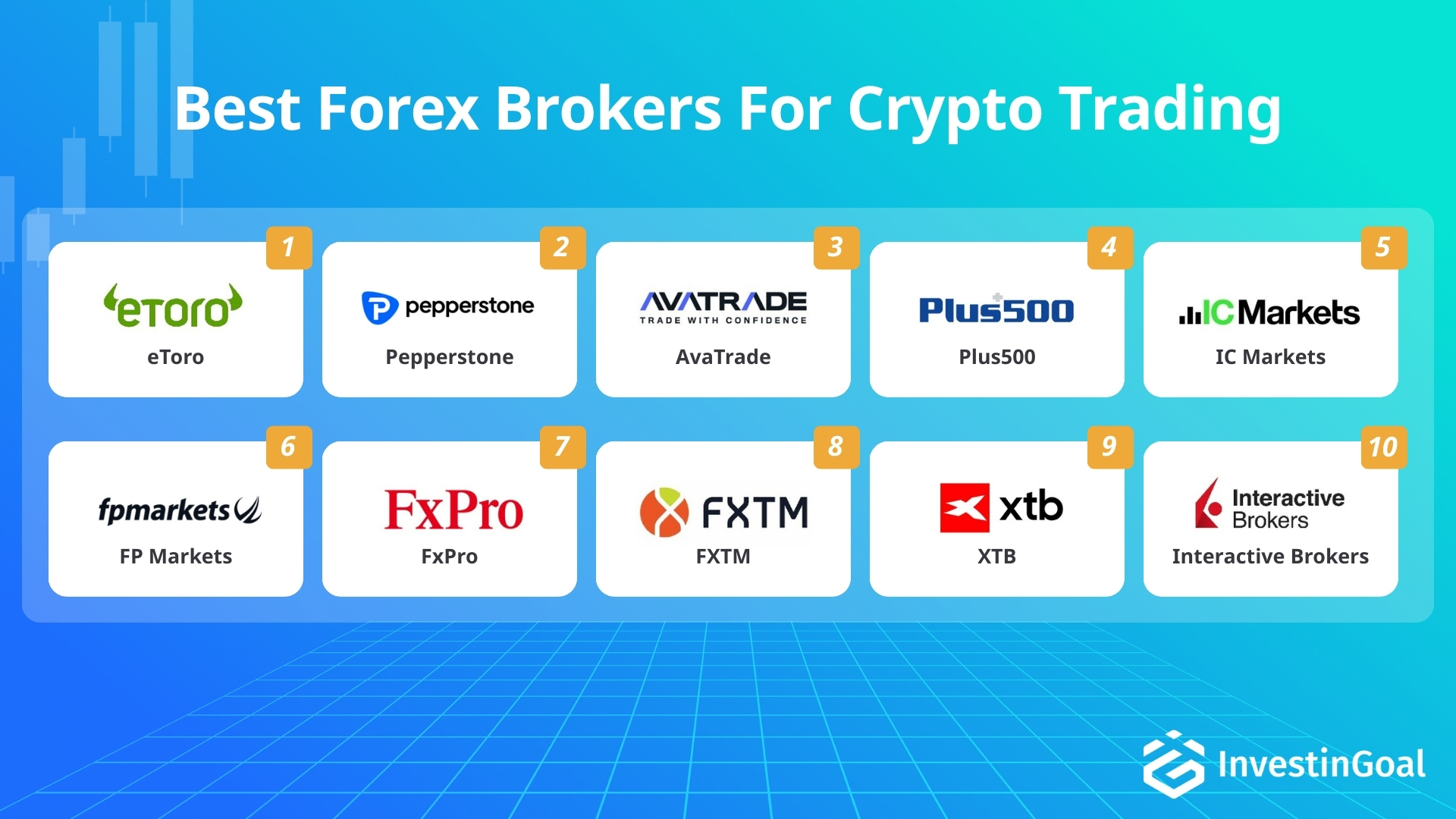
The best Forex brokers for crypto CFD trading are eToro, Pepperstone, AvaTrade and Plus500.
The most important criteria to consider when choosing the best Forex broker for crypto CFD trading are regulation & client-fund safety, trading costs (spreads/fees/commissions), crypto market access (coin selection + 24/7 availability), and platform features (ease of use, tools like copy trading, and risk-management options).
eToro is the best crypto CFD trading FX broker overall, thanks to offering regulation & client-fund safety, competitive and transparent trading costs, broad crypto market access, and strong platform features (including social/copy trading and easy risk tools).
Ranked just behind eToro, the best crypto CFD trading Forex brokers for regulation, pricing, crypto-market access, and platform quality include Pepperstone, AvaTrade, and Plus500. Pepperstone showcases tight pricing, fast execution, MT4/MT5/cTrader/TradingView support, and 24/7 crypto CFD trading. AvaTrade includes strong regulation, 24/7 crypto CFD markets, MT4/MT5 plus proprietary platforms, and added risk tools. Plus500 features a simple proprietary platform, a wide 24/7 crypto CFD lineup, and beginner-friendly risk controls. Some of the best crypto CFD trading Forex brokers—such as eToro, Pepperstone, and AvaTrade—combine competitive pricing, robust platforms and tools, fast execution, and responsive customer support, which is why they are also widely regarded among the best forex brokers.

eToro
(Best crypto trading Forex broker overall)
eToro is the best crypto trading Forex broker overall thanks to CopyTrader social trading, support for 70+ cryptocurrencies globally (100+ for US clients), and a transparent 1% fee on crypto buys and sells. eToro is a top pick for copy-based crypto trading alongside FX because CopyTrading lets you mirror experienced traders from a single web and mobile platform, with CopyTrading starting from $200 and a minimum deposit that can be as low as $50 depending on region. eToro’s CopyTrader social trading provides traders with hands-free strategy replication and portfolio diversification across major coins without needing an external crypto wallet.
-
Regulations:
-
Avg. EUR/USD Spread:
-
Platforms:
eToro Features
The features of eToro are listed below.
- eToro offers CopyTrader social trading that lets users copy crypto traders on the platform.
- eToro lists 70 plus cryptocurrencies globally and 100 plus cryptocurrencies for U.S. clients.
- eToro supports direct crypto purchases in supported regions and crypto CFD trading where permitted.
- eToro charges a 1% fee on crypto trades on top of the market spread.
- eToro minimum deposit starts from $50 in some regions and rises to $200 in others.
- eToro provides a $100,000 virtual portfolio demo account.
eToro Pros and Cons
Advantages of eToro
The advantages of eToro are listed below.
- Great copy trading and social trading features
- Wide range of asset classes
- It allows to buy fractional stocks from $10
Disadvantages of eToro
The disadvantages of eToro are listed below.
- The eToro spreads can be high
- Offers only USD accounts
- Transferring cryptocurrencies to other platforms can be hard
About eToro
eToro is a global multi-asset investment platform founded in 2007, offering trading on stocks, ETFs, Crypto CFDs, commodities, and forex. eToro provides a proprietary web and mobile platform with social trading features. eToro is regulated by multiple authorities including FCA, ASIC, and CySEC. eToro is known for its user-friendly interface, copy trading functionality, and commission-free stock trading. eToro serves over 30 million users worldwide. The eToro CEO and co-founder is Yoni Assia.

Pepperstone
(Best crypto trading Forex broker for TradingView)
Pepperstone is the second best crypto trading Forex broker for TradingView due to its TradingView integration, 24/7 crypto CFD markets across nearly 20 coins, and tight crypto CFD spreads such as BTC/USD from about $15 and ETH/USD from about $2. Pepperstone is a leading option for TradingView-first traders because you can place and manage crypto CFD orders directly from TradingView charts while still having MT4, MT5, and cTrader available for advanced workflows, and it has no fixed minimum deposit requirement. Pepperstone’s TradingView integration helps traders with chart-to-order execution and alert-driven entries when crypto markets keep moving on weekends.
-
Regulations:
-
Avg. EUR/USD Spread:
-
Platforms:
Pepperstone Features
The features of Pepperstone are listed below.
- Pepperstone offers crypto CFD trading on Bitcoin, Ethereum, and nearly 20 other coins.
- Pepperstone supports 24/7 crypto CFD markets with weekend availability.
- Pepperstone provides retail crypto CFD leverage up to 1:2 in eligible jurisdictions.
- Pepperstone lists BTC/USD spreads from about $15 and ETH/USD spreads from about $2 on crypto CFDs.
- Pepperstone offers MT4, MT5, cTrader, TradingView, and a web platform for crypto CFD trading.
- Pepperstone sets no fixed minimum deposit for live accounts.
Pepperstone Pros and Cons
Advantages of Pepperstone
The advantages of Pepperstone are listed below.
- Stable raw spreads (0,10 pips on EUR/USD on average)
- Caters for algorithmic trading
- Has won over 30 Forex industry awards
Disadvantages of Pepperstone
The disadvantages of Pepperstone are listed below.
- The demo account is not unlimited
About Pepperstone
Pepperstone is a global forex and CFD broker founded in 2010 in Melbourne, Australia. Pepperstone offers trading on currencies, commodities, indices, stocks, and cryptocurrencies through MetaTrader and cTrader platforms. Pepperstone is regulated by multiple authorities including ASIC, FCA, and CySEC. Pepperstone is known for competitive spreads, fast execution, and extensive educational resources. Pepperstone serves clients in over 160 countries worldwide. The Pepperstone CEO is Tamas Szabo.

AvaTrade
(Best crypto trading Forex broker for risk tools)
AvaTrade is the third best crypto trading Forex broker for risk tools because of AvaProtect, crypto CFD leverage up to 5:1 in eligible jurisdictions, and platform coverage via MT4, MT5, WebTrader, and the AvaTradeGO app. AvaTrade is an ideal choice for defined-risk crypto CFD trading since AvaProtect can cover a position against losses for a selected time window, which is valuable when Bitcoin and Ethereum volatility spikes, and the typical minimum deposit is $100. AvaTrade’s AvaProtect protects traders from sudden downside shocks by capping losses on covered crypto CFD trades.
-
Regulations:
-
Avg. EUR/USD Spread:
-
Platforms:
AvaTrade Features
The features of AvaTrade are listed below.
- AvaTrade offers crypto CFD trading on major coins including Bitcoin and Ethereum.
- AvaTrade supports 24/7 crypto CFD trading.
- AvaTrade provides up to 5:1 leverage on crypto CFDs in eligible jurisdictions.
- AvaTrade offers MT4, MT5, WebTrader, and AvaTradeGO for crypto CFD trading.
- AvaTrade uses spread only pricing with no separate trading commission on crypto CFDs.
- AvaTrade minimum deposit is $100.
AvaTrade Pros and Cons
Advantages of AvaTrade
The advantages of AvaTrade are listed below.
- Tight fixed spreads from 0.6 pips (0.9 pips for retail traders)
- The mobile apps are well designed
- Can be connected to ZuluTrade and Duplitrade
Disadvantages of AvaTrade
The disadvantages of AvaTrade are listed below.
- High inactivity fees
- The demo account is limited to 30 days
About AvaTrade
AvaTrade is a global forex and CFD broker founded in 2006 and headquartered in Dublin, Ireland. AvaTrade offers trading on currencies, commodities, indices, stocks, bonds, ETFs, and cryptocurrencies. AvaTrade provides proprietary platforms alongside MetaTrader 4 and 5. AvaTrade is regulated by multiple authorities including CySEC, ASIC, and FSA. AvaTrade serves over 300,000 clients worldwide. AvaTrade is known for competitive spreads and extensive educational resources. The AvaTrade CEO is David Dryzin since 2016.

Plus500
(Best crypto trading Forex broker for simple app)
Plus500 is the fourth best crypto trading Forex broker for a simple app thanks to its proprietary web and mobile platform, 24/7 access to dozens of crypto CFDs, and built-in risk controls like price alerts and guaranteed stop-loss orders. Plus500 is a strong choice for straightforward crypto CFD trading because it keeps everything commission-free and spread-based, so you can go long or short without setting up MT4 or MT5 or managing a crypto wallet, with a $100 minimum deposit and an unlimited demo account. Plus500’s proprietary platform provides traders with a clean order ticket and clear margin and financing displays for leveraged crypto positions.
-
Regulations:
-
Avg. EUR/USD Spread:
-
Platforms:
Plus500 Features
The features of Plus500 are listed below.
- Plus500 offers dozens of cryptocurrency CFDs including major coins and many altcoins.
- Plus500 provides 24/7 crypto CFD trading with a brief Sunday maintenance pause.
- Plus500 supports long and short crypto CFD positions from the same platform.
- Plus500 charges zero trading commission and prices crypto CFDs through the spread.
- Plus500 minimum deposit is $100 for most payment methods.
- Plus500 provides an unlimited demo account that can be reset.
Plus500 Pros and Cons
Advantages of Plus500
The advantages of Plus500 are listed below.
- Well-regulated CFD provider
- Over 2000 tradable CFDs
- Unlimited demo account offered
Disadvantages of Plus500
The disadvantages of Plus500 are listed below.
- Limited Regulatory Protections for Professionals
- Inactivity fees
- Limited deposit methods
About Plus500
Plus500 is a global fintech company founded in 2008, offering online Futures trading services in different markets such as Agriculture, Cryptocurrencies, Metals, Commodities, Forex, Interest Rates, Energy and Equity Indices. Plus500 provides proprietary web and mobile trading platforms. Plus500 is regulated by multiple top-tier authorities including FCA, ASIC, and CySEC. Plus500 is listed on the London Stock Exchange and is a constituent of the FTSE 250 Index. The Plus500 CEO is David Zruia since April 2020.

IC Markets
(Best crypto trading Forex broker for algorithmic traders)
IC Markets is the fifth best crypto trading Forex broker for algorithmic traders thanks to Raw Spread ECN execution, MT4/MT5 plus cTrader and TradingView support, and Raw-account pricing with spreads averaging about 0.1 pip on EUR/USD plus a $6–$7 per lot round turn commission. IC Markets is a go-to for crypto CFD bots and scalping systems because its deep liquidity and fast execution infrastructure can reduce spread drag and slippage when algorithms trade fast-moving pairs like BTC/USD, with a $200 minimum deposit and free VPS access for eligible high-volume traders. IC Markets’ Raw Spread execution provides traders with lower trading friction, which can matter when an automated strategy places many crypto trades per week.
-
Regulations:
-
Avg. EUR/USD Spread:
-
Platforms:
IC Markets Features
The features of IC Markets are listed below.
- IC Markets offers 10 to 20 crypto CFDs including Bitcoin and Ethereum.
- IC Markets provides retail crypto CFD leverage up to 1:5 in eligible jurisdictions.
- IC Markets offers Raw Spread pricing with near zero spreads plus about $6 to $7 per lot round turn commission.
- IC Markets supports MT4, MT5, cTrader, and TradingView for crypto CFD trading.
- IC Markets uses high liquidity no dealing desk execution designed for fast fills.
- IC Markets minimum deposit is $200.
IC Markets Pros and Cons
Advantages of IC Markets
The advantages of IC Markets are listed below.
- Low-latency trading environment
- Institutional level liquidity
- MT4, MT5, cTrader platforms are all available
Disadvantages of IC Markets
The disadvantages of IC Markets are listed below.
- Small amount of educational tools for new traders
- Small range of tradable assets compared to other CFD/Forex brokers
About IC Markets
IC Markets is a global forex and CFD broker founded in 2007 and based in Sydney, Australia. IC Markets offers trading on over 2,250 instruments including currencies, commodities, indices, stocks, and cryptocurrencies. IC Markets provides MetaTrader 4, MetaTrader 5, and cTrader platforms. IC Markets is regulated by multiple authorities including ASIC and CySEC. IC Markets is known for its ECN execution model and low spreads. The IC Markets CEO is Andrew Budzinski.

FP Markets
(Best crypto trading Forex broker for cTrader)
FP Markets is the sixth best crypto trading Forex broker for cTrader thanks to its cTrader platform access, 12+ cryptocurrency CFDs including BTC and ETH, and ECN-style Raw account pricing designed for low-spread trading. FP Markets is a top pick for cTrader users because cTrader’s depth-of-market tools and clean interface pair with Raw-account spreads that can be near zero on major FX pairs plus a $6 per lot commission, and live accounts typically start from a $100 minimum deposit. FP Markets’ cTrader offering provides traders with advanced order management and execution transparency for volatile crypto CFD moves.
-
Regulations:
-
Avg. EUR/USD Spread:
-
Platforms:
FP Markets Features
The features of FP Markets are listed below.
- FP Markets offers 12 plus cryptocurrency CFDs including Bitcoin and Ethereum.
- FP Markets provides retail crypto CFD leverage up to 1:2 in eligible jurisdictions.
- FP Markets offers Raw account pricing with near zero spreads plus about $6 per lot commission.
- FP Markets supports MT4, MT5, cTrader, and TradingView integration for crypto CFD trading.
- FP Markets provides analysis add ons including Autochartist and Trading Central.
- FP Markets minimum deposit is $100.
FP Markets Pros and Cons
Advantages of FP Markets
The advantages of FP Markets are listed below.
- Broad Instrument Offering
- Competitive Spreads
- Multiple Trading Platforms
Disadvantages of FP Markets
The disadvantages of FP Markets are listed below.
- High Fees for International Withdrawals
- Outdated Platform Design
About FP Markets
FP Markets is an Australian-based global forex and CFD broker founded in 2005. FP Markets offers trading on over 10,000 instruments including forex, stocks, indices, commodities, and cryptocurrencies. FP Markets provides MetaTrader 4, MetaTrader 5, and proprietary platforms. FP Markets is regulated by multiple authorities including ASIC, CySEC, and FSA. FP Markets is known for tight spreads, fast execution, and extensive educational resources. The FP Markets CEO is Craig Allison.

FxPro
(Best crypto trading Forex broker for fast execution)
FxPro is the seventh best crypto trading Forex broker for fast execution because of its no dealing desk model, order execution around 13 milliseconds, and 24/7 crypto CFD trading across 20+ crypto pairs. FxPro is a strong choice for short-term crypto CFD traders since its NDD setup streams liquidity-provider pricing on MT4, MT5, cTrader, and FxPro Edge, helping reduce requotes when prices move quickly, with a minimum deposit commonly set at $100. FxPro’s no dealing desk execution provides traders with low-latency fills and fewer execution interruptions during sharp crypto swings.
-
Regulations:
-
Avg. EUR/USD Spread:
-
Platforms:
FxPro Features
The features of FxPro are listed below.
- FxPro offers 20 plus crypto CFD pairs against USD.
- FxPro supports 24/7 crypto CFD trading including weekends.
- FxPro runs no dealing desk execution with reported average execution around 13 milliseconds.
- FxPro supports MT4, MT5, cTrader, and the FxPro Edge platform for crypto CFD trading.
- FxPro offers Raw style accounts with tight spreads plus commission for lower all in costs.
- FxPro minimum deposit is $100 for most account types.
FxPro Pros and Cons
Advantages of FxPro
The advantages of FxPro are listed below.
- Regulated and Trusted Forex broker
- Diverse Trading Platforms
- Wide Range of Instruments
Disadvantages of FxPro
The disadvantages of FxPro are listed below.
- Inactivity Fee
- Limited Educational Resources
- No Guaranteed Stop-Loss Orders
About FxPro
FxPro is a global online broker founded in 2006, offering trading on forex, CFDs, stocks, indices, commodities, and cryptocurrencies. FxPro provides multiple trading platforms including MetaTrader 4, MetaTrader 5, cTrader, and its proprietary FxPro Platform. FxPro is regulated by multiple authorities including FCA, CySEC, SCB, FSC and KNN. FxPro serves clients in over 170 countries and has won numerous industry awards. The FxPro CEO is Charalambos Psimolophitis.

FXTM
(Best crypto trading Forex broker for education)
FXTM is the eighth best crypto trading Forex broker for education thanks to its training materials and market analysis, MetaTrader 4 and 5 support for about 10–11 crypto CFDs, and flexible pricing via Advantage (raw spreads plus commission) or Advantage Plus (spread-only). FXTM is an ideal choice for learning-focused crypto CFD trading because its educational resources and regular commentary help traders understand volatility, leverage limits, and risk management before they execute on MT4 or MT5, with a typical minimum deposit around $200 for its main account types. FXTM’s education and research help traders with clearer trade plans and more disciplined position sizing in 24/7 crypto markets.
-
Regulations:
-
Avg. EUR/USD Spread:
-
Platforms:
FXTM Features
The features of FXTM are listed below.
- FXTM offers about 10 to 11 crypto CFDs on major cryptocurrencies.
- FXTM provides MT4 and MT5 access for crypto CFD trading.
- FXTM offers an Advantage account with near zero FX spreads plus about $7 per lot round turn commission.
- FXTM supports FXTM Invest copy trading for following strategy managers on the platform.
- FXTM publishes frequent education and market analysis that covers crypto markets.
- FXTM minimum deposit is $200 on its main account types.
FXTM Pros and Cons
Advantages of FXTM
The advantages of FXTM are listed below.
- User-Friendly Platform
- Fast Customer Support
- Low Minimum Deposit
Disadvantages of FXTM
The disadvantages of FXTM are listed below.
- Withdrawal Fees
- Limited Product Range
- Inactivity Fees
About FXTM
FXTM, also known as ForexTime, is a global forex and CFD broker founded in 2011. FXTM offers trading on currencies, commodities, indices, stocks, and cryptocurrencies through MetaTrader 4, MetaTrader 5, and proprietary platforms. FXTM is regulated by multiple authorities including CySEC, FCA, and FSC Mauritius. FXTM is known for low spreads, fast execution, and extensive educational resources. FXTM serves over 2 million clients worldwide. The FXTM CEO is Nicholas Defteras.

XTB
(Best crypto trading Forex broker for no overnight fees)
XTB is the ninth best crypto trading Forex broker for no overnight fees thanks to its zero swap policy on crypto CFDs, the xStation 5 web and mobile platform with tools like sentiment and a trade calculator, and no minimum deposit requirement. XTB is a top pick for holding crypto CFD positions since it removed overnight financing on crypto CFDs, so multi-day trades are mainly affected by spread and price movement rather than daily swap charges. XTB’s zero overnight fees protect traders from avoidable carry costs, which can materially reduce total costs for swing and position strategies.
-
Regulations:
-
Avg. EUR/USD Spread:
-
Platforms:
XTB Features
The features of XTB are listed below.
- XTB offers dozens of crypto CFDs including major coins and many altcoins.
- XTB provides retail crypto CFD leverage up to 1:2 in eligible jurisdictions.
- XTB charges no overnight swap fees on crypto CFD positions.
- XTB prices crypto CFD trading with no separate commission and costs built into the spread.
- XTB runs its xStation 5 platform on web, desktop, and mobile for crypto CFD trading.
- XTB sets no fixed minimum deposit requirement.
XTB Pros and Cons
Advantages of XTB
The advantages of XTB are listed below.
- No minimum deposit
- Wide selection of assets
- Competitive trading costs
Disadvantages of XTB
The disadvantages of XTB are listed below.
- Small withdrawal fee
- No social or copy trading
- XTB demo account is limited to 30 days
About XTB
XTB is a global forex and CFD broker founded in 2002 and headquartered in Poland. XTB offers trading on over 2,000 instruments including currencies, stocks, indices, commodities, and cryptocurrencies. XTB provides the proprietary xStation platform and is regulated by multiple authorities including FCA, CySEC, and KNF. XTB is listed on the Warsaw Stock Exchange and serves over 897,500 clients worldwide. The XTB CEO is Omar Arnaout since March 2017.

Interactive Brokers
(Best crypto trading Forex broker for low crypto fees)
Interactive Brokers is the tenth best crypto trading Forex broker for low crypto fees due to spot crypto commissions of about 18–20 basis points of trade value, institutional-style FX pricing such as EUR/USD spreads around one-tenth of a pip plus about $2 per $100,000 traded, and the Trader Workstation platform for advanced order types. Interactive Brokers is a leading option for cost-focused crypto traders because its low percentage-based commissions can keep transaction costs small on $10,000+ crypto orders, and cash accounts have a $0 minimum deposit for getting started. Interactive Brokers’ spot crypto commission provides traders with lower per-trade friction, which is especially valuable when rebalancing or scaling in and out frequently.
-
Regulations:
-
Avg. EUR/USD Spread:
-
Platforms:
Interactive Brokers Features
The features of Interactive Brokers are listed below.
- Interactive Brokers supports spot crypto trading in supported jurisdictions through regulated partners.
- Interactive Brokers charges crypto commissions around 0.18% to 0.20% of trade value on spot crypto.
- Interactive Brokers offers crypto exposure through products like futures and exchange traded crypto instruments where available.
- Interactive Brokers provides Trader Workstation for advanced order types and multi asset portfolio trading.
- Interactive Brokers provides paper trading to simulate crypto trades and platform workflows.
- Interactive Brokers sets no minimum deposit for cash accounts and requires $2,000 minimum for margin accounts.
Interactive Brokers Pros and Cons
Advantages of Interactive Brokers
The advantages of Interactive Brokers are listed below.
- Low Trading Fees
- Advanced Trading Tools
- Wide Market Access
Disadvantages of Interactive Brokers
The disadvantages of Interactive Brokers are listed below.
- Not user-friendly
- No MetaTrader Support
- Additional Fees
About Interactive Brokers
Interactive Brokers is a global electronic broker founded in 1978, offering trading in stocks, options, futures, forex, bonds, ETFs, and cryptocurrencies across 150 markets in 33 countries. Interactive Brokers provides advanced trading platforms, low commissions, and access to a wide range of financial instruments. Interactive Brokers is known for its sophisticated technology and serves both retail and institutional clients. Interactive Brokers is regulated by multiple top-tier authorities worldwide. The CEO of the Interactive Brokers Group is Milan Galik.
Comparison of the best crypto forex brokers
The table that compares the best crypto forex brokers is shown below.
| Broker | Primary regulators | Crypto instruments count | Max retail crypto leverage | Minimum deposit (USD) | Typical EUR/USD spread (pips) |
|---|---|---|---|---|---|
| eToro | FCA, CySEC, ASIC | 70+ (globally) | N/A | $50-$200 | 1.0 |
| Pepperstone | FCA, ASIC, CySEC, BaFin, DFSA, CMA, SCB | 20 | 1:2 | $0 (no minimum) | 1.1 |
| AvaTrade | Central Bank of Ireland, ASIC, FSC (BVI), FSCA, FSA (Japan) | N/A | 1:5 | $100 | 0.9 |
| Plus500 | FCA, CySEC, ASIC, MAS, FMA, FSCA | dozens | N/A | $100 | 0.8-1.0 |
| IC Markets | ASIC, CySEC, SCB, FSA | 10-20 | 1:5 | $200 | 0.1 |
| FP Markets | ASIC, CySEC, FSCA, FSA (Seychelles), FSC (Mauritius), CMA | 12+ | 1:2 | $100 | 1.1-1.2 |
| FxPro | FCA, CySEC, FSCA, SCB | 20+ | N/A | $100 | 1.2-1.5 |
| FXTM | FCA, FSCA, FSC (Mauritius) | 10-11 | 1:2 | $200 | 1.5-1.9 |
| XTB | KNF, FCA, CySEC, FSC (Belize), DFSA | dozens | 1:2 | $0 (no minimum) | 0.8-0.9 |
| Interactive Brokers | SEC/CFTC/FINRA, FCA, IIROC, ASIC, SFC, MAS, FSA (Japan), CSSF | 4 | N/A | $0 | 0.1 |
Warning
CFDs are complex instruments and come with a high risk of losing money rapidly due to leverage. Between 74-89% of retail investor accounts lose money when trading CFDs. You should consider whether you can afford to take the high risk of losing your money.
The best crypto Forex broker for beginners is eToro. eToro stands out with an intuitive web/mobile platform, CopyTrader social/copy trading, and a free demo account with $100,000 virtual funds. These beginner-friendly features offered by eToro let new traders learn the interface quickly, follow experienced investors via copying, and practice crypto trading without risking real money.
Beginner crypto traders look for an easy-to-use platform, a demo account, and guidance tools like copy trading in the best beginner crypto Forex brokers. Plus500 offers a simple proprietary web/mobile platform, an unlimited free demo account, and built-in risk tools such as guaranteed stop-loss orders and price alerts that make it an alternative to eToro. XTB is another option alongside eToro, mainly since it provides the user-friendly xStation 5 platform, no minimum deposit requirement, and no overnight fees on crypto CFDs, making it a solid fit for a Forex broker for beginners approach to getting started.
The best crypto Forex broker with MT4 is Pepperstone. Pepperstone delivers MT4 support for crypto CFD trading, fast execution, and tight pricing such as Razor-style raw spreads plus commission. These MT4 strengths provided by Pepperstone help traders run familiar MT4 setups while benefiting from quicker fills and lower trading costs.
Top MT4 crypto brokers usually offer MT4 access for crypto CFDs, reliable execution speeds, and pricing models that stay competitive during active trading. A similar alternative to Pepperstone is IC Markets for MT4 crypto CFD trading, ultra-tight Raw Spread pricing with commission, and high liquidity with fast execution (ECN-style). FP Markets offers similar features to Pepperstone like MT4 crypto CFD support, Raw spreads near 0.0 pips plus commission, and copy/analysis tools such as Autochartist/Trading Central, and it is often listed as a best broker for MT4.
The best crypto Forex broker with MT5 is IC Markets. IC Markets combines MT5 support for crypto CFD trading, Raw Spread pricing suited to active trading, and access to multiple pro platforms including MT5, cTrader, and TradingView. These features offered by IC Markets give MT5 traders flexible platform choice while keeping costs lean and execution geared toward frequent crypto trading.
The strongest MT5 crypto brokers tend to pair MT5 availability with competitive pricing structures and additional platform options or trader support tools. Pepperstone is an alternative to IC Markets because it supports MT5 for crypto CFD trading, provides 24/7 crypto markets, and offers competitive crypto spreads (e.g., BTC/USD from about $15), making it a frequent pick for the best broker for MT5. AvaTrade is another alternative to IC Markets, as it delivers MT5 support, commission-free trading with costs in the spread, and beginner support through education plus risk tools like AvaProtect.
The best crypto Forex broker with low spreads is IC Markets. IC Markets offers Raw Spread accounts with spreads near zero plus commission, is built for high liquidity and fast execution, and supports MT4/MT5/cTrader/TradingView for platform flexibility. These low-cost characteristics provided by IC Markets can reduce trading friction for crypto strategies where spreads and execution quality directly impact performance.
Raw pricing, deep liquidity, and broad platform support are often featured in low-spread crypto brokers. FP Markets is an alternative to IC Markets since it delivers very tight spreads plus commission on its Raw account, is known for fast execution and ECN-style pricing, and supports MT4/MT5/cTrader (and TradingView on certain accounts). Pepperstone is also a solid substitute to IC Markets because it offers Razor-style low spreads plus commission, advertises tight crypto pricing (e.g., BTC/USD from about $15), and is known for low-latency execution, placing it among the Forex brokers with low spread.
The best crypto Forex broker for TradingView is Pepperstone. Pepperstone offers TradingView integration for trading crypto CFDs, tight pricing and fast execution, and extra platform flexibility with MT4/MT5/cTrader. These TradingView-focused capabilities provided by Pepperstone let traders place crypto CFD trades from familiar charts while still keeping execution and costs competitive.
The best TradingView-friendly crypto brokers typically provide direct TradingView connectivity, fast order handling, and pricing that stays efficient for active chart-based trading. IC Markets is an alternative to Pepperstone because it supports TradingView integration for crypto CFDs, offers very low Raw Spread pricing with commission, and provides deep liquidity with fast execution for active TradingView traders, which is why it’s often included among the best TradingView Forex brokers. A similar alternative to Pepperstone is FP Markets for TradingView integration (notably on certain accounts), raw spreads plus commission, and MT4/MT5/cTrader as backup platforms if you change workflows.
The best crypto Forex broker for day trading is IC Markets. IC Markets delivers ultra-tight Raw spreads plus commission for frequent trading, high liquidity and fast execution, and trader tools like VPS for eligible/high-volume traders. These day-trading advantages provided by IC Markets can help reduce costs per trade, improve fill quality, and support low-latency strategies when speed matters.
Day-trading crypto traders look for sharp pricing, fast execution, and infrastructure support like VPS in the best day-trading brokers. Pepperstone is an alternative to IC Markets thanks to fast execution suited to intraday trading, competitive spreads (including raw-spread style accounts), and broad platform support across MT4/MT5/cTrader/TradingView. FxPro is another alternative to IC Markets, partly because it uses NDD execution with very fast order execution (13 ms stated), supports MT4/MT5/cTrader for active trading workflows, and offers raw-spread account options (Raw+ / Elite) for tighter costs, making it a contender for the best day trading.
The criteria for choosing the best Crypto Forex brokers are listed below.
- Regulation and custody: Prioritize brokers licensed by top-tier regulators (e.g., FCA, ASIC, CySEC, or SEC/CFTC/FINRA) and verify client-money safeguards (segregated funds and negative balance protection). For example, eToro (FCA/CySEC/ASIC) and Pepperstone (FCA/ASIC/CySEC/BaFin) emphasize multi-jurisdiction oversight, while Interactive Brokers operates under extensive global regulation.
- Crypto market breadth: Choose brokers with broad, liquid crypto coverage and a clear product model (spot vs CFDs). For instance, eToro offers 70+ cryptocurrencies globally (and 100+ in the U.S.), while Plus500 and XTB provide wide crypto-CFD selections.
- All-in trading costs: Quantify total cost per trade using the broker’s full pricing stack (spread + commission + financing). Examples: eToro applies a 1% crypto trading fee, Interactive Brokers prices spot crypto at roughly 18%–0.20%, and ECN-style models like IC Markets and FP Markets combine near-raw spreads with commissions around $6–$7 per lot on FX. For crypto CFDs, explicitly include overnight/holding charges (noting XTB’s no overnight fees on crypto CFDs).
- Leverage and margin: Select leverage consistent with your risk constraints and confirm crypto margin rules in writing. Retail crypto CFD leverage is commonly capped near 1:2, while some brokers advertise higher limits in specific jurisdictions or professional categories (e.g., AvaTrade up to 5:1, IC Markets up to 1:5). Treat higher leverage as a stress-test requirement: calculate liquidation levels and margin-call triggers before trading.
- Execution and liquidity: Favor brokers with ECN/NDD-style execution, deep liquidity access, and measurable speed—especially for volatile crypto. FxPro cites execution around 13 ms, while IC Markets and Pepperstone emphasize low-latency environments designed to reduce slippage. Confirm whether the broker runs a dealing desk and whether crypto trading remains stable during weekend volatility.
- Platform ecosystem: Match the broker’s platform stack to your workflow (manual TA, algo trading, TradingView, copy trading). If you need MT4/MT5/cTrader/TradingView, brokers like Pepperstone, IC Markets, and FP Markets offer broad multi-platform coverage. If you prefer streamlined proprietary platforms, Plus500 and XTB (xStation 5) are optimized for usability, while Interactive Brokers (TWS) targets advanced order types and multi-asset portfolio integration.
- Risk controls: Require robust, instrument-level risk tooling for crypto’s 24/7 volatility: guaranteed stops where available (e.g., Plus500), dedicated protection tools (e.g., AvaProtect), and regulator-mandated protections (e.g., negative balance protection under EU/UK frameworks). Confirm whether crypto markets are 24/7 on the platform so you can manage weekend risk without forced downtime.
- Account accessibility: Use minimum deposit, demo quality, and funding flexibility as practical filters—then validate with a live-cost simulation. Examples: $50–$200 starting deposits at eToro (CopyTrading typically $200), $100 minimums at AvaTrade and Plus500, and $0 cash-account entry at Interactive Brokers (with margin commonly requiring $2,000 under U.S. rules). Prefer high-fidelity practice environments (e.g., $100,000 virtual portfolio) to test spreads, slippage, and order behavior before funding materially.
To choose crypto brokers without KYC while staying safe and compliant, you should assume the compliant count is 0: any reputable fiat on-ramp or custodial broker/exchange will require identity verification (KYC), so “no-KYC crypto broker” is usually a sign of an offshore or unlicensed setup.
The reason is regulatory: global AML/CFT standards expect virtual-asset service providers (VASPs) that custody, broker, or transmit crypto to be licensed/registered and to collect customer information (including Travel Rule data flows for transfers). In the EU, crypto-asset service providers operate under an authorisation and conduct framework, which effectively pushes mainstream providers toward KYC.
If you are looking at “crypto forex brokers”, note that most provide crypto exposure as CFDs (cash-settled derivatives) rather than coin delivery; that model still requires KYC and adds broker counterparty risk.
If your goal is privacy (not evasion), the safest pattern is: use a licensed provider to fund/withdraw, then move coins to a self-custody wallet; trade on transparent venues; and keep tax and source-of-funds records. Your due-diligence checklist is: confirm the exact legal entity and regulator; understand KYC in trading requirements and why they matter; prefer top-tier oversight (FCA, CySEC, ASIC-style); avoid “too-good” leverage/bonus offers; enable hardware-key 2FA and withdrawal whitelists; and avoid storing large balances on-platform longer than necessary.
There are 6 recurring cost buckets you should watch for when choosing a forex trading brokers for crypto trading: (1) spread/markup, (2) explicit commission, (3) overnight financing on leveraged CFDs, (4) currency conversion, (5) deposit/withdrawal and inactivity charges, and (6) execution slippage (especially during weekend/low-liquidity conditions).
The headline fee is often not the total cost. A broker can advertise “$0 commission” yet charge a wide spread, or charge both. For example, eToro applies a 1% crypto trading fee and still uses a spread (the bid-ask difference). At ECN-style brokers, you may see very low raw spreads but then pay a per-trade commission (e.g., Razor-style pricing models).
If you trade crypto via CFDs, overnight financing is frequently the largest hidden drag when you hold positions for days or weeks; Plus500 explicitly applies overnight funding after a cut-off time.
Also check instrument-specific spreads: on BTC/USD CFDs, Pepperstone publishes typical spreads around $15 in normal conditions, which widens in volatility.
To make brokers comparable, estimate a round-trip cost as a percentage of notional: (entry spread + exit spread) + commissions + expected financing for your holding period. Interactive Brokers’ crypto commissions are quoted in basis points (about 0.12%–0.18%) with no added broker markups. For currency pairs, compare all-in spreads, swap rates, and any platform commissions to understand your trading costs.
The difference between a crypto broker and a crypto exchange is structural. A crypto exchange is a marketplace that matches many buyers and sellers via an order book, while a crypto broker is an intermediary that quotes you a price or routes your order and may internalise execution.
On a centralised spot exchange (e.g., Kraken), you typically trade on an order book, pay maker/taker fees, and can withdraw the purchased cryptocurrency to a self-custody wallet—so you face exchange custody and operational risks until you withdraw. On a broker, you are usually trading against the broker’s quoted spread or a broker-routed price; pricing is commonly expressed as “spread + fee” rather than a maker/taker schedule, and withdrawals may be limited to fiat or to supported wallets depending on the product.
The distinction is clearest with crypto CFDs at crypto forex brokers (e.g., Pepperstone or Plus500): a Contract for Difference is a cash-settled derivative where you do not own the underlying coin; you have a contract with the broker, and costs can include spreads and overnight financing.
In short, choose an exchange when coin ownership/withdrawal and market-depth transparency matter, and choose a broker when you prioritise integrated multi-asset access, regulated account structures, or derivative tools such as short selling and leverage (where legal).
Regulatory entities impose limitations on the maximum leverage offered by crypto forex brokers. For retail clients, the typical regulatory ceiling is 2:1 on cryptocurrency CFDs in major regulated markets (EU/EEA and Australia), and it is effectively 0 in the UK because retail crypto-derivative sales are banned.
In the EU/EEA, product-intervention measures explicitly set crypto-CFD leverage at 2:1 due to volatility and market-integrity concerns. Australia’s ASIC imposes retail CFD leverage limits that range down to 2:1 and pairs them with protections such as margin close-out rules and negative balance protection. In the UK, the FCA banned the sale and marketing of crypto-derivatives to retail consumers effective 6 January 2021, so FCA-regulated brokers generally cannot offer leveraged crypto CFDs to retail clients.
Variation comes from (a) the broker entity you are onboarded to (e.g., FCA vs CySEC vs offshore), and (b) your client classification. “Professional client” status can unlock higher crypto leverage at some brokers, but it typically reduces investor protections. Your compliance step is to verify the regulator, your client status, and the specific crypto leverage table before you place a trade. If you see 5:1, 10:1, or higher crypto leverage, it usually means you are onboarded to a non-EU/UK entity, so re-check enforceability, complaint avenues, and liquidation mechanics before funding the account.