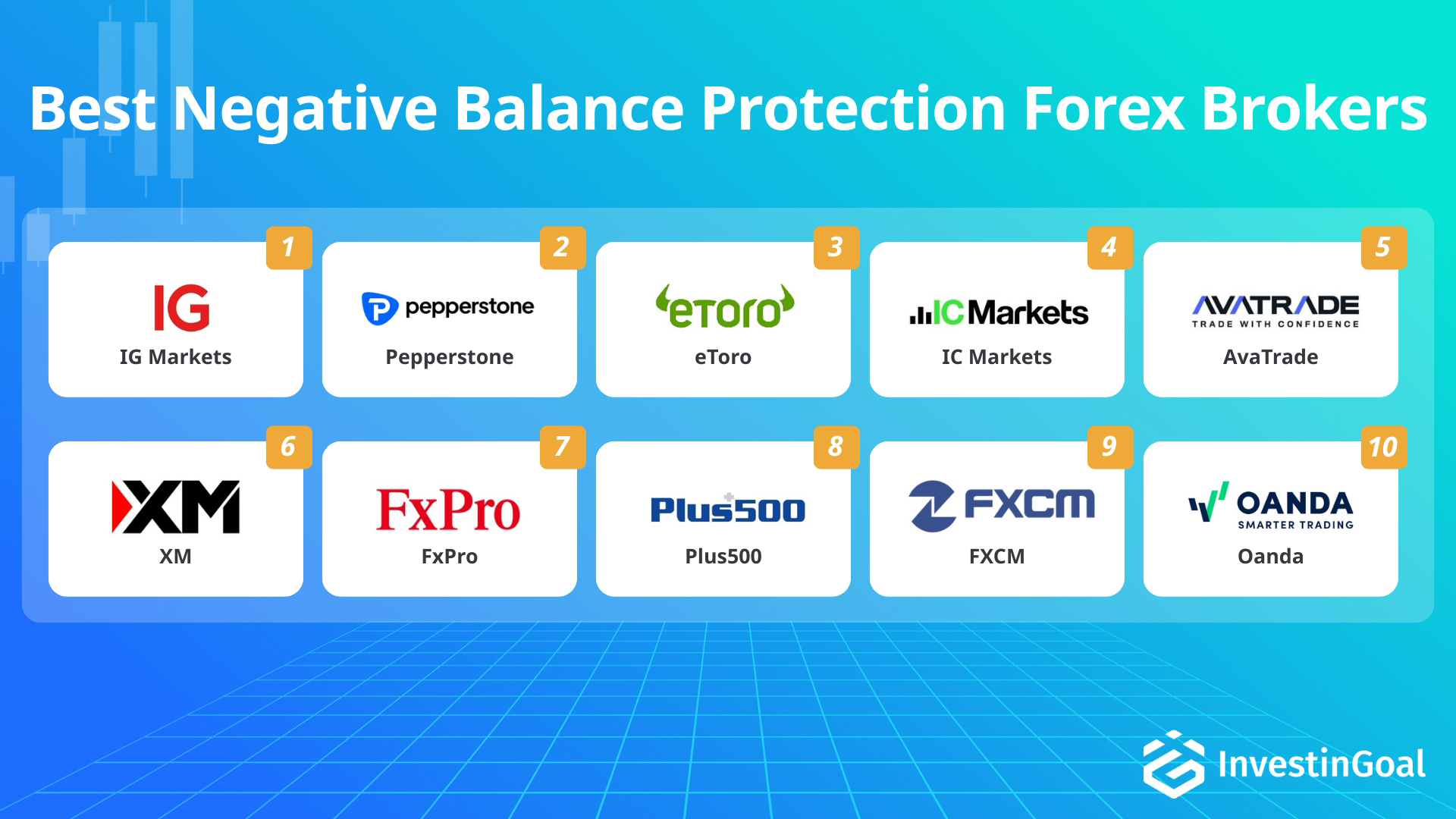
The best Forex brokers for negative balance protection (NBP) are IG, Pepperstone, eToro and IC Markets.
The most important criteria to consider when choosing the best Forex broker for negative balance protection (NBP) are the strength/scope of negative balance protection, the broker’s regulation and overall safety, trading costs (especially typical spreads/commissions), and platform + account accessibility (platform options, demo account terms, and minimum deposit).
IG is the best negative balance protection (NBP) Forex broker overall, thanks to how it provides retail negative balance protection, strong top-tier regulation, competitive EUR/USD pricing, and excellent platform + account accessibility.
Ranked just behind IG, the best negative balance protection (NBP) Forex brokers for NBP coverage, safety/regulation, costs, and platform experience include Pepperstone, eToro, and IC Markets. Pepperstone showcases retail NBP, very tight pricing (especially on its Razor account), and multiple pro-grade platforms (MT4/MT5/cTrader/TradingView). eToro features retail NBP plus a highly beginner-friendly, social/copy-trading-focused platform and an unlimited virtual demo portfolio. Some of the best NBP brokers, IG, Pepperstone, and IC Markets, are also considered the best forex brokers overall thanks to consistently low trading costs, robust platforms and tools, fast execution, and responsive customer support.

IG Markets
(Best NBP Forex broker overall)
IG is the best negative balance protection Forex broker thanks to FCA/ESMA retail negative balance protection that resets any sub‑zero CFD or spread‑betting balance to $0, tier‑1 regulation across agencies like the FCA, FINMA, BaFin, ASIC, and MAS, and low funding barriers with no fixed bank‑transfer minimum and about a $50 card minimum. IG is a top choice for overall NBP coverage since its UK/EU retail policy applies on a per‑account basis and zeroes the balance at no cost, so a sudden gap can’t turn a losing trade into a debt. IG’s per‑account negative balance protection protects traders from a debit balance after extreme volatility or weekend price gaps.
-
Regulations:
-
Avg. EUR/USD Spread:
-
Platforms:
IG Markets Features
The features of IG Markets are listed below.
- IG applies negative balance protection to retail clients in the UK and EU by resetting any negative account balance to $0.
- IG does not apply negative balance protection to professional clients.
- IG has no fixed minimum deposit for bank transfers and IG sets a $50 minimum for card deposits.
- IG is regulated by major authorities including FCA, FINMA, BaFin, ASIC, and MAS.
- IG offers an unlimited demo account and IG MetaTrader demos can expire after 60 days of inactivity.
- IG averages about a 0.9 pip EUR/USD spread on standard forex CFD trading.
IG Markets Pros and Cons
Advantages of IG Markets
The advantages of IG Markets are listed below.
- Low spreads from 0.6 pips on Forex
- Wide range of financial instruments
- 40 years of experience in the Forex industry
Disadvantages of IG Markets
The disadvantages of IG Markets are listed below.
- No copy trading features
- No social trading features
About IG Markets
IG Markets is a global online trading provider founded in 1974, offering access to over 17,000 financial markets including forex, stocks, indices, commodities, and cryptocurrencies. IG Markets provides proprietary trading platforms alongside MetaTrader 4 and ProRealTime. IG Markets is regulated by multiple top-tier authorities worldwide, including the FCA and ASIC. IG Markets is known for competitive spreads, extensive educational resources, and innovative features like weekend trading. The IG Markets’ parent company “IG Group” CEO is Breon Corcoran.

Pepperstone
(Best NBP Forex broker for tight spreads)
Pepperstone is the second best negative balance protection Forex broker due to retail negative balance protection that resets any negative equity to $0, a 50% margin stop‑out level that helps prevent deficits during fast markets, and Razor account pricing where EUR/USD raw spreads can hit 0.0–0.1 pips plus a $7 round‑turn commission per lot. Pepperstone is a leading option for tight spreads since the Razor setup typically delivers an all‑in EUR/USD cost around 0.6–0.8 pips, which is valuable for scalpers who need low friction while still having retail NBP if a sudden gap overwhelms stops. Pepperstone’s retail negative balance protection protects traders from a debit balance if volatility drives the account below zero.
-
Regulations:
-
Avg. EUR/USD Spread:
-
Platforms:
Pepperstone Features
The features of Pepperstone are listed below.
- Pepperstone provides negative balance protection to all retail clients by adjusting any negative balance back to $0.
- Pepperstone does not provide negative balance protection to Pepperstone Pro professional accounts.
- Pepperstone uses a 50% margin stop out level to reduce the risk of negative balances for Pepperstone retail clients.
- Pepperstone has no minimum deposit requirement and Pepperstone recommends about a $200 starting deposit.
- Pepperstone supports MT4, MT5, cTrader, and TradingView integration for Pepperstone clients.
- Pepperstone Razor pricing can show EUR/USD from 0.0 to 0.1 pips plus a $7 per lot round turn commission at Pepperstone.
Pepperstone Pros and Cons
Advantages of Pepperstone
The advantages of Pepperstone are listed below.
- Stable raw spreads (0,10 pips on EUR/USD on average)
- Caters for algorithmic trading
- Has won over 30 Forex industry awards
Disadvantages of Pepperstone
The disadvantages of Pepperstone are listed below.
- The demo account is not unlimited
About Pepperstone
Pepperstone is a global forex and CFD broker founded in 2010 in Melbourne, Australia. Pepperstone offers trading on currencies, commodities, indices, stocks, and cryptocurrencies through MetaTrader and cTrader platforms. Pepperstone is regulated by multiple authorities including ASIC, FCA, and CySEC. Pepperstone is known for competitive spreads, fast execution, and extensive educational resources. Pepperstone serves clients in over 160 countries worldwide. The Pepperstone CEO is Tamas Szabo.

eToro
(Best NBP Forex broker for copy trading)
eToro is the third best negative balance protection Forex broker thanks to automatic retail negative balance protection that caps losses at your deposit, an account‑wide risk engine that margin‑calls and closes positions before equity turns negative, and a social platform with one‑click copy trading and a $100,000 virtual portfolio that doesn’t expire. eToro is the go‑to for copy trading because you can copy other traders’ leveraged CFD positions from the same web/app interface, while the platform’s retail NBP means an extreme move cannot push your account into debt. eToro’s retail negative balance protection protects traders from owing money after a sharp overnight gap or forced liquidation.
-
Regulations:
-
Avg. EUR/USD Spread:
-
Platforms:
eToro Features
The features of eToro are listed below.
- eToro provides negative balance protection to retail clients so eToro account losses cannot exceed deposited funds.
- eToro does not provide negative balance protection to eToro professional clients.
- eToro minimum deposit is typically $200 and eToro allows $50 or $10 minimums in some regions.
- eToro offers an unlimited demo portfolio with $100,000 virtual funds on eToro.
- eToro uses a proprietary social and copy trading platform and eToro does not support MT4 or MT5 for typical clients.
- eToro averages about a 1.0 pip EUR/USD spread with no trading commission on eToro.
eToro Pros and Cons
Advantages of eToro
The advantages of eToro are listed below.
- Great copy trading and social trading features
- Wide range of asset classes
- It allows to buy fractional stocks from $10
Disadvantages of eToro
The disadvantages of eToro are listed below.
- The eToro spreads can be high
- Offers only USD accounts
- Transferring cryptocurrencies to other platforms can be hard
About eToro
eToro is a global multi-asset investment platform founded in 2007, offering trading on stocks, ETFs, Crypto CFDs, commodities, and forex. eToro provides a proprietary web and mobile platform with social trading features. eToro is regulated by multiple authorities including FCA, ASIC, and CySEC. eToro is known for its user-friendly interface, copy trading functionality, and commission-free stock trading. eToro serves over 30 million users worldwide. The eToro CEO and co-founder is Yoni Assia.

IC Markets
(Best NBP Forex broker for algorithmic trading)
IC Markets is the fourth best negative balance protection Forex broker thanks to retail NBP under its ASIC and CySEC regulated entities that limits losses to deposited funds, MT4/MT5/cTrader support with Expert Advisors and cTrader Automate for systematic execution, and ECN-style costs where EUR/USD on Raw accounts often averages about 0.1–0.2 pips plus a $7 round‑turn commission per lot. IC Markets is an ideal pick for algorithmic trading since its low‑latency setup pairs raw spreads with automation-friendly platforms, and retail NBP in eligible jurisdictions prevents a runaway EA during a gap from creating a negative balance. IC Markets’ retail negative balance protection protects traders from a negative‑equity liability during flash moves and weekend price gaps.
-
Regulations:
-
Avg. EUR/USD Spread:
-
Platforms:
IC Markets Features
The features of IC Markets are listed below.
- IC Markets provides negative balance protection for retail clients under IC Markets ASIC and CySEC regulated entities.
- IC Markets requires a $200 minimum deposit to open an IC Markets account.
- IC Markets is regulated by ASIC and CySEC and IC Markets also operates entities regulated by the Seychelles FSA and the Bahamas SCB.
- IC Markets demo accounts remain active with periodic use and IC Markets demo access expires after 30 days of inactivity.
- IC Markets supports MT4, MT5, and cTrader across IC Markets accounts.
- IC Markets Raw pricing typically shows EUR/USD around 0.1 to 0.2 pips plus a $7 per lot round turn commission at IC Markets.
IC Markets Pros and Cons
Advantages of IC Markets
The advantages of IC Markets are listed below.
- Low-latency trading environment
- Institutional level liquidity
- MT4, MT5, cTrader platforms are all available
Disadvantages of IC Markets
The disadvantages of IC Markets are listed below.
- Small amount of educational tools for new traders
- Small range of tradable assets compared to other CFD/Forex brokers
About IC Markets
IC Markets is a global forex and CFD broker founded in 2007 and based in Sydney, Australia. IC Markets offers trading on over 2,250 instruments including currencies, commodities, indices, stocks, and cryptocurrencies. IC Markets provides MetaTrader 4, MetaTrader 5, and cTrader platforms. IC Markets is regulated by multiple authorities including ASIC and CySEC. IC Markets is known for its ECN execution model and low spreads. The IC Markets CEO is Andrew Budzinski.

AvaTrade
(Best NBP Forex broker for FX options)
AvaTrade is the fifth best negative balance protection Forex broker thanks to a guaranteed NBP policy that ensures losses never exceed account equity, the AvaOptions platform for trading FX options to define risk/reward, and broad regulation that includes the Central Bank of Ireland and ASIC. AvaTrade is a strong pick for FX options because AvaOptions lets you combine spot and vanilla options to cap downside in advance, and the broker’s guaranteed NBP provides a second layer of protection if markets gap beyond expected pricing. AvaTrade’s guaranteed negative balance protection protects traders from a debit balance after extreme volatility.
-
Regulations:
-
Avg. EUR/USD Spread:
-
Platforms:
AvaTrade Features
The features of AvaTrade are listed below.
- AvaTrade guarantees negative balance protection so AvaTrade clients cannot lose more than their account equity.
- AvaTrade requires a $100 minimum deposit to open an AvaTrade live account.
- AvaTrade is regulated by the Central Bank of Ireland and AvaTrade also holds licenses including ASIC, Japan FSA, FSCA, and Abu Dhabi FSRA.
- AvaTrade demo access typically expires after 21 days on AvaTrade.
- AvaTrade supports MT4, MT5, AvaTrade WebTrader, AvaTradeGO, and AvaOptions on AvaTrade.
- AvaTrade typically prices EUR/USD around 0.8 to 1.0 pips with no added commission on AvaTrade.
AvaTrade Pros and Cons
Advantages of AvaTrade
The advantages of AvaTrade are listed below.
- Tight fixed spreads from 0.6 pips (0.9 pips for retail traders)
- The mobile apps are well designed
- Can be connected to ZuluTrade and Duplitrade
Disadvantages of AvaTrade
The disadvantages of AvaTrade are listed below.
- High inactivity fees
- The demo account is limited to 30 days
About AvaTrade
AvaTrade is a global forex and CFD broker founded in 2006 and headquartered in Dublin, Ireland. AvaTrade offers trading on currencies, commodities, indices, stocks, bonds, ETFs, and cryptocurrencies. AvaTrade provides proprietary platforms alongside MetaTrader 4 and 5. AvaTrade is regulated by multiple authorities including CySEC, ASIC, and FSA. AvaTrade serves over 300,000 clients worldwide. AvaTrade is known for competitive spreads and extensive educational resources. The AvaTrade CEO is David Dryzin since 2016.

XM
(Best NBP Forex broker for low minimum deposit)
XM is the sixth best negative balance protection Forex broker thanks to negative balance protection on all account types that zeroes out any deficit, a $5 minimum deposit for its main forex accounts, and MT4/MT5 trading with margin rules designed to close positions before equity turns negative. XM is a standout for low minimum deposit trading since you can go live with $5, trade micro lots, and still have NBP, which lets new traders limit worst‑case loss to the small amount funded. XM’s all‑accounts negative balance protection protects traders from owing money if a leveraged position is hit by a sudden price gap.
-
Regulations:
-
Avg. EUR/USD Spread:
-
Platforms:
XM Features
The features of XM are listed below.
- XM provides negative balance protection across XM account types by preventing balances below $0.
- XM requires a $5 minimum deposit for XM Standard and XM Ultra Low accounts.
- XM is regulated by CySEC and XM also operates under IFSC Belize, FSC Mauritius, and FSA Seychelles oversight.
- XM demo accounts do not have a fixed expiry and XM archives demos after about 90 days of inactivity.
- XM supports MT4 and MT5 as core platforms and XM also offers the XM mobile app and XM web trading access.
- XM averages about 1.1 pips EUR/USD on XM Ultra Low accounts and XM averages about 1.7 to 2.0 pips on XM Standard accounts.
XM Pros and Cons
Advantages of XM
The advantages of XM are listed below.
- There’s a wide range of account types
- The demo account at XM is unlimited
- Wide range of educational resources
Disadvantages of XM
The disadvantages of XM are listed below.
- No social trading features available
- The account availability changes depending on the location of the trader
- High minimum deposit to invest in securities ($10000 for the XM Shares account)
About XM
XM is a global forex and CFD broker founded in 2009, offering trading on currencies, commodities, indices, stocks, and cryptocurrencies. XM provides MetaTrader 4, MetaTrader 5, and proprietary platforms. XM is regulated by multiple authorities including CySEC, ASIC, and IFSC. XM is known for competitive spreads, extensive educational resources, and multilingual customer support. XM serves over 5 million clients from 196 countries. XM offers various account types and a no-requote policy.

FxPro
(Best NBP Forex broker for cTrader users)
FxPro is the seventh best negative balance protection Forex broker thanks to NBP written into its client agreement that adjusts any negative balance back to $0, cTrader availability with Level‑II market depth and cTrader Automate, and strong oversight via regulators such as the FCA and CySEC. FxPro is an ideal pick for cTrader users because you can run cTrader Automate strategies and manage orders with detailed execution tools, while NBP means slippage in fast markets cannot leave your account below zero. FxPro’s negative balance protection protects traders from a debit balance when volatility overwhelms stop‑outs.
-
Regulations:
-
Avg. EUR/USD Spread:
-
Platforms:
FxPro Features
The features of FxPro are listed below.
- FxPro provides negative balance protection so FxPro clients cannot lose more than total deposits.
- FxPro does not set a fixed minimum deposit and FxPro recommends at least $100 to start.
- FxPro is regulated by FCA and CySEC and FxPro also operates under SCB Bahamas and FSCA coverage.
- FxPro demo accounts expire after 180 days of inactivity on FxPro.
- FxPro supports MT4, MT5, cTrader, and FxPro Edge WebTrader and FxPro also integrates TradingView trading.
- FxPro averages about 1.3 to 1.5 pips EUR/USD on FxPro standard pricing.
FxPro Pros and Cons
Advantages of FxPro
The advantages of FxPro are listed below.
- Regulated and Trusted Forex broker
- Diverse Trading Platforms
- Wide Range of Instruments
Disadvantages of FxPro
The disadvantages of FxPro are listed below.
- Inactivity Fee
- Limited Educational Resources
- No Guaranteed Stop-Loss Orders
About FxPro
FxPro is a global online broker founded in 2006, offering trading on forex, CFDs, stocks, indices, commodities, and cryptocurrencies. FxPro provides multiple trading platforms including MetaTrader 4, MetaTrader 5, cTrader, and its proprietary FxPro Platform. FxPro is regulated by multiple authorities including FCA, CySEC, SCB, FSC and KNN. FxPro serves clients in over 170 countries and has won numerous industry awards. The FxPro CEO is Charalambos Psimolophitis.

Plus500
(Best NBP Forex broker for beginner-friendly platform)
Plus500 is the eighth best negative balance protection Forex broker thanks to an automatic margin call and close‑out system designed to prevent sub‑zero equity, negative balance protection that brings any rare deficit back to $0, and a beginner-oriented proprietary CFD platform backed by an unlimited demo account. Plus500 is a solid choice for a beginner‑friendly platform since its web/desktop/mobile interface keeps trading and risk controls in one place (including stop orders and margin alerts), which helps new traders stay within the limits of their deposited funds. Plus500’s negative balance protection protects traders from owing the broker money after a sharp move or weekend gap.
-
Regulations:
-
Avg. EUR/USD Spread:
-
Platforms:
Plus500 Features
The features of Plus500 are listed below.
- Plus500 applies negative balance protection by closing positions via margin calls and Plus500 brings any negative balance back to $0.
- Plus500 requires a 100 unit minimum deposit in the Plus500 account base currency for most payment methods.
- Plus500 is regulated by major authorities including FCA, CySEC, ASIC, MAS, and FMA across Plus500 entities.
- Plus500 offers an unlimited demo account that does not expire on Plus500.
- Plus500 uses a proprietary platform across web, desktop, and mobile and Plus500 does not support MT4 or MT5.
- Plus500 typically prices EUR/USD around 0.8 to 1.1 pips with no trading commission on Plus500.
Plus500 Pros and Cons
Advantages of Plus500
The advantages of Plus500 are listed below.
- Well-regulated CFD provider
- Over 2000 tradable CFDs
- Unlimited demo account offered
Disadvantages of Plus500
The disadvantages of Plus500 are listed below.
- Limited Regulatory Protections for Professionals
- Inactivity fees
- Limited deposit methods
About Plus500
Plus500 is a global fintech company founded in 2008, offering online Futures trading services in different markets such as Agriculture, Cryptocurrencies, Metals, Commodities, Forex, Interest Rates, Energy and Equity Indices. Plus500 provides proprietary web and mobile trading platforms. Plus500 is regulated by multiple top-tier authorities including FCA, ASIC, and CySEC. Plus500 is listed on the London Stock Exchange and is a constituent of the FTSE 250 Index. The Plus500 CEO is David Zruia since April 2020.

FXCM
(Best NBP Forex broker for API traders)
FXCM is the ninth best negative balance protection Forex broker thanks to retail NBP in its FCA/ASIC-regulated entities that limits losses to the account balance, robust programmatic access via REST, FIX, and Java APIs for systematic execution, and a low $50 minimum deposit for standard retail accounts. FXCM is a leading choice for API traders because its interfaces let you automate price streaming and order management, and—where retail NBP applies—an extreme volatility spike won’t turn an algorithm’s drawdown into a negative balance owed to the broker. FXCM’s retail negative balance protection protects traders from a debit balance caused by gaps and slippage during fast markets.
-
Regulations:
-
Avg. EUR/USD Spread:
-
Platforms:
FXCM Features
The features of FXCM are listed below.
- FXCM provides negative balance protection for retail clients in applicable regulated regions under FXCM policies.
- FXCM does not provide negative balance protection to FXCM professional clients in the UK.
- FXCM requires a $50 minimum deposit to open an FXCM retail account.
- FXCM offers a practice account that typically lasts 30 days on FXCM.
- FXCM supports Trading Station and MT4 and FXCM also supports NinjaTrader connections plus API trading.
- FXCM is commonly benchmarked around a 0.8 pip EUR/USD spread level in industry comparisons for FXCM.
FXCM Pros and Cons
Advantages of FXCM
The advantages of FXCM are listed below.
- Regulation and Trust
- Advanced Trading Tools
- Competitive Spreads for Active Traders
Disadvantages of FXCM
The disadvantages of FXCM are listed below.
- Limited Range of Instruments
- Average Pricing Structure
About FXCM
FXCM is a global forex and CFD broker founded in 1999, offering trading on currencies, commodities, indices, stocks, and cryptocurrencies. FXCM provides MetaTrader 4 and proprietary trading platforms. FXCM is regulated by multiple authorities including FCA, ASIC, and CySEC. FXCM is known for competitive spreads, extensive educational resources, and copy trading services. FXCM recently launched a sister platform called Tradu. The FXCM parent company “Stratos Group” CEO is Brendan Callan.

Oanda
(Best NBP Forex broker with no minimum deposit)
OANDA is the tenth best negative balance protection Forex broker thanks to no minimum deposit on standard accounts, retail NBP in regions such as the EU and Canada where balances are kept at or above $0, and flexible position sizing down to 1 unit to keep leverage exposure precise. OANDA is an ideal pick for no‑minimum‑deposit trading because you can fund any amount and trade very small sizes, and when retail NBP applies your maximum loss is capped at the cash in the account instead of an open‑ended liability. OANDA’s retail negative balance protection protects traders from owing money after a rapid price gap or forced liquidation in a highly leveraged market.
-
Regulations:
-
Avg. EUR/USD Spread:
-
Platforms:
Oanda Features
The features of Oanda are listed below.
- OANDA provides negative balance protection for retail clients under OANDA EU and OANDA Canada entities.
- OANDA has no minimum deposit requirement for standard OANDA accounts.
- OANDA is regulated by CFTC and NFA and OANDA is also regulated by FCA, IIROC or CIRO, MAS, ASIC, and Japan FSA across entities.
- OANDA offers a practice account with no fixed expiry and OANDA keeps demos active with periodic logins.
- OANDA supports OANDA Trade web and mobile plus MT4 and MT5 and OANDA also supports TradingView and a REST API.
- OANDA typically prices EUR/USD around 1.2 to 1.4 pips on OANDA Standard pricing and OANDA Core pricing targets about 0.6 to 0.8 pips all in.
Oanda Pros and Cons
Advantages of Oanda
The advantages of Oanda are listed below.
- Comprehensive Platforms
- Robust Education
- Highly Regulatory Trust
Disadvantages of Oanda
The disadvantages of Oanda are listed below.
- Higher Spreads
- Proprietary Platform Limitations
- Inactivity Fees
About Oanda
OANDA is a global multi-asset broker founded in 1996, offering trading on forex, CFDs, commodities, indices, and cryptocurrencies. OANDA provides proprietary platforms and API solutions. OANDA is regulated by multiple authorities including FCA, ASIC, and MAS. OANDA is known for competitive spreads, fast execution, and currency data services. OANDA serves both retail and institutional clients worldwide. The Oanda Chief Executive Officer is Gavin Bambury since August 2019.
Comparison of the best Negative Balance Protection (NBP) forex brokers
The table that compares the best Negative Balance Protection (NBP) forex brokers is shown below.
| Broker | NBP coverage (retail/pro eligibility) | Margin stop-out level (%) | Tier-1 regulator count | EUR/USD all-in trading cost (pips) | Minimum deposit (USD) |
|---|---|---|---|---|---|
| IG | Retail NBP: Yes; Professional excluded: Yes; Entity: UK/EU (ESMA) retail | N/A | 5 | 0.9 | 0 |
| Pepperstone | Retail NBP: Yes; Professional excluded: Yes; Entity: N/A | 50% | 3 | 0.7 | 0 |
| eToro | Retail NBP: Yes; Professional excluded: Yes; Entity: Retail clients (EU-regulated context) | N/A | 2 | 1.0 | 200 |
| IC Markets | Retail NBP: Yes; Professional excluded: N/A; Entity: ASIC/CySEC retail (offshore may vary) | N/A | 1 | 0.8 | 200 |
| AvaTrade | Retail NBP: Yes; Professional excluded: N/A; Entity: Global retail policy stated | N/A | 3 | 0.9 | 100 |
| XM | Retail NBP: Yes; Professional excluded: N/A; Entity: All account types stated | N/A | 0 | 1.1 | 5 |
| FxPro | Retail NBP: Yes; Professional excluded: No; Entity: All clients (per policy stated) | N/A | 1 | 0.9 | 0 |
| Plus500 | Retail NBP: Yes; Professional excluded: N/A; Entity: UK/EU retail (as required) / general policy stated | N/A | 3 | 0.9 | 100 |
| FXCM | Retail NBP: Yes; Professional excluded: Yes; Entity: Applicable regions (UK/EU/AU noted) | N/A | 2 | 0.9 | 50 |
| OANDA | Retail NBP: Yes; Professional excluded: N/A; Entity: Where required (UK/EU/Canada etc.), US not guaranteed | N/A | 6 | 0.7 | 0 |
Warning
CFDs are complex instruments and come with a high risk of losing money rapidly due to leverage. Between 74-89% of retail investor accounts lose money when trading CFDs. You should consider whether you can afford to take the high risk of losing your money.
The best Negative Balance Protection broker for CFD is IG. IG stands out for per-account NBP for UK/EU retail CFD/spread betting clients, direct market access via L2 Dealer, and broad platform choice including MT4 and ProRealTime. These strengths at IG help CFD traders keep downside capped after sharp gaps, react with more control through DMA tools, and trade on the platform setup that best fits their workflow.
Top NBP CFD brokers typically combine strong retail NBP rules, CFD-first platforms with risk controls, and reliable execution infrastructure. A similar alternative to IG is Plus500 for its CFD-focused proprietary platform, integrated economic calendar and guaranteed stops, and a margin-call setup designed to prevent negative balances. IC Markets also competes well versus IG, offering retail NBP under ASIC/CySEC entities, access to MT4/MT5/cTrader, and low-latency execution backed by deep liquidity for active CFD trading, with features that often place it among the best CFD trading accounts for active traders.
The best Negative Balance Protection broker with high leverage is Plus500. Plus500 is built around high-leverage accessibility for beginners, a margin-call system aimed at avoiding negative balances, and risk tools such as guaranteed stop orders. With these features, Plus500 can help leveraged traders limit worst-case outcomes during fast moves, while platform-level protections and stops reduce the chance of losses exceeding deposits.
The best high-leverage NBP brokers generally offer clear downside protection, strong margin/closeout mechanics, and platform tools that control risk during volatility. XM is an alternative to Plus500 since it provides NBP across account types, a robust margin-call/closeout framework, and MT4/MT5 support for traders who rely on MetaTrader for leveraged strategies. AvaTrade offers guaranteed NBP, a wide platform suite (MT4/MT5, WebTrader, AvaTradeGO), and AvaOptions access, which makes it an alternative to Plus500 for traders who want more structured risk management and is often listed as a best Forex broker with high leverage.
The best Negative Balance Protection broker for scalping is Pepperstone. Pepperstone excels with fast ECN execution and deep liquidity, MT4/MT5/cTrader plus TradingView integration, and razor-thin raw spreads from 0.0–0.1 pips with commission. Those advantages at Pepperstone can matter for scalpers because tighter pricing improves breakeven points, while quick fills and flexible platforms help reduce slippage and manage rapid entries and exits.
Scalpers look for ultra-tight trading costs, rapid execution, and automation-friendly platforms in the best NBP scalping brokers. IC Markets is an alternative to Pepperstone due to its low-latency execution with strong liquidity, MT4/MT5/cTrader availability, and tight raw spreads around 0.1–0.2 pips plus commission for cost-sensitive scalping. FxPro is also a viable substitute when comparing with Pepperstone, offering cTrader support, a Raw+ pricing model (raw spreads + commission), and NBP terms that apply to clients under its agreement, which can suit frequent-fire trading styles, and is often featured among the best scalping Forex brokers for active traders.
The best Negative Balance Protection broker for news trading is OANDA. OANDA is strong for this style thanks to its comprehensive news feed, built-in economic calendar, and TradingView integration for chart-based decisions. These tools at OANDA can help news traders prepare for scheduled releases, respond quickly as headlines hit, and align entries with technical levels without constantly switching between external apps.
The best NBP news-trading brokers tend to include real-time information feeds, event scheduling tools, and risk controls for gap-heavy volatility. Plus500 is an alternative to OANDA because it includes an integrated economic calendar, offers guaranteed stop orders for gap-risk control, and uses a margin-call system designed to avoid negative balances during sudden moves. IG is another strong contender compared with OANDA, given its per-account NBP for UK/EU retail CFD clients, multi-platform support including MT4, and L2 Dealer access for faster reaction and order control around major announcements, and it is often ranked among the best Forex brokers for news trading.
The best Negative Balance Protection broker with fast execution is IC Markets. IC Markets is known for low-latency execution with a liquidity focus, support for MT4/MT5/cTrader, and raw-spread pricing with very tight typical spreads (around 0.1–0.2 pips plus commission). In practice, these strengths at IC Markets can help speed-sensitive traders reduce execution delay, keep costs down on frequent orders, and run strategies efficiently across the major trading platforms.
Low-latency infrastructure, deep liquidity access, and consistently competitive pricing are highly regarded by traders in the best fast-execution NBP brokers. Pepperstone is an alternative to IC Markets thanks to its fast ECN execution, MT4/MT5/cTrader (and TradingView) support, and Razor pricing with ultra-low raw spreads from 0.0–0.1 pips plus commission, and it is frequently cited among the best fast executions Forex brokers for speed-focused trading. FxPro also stacks up well against IC Markets, offering cTrader compatibility, an emphasis on execution quality, and a Raw+ model that can keep trading costs efficient while still maintaining NBP terms in its client framework.
The criteria for choosing the best Negative Balance Protection (NBP) Forex brokers are listed below.
- NBP coverage: Verify NBP is automatic for retail clients, applied per account, with a clear reset-to-zero Confirm exclusions (e.g., Professional accounts) and entity-specific applicability (e.g., IG, Pepperstone, eToro, IC Markets).
- Margin stop-out rules: Treat NBP as a backstop, prioritize explicit automated liquidation rules (e.g., 50% margin stop-out, margin call/close-out) and, where available, guaranteed stop protection (e.g., Pepperstone, Plus500).
- Tier-1 regulation: Prefer Tier-1 regulators and multi-regulated brokers (e.g., FCA, ASIC, CFTC/NFA, IIROC/CIRO, MAS, BaFin, FINMA) and confirm statutory protection such as FSCS up to £85,000 (e.g., IG, OANDA).
- All-in trading costs: Compare total cost (spread + commission) using EUR/USD Prioritize transparent typical pricing and competitive all-in ranges (e.g., 0.6–0.8 pips, $7/lot round-turn) across Pepperstone, IC Markets, IG, eToro, OANDA.
- Execution & liquidity: Prioritize execution quality to reduce slippage and gaps. Favor brokers with deep liquidity and low-latency execution or DMA access (e.g., Pepperstone, IC Markets, IG).
- Platform risk controls: Choose platforms with strong risk controls (robust order types, reliable stop-loss handling, stable execution) and advanced tooling (e.g., MT4/MT5, cTrader, TradingView, API, AvaOptions) from Pepperstone, FXCM, OANDA, AvaTrade.
- Minimum deposit fit: Match minimum deposit and position-sizing flexibility to conservative margin buffers (e.g., $5, $50, $100, $200, no minimum deposit, 1-unit sizing) across XM, FXCM, AvaTrade, Plus500, IC Markets, eToro, IG, OANDA.
The regulators that matter most are tier-1 authorities that require retail negative balance protection and standardized margin close-out—primarily the UK Financial Conduct Authority (FCA), EU/EEA regulators applying the ESMA CFD framework (e.g., CySEC, BaFin, CBI), and the Australian Securities and Investments Commission (ASIC).
These regimes mandate negative balance protection on a per-account basis (your maximum liability is capped at the funds in your CFD trading account) and a margin close-out rule that forces liquidation when account funds fall to about 50% of required margin, making a negative balance a rare “tail-event” rather than an ordinary outcome.
Two practical caveats decide whether you actually receive NBP: (1) regulation is entity-specific, so the same broker brand can onboard you under a UK/EU/AU entity (stronger retail protections) or an offshore entity (potentially weaker or purely contractual protections); (2) “professional client” status commonly strips retail safeguards, so you should avoid being reclassified unless you deliberately accept higher leverage and the loss of protections. Client protections and leverage limits are determined by rules set by each jurisdiction’s regulatory body, with Forex trading regulations clarifying client categories and the safeguards attached to them under law.
A margin call is a warning that your account equity is approaching the minimum margin required to keep positions open; a stop-out (also called margin close-out) is automatic position liquidation once equity hits the broker’s liquidation threshold—commonly standardized at about 50% of required margin for retail CFD accounts in the UK/EU and Australia.
Mechanically, your “margin level” is driven by equity (balance ± unrealized P/L) relative to used margin; as losses reduce equity, the system first restricts new exposure and then begins forced closures to restore margin. Under the ESMA-style model, the close-out test is applied on an account basis across open CFD positions, not trade-by-trade, and can include positions even if they have limited-risk features.
Negative balance protection is the backstop after these controls: if a fast gap, weekend reopen, or execution latency causes losses to overshoot liquidation and push the account below zero, retail NBP caps your liability at the funds in the CFD trading account and prevents a debt to the broker. Understanding the collateral required to open and maintain leveraged positions begins with a clear definition of what is margin.
You reduce slippage by using price-controlled order types (limit / stop-limit) and, where available, guaranteed stop-loss orders (GSLOs); then you avoid predictable slippage regimes (thin liquidity and event shocks).
Slippage is the difference between the requested price and the executed price, and it concentrates during high volatility, gaps, and low-liquidity sessions. (IG) For entries, a limit order sets the maximum buy price or minimum sell price; for exits, a stop-limit converts a stop trigger into a limit order, preventing “worse than X” fills at the cost of possible non-execution.
Where the broker offers it, a GSLO is the most direct anti-gap tool because it guarantees execution at the exact level you set even if the market jumps, typically for a fee/wider spread and only on eligible instruments.
NBP does not prevent slippage; it only caps worst-case liability at the account level. To manage execution risk, downshift leverage, keep excess free margin, understand slippage meaning, trade liquid FX sessions, and avoid holding leveraged positions through major scheduled releases if a precise exit price matters.
A guaranteed stop loss is a position-level execution guarantee at a preset price; negative balance protection is an account-level liability cap that prevents you from owing the broker money.
A GSLO directly targets gap risk and stop-order slippage: if the price jumps through your stop, the broker still closes you at your chosen level (usually charging a fee via a wider spread and limiting availability by instrument/market conditions).
NBP, by contrast, activates only when losses would otherwise push your account below zero—after margining, liquidation, and any residual negative balance is computed—so you can still lose the full account balance on one or multiple trades even though you cannot go into debt.
They are complementary layers: GSLO manages trade-specific tail risk; margin close-out reduces the probability of ruin; and NBP is the final backstop. Notably, standardized margin close-out rules are applied at the account level even when a position uses a GSLO.