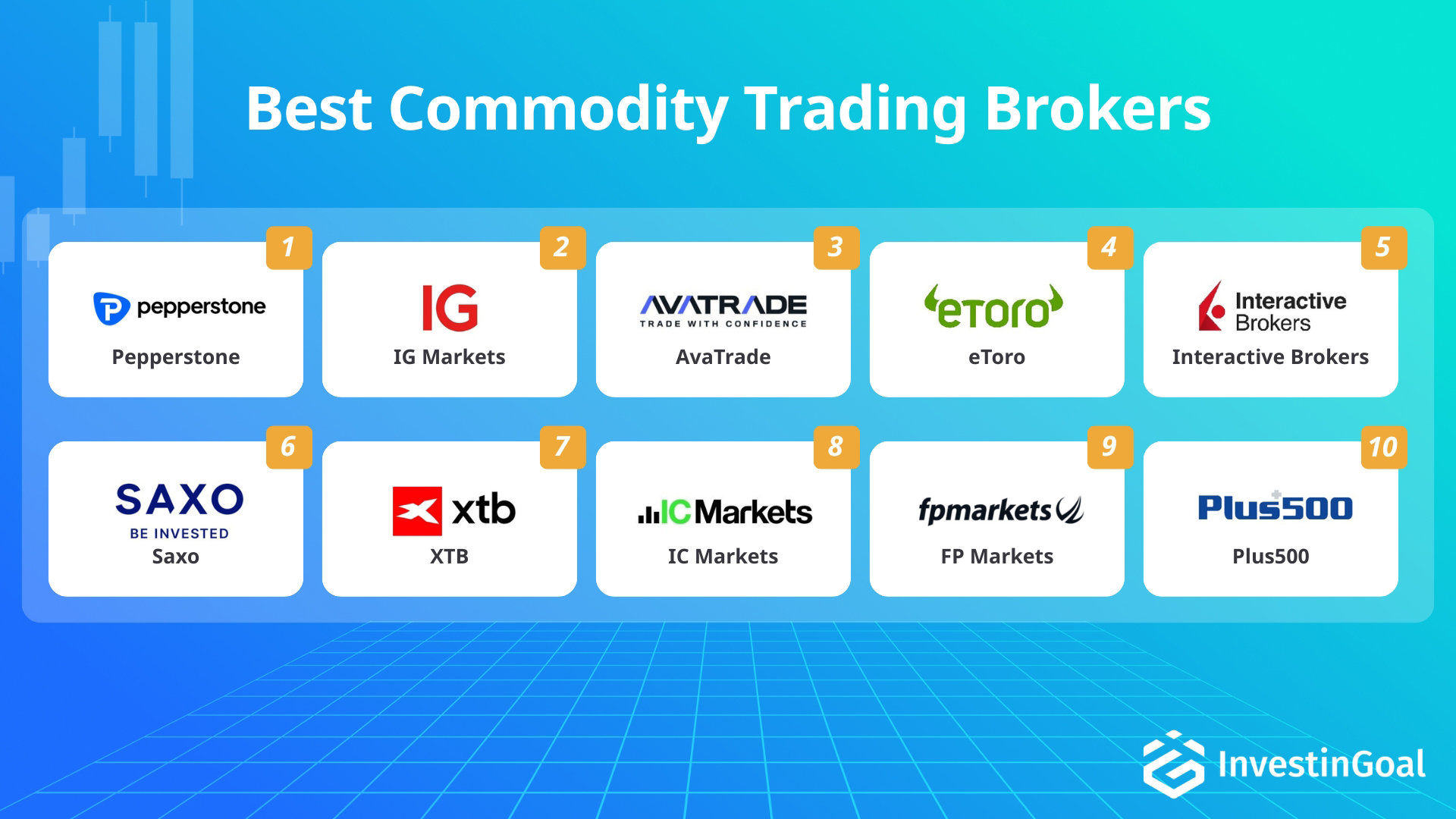
The best Forex brokers for commodity trading are Pepperstone, IG, AvaTrade and eToro.
When choosing the best commodity trading FX broker, commodity market range, trading costs (spreads/commissions), platform quality & trading tools (execution, risk management, research), and regulation & client protection are the most important criteria.
Pepperstone is the best commodity trading Forex broker overall, thanks to offering commodity market range, trading costs (spreads/commissions), platform quality & trading tools (execution, risk management, research), and regulation & client protection at a consistently high standard for active CFD traders.
Ranked just behind Pepperstone, the best commodity trading Forex brokers for market range, costs, platforms/tools, and regulation include IG, AvaTrade, and eToro. IG showcases a strong commodity lineup, undated commodity CFDs, advanced research, and risk controls such as guaranteed stops. AvaTrade includes 35+ commodity CFDs plus access to commodity options (including gold options) via its options platform and broad platform coverage. eToro supports a wide commodity CFD list and social/copy-trading features designed for diversification and a more hands-off workflow.
Some of the top commodity-focused brokers such as Pepperstone, IG, and AvaTrade are also considered the best Forex brokers overall thanks to low trading costs, fast execution, robust platforms, and strong regulation.

Pepperstone
(Best commodity trading Forex broker overall)
Pepperstone is the best commodity trading broker thanks to 40+ commodity CFDs, tight spread-only pricing with no commodity commissions, and fast execution backed by deep liquidity. Pepperstone is a uniquely exceptional choice for overall commodity CFD trading because gold spreads can start around 0.05 points and leverage can reach 200:1 on gold (0.5% margin), which helps active traders keep costs low and adjust position size across multiple commodity markets (like silver and Brent crude). Pepperstone’s 40+ commodity CFDs provide traders with diversified access to precious metals (e.g., silver and platinum), base metals (such as copper), energies (like Brent crude and natural gas), and agricultural “softs” (for example coffee and sugar) via cash-settled long and short positions.
-
Regulations:
-
Avg. EUR/USD Spread:
-
Platforms:
Pepperstone Features
The features of Pepperstone are listed below.
- Pepperstone offers CFD trading on 40+ commodities across precious metals, base metals, energies, and agricultural softs.
- Pepperstone commodity CFDs are commission free, with spreads from about 0.05 points on gold and about 2 points on oil.
- Pepperstone provides leverage up to 200:1 on gold with a 0.5% margin requirement.
- Pepperstone supports MetaTrader 4, MetaTrader 5, cTrader, TradingView integration, and a web platform.
- Pepperstone has no minimum deposit requirement to open an account.
- Pepperstone is regulated by ASIC, FCA, CySEC, BaFin, DFSA, CMA, SCB, and other regulators.
Pepperstone Pros and Cons
Advantages of Pepperstone
The advantages of Pepperstone are listed below.
- Stable raw spreads (0,10 pips on EUR/USD on average)
- Caters for algorithmic trading
- Has won over 30 Forex industry awards
Disadvantages of Pepperstone
The disadvantages of Pepperstone are listed below.
- The demo account is not unlimited
About Pepperstone
Pepperstone is a global forex and CFD broker founded in 2010 in Melbourne, Australia. Pepperstone offers trading on currencies, commodities, indices, stocks, and cryptocurrencies through MetaTrader and cTrader platforms. Pepperstone is regulated by multiple authorities including ASIC, FCA, and CySEC. Pepperstone is known for competitive spreads, fast execution, and extensive educational resources. Pepperstone serves clients in over 160 countries worldwide. The Pepperstone CEO is Tamas Szabo.

IG Markets
(Best commodity trading Forex broker for undated CFDs)
IG is the second best commodity trading broker due to undated commodity CFDs that do not expire, 35 commodity markets across metals, energies, and agriculture, and strong risk tools such as guaranteed stop-loss orders. IG is a truly exceptional option for undated commodity CFDs since its undated contracts remove monthly expiry and rollover management, while spreads can start around 0.1 points on gold and about 2.8 points on Brent Crude during peak hours for standard contract sizes. IG’s undated commodity CFDs that do not expire offer traders protection from rollover friction by letting them hold positions without switching to a new contract each month.
-
Regulations:
-
Avg. EUR/USD Spread:
-
Platforms:
IG Markets Features
The features of IG Markets are listed below.
- IG provides 35 commodity markets via CFDs and spread betting, covering metals, energies, and agriculture.
- IG offers undated commodity CFDs that do not expire monthly.
- IG spreads start from 0.1 points on gold and about 2.8 points on Brent Crude during peak hours.
- IG supports guaranteed stop loss orders on commodities for gap protection (premium applies).
- IG has no required minimum deposit to open an account.
- IG is regulated by FCA, BaFin, ASIC, CySEC, MAS, DFSA, FSCA, and other regulators.
IG Markets Pros and Cons
Advantages of IG Markets
The advantages of IG Markets are listed below.
- Low spreads from 0.6 pips on Forex
- Wide range of financial instruments
- 40 years of experience in the Forex industry
Disadvantages of IG Markets
The disadvantages of IG Markets are listed below.
- No copy trading features
- No social trading features
About IG Markets
IG Markets is a global online trading provider founded in 1974, offering access to over 17,000 financial markets including forex, stocks, indices, commodities, and cryptocurrencies. IG Markets provides proprietary trading platforms alongside MetaTrader 4 and ProRealTime. IG Markets is regulated by multiple top-tier authorities worldwide, including the FCA and ASIC. IG Markets is known for competitive spreads, extensive educational resources, and innovative features like weekend trading. The IG Markets’ parent company “IG Group” CEO is Breon Corcoran.

AvaTrade
(Best commodity trading Forex broker for commodity options)
AvaTrade is the third best commodity trading broker because of its AvaOptions commodity options platform (including gold options), 35+ commodity CFDs across metals, energy, and agriculture, and competitive commodity pricing (around $0.34 on gold and about $0.03 on crude oil in its instrument list). AvaTrade is an exceptional choice for commodity options trading since AvaOptions lets traders build calls and puts on gold with defined-risk payoffs, enabling hedges and directional strategies that spot-only CFD trading cannot replicate. AvaTrade’s AvaOptions commodity options platform provides traders with defined-risk exposure by letting them choose strikes and expiries and cap downside at the option premium.
-
Regulations:
-
Avg. EUR/USD Spread:
-
Platforms:
AvaTrade Features
The features of AvaTrade are listed below.
- AvaTrade offers 35+ commodity markets via CFDs across metals, energies, and agricultural products.
- AvaTrade provides leverage up to 200:1 on gold for professional accounts.
- AvaTrade lists typical commodity spreads around $0.34 on gold and around $0.03 on US crude oil with no commodity CFD commissions.
- AvaTrade offers AvaOptions, including the ability to trade gold options.
- AvaTrade requires a $100 minimum deposit to open an account.
- AvaTrade provides a demo account that is typically time limited to about 21 days.
AvaTrade Pros and Cons
Advantages of AvaTrade
The advantages of AvaTrade are listed below.
- Well-regulated Futures provider
- Wide range of Futures instruments
- Unlimited demo account offered
Disadvantages of AvaTrade
The disadvantages of AvaTrade are listed below.
- Advanced technical analysis tools not available
- Doesn’t support automated trading options
- No Negative Balance Protection
About AvaTrade
AvaTrade is a global forex and CFD broker founded in 2006 and headquartered in Dublin, Ireland. AvaTrade offers trading on currencies, commodities, indices, stocks, bonds, ETFs, and cryptocurrencies. AvaTrade provides proprietary platforms alongside MetaTrader 4 and 5. AvaTrade is regulated by multiple authorities including CySEC, ASIC, and FSA. AvaTrade serves over 300,000 clients worldwide. AvaTrade is known for competitive spreads and extensive educational resources. The AvaTrade CEO is David Dryzin since 2016.

eToro
(Best commodity trading Forex broker for copy trading)
eToro is the fourth best commodity trading broker thanks to its CopyTrader system, 47 commodity CFD markets, and built-in community positioning data that can show how many users are long or short on a given commodity. The CopyTrader system of eToro places it among the outstanding options for commodity copy trading because it can automatically mirror experienced investors’ trades in markets like gold, oil, and agricultural CFDs, giving users a hands-free way to follow a commodity strategy without placing each trade manually. The CopyTrader system of eToro helps traders with automated execution by copying the same entries, exits, and position sizes from the trader they follow.
-
Regulations:
-
Avg. EUR/USD Spread:
-
Platforms:
eToro Features
The features of eToro are listed below.
- eToro offers CFDs on 47 commodities, including metals, energies, and agricultural markets.
- eToro enables social and copy trading for commodities via CopyTrader and thematic portfolios.
- eToro charges 0% commission on commodity CFDs, with trading costs embedded in the spread.
- eToro provides a virtual portfolio demo account with $100,000 in virtual funds.
- eToro minimum deposit starts from $50 in many regions and is higher in others.
- eToro is regulated by FCA, CySEC, ASIC, and additional regulators for specific product lines.
eToro Pros and Cons
Advantages of eToro
The advantages of eToro are listed below.
- Great copy trading and social trading features
- Wide range of asset classes
- It allows to buy fractional stocks from $10
Disadvantages of eToro
The disadvantages of eToro are listed below.
- The eToro spreads can be high
- Offers only USD accounts
- Transferring cryptocurrencies to other platforms can be hard
About eToro
eToro is a global multi-asset investment platform founded in 2007, offering trading on stocks, ETFs, Crypto CFDs, commodities, and forex. eToro provides a proprietary web and mobile platform with social trading features. eToro is regulated by multiple authorities including FCA, ASIC, and CySEC. eToro is known for its user-friendly interface, copy trading functionality, and commission-free stock trading. eToro serves over 30 million users worldwide. The eToro CEO and co-founder is Yoni Assia.

Interactive Brokers
(Best commodity trading Forex broker for futures markets)
Interactive Brokers is the fifth best commodity trading broker for direct access to global commodity futures and options (such as WTI crude oil futures and gold futures), institutional-style pricing with low commissions and no spread mark-ups, and the Trader Workstation platform for professional-grade order types and analytics. Interactive Brokers is an excellent choice for futures-market commodity trading since its exchange access enables trading metals (like gold), energy (such as WTI crude), grains (e.g., corn), and softs (like coffee) on major venues such as CME and ICE with real order-book liquidity and advanced tools for futures options hedging. Interactive Brokers’ direct access to global commodity futures and options provides traders with exchange-traded pricing and standardized contracts that support precise hedging and spread strategies.
-
Regulations:
-
Avg. EUR/USD Spread:
-
Platforms:
Interactive Brokers Features
The features of Interactive Brokers are listed below.
- Interactive Brokers provides direct access to commodity futures and options across major global exchanges (CME, ICE, LME, and others).
- Interactive Brokers supports commodity options on futures for advanced hedging and spread strategies.
- Interactive Brokers uses a commission model with no spread mark up, targeting near raw market pricing.
- Interactive Brokers has no minimum deposit for standard retail accounts.
- Interactive Brokers provides Trader Workstation (TWS), WebTrader, mobile apps, and APIs for systematic trading.
- Interactive Brokers offers paper trading for strategy testing with platform level tools.
Interactive Brokers Pros and Cons
Advantages of Interactive Brokers
The advantages of Interactive Brokers are listed below.
- Low Trading Fees
- Advanced Trading Tools
- Wide Market Access
Disadvantages of Interactive Brokers
The disadvantages of Interactive Brokers are listed below.
- Not user-friendly
- No MetaTrader Support
- Additional Fees
About Interactive Brokers
Interactive Brokers is a global electronic broker founded in 1978, offering trading in stocks, options, futures, forex, bonds, ETFs, and cryptocurrencies across 150 markets in 33 countries. Interactive Brokers provides advanced trading platforms, low commissions, and access to a wide range of financial instruments. Interactive Brokers is known for its sophisticated technology and serves both retail and institutional clients. Interactive Brokers is regulated by multiple top-tier authorities worldwide. The CEO of the Interactive Brokers Group is Milan Galik.

Saxo
(Best commodity trading Forex broker for multi-asset portfolios)
Saxo Bank is the sixth best commodity trading broker through multi-asset access to commodity CFDs, futures, and options in one account, SaxoTraderGO and SaxoTraderPRO platforms for cross-asset portfolio management, and tight commodity pricing such as around 0.42 USD on gold CFDs. Saxo Bank is a great option for multi-asset commodity portfolios because one account can combine tactical commodity CFD positions with exchange-traded futures and options hedges, all monitored and adjusted in SaxoTraderGO or the multi-screen SaxoTraderPRO terminal. The multi-asset access to commodity CFDs, futures, and options in one account of Saxo Bank provides traders with portfolio-level diversification by letting them allocate across commodities and other asset classes and hedge exposures without moving funds between separate accounts.
-
Regulations:
-
Avg. EUR/USD Spread:
-
Platforms:
Saxo Features
The features of Saxo are listed below.
- Saxo Bank offers commodities via CFDs, exchange traded futures, and options from one multi asset account.
- Saxo Bank lists about 20 commodity CFDs across energies, metals, and agricultural markets.
- Saxo Bank reports commodity CFD spreads around $0.42 on gold and about $0.025 on silver.
- Saxo Bank provides SaxoTraderGO (web/mobile) and SaxoTraderPRO (desktop) for advanced order types and analytics.
- Saxo Bank offers a demo account typically valid for about 20 days with virtual funds.
- Saxo Bank is regulated by the Danish FSA and additional regulators including FCA, MAS, FINMA, JFSA, and DFSA.
Saxo Pros and Cons
Advantages of Saxo
The advantages of Saxo are listed below.
- Regulation and Trust
- Extensive Product Range
- Advanced Trading Platform
Disadvantages of Saxo
The disadvantages of Saxo are listed below.
- High Minimum Deposits for Premium Accounts
- Lack of Spread Betting Options
- Custody Fees in Certain Regions
About Saxo
Saxo is a Danish investment bank and online trading platform founded in 1992. Saxo offers trading in forex, stocks, CFDs, futures, options, and other financial instruments across global markets. Saxo provides proprietary trading platforms and white-label solutions for institutional clients. Saxo is regulated by multiple authorities including the Danish FSA and UK FCA. Saxo serves retail and institutional clients in over 170 countries. The Saxo CEO and co-founder is Kim Fournais.

XTB
(Best commodity trading Forex broker for sentiment tools)
XTB is the seventh best commodity trading broker because of its xStation 5 sentiment indicators and heatmaps, a lineup of about 20+ commodity CFDs with micro-lot sizing, and a low barrier to entry with no minimum deposit. XTB is a strong choice for commodity sentiment tools since xStation 5 integrates sentiment and market heatmaps that help traders gauge market mood and validate timing for trades in commodities like gold, oil, or natural gas alongside news-driven volatility. XTB’s xStation 5 sentiment indicators and heatmaps provide traders with clearer trade context by showing positioning and market strength signals alongside the price chart.
-
Regulations:
-
Avg. EUR/USD Spread:
-
Platforms:
XTB Features
The features of XTB are listed below.
- XTB offers roughly 20+ commodity CFDs (around 21) across metals, energy, and agriculture.
- XTB provides xStation 5 with integrated news, sentiment tools, and trading analytics.
- XTB has no minimum deposit requirement.
- XTB offers a demo account typically valid for 30 days with virtual funds.
- XTB is regulated by FCA, KNF, CySEC, and additional European regulators through registrations.
- XTB offers a Pro account structure with rawer pricing plus commission of about $3.50 per lot per side (availability depends on region).
XTB Pros and Cons
Advantages of XTB
The advantages of XTB are listed below.
- No minimum deposit
- Wide selection of assets
- Competitive trading costs
Disadvantages of XTB
The disadvantages of XTB are listed below.
- Small withdrawal fee
- No social or copy trading
- XTB demo account is limited to 30 days
About XTB
XTB is a global forex and CFD broker founded in 2002 and headquartered in Poland. XTB offers trading on over 2,000 instruments including currencies, stocks, indices, commodities, and cryptocurrencies. XTB provides the proprietary xStation platform and is regulated by multiple authorities including FCA, CySEC, and KNF. XTB is listed on the Warsaw Stock Exchange and serves over 897,500 clients worldwide. The XTB CEO is Omar Arnaout since March 2017.

IC Markets
(Best commodity trading Forex broker for scalping)
IC Markets is the eighth best commodity trading broker thanks to ultra-low spreads with high-speed execution, support for MT4, MT5, and cTrader for algorithmic trading, and a broad commodity CFD list that includes softs such as corn, soybeans, sugar, coffee, cocoa, and wheat. IC Markets’ ultra-low spreads with high-speed execution help traders with lower trading costs and reduced slippage on short-duration commodity strategies. IC Markets is a solid option for commodity scalping because its low-latency execution and tight pricing reduce the cost of frequent entries and exits in fast markets like gold and oil, especially when running Expert Advisors or cBots.
-
Regulations:
-
Avg. EUR/USD Spread:
-
Platforms:
IC Markets Features
The features of IC Markets are listed below.
- IC Markets offers commodity CFDs across metals, energies, and soft commodities such as corn, soybeans, sugar, coffee, cocoa, and wheat.
- IC Markets provides Standard and Raw pricing structures geared to very tight spreads and fast execution.
- IC Markets supports MetaTrader 4, MetaTrader 5, and cTrader for commodity CFD trading.
- IC Markets minimum deposit is typically $200 for live accounts.
- IC Markets is regulated by ASIC and CySEC, with an additional FSA regulated entity for some international clients.
- IC Markets charges about $3.50 per lot per side commission on Raw accounts for MT4 FX pricing, while commodity CFDs are typically priced spread only.
IC Markets Pros and Cons
Advantages of IC Markets
The advantages of IC Markets are listed below.
- Low-latency trading environment
- Institutional level liquidity
- MT4, MT5, cTrader platforms are all available
Disadvantages of IC Markets
The disadvantages of IC Markets are listed below.
- Small amount of educational tools for new traders
- Small range of tradable assets compared to other CFD/Forex brokers
About IC Markets
IC Markets is a global forex and CFD broker founded in 2007 and based in Sydney, Australia. IC Markets offers trading on over 2,250 instruments including currencies, commodities, indices, stocks, and cryptocurrencies. IC Markets provides MetaTrader 4, MetaTrader 5, and cTrader platforms. IC Markets is regulated by multiple authorities including ASIC and CySEC. IC Markets is known for its ECN execution model and low spreads. The IC Markets CEO is Andrew Budzinski.

FP Markets
(Best commodity trading Forex broker for MT4 trading)
FP Markets is the ninth best commodity trading broker for its MT4 and MT5 platform focus, 22 commodity and metal CFDs (such as gold, silver, WTI crude, and natural gas), and tight average commodity spreads such as about 0.16 USD on gold and about 0.02 USD on WTI. FP Markets is a very good choice for MT4 commodity trading since MetaTrader 4 supports indicators and Expert Advisors while FP Markets keeps commodity pricing spread-based with “no additional costs” beyond the market spread, which is practical for frequent trading. FP Markets’ MT4 and MT5 platform focus helps traders with automation by enabling EA-based execution, custom indicators, and one-click order placement from the chart.
-
Regulations:
-
Avg. EUR/USD Spread:
-
Platforms:
FP Markets Features
The features of FP Markets are listed below.
- FP Markets offers CFD trading on 22 commodities and metals, including energies, metals, and key agricultural markets.
- FP Markets lists typical spreads around $0.02 on WTI crude oil and around $0.16 on gold.
- FP Markets states commodities are priced with no additional costs beyond the spread on its standard CFD offering.
- FP Markets requires a $100 minimum deposit.
- FP Markets supports MetaTrader 4 and MetaTrader 5 for commodity CFD trading.
- FP Markets is regulated by ASIC and CySEC, with additional registrations in other jurisdictions.
FP Markets Pros and Cons
Advantages of FP Markets
The advantages of FP Markets are listed below.
- Broad Instrument Offering
- Competitive Spreads
- Multiple Trading Platforms
Disadvantages of FP Markets
The disadvantages of FP Markets are listed below.
- High Fees for International Withdrawals
- Outdated Platform Design
About FP Markets
FP Markets is an Australian-based global forex and CFD broker founded in 2005. FP Markets offers trading on over 10,000 instruments including forex, stocks, indices, commodities, and cryptocurrencies. FP Markets provides MetaTrader 4, MetaTrader 5, and proprietary platforms. FP Markets is regulated by multiple authorities including ASIC, CySEC, and FSA. FP Markets is known for tight spreads, fast execution, and extensive educational resources. The FP Markets CEO is Craig Allison.

Plus500
(Best commodity trading Forex broker for simple app)
Plus500 is the tenth best commodity trading broker due to its simple proprietary web and mobile app, spread-only pricing with zero commissions, and an unlimited demo account designed for practicing commodity CFD trading. The simple proprietary web and mobile app of Plus500 ranks it among the good options for simple app-based commodity trading because its platform keeps order entry and position management straightforward, shows the spread cost directly, and supports core risk controls like stops and, on certain instruments, guaranteed stops for gap risk. Plus500’s simple proprietary web and mobile app provides traders with a clear, beginner-friendly workflow for placing orders, setting stops, and tracking P&L on commodity CFDs like gold, crude oil, and natural gas.
-
Regulations:
-
Avg. EUR/USD Spread:
-
Platforms:
Plus500 Features
The features of Plus500 are listed below.
- Plus500 offers commodity CFDs on major metals, energies, and a selection of agricultural markets.
- Plus500 uses a zero commission model, with all trading costs embedded in the spread.
- Plus500 offers guaranteed stops on certain instruments for gap protection (where available).
- Plus500 minimum deposit is typically $100 (or local currency equivalent).
- Plus500 provides an unlimited demo account with an auto replenishing virtual balance.
- Plus500 operates a proprietary web and mobile platform without MT4 or MT5 support.
Plus500 Pros and Cons
Advantages of Plus500
The advantages of Plus500 are listed below.
- Well-regulated CFD provider
- Over 2000 tradable CFDs
- Unlimited demo account offered
Disadvantages of Plus500
The disadvantages of Plus500 are listed below.
- Limited Regulatory Protections for Professionals
- Inactivity fees
- Limited deposit methods
About Plus500
Plus500 is a global fintech company founded in 2008, offering online Futures trading services in different markets such as Agriculture, Cryptocurrencies, Metals, Commodities, Forex, Interest Rates, Energy and Equity Indices. Plus500 provides proprietary web and mobile trading platforms. Plus500 is regulated by multiple top-tier authorities including FCA, ASIC, and CySEC. Plus500 is listed on the London Stock Exchange and is a constituent of the FTSE 250 Index. The Plus500 CEO is David Zruia since April 2020.
Comparison of the best commodity trading brokers
The table that compares the best commodity trading brokers is shown below.
| Broker | Commodity markets (count) | Typical gold spread | Exchange-traded commodity futures access (Yes/No) | Minimum deposit (USD) | Demo account duration (days/unlimited) |
|---|---|---|---|---|---|
| Pepperstone | 40+ | 0.05 points | No | $0 | 30 (MT4/MT5); Unlimited (cTrader) |
| IG Markets | 35 | 0.1 points | Yes | $0 | Unlimited |
| AvaTrade | 35+ | $0.34 | No | $100 | 21 |
| eToro | 47 | N/A | No | $50-$200 | Unlimited |
| Interactive Brokers | N/A | $0.3 | Yes | $0 | Unlimited |
| Saxo | 20 | $0.42 | Yes | $0 | 20 |
| XTB | 21 | $0.30-$0.35 | No | $0 | 30 |
| IC Markets | N/A | $0.20-$0.30 | No | $200 | Unlimited (may expire after 30 days inactivity) |
| FP Markets | 22 | $0.16 | No | $100 | 30 |
| Plus500 | N/A | $0.5 (varies) | N/A | $100 | Unlimited |
Warning
CFDs are complex instruments and come with a high risk of losing money rapidly due to leverage. Between 74-89% of retail investor accounts lose money when trading CFDs. You should consider whether you can afford to take the high risk of losing your money.
The best commodity trading platform for beginners is eToro. eToro stands out for CopyTrader copy trading, a sleek, easy-to-use web/mobile platform, and an unlimited demo with a $100,000 virtual portfolio. The copy feature helps new traders learn by following experienced investors, while the simple interface and always-available demo make it easier to practice commodities without risking real money.
Beginner-friendly commodity platforms usually combine an intuitive interface, a risk-free practice account, and low-friction ways to learn as you trade. Plus500 is a strong alternative to eToro thanks to its clean, easy-to-navigate platform, unlimited demo (auto-replenishing balance), and zero-commission spread-only commodity CFDs. If you want a different option than eToro, XTB is also compelling because of its user-friendly xStation 5 (one-click trading + tools), no minimum deposit, and strong education/support via XTB Academy and webinars, and it’s often featured among the best forex trading platforms for beginners for learning-oriented traders.
The best commodity trading platform to trade futures is Interactive Brokers. Interactive Brokers is built for futures traders with direct access to major commodity exchanges (CME/ICE/etc.), very low futures commissions with no spread mark-ups, and pro-grade Trader Workstation tools. That mix lets you trade listed futures with institutional-style functionality while keeping trading costs tight and execution tools robust.
Top futures platforms typically deliver exchange access, competitive commission structures, and professional-grade order/trading tools. Saxo Bank is a good alternative to Interactive Brokers because it offers access to commodity futures exchanges (standard/mini contracts), a SaxoTraderPRO setup designed for active futures trading (depth of book + advanced order types), and strong pricing (tight spreads/low commissions), and it’s often mentioned among the best trading platforms for futures for active traders. Depending on your region, IG can also serve as an alternative to Interactive Brokers, pairing commodity futures support (in certain regions) with deep liquidity/fast execution and strong risk tools like guaranteed stop-loss orders.
The best commodity trading platform for agricultural products is Interactive Brokers. Interactive Brokers excels here with direct trading in grains and softs (corn/soybeans/wheat/coffee/cocoa/etc.), broad global exchange access, and commodity options on futures for hedging. This combination is useful if you want wide ag-market coverage and the ability to manage risk with options alongside your core positions.
Broad soft/grains coverage, efficient pricing, and flexible platform choice are often featured in the best agricultural commodity brokers. Pepperstone is a credible alternative to Interactive Brokers, offering a wide ag “softs” range (coffee/sugar/corn/wheat/cattle), tight-spread commodity CFDs with no extra commission, and multiple platforms (MT4/MT5/cTrader/TradingView). For traders who prefer a different route than Interactive Brokers, IC Markets is another option with a strong soft-commodity CFD lineup (corn/soybeans/sugar/coffee/cocoa/wheat), ultra-low spreads + fast execution, and MT4/MT5/cTrader support.
The best commodity trading platform to trade options is Interactive Brokers. Interactive Brokers is particularly strong for this use case due to commodity options on futures (e.g., crude/corn options), advanced options analytics in Trader Workstation, and low all-in costs (low commissions/no spread mark-ups). Those analytics and pricing conditions help options traders structure, analyze, and execute strategies more efficiently.
The best commodity options platforms tend to pair access to listed options markets with powerful option-chain tooling and cost-efficient execution. A similar alternative to Interactive Brokers is Saxo Bank for commodity options on futures access, SaxoTraderPRO option-chain tooling + advanced execution features, and futures+options+CFDs in one account. AvaTrade is often referenced among trusted options brokers online thanks to AvaOptions support for gold options, MT4/MT5 + AvaTradeGO for commodity CFDs, and strong educational resources for commodities that make it an alternative to Interactive Brokers.
The best commodity trading platform for demo trading is Plus500. Plus500 makes demo practice straightforward with an unlimited demo (auto-replenishing balance), the same clean proprietary platform as live trading, and commission-free commodity CFDs. That setup is handy for rehearsing entries, exits, and position sizing in a live-like environment without worrying about the demo account running dry.
Always available practice accounts, realistic trading interfaces, and broad market coverage are highly regarded features of the best demo trading brokers. IG offers similar features to Plus500 like an unlimited demo (pre-loaded virtual funds), a full-featured platform (charting + news + tools), and a broad commodity lineup with competitive spreads. If you’d rather not use Plus500, eToro is another demo-friendly choice because it has an unlimited demo ($100,000 virtual portfolio), lets you practice CopyTrader on commodity CFDs, and supports a very wide commodity CFD selection (47), and it’s often listed among the best demo accounts for forex trading.
The criteria for choosing the best commodity trading brokers are listed below.
- Market breadth: Prioritize brokers with 30+ commodity markets across metals, energies, and agriculture to avoid single-market concentration; for example, eToro (47 commodities), Pepperstone (40+ commodities), and IG/AvaTrade (35+) provide materially broader coverage than “gold-and-oil-only” lineups.
- Instrument access: Match the instrument set to your objective. Use commodity CFDs for flexible long/short exposure and smaller sizing, but require exchange-traded futures/options for institutional-grade hedging (calendar spreads, options structures). Interactive Brokers and Saxo Bank stand out for futures + options access, while IG emphasizes CFDs (including undated structures) and AvaTrade adds gold options via dedicated tooling.
- Trading costs: Benchmark all-in costs on core contracts (e.g., gold, Brent/WTI, natural gas) using typical spreads + commissions + overnight financing/roll costs; examples of stated/illustrative levels include Pepperstone gold 0.05 points, IG gold 0.1 points, AvaTrade gold $0.34 and US crude $0.03, and FP Markets WTI $0.02 and gold $0.16, then verify whether pricing is spread-only (common for commodity CFDs) or raw spread + commission (more common in professional-style models like IBKR).
- Execution quality: Favor brokers engineered for fast fills and low slippage in volatile commodities. Look for deep liquidity aggregation, no dealing-desk intervention, and infrastructure positioning (e.g., IC Markets emphasizes high-speed execution and institutional-style routing; IG highlights depth/liquidity built over decades; Pepperstone markets “fast execution” for active commodity CFDs).
- Platform capability: Select a platform stack aligned with your trading style. MT4/MT5/cTrader/TradingView ecosystems support EAs/automation and advanced workflows (e.g., Pepperstone, IC Markets), while professional multi-derivative terminals (e.g., IBKR Trader Workstation, SaxoTraderPRO) better serve futures/options analytics. If you need simplicity and social signals, eToro’s proprietary platform offers copy trading but no MT4/MT5.
- Regulation & protection: Require top-tier regulation and robust client-money safeguards (segregation, conduct oversight across major jurisdictions); strong multi-licensing examples include IG (FCA/BaFin/ASIC and more), Pepperstone (ASIC/FCA/CySEC/BaFin and more), and Saxo Bank as a regulated Danish bank with extensive global authorizations, treat lightly regulated offshore-only structures as higher counterparty risk.
- Risk controls: Prefer brokers that operationalize risk limits in fast-moving commodities. Prioritize guaranteed stop-loss availability where offered (e.g., IG; also available on Plus500 for certain instruments), plus robust stop/limit order types, alerts, and clear margining; align leverage with your risk budget (retail commodity leverage is often capped around 1:10–1:20, while “professional” settings can be much higher, such as up to 200:1 on gold at some venues).
- Minimums & demo: Use entry conditions as a screening filter. Compare minimum deposits (e.g., $0 at Pepperstone/IG/IBKR/XTB versus $100 at AvaTrade/Plus500/FP Markets and $200 at IC Markets), and require a high-fidelity demo that reflects commodity margin/spread behavior (e.g., IG and eToro offer large, reusable virtual portfolios; some brokers impose time-limited demos such as AvaTrade 21 days, XTB 30 days, Saxo 20 days).
The fees that matter most when picking low-cost commodity trading brokers are the bid–ask spread and/or ticket commission, overnight financing (“swap”) and any roll adjustment, FX conversion on non-base-currency commodities, exchange, clearing, and market-data fees if you trade listed futures/options, and non-trading fees (inactivity, withdrawal, guaranteed-stop premiums).
Your holding period determines which dominates. For intraday gold or WTI trades, spread plus execution slippage is usually the main cost, so tight-spread CFD brokers such as Pepperstone, IC Markets, and FP Markets are structurally advantaged, “zero-commission” CFD venues such as IG, Plus500, and eToro still charge through the spread.
For multi-day positions, financing becomes first-order because CFDs are leveraged and incur an overnight charge/credit after the daily cut-off, a “cheap spread” can be overwhelmed by recurring financing.
If you hedge with exchange-traded commodity futures/options (CME, ICE, LME), note that exchange and regulatory fees can be comparable to, or larger than, the broker’s commission, especially on micro contracts; Interactive Brokers’ tiered futures commission can be as low as $0.25 per contract, while market-data subscriptions can add a monthly fixed cost.
Finally, treat “risk-control fees” as costs: guaranteed stops can carry a stop premium or be charged via a wider spread, so use them selectively.
CFD and spot pricing differences affect your choice of commodity trading brokers because they determine whether your trade tracks the cash market you observe or the derivative curve your broker actually references.
A commodity CFD is a bilateral contract that settles the price difference rather than delivering the commodity, so the broker chooses a reference price (often an interbank spot feed for metals, or a front-month futures price for energies/softs).
In practice, many “spot” oil CFDs are futures-based and are rolled at expiry; that roll, plus daily financing/swaps, can make your CFD chart diverge from the headline spot or the next listed futures contract.
The futures curve explains the drift: in contango, forwards/futures sit above spot, and in backwardation, they sit below spot. When exposure is rolled, the curve shape creates positive or negative roll yield, so two brokers with different roll schedules (or “undated” mechanics) can generate different carry on the “same” commodity.
You should pick brokers that label instruments as spot/forward/futures-based, publish rollover timing and swap/financing mechanics, and show contract specifications and trading hours. If you hedge a futures-referenced exposure (e.g., NYMEX WTI or COMEX gold), direct futures access via Interactive Brokers or Saxo Bank reduces basis risk; for short-horizon speculation, tight-spread CFD venues like Pepperstone or IC Markets can be sufficient.
The platform features that matter for futures vs options on commodity trading brokers are, for futures: exchange routing with depth-of-market, contract/roll management, and margin/position controls, and for options: an option chain with Greeks and implied volatility, multi-leg strategy entry, and risk visualization.
For commodity futures (e.g., CME Group metals/energy or ICE softs), you want Level-II order book (DOM), time-and-sales, and order types that manage fills under volatility (limit, stop-limit, bracket/OCO, and GTC). The platform should surface tick value, contract size, trading hours, and first-notice/last-trade dates so you can roll or exit before delivery risk. Real-time exchange market data (often a paid subscription) matters because it drives the bid/ask and depth you route against.
For commodity options (often options on futures), you need a chain that displays bid/ask, open interest, volume, implied volatility, and the Greeks (delta, gamma, vega, theta), plus a strategy builder that routes spreads/straddles/condors as single multi-leg orders and shows a payoff/risk graph. Interactive Brokers’ OptionTrader supports single- and multi-leg options with implied volatility and Greeks, Saxo’s option toolset includes an option chain, strategy builder, and risk graphs.
If your broker only offers MetaTrader-style commodity CFDs, expect weaker native options analytics and fewer exchange-style roll/spread workflows, even when the headline spread looks low.
The hedging features commodity trading brokers should offer for commodity risk management are instruments for linear and convex hedges (shorting, futures, and options), spread trading across maturities and related commodities, risk-based margining and portfolio analytics, and robust order-level risk controls and alerts.
Instrument breadth matters because hedging is basis-sensitive. You need access to the specific benchmark you are exposed to (e.g., NYMEX WTI vs Brent, COMEX gold vs spot XAUUSD), plus smaller “micro” contracts for sizing. Brokers with exchange access (Interactive Brokers, Saxo Bank) support futures/options hedges, CFD-led brokers (IG, Pepperstone, IC Markets, Plus500) provide short exposure but with financing/roll costs.
Your platform should support calendar spreads and multi-leg option strategies as a single order to reduce leg risk, and it should provide scenario analysis of P&L and Greeks. Clearing-style margin systems such as CME SPAN are portfolio-risk based and are designed to estimate worst-case one-day loss under multiple price/volatility scenarios.
At the execution layer, require bracket orders, OCO, trailing stops, and margin/price alerts. In fast markets, guaranteed stops can cap gapping risk at the cost of a stop premium or wider spread, so they are a hedging “insurance” tool rather than a default.