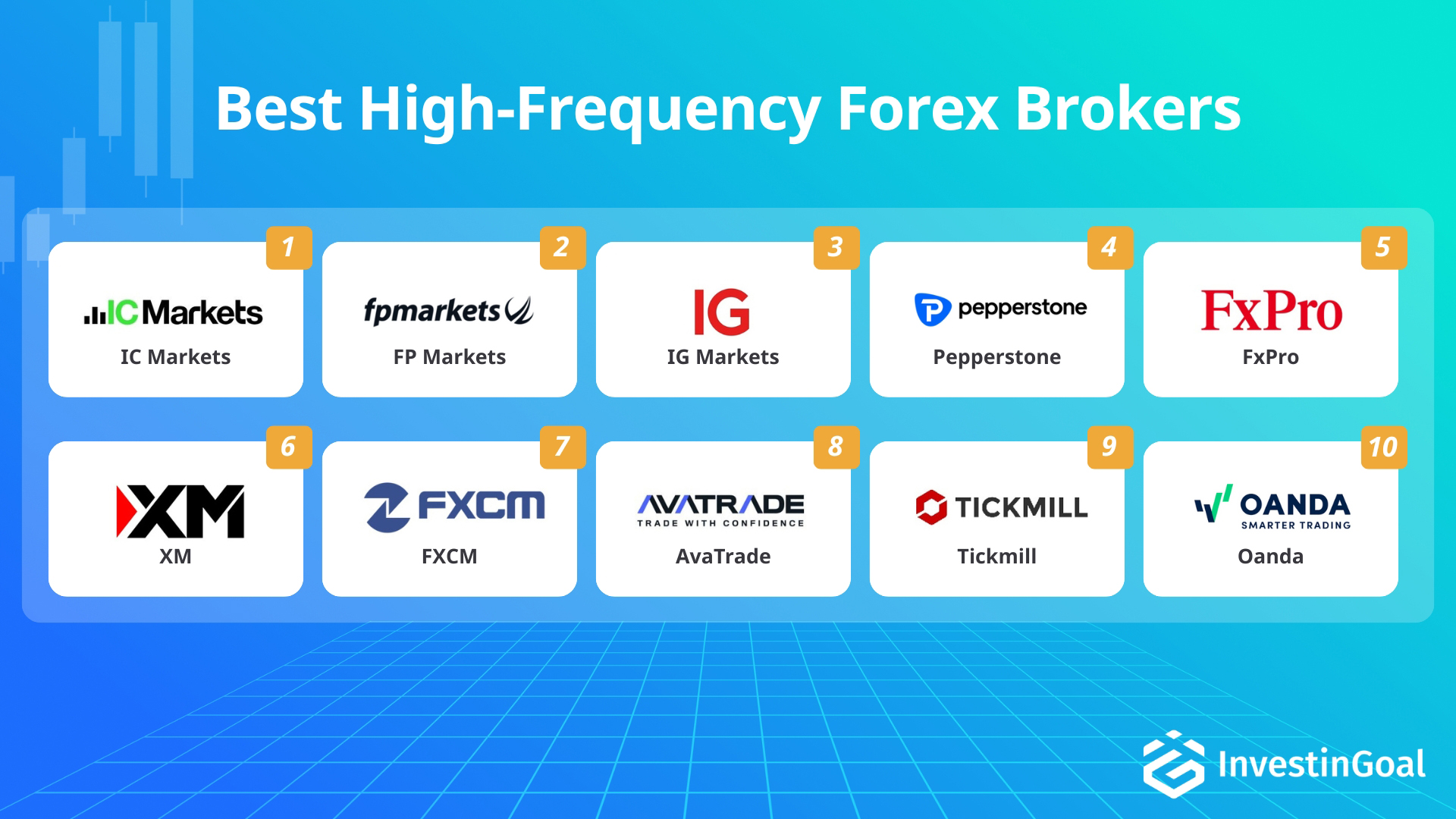
The best Forex brokers for high-frequency trading are IC Markets, FP Markets, IG and Pepperstone.
When choosing the best high-frequency trading FX broker, execution speed/latency, tight all-in trading costs (spreads + commissions), HFT-friendly execution rules (no scalping/EA restrictions, minimal slippage/requotes), and strong algo infrastructure (MT4/MT5/cTrader/TradingView, APIs, VPS/co-location) plus solid regulation are the most important criteria.
IC Markets is the best high-frequency trading Forex broker overall, thanks to offers ultra-low latency execution, raw ECN pricing with very tight spreads, no scalping/HFT restrictions, and strong automation-ready platforms and infrastructure under robust regulation.
Following IC Markets, the best high-frequency trading Forex brokers for speed, low costs, and algorithmic-trading readiness include FP Markets, IG, and Pepperstone. FP Markets showcases ECN execution that explicitly embraces scalping/HFT, with raw spreads from 0.0 pips and competitive commission pricing. IG includes DMA + API connectivity with very fast execution, making it a strong fit for systematic and scalping-style algorithms. Pepperstone supports extremely low-latency execution, raw spreads from 0.0 pips via its Razor account, and HFT-focused perks for active traders (like potential VPS/discount programs). Some of the best HFT-ready brokers—IC Markets, FP Markets, IG, and Pepperstone—are also considered among the best forex brokers overall thanks to low trading costs, fast execution, robust platforms/tools, and reliable customer support.

IC Markets
(Best high-frequency Forex broker overall)
IC Markets is the best high-frequency Forex broker thanks to sub-1 ms average execution from Equinix NY4 co-location, a 0 minimum-distance/freeze-level policy for scalping, and deep liquidity (up to 25 providers) that can deliver 0.0-pip raw spreads. IC Markets is a truly exceptional option for high-frequency forex trading overall because its 0.5 ms average latency and Raw account pricing (0.1 pip average EUR/USD spread + $7 round-turn commission) keep slippage and per-trade costs tight for EAs and scalpers. IC Markets’s sub-millisecond NY4 execution provides traders with near-instant order fills, which is critical for strategies that must enter and exit within seconds.
-
Regulations:
-
Avg. EUR/USD Spread:
-
Platforms:
IC Markets Features
The features of IC Markets are listed below.
- IC Markets average execution is under 1 millisecond on servers co located in the Equinix NY4 data center.
- IC Markets allows scalping and high frequency trading with zero minimum distance and a freeze level of 0.
- IC Markets provides deep liquidity from up to 25 providers with raw ECN pricing and spreads that can reach 0.0 pips on major pairs.
- IC Markets Raw Spread account averages about 0.1 pips on EUR/USD plus a $7 round turn commission per lot.
- IC Markets supports MT4, MT5, cTrader, and TradingView for automated trading via EAs and platform automation.
- IC Markets minimum deposit is $200.
IC Markets Pros and Cons
Advantages of IC Markets
The advantages of IC Markets are listed below.
- Low-latency trading environment
- Institutional level liquidity
- MT4, MT5, cTrader platforms are all available
Disadvantages of IC Markets
The disadvantages of IC Markets are listed below.
- Small amount of educational tools for new traders
- Small range of tradable assets compared to other CFD/Forex brokers
About IC Markets
IC Markets is a global forex and CFD broker founded in 2007 and based in Sydney, Australia. IC Markets offers trading on over 2,250 instruments including currencies, commodities, indices, stocks, and cryptocurrencies. IC Markets provides MetaTrader 4, MetaTrader 5, and cTrader platforms. IC Markets is regulated by multiple authorities including ASIC and CySEC. IC Markets is known for its ECN execution model and low spreads. The IC Markets CEO is Andrew Budzinski.

FP Markets
(Best high-frequency Forex broker for IRESS DMA)
FP Markets is the second best high-frequency Forex broker due to ECN order routing with 50 ms execution speeds, a Raw ECN cost structure (0.0-pip minimum spreads and about $6 round-turn commission), and platform access that includes trading platforms like MetaTrader 4, MetaTrader 5, and cTrader, plus IRESS DMA. FP Markets is a highly exceptional choice for IRESS DMA users since its ECN routing (50 ms execution), Raw ECN pricing (0.0-pip minimum spreads and about $6 round-turn commission), and MT4/MT5/cTrader + IRESS access let high-frequency traders run DMA workflows without scalping penalties. FP Markets’s 50 ms ECN execution helps traders with fast, market-style fills, which reduces missed entries when an algo needs immediate confirmation.
-
Regulations:
-
Avg. EUR/USD Spread:
-
Platforms:
FP Markets Features
The features of FP Markets are listed below.
- FP Markets uses ECN execution with average execution speeds around 50 milliseconds or better.
- FP Markets permits scalping and algorithmic high frequency trading with no penalties or strategy restrictions.
- FP Markets Raw account offers spreads from 0.0 pips with a typical EUR/USD spread around 0.1 pips plus a $6 round turn commission.
- FP Markets supports MT4, MT5, cTrader, and TradingView integration for high frequency and automated trading workflows.
- FP Markets offers VPS services designed for running automated strategies continuously.
- FP Markets minimum deposit is $100.
FP Markets Pros and Cons
Advantages of FP Markets
The advantages of FP Markets are listed below.
- Broad Instrument Offering
- Competitive Spreads
- Multiple Trading Platforms
Disadvantages of FP Markets
The disadvantages of FP Markets are listed below.
- High Fees for International Withdrawals
- Outdated Platform Design
About FP Markets
FP Markets is an Australian-based global forex and CFD broker founded in 2005. FP Markets offers trading on over 10,000 instruments including forex, stocks, indices, commodities, and cryptocurrencies. FP Markets provides MetaTrader 4, MetaTrader 5, and proprietary platforms. FP Markets is regulated by multiple authorities including ASIC, CySEC, and FSA. FP Markets is known for tight spreads, fast execution, and extensive educational resources. The FP Markets CEO is Craig Allison.

IG Markets
(Best high-frequency Forex broker for ProRealTime users)
IG is the third best high-frequency Forex broker through DMA-style execution averaging about 14 ms, tight commission-free forex spreads (around 0.6–0.8 pips on EUR/USD), and integrated tooling like ProRealTime and the L2 Dealer terminal. IG is an exceptional option for ProRealTime users because ProRealTime plugs into IG’s DMA-style stack (14 ms execution), enabling signal-to-order workflows with no separate forex commission and typical EUR/USD spreads around 0.6–0.8 pips. IG’s 14 ms execution provides traders with quick order routing, helping reduce slippage when positions are opened and closed rapidly.
-
Regulations:
-
Avg. EUR/USD Spread:
-
Platforms:
IG Markets Features
The features of IG Markets are listed below.
- IG delivers average execution speed around 14 milliseconds with direct market access features suited to high frequency scalping.
- IG provides REST and FIX API access for integrating proprietary algorithmic trading systems.
- IG offers L2 Dealer and ProRealTime platforms alongside MT4 for fast execution and automated trading.
- IG prices forex with no commission on its standard CFD account and EUR/USD typically runs around 0.6 to 0.8 pips.
- IG does not provide free VPS hosting for algorithmic traders.
- IG has no fixed minimum deposit for bank transfers and card deposits are typically about $250 minimum.
IG Markets Pros and Cons
Advantages of IG Markets
The advantages of IG Markets are listed below.
- Low spreads from 0.6 pips on Forex
- Wide range of financial instruments
- 40 years of experience in the Forex industry
Disadvantages of IG Markets
The disadvantages of IG Markets are listed below.
- No copy trading features
- No social trading features
About IG Markets
IG Markets is a global online trading provider founded in 1974, offering access to over 17,000 financial markets including forex, stocks, indices, commodities, and cryptocurrencies. IG Markets provides proprietary trading platforms alongside MetaTrader 4 and ProRealTime. IG Markets is regulated by multiple top-tier authorities worldwide, including the FCA and ASIC. IG Markets is known for competitive spreads, extensive educational resources, and innovative features like weekend trading. The IG Markets’ parent company “IG Group” CEO is Breon Corcoran.

Pepperstone
(Best high-frequency Forex broker for ultra-low latency)
Pepperstone is the fourth best high-frequency Forex broker because of latency that can drop to 0.2 ms, the Razor account’s raw spreads (from 0.0 pips; EUR/USD averaged 0.10 pips in Oct 2025), and an Active Trader Program that can include free VPS hosting (for example for MetaTrader 4/MetaTrader 5 EAs) and commission discounts. The ultra-low latency of Pepperstone places it among the outstanding choices for ultra-low-latency high-frequency forex trading because its Equinix-hosted, no-dealing-desk setup can cut order-to-fill time to 0.2 ms while the Razor account starts from 0.0-pip spreads and can add VPS/commission benefits for heavy algo users. The 0.2 ms latency of Pepperstone provides traders with faster fills and fewer timing gaps, which is especially useful when trading news spikes or short-lived price inefficiencies.
-
Regulations:
-
Avg. EUR/USD Spread:
-
Platforms:
Pepperstone Features
The features of Pepperstone are listed below.
- Pepperstone can deliver latency as low as 0.2 milliseconds in optimal conditions for rapid order execution.
- Pepperstone Razor account provides raw spreads starting from 0.0 pips for cost sensitive high frequency strategies.
- Pepperstone supports MT4, MT5, cTrader, and TradingView, including FIX API and cAlgo for automation.
- Pepperstone Active Trader Program provides commission discounts and free VPS hosting for high volume clients.
- Pepperstone Razor account EUR/USD spread averaged 0.10 pips in October 2025 and the $7 round turn commission brought total cost to about 0.7 pips.
- Pepperstone has no minimum deposit requirement.
Pepperstone Pros and Cons
Advantages of Pepperstone
The advantages of Pepperstone are listed below.
- Stable raw spreads (0,10 pips on EUR/USD on average)
- Caters for algorithmic trading
- Has won over 30 Forex industry awards
Disadvantages of Pepperstone
The disadvantages of Pepperstone are listed below.
- The demo account is not unlimited
About Pepperstone
Pepperstone is a global forex and CFD broker founded in 2010 in Melbourne, Australia. Pepperstone offers trading on currencies, commodities, indices, stocks, and cryptocurrencies through MetaTrader and cTrader platforms. Pepperstone is regulated by multiple authorities including ASIC, FCA, and CySEC. Pepperstone is known for competitive spreads, fast execution, and extensive educational resources. Pepperstone serves clients in over 160 countries worldwide. The Pepperstone CEO is Tamas Szabo.

FxPro
(Best high-frequency Forex broker for execution transparency)
FxPro is the fifth best high-frequency Forex broker thanks to its Quotix liquidity aggregation delivering 13 ms average execution, published execution-quality stats showing 84% of orders with zero or positive slippage, and cTrader support with level-2 depth and C# automation. FxPro is an excellent choice for execution transparency because it publishes slippage outcomes (84% of orders with zero or positive slippage) and routes orders via its Quotix aggregator at 13 ms average execution while supporting high throughput (7,000+ orders per second). FxPro’s 13 ms execution helps traders with consistent, high-capacity order processing, so strategies can send many orders without delays during volatile sessions.
-
Regulations:
-
Avg. EUR/USD Spread:
-
Platforms:
FxPro Features
The features of FxPro are listed below.
- FxPro averages about 13 milliseconds order execution using its Quotix liquidity aggregation infrastructure.
- FxPro can handle over 7,000 orders per second for high throughput automated trading.
- FxPro allows scalping and algorithmic trading and offers cTrader with level 2 depth and C# automation.
- FxPro reports about 84% of orders executed with zero or positive slippage in a recent year.
- FxPro cTrader and Raw accounts offer EUR/USD spreads near 0.0 to 0.2 pips plus a $7 commission per lot.
- FxPro minimum deposit is $100.
FxPro Pros and Cons
Advantages of FxPro
The advantages of FxPro are listed below.
- Regulated and Trusted Forex broker
- Diverse Trading Platforms
- Wide Range of Instruments
Disadvantages of FxPro
The disadvantages of FxPro are listed below.
- Inactivity Fee
- Limited Educational Resources
- No Guaranteed Stop-Loss Orders
About FxPro
FxPro is a global online broker founded in 2006, offering trading on forex, CFDs, stocks, indices, commodities, and cryptocurrencies. FxPro provides multiple trading platforms including MetaTrader 4, MetaTrader 5, cTrader, and its proprietary FxPro Platform. FxPro is regulated by multiple authorities including FCA, CySEC, SCB, FSC and KNN. FxPro serves clients in over 170 countries and has won numerous industry awards. The FxPro CEO is Charalambos Psimolophitis.

XM
(Best high-frequency Forex broker for $5 deposits)
XM is the sixth best high-frequency Forex broker for its $5 minimum deposit on Micro/Standard accounts, a reported 99.35% of orders executed in under one second with no requotes or rejections, and a Zero account that pairs 0.0-pip spreads with a $7 round-turn commission. The $5 minimum deposit of XM helps traders with low-barrier live testing, so they can validate slippage and fill quality on real money before scaling up. XM is a great option for $5 deposits given that traders can start live from $5 and still get fast handling (99.35% of orders executed in under one second with no requotes or rejections), then move to XM Zero (0.0-pip spreads + $7 round-turn commission) for lower spread costs as trading frequency increases.
-
Regulations:
-
Avg. EUR/USD Spread:
-
Platforms:
XM Features
The features of XM are listed below.
- XM executes 99.35% of orders in less than one second with no requotes and no order rejections.
- XM allows scalping and automated trading on its platforms with no limits on EA usage or order frequency.
- XM Zero account offers spreads starting from 0.0 pips with a $7 round turn commission per lot.
- XM Ultra Low account offers spreads as low as 0.6 pips with no commission in eligible regions.
- XM minimum deposit is $5 on Micro and Standard accounts and XM Zero account minimum deposit is $100.
- XM provides free VPS access for clients who meet balance requirements.
XM Pros and Cons
Advantages of XM
The advantages of XM are listed below.
- There’s a wide range of account types
- The demo account at XM is unlimited
- Wide range of educational resources
Disadvantages of XM
The disadvantages of XM are listed below.
- No social trading features available
- The account availability changes depending on the location of the trader
- High minimum deposit to invest in securities ($10000 for the XM Shares account)
About XM
XM is a global forex and CFD broker founded in 2009, offering trading on currencies, commodities, indices, stocks, and cryptocurrencies. XM provides MetaTrader 4, MetaTrader 5, and proprietary platforms. XM is regulated by multiple authorities including CySEC, ASIC, and IFSC. XM is known for competitive spreads, extensive educational resources, and multilingual customer support. XM serves over 5 million clients from 196 countries. XM offers various account types and a no-requote policy.

FXCM
(Best high-frequency Forex broker for volume rebates)
FXCM is the seventh best high-frequency Forex broker thanks to its Active Trader volume rebate program (with examples of fees dropping to around $5.5 per lot), DMA-style pricing that can reach 0.2-pip EUR/USD spreads plus about $6 per round lot, and API/VPS support geared to automation. FXCM is a strong choice for volume rebates because frequent traders can lower effective costs (examples near $5.5 per lot) while pairing DMA-style pricing (0.2-pip EUR/USD + about $6 per round lot) with API/VPS tooling for automated scalpers. FXCM’s rebate program increases traders’ ability to keep effective per-lot costs down, which matters most for strategies that generate high monthly lot volume.
-
Regulations:
-
Avg. EUR/USD Spread:
-
Platforms:
FXCM Features
The features of FXCM are listed below.
- FXCM Active Trader accounts provide DMA style execution with no dealing desk intervention for low latency trading.
- FXCM offers REST, FIX, and Java APIs for algorithmic trading connectivity, mainly for Active Trader clients.
- FXCM supports VPS hosting and rebates VPS costs for active traders.
- FXCM standard accounts price forex with no commission and EUR/USD spreads around 1.1 pips.
- FXCM Active Trader pricing can reach about 0.2 pips on EUR/USD plus a $6 per round lot commission.
- FXCM minimum deposit is $50.
FXCM Pros and Cons
Advantages of FXCM
The advantages of FXCM are listed below.
- Regulation and Trust
- Advanced Trading Tools
- Competitive Spreads for Active Traders
Disadvantages of FXCM
The disadvantages of FXCM are listed below.
- Limited Range of Instruments
- Average Pricing Structure
About FXCM
FXCM is a global forex and CFD broker founded in 1999, offering trading on currencies, commodities, indices, stocks, and cryptocurrencies. FXCM provides MetaTrader 4 and proprietary trading platforms. FXCM is regulated by multiple authorities including FCA, ASIC, and CySEC. FXCM is known for competitive spreads, extensive educational resources, and copy trading services. FXCM recently launched a sister platform called Tradu. The FXCM parent company “Stratos Group” CEO is Brendan Callan.

AvaTrade
(Best high-frequency Forex broker for forex options)
AvaTrade is the eighth best high-frequency Forex broker due to the AvaOptions platform for FX options, no explicit restrictions on scalping or automated trading on MT4/MT5, and commission-free forex pricing with EUR/USD spreads typically around 0.9–1.2 pips. AvaTrade is a solid choice for forex options since AvaOptions lets traders hedge short-term spot exposure with defined-risk FX option structures while still supporting MT4/MT5 automation, even though forex costs are spread-only (typically 0.9–1.2 pips on EUR/USD). AvaTrade’s AvaOptions platform helps traders with option-based hedging tools that can cap downside, making it easier to run fast spot strategies with a predefined maximum risk.
-
Regulations:
-
Avg. EUR/USD Spread:
-
Platforms:
AvaTrade Features
The features of AvaTrade are listed below.
- AvaTrade allows scalping and algorithmic trading with no explicit prohibitions.
- AvaTrade uses a market maker model and does not provide a specialized co located low latency high frequency infrastructure.
- AvaTrade supports MT4 and MT5 plus proprietary platforms including AvaTradeGO, WebTrader, and AvaOptions.
- AvaTrade offers commission free forex pricing with EUR/USD typically around 0.9 to 1.2 pips.
- AvaTrade does not offer a raw spread plus commission account structure.
- AvaTrade minimum deposit is $100.
AvaTrade Pros and Cons
Advantages of AvaTrade
The advantages of AvaTrade are listed below.
- Tight fixed spreads from 0.6 pips (0.9 pips for retail traders)
- The mobile apps are well designed
- Can be connected to ZuluTrade and Duplitrade
Disadvantages of AvaTrade
The disadvantages of AvaTrade are listed below.
- High inactivity fees
- The demo account is limited to 30 days
About AvaTrade
AvaTrade is a global forex and CFD broker founded in 2006 and headquartered in Dublin, Ireland. AvaTrade offers trading on currencies, commodities, indices, stocks, bonds, ETFs, and cryptocurrencies. AvaTrade provides proprietary platforms alongside MetaTrader 4 and 5. AvaTrade is regulated by multiple authorities including CySEC, ASIC, and FSA. AvaTrade serves over 300,000 clients worldwide. AvaTrade is known for competitive spreads and extensive educational resources. The AvaTrade CEO is David Dryzin since 2016.

Tickmill
(Best high-frequency Forex broker for low commissions)
Tickmill is the ninth best high-frequency Forex broker thanks to its very low Pro-account commissions ($2 per side per 100k, or $4 round-turn per standard lot), near-zero spreads on majors (often 0.0 pips with 0.1-pip typical EUR/USD), and fast execution around 0.15–0.20 seconds with no scalping limits. Tickmill is a very good option for low commissions because its Pro account charges $2 per side per 100k ($4 round-turn per lot) with spreads that are often 0.0–0.1 pips on majors, keeping all-in costs low for scalpers targeting small edges. Tickmill’s $4 round-turn commission provides traders with a lower break-even threshold per trade, so a strategy can remain profitable even when average wins are only a few pips.
-
Regulations:
-
Avg. EUR/USD Spread:
-
Platforms:
Tickmill Features
The features of Tickmill are listed below.
- Tickmill average execution speed is about 0.15 to 0.20 seconds for market execution order fills.
- Tickmill Pro account delivers typical EUR/USD spreads around 0.1 pips and can show 0.0 pips during active sessions.
- Tickmill Pro account commission is $4 round turn per standard lot.
- Tickmill places no restrictions on scalping, news trading, or algorithmic trading on its MetaTrader platforms.
- Tickmill offers VIP style pricing that can reduce commissions further for qualifying high volume clients.
- Tickmill minimum deposit is $100.
Tickmill Pros and Cons
Advantages of Tickmill
The advantages of Tickmill are listed below.
- Regulatory Trust
- Competitive Pricing
- Comprehensive Platform Support
Disadvantages of Tickmill
The disadvantages of Tickmill are listed below.
- Limited Asset Variety
- Higher Costs on Classic Account
- Discontinued Features
About Tickmill
Tickmill is a global multi-asset broker founded in 2014, offering trading on forex, CFDs, stocks, indices, commodities, and cryptocurrencies. Tickmill provides MetaTrader 4, MetaTrader 5, and proprietary platforms. Tickmill is regulated by multiple authorities including FCA, CySEC, and FSCA. Tickmill is known for low spreads, fast execution, and extensive educational resources. Tickmill serves over 500,000 clients worldwide. The Tickmill CEO is Sudhanshu Agarwal.

Oanda
(Best high-frequency Forex broker for API developers)
OANDA is the tenth best high-frequency Forex broker thanks to open REST API access (with Java and Python libraries), no minimum deposit and flexible trade sizing for many small orders, and optional Core Pricing that can drop EUR/USD to 0.1–0.2 pips plus commission (about 0.4–0.5 pips all-in). The open REST API of OANDA ranks it as a good choice for API-driven high-frequency forex trading because developers can place and manage orders directly from code (in languages like Java and Python), use flexible trade sizing with no minimum deposit, and access Core Pricing in some regions (0.1–0.2-pip EUR/USD + commission, 0.4–0.5 pips all-in). The open REST API of OANDA provides traders with direct programmatic control over execution, letting them automate order placement, cancellations, and risk rules without relying on a charting terminal.
-
Regulations:
-
Avg. EUR/USD Spread:
-
Platforms:
Oanda Features
The features of Oanda are listed below.
- OANDA provides open REST API access and supports Java and Python tooling for custom algorithmic execution.
- OANDA supports high frequency order flow with no minimum trade sizes and flexible lot sizing.
- OANDA imposes no minimum deposit requirement for opening an account.
- OANDA Core Pricing in some regions offers EUR/USD raw spreads around 0.1 to 0.2 pips plus commission, targeting about 0.4 to 0.5 pips all in.
- OANDA standard pricing is spread only with EUR/USD typically around 1.2 pips during peak times.
- OANDA supports OANDA Trade plus MT4 and MT5 and integrates with TradingView and NinjaTrader.
Oanda Pros and Cons
Advantages of Oanda
The advantages of Oanda are listed below.
- Comprehensive Platforms
- Robust Education
- Highly Regulatory Trust
Disadvantages of Oanda
The disadvantages of Oanda are listed below.
- Higher Spreads
- Proprietary Platform Limitations
- Inactivity Fees
About Oanda
OANDA is a global multi-asset broker founded in 1996, offering trading on forex, CFDs, commodities, indices, and cryptocurrencies. OANDA provides proprietary platforms and API solutions. OANDA is regulated by multiple authorities including FCA, ASIC, and MAS. OANDA is known for competitive spreads, fast execution, and currency data services. OANDA serves both retail and institutional clients worldwide. The Oanda Chief Executive Officer is Gavin Bambury since August 2019.
Comparison of the best high-frequency forex brokers
The table that compares the best high-frequency forex brokers is shown below.
| Broker | Average execution latency (ms) | Execution model | All-in EUR/USD cost (pips) | FIX API availability | VPS offering |
|---|---|---|---|---|---|
| IC Markets | 0.5 ms | ECN | 0.7 pips | N/A | N/A |
| FP Markets | 50 ms | ECN | 0.7 pips | N/A | N/A |
| IG | 14 ms | Hybrid | 0.6 pips | Yes | None |
| Pepperstone | 0.2 ms | NDD | 0.7 pips | Yes | Free (Active Trader Program) |
| FxPro | 13 ms | Hybrid | 0.7 pips | N/A | Paid (free for high-volume) |
| XM | N/A | Market maker | 0.8 pips | N/A | Free (balance threshold) |
| FXCM | N/A | DMA | 0.8 pips | Yes (Active Trader only) | Rebate (Active Trader) |
| AvaTrade | N/A | Market maker | 0.9 pips | N/A | N/A |
| Tickmill | 150 ms | ECN/STP | 0.5 pips | Yes (VIP/large account) | N/A |
| OANDA | N/A | Market maker | 0.5 pips | N/A | N/A |
Warning
CFDs are complex instruments and come with a high risk of losing money rapidly due to leverage. Between 74-89% of retail investor accounts lose money when trading CFDs. You should consider whether you can afford to take the high risk of losing your money.
The best high-frequency Forex broker for beginners is XM. XM stands out with a $5 minimum deposit, free demo accounts, and the fact that scalping and EAs are explicitly allowed. These XM conditions let new traders start small, practice risk-free, and still use faster styles (or automation) without worrying about trading restrictions as they learn.
Beginner high-frequency traders look for low entry costs, safe practice tools, and flexible trading rules in the best beginners FX brokers. A similar alternative to XM is OANDA for no minimum deposit, a beginner-friendly proprietary platform plus MT4/MT5, and a strong global regulation footprint. FP Markets offers MT4/MT5/cTrader support, Raw account spreads from 0.0 pips, and a $100 minimum deposit that make it an alternative to XM.
The best high-frequency Forex broker with Expert Advisor (EA) support is Pepperstone. Pepperstone is strong for EAs thanks to MT4/MT5 EA support plus cTrader automation, ultra-low latency (as low as 0.2 ms), and a free VPS for active/high-volume traders via its Active Trader program. These Pepperstone features help automated systems run more reliably, execute faster, and stay online continuously, which is exactly what EA traders need.
Top EA-friendly HFT brokers tend to deliver automation-ready platforms, very fast execution, and stable hosting/VPS options. IC Markets offers similar features to Pepperstone like MT4/MT5 EAs plus cTrader, sub-1 ms average execution from Equinix NY4, and no restrictions on HFT/scalping (freeze level 0). FxPro also competes with Pepperstone, notably through cTrader with cAlgo (C#), 13 ms average execution with high order capacity, and VPS availability for round-the-clock EA uptime.
The best high-frequency Forex broker for news trading is IC Markets. IC Markets fits the news-trading style with sub-1 ms execution, no minimum distance/freeze level 0 for rapid order placement, and deep liquidity from up to 25 providers. Those IC Markets strengths can reduce slippage during spikes, allow quick order handling when seconds matter, and keep fills more consistent when volatility surges.
Rapid execution, minimal order restrictions, and strong liquidity depth of the best news-trading Forex brokers are highly regarded by Forex traders. Pepperstone is a capable alternative to IC Markets, offering very low latency execution, a no requotes record even in volatile periods, and Razor account raw spreads from 0.0 pips to keep costs tight. Tickmill is another substitute relative to IC Markets, with no restrictions on news trading, Pro account ultra-low all-in costs (0.0–0.1 pip typical + low commission), and fast execution around 0.15–0.20s, and it is often featured among the best brokers for news trading.
The best high-frequency Forex broker for algo trading is IG. IG supports systematic traders with a robust REST and FIX API for integration, DMA-style execution and liquidity depth, and very fast execution reported around 14 ms. These IG capabilities make it easier to plug strategies into reliable connectivity, route orders efficiently, and keep latency low when algorithms depend on timely signals.
Great algo-trading brokers typically combine strong APIs, quality execution access, and infrastructure that supports fast routing, which is why many are compared against the best algo trading brokers for systematic strategies. OANDA is an alternative to IG since it provides open APIs (REST + libraries), strong historical data access for backtesting, and no minimum deposit for easy testing and rollout. Pepperstone also works as a replacement for IG, featuring cTrader + FIX/API pathways, co-located/low-latency infrastructure, and VPS support for always-on automated operation.
The best high-frequency Forex broker for scalping is Tickmill. Tickmill is built for scalpers with Pro account spreads frequently at 0.0 pips, a very low commission ($4 round-turn/lot), and no restrictions on scalping. Those Tickmill conditions help frequent in-and-out traders keep transaction costs down and execute aggressively without policy limits.
Ultra-tight spreads, low commissions, and unrestricted trading rules are often featured in the best scalping Forex brokers. IC Markets offers no scalping restrictions, the ability to place orders inside the spread, and sub-1 ms execution with raw spreads that can hit 0.0 pips on majors that make it an alternative to Tickmill. A similar alternative to Tickmill is FP Markets for Raw spreads from 0.0 pips, a low $6 round-turn commission with ECN execution, and the fact it explicitly embraces scalpers/HFT, and it is frequently listed among the top scalping Forex brokers.
The criteria for choosing the best High-Frequency Forex brokers are listed below.
- Execution latency: Prefer brokers with millisecond-grade execution (co-located servers and optimized routing) and verify published execution metrics. For latency-sensitive strategies, prioritize IC Markets (<1 ms, Equinix NY4), Pepperstone (0.2 ms), and FxPro (13 ms) over slower venues like FP Markets (50 ms) or Tickmill (150–200 ms).
- Liquidity and market access: Select ECN/DMA or true NDD execution models with deep liquidity aggregation to reduce partial fills and price impact. For example, IC Markets (up to 25 providers), IG, and FXCM Active Trader emphasize DMA-style access for high-frequency order handling.
- Slippage and requotes: Choose brokers that minimize dealer intervention—target no requotes and stable fills during volatility. FxPro (84% zero/positive slippage), XM (99.35% executed in <1 second; no requotes), and Pepperstone (no requotes) are materially advantageous for scalping and short-horizon systematic trading.
- All-in trading costs: Quantify true per-trade cost as raw spread + round-turn commission on liquid majors under live conditions. Favor Tickmill ($4/lot; 0.0–0.1 pip), FP Markets ($6/lot; 0.1 pip), and IC Markets/Pepperstone ($7/lot; 0.1 pip) over spread-only pricing like IG (0.6–0.8 pips) or AvaTrade (0.9–1.2 pips); OANDA Core Pricing (0.4–0.5 pips all-in) can also be competitive.
- Automation and APIs: Require stacks that support high-frequency automation with deterministic routing. Prioritize MT4/MT5 EAs, cTrader/cAlgo, and broker connectivity such as IG REST/FIX, OANDA APIs, FXCM REST/FIX/Java, and Pepperstone FIX/API for systematic deployment.
- VPS and proximity: Run strategies close to broker trade servers to reduce network jitter and packet loss; treat VPS as an execution control. Strong options include Pepperstone (free VPS via Active Trader), FXCM (VPS rebates), and XM (free VPS) to improve round-trip times for continuous algo execution.
- HFT policy: Confirm the broker permits scalping, algorithmic trading, and high order frequency, and verify constraints that degrade HFT performance (stop distances, freeze levels, throttles). IC Markets (inside-spread orders; 0 minimum distance; freeze level 0), FP Markets, and Tickmill explicitly support high-frequency/scalping activity, while AvaTrade may be less specialized for latency-critical workflows.
To confirm a high-frequency Forex broker allows legal high-frequency trading, you must verify four items in writing: (1) the Client Agreement and Execution Policy explicitly permit scalping/automated trading and do not impose minimum holding times, maximum order/message rates, minimum distance-to-market, or a ban on “latency arbitrage”; (2) the technology stack supports your automation method (MetaTrader 4/5 Expert Advisors, cTrader/cAlgo, and—if needed—FIX/REST API) plus VPS/co-location; (3) the execution model is market execution (ECN/DMA or NDD) with a stated approach to requotes/rejections and published execution metrics; (4) the broker entity you will use is properly licensed for your jurisdiction and account type.
In practice, “legal” is typically a contract-and-rules issue rather than a speed issue: algorithmic trading is broadly defined as computer-determined order parameters with limited/no human intervention, and many venues allow it while restricting abusive variants (notably latency arbitrage) or applying throttles. Look for explicit statements tying low-latency infrastructure (e.g., Equinix NY4/LD4) to HFT/scalping suitability and “no restrictions” language that names scalping, arbitrage, EAs/algorithms. After paperwork, run a controlled pilot (100–300 micro-lot trades) and log rejects, delays, slippage, and any post-trade cancellations; demo-only tolerance is a red flag.
To evaluate a high-frequency Forex broker’s fit for your trading strategy, use an 8-metric scorecard and accept the broker only if live results match your model assumptions: (1) median and 95th-percentile execution time, (2) client-to-server latency (VPS/co-location), (3) all-in cost (spread + commission), (4) slippage distribution (positive/at-quote/negative), (5) reject/requote rate, (6) market access (ECN/DMA/NDD vs dealing desk), (7) platform/API robustness (MT4/MT5, cTrader, FIX/REST), (8) volatility controls (margin, stop-out, order limits).
Fit depends on where your edge lives. A latency-sensitive scalper or market-making bot needs deterministic routing near the execution venue (e.g., Equinix NY4/LD4) and consistently fast fills—some brokers disclose “most orders” executing in <30–60 ms, while others disclose 0.15–0.20 s averages. A higher-level algo (trend/mean-reversion) may tolerate slower fills but is extremely sensitive to cost stability and negative slippage. Validate by running at least 1,000 orders on your symbols and session times, computing realized spread and slippage per order type—an essential step if you’re benchmarking against the best trading strategy—and compare the outcomes against disclosed execution statistics and your backtest’s assumed transaction-cost model.
To distinguish HFT trading from algorithmic trading, you should treat high-frequency trading (HFT) as a subset of algorithmic trading: all HFT is algorithmic, but most algorithmic trading is not HFT.
Algorithmic trading is defined (in a widely used regulatory framing) as trading where a computer algorithm automatically determines order parameters—initiation, timing, price, size, or post-submission management—with limited or no human intervention (excluding simple order routing-only systems). HFT adds microstructure-specific constraints: ultra-low latency (often via co-location), very high message rates and order-to-trade ratios, and very short holding periods (seconds to fractions of a second), with many HFT firms aiming to end the day with small or no overnight positions.
Operationally, HFT requires a specialized stack: tick-level data handling, deterministic networking, strict risk controls (kill switches, max message rates), and execution venues where milliseconds matter. Broader algorithmic trading includes slower systematic strategies—VWAP/TWAP execution, trend-following, statistical arbitrage—that can hold positions minutes to weeks and remain profitable even if execution latency moves from, for example, 10 ms to 100 ms.
To judge a high-frequency Forex broker’s performance during high volatility, you should measure four numbers in predefined stress windows: (1) spread widening (median and 95th percentile), (2) execution delay (fill-time distribution), (3) slippage in pips by order type (market/stop/limit), (4) rejects/requotes and any post-trade cancellations.
Define stress windows using event time-stamps (CPI/NFP, central-bank decisions), session transitions (London/New York open), and liquidity troughs (rollover). High volatility naturally widens spreads and increases slippage risk because price can move between order submission and execution; the question is whether degradation is bounded and symmetric rather than abrupt and one-sided. Prefer brokers that (a) run market execution without “virtual dealer” delays, (b) publicly disclose execution quality and pass positive slippage, and (c) show low rejection/requote behavior under load; for example, some publish “no re-quotes” policies with 99%+ sub-second execution, and others publish periodic slippage distributions where roughly 80%+ of orders are at-quote or better. Also track margin changes and stop-out rules, because volatility-driven margin hikes can force liquidations even when execution speed looks acceptable. Effective stress testing, risk limits, and position sizing depend on a precise understanding of volatility meaning.