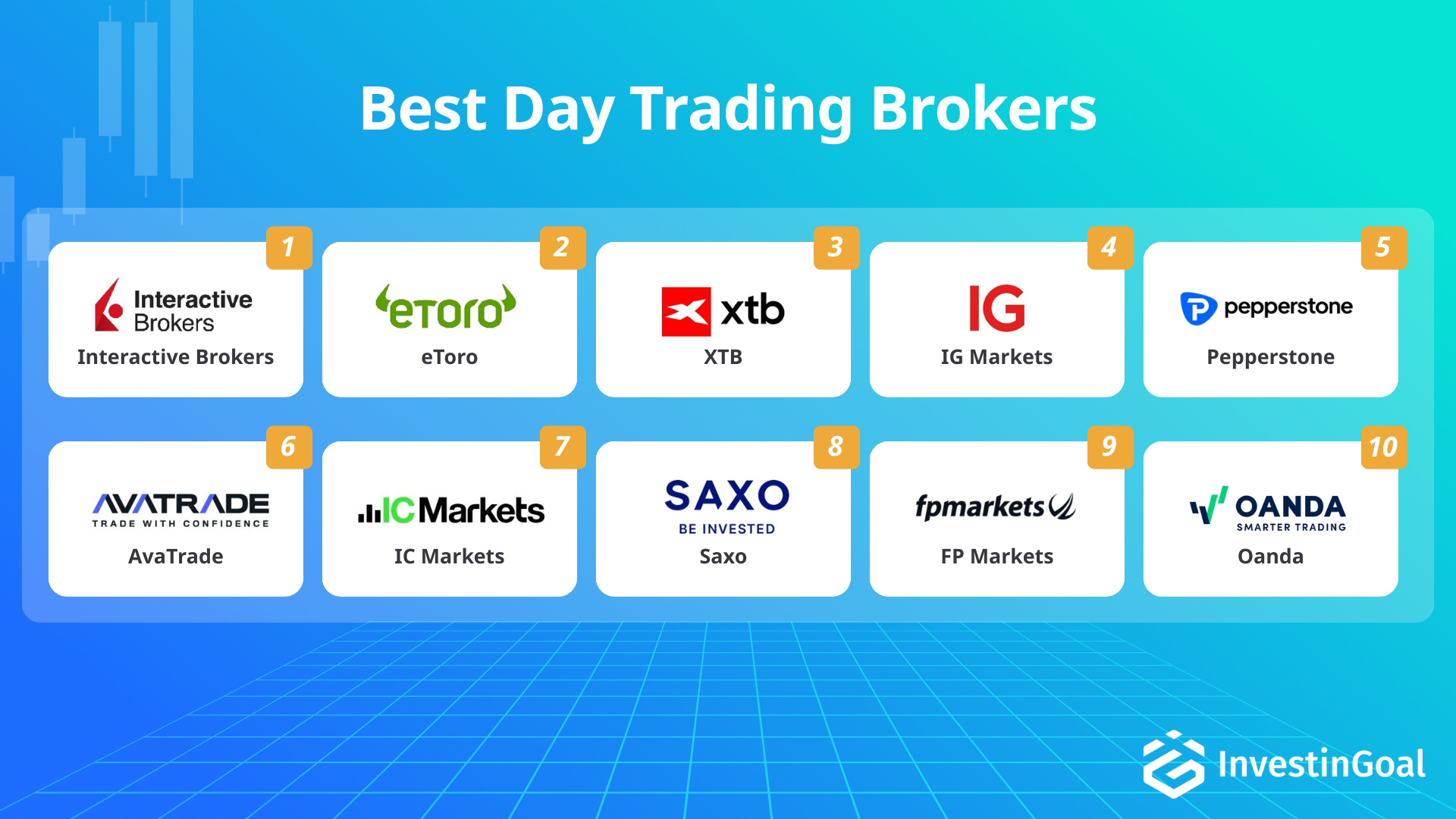
The best Forex brokers for day trading in the UK are Interactive Brokers, eToro, XTB and IG.
When choosing the best day trading platform, low all-in trading costs (tight spreads + low commissions), fast execution and deep liquidity access, a strong day-trading platform (advanced charting + fast order entry + robust order types), and strong regulation plus transparent account conditions (minimum deposit, demo availability, and non-trading fees) are the most important criteria.
Interactive Brokers is the best day trading platform in the UK overall, thanks to how it offers ultra-competitive pricing, direct market access/fast execution, professional-grade platform features (Trader Workstation tools and advanced order types), and strong regulation with transparent fees and paper trading.
Ranked just behind Interactive Brokers, the best day trading brokers for cost, execution quality, platform strength, and overall account conditions include eToro, XTB, and IG. eToro showcases an easy-to-use platform with social/CopyTrader tools and an always-available demo (though typically higher spreads). XTB includes competitive spread-only pricing, fast/stable execution, and the powerful xStation 5 platform with strong education and analysis. IG enables competitive spreads, premium trading tools and broad market access, plus UK-friendly options like spread betting under strong FCA oversight.
Some of the best UK day trading brokers, such as eToro, XTB, and IG, are also considered in the best Forex brokers ranking thanks to competitive pricing, robust platforms, and reliable execution.

Interactive Brokers
(best day trading broker overall)
Interactive Brokers is the best day trading platform thanks to its Trader Workstation (TWS) platform with Level II data and 100+ order types/algos, ultra-low EUR/USD pricing with spreads as low as about 0.1 pip plus a 0.2 bps commission (about 0.6–0.7 pips all-in per lot), and direct market access designed for fast, no-dealing-desk execution. Interactive Brokers is an exceptional option for precision intraday Forex execution because TWS supports advanced bracket and algorithmic orders, helping active traders control entries, exits, and risk in one ticket. Interactive Brokers’ TWS order stack provides traders with high-control routing and execution tools that reduce slippage and keep round-trip costs tight for high-turnover strategies.
-
Regulations:
-
Avg. EUR/USD Spread:
-
Platforms:
Interactive Brokers Features
The features of Interactive Brokers are listed below.
- Interactive Brokers EUR/USD spread can be about 0.1 pip and Interactive Brokers commission is 0.2 basis points, which puts Interactive Brokers all in cost around 0.6 to 0.7 pips on EUR/USD.
- Interactive Brokers provides direct market access style execution across forex, stocks, futures, and other markets with no dealing desk intervention.
- Interactive Brokers Trader Workstation includes advanced charting, Level II quotes, and 100 plus order types and algos for intraday execution.
- Interactive Brokers minimum deposit is $0 and Interactive Brokers charges no inactivity fee.
- Interactive Brokers is regulated by top tier authorities including the SEC and Interactive Brokers UK is FCA authorised.
- Interactive Brokers offers a Paper Trading demo that mirrors live account settings.
Interactive Brokers Pros and Cons
Advantages of Interactive Brokers
The advantages of Interactive Brokers are listed below.
- Low Trading Fees
- Advanced Trading Tools
- Wide Market Access
Disadvantages of Interactive Brokers
The disadvantages of Interactive Brokers are listed below.
- Not user-friendly
- No MetaTrader Support
- Additional Fees
About Interactive Brokers
Interactive Brokers is a global electronic broker founded in 1978, offering trading in stocks, options, futures, forex, bonds, ETFs, and cryptocurrencies across 150 markets in 33 countries. Interactive Brokers provides advanced trading platforms, low commissions, and access to a wide range of financial instruments. Interactive Brokers is known for its sophisticated technology and serves both retail and institutional clients. Interactive Brokers is regulated by multiple top-tier authorities worldwide. The CEO of the Interactive Brokers Group is Milan Galik.

eToro
(best day trading platform for copy trading)
eToro is the second best day trading platform because of its CopyTrader copy-trading network, TradingView-powered advanced charts on the web platform, and one-click execution across web and mobile backed by a $100,000 virtual demo account. eToro is an outstanding choice for copy-trading day traders since CopyTrader can automatically mirror selected traders’ positions and show their performance statistics, giving newcomers a structured way to learn intraday decision-making. The CopyTrader network of eToro provides traders with automated trade replication and clear performance metrics that make it easier to compare traders, set allocation limits, and diversify across multiple strategies.
-
Regulations:
-
Avg. EUR/USD Spread:
-
Platforms:
eToro Features
The features of eToro are listed below.
- eToro CopyTrader lets users automatically copy the trades of other traders inside the eToro platform.
- eToro EUR/USD spread is typically about 1.0 pip on a spread only model with no added commission on forex CFDs.
- eToro uses a proprietary web and mobile platform and eToro does not support MT4 or MT5.
- eToro demo account provides $100,000 virtual funds and eToro demo access is unlimited in duration.
- eToro is regulated by major authorities including eToro UK under the FCA plus CySEC and ASIC.
- eToro minimum deposit is $50 in most regions and eToro charges a $5 withdrawal fee plus a $10 monthly inactivity fee after 12 months with no login.
eToro Pros and Cons
Advantages of eToro
The advantages of eToro are listed below.
- Great copy trading and social trading features
- Wide range of asset classes
- It allows to buy fractional stocks from $10
Disadvantages of eToro
The disadvantages of eToro are listed below.
- The eToro spreads can be high
- Offers only USD accounts
- Transferring cryptocurrencies to other platforms can be hard
About eToro
eToro is a global multi-asset investment platform founded in 2007, offering trading on stocks, ETFs, Crypto CFDs, commodities, and forex. eToro provides a proprietary web and mobile platform with social trading features. eToro is regulated by multiple authorities including FCA, ASIC, and CySEC. eToro is known for its user-friendly interface, copy trading functionality, and commission-free stock trading. eToro serves over 30 million users worldwide. The eToro CEO and co-founder is Yoni Assia.

XTB
(best day trading broker for intuitive platform)
XTB is the third best day trading broker due to its xStation 5 platform, spread-only pricing with EUR/USD starting around 0.8 pips on standard accounts, and built-in decision tools such as an economic calendar, news feed, sentiment heatmaps, and a trader calculator. XTB is an excellent option for an intuitive intraday workflow because xStation 5 pairs advanced charting with one-click dealing and integrated analytics, so traders can scan, size, and execute without switching platforms. XTB’s xStation 5 helps traders with fast execution and on-platform context that supports quicker trade decisions, cleaner entry/exit management, and more consistent position sizing.
-
Regulations:
-
Avg. EUR/USD Spread:
-
Platforms:
XTB Features
The features of XTB are listed below.
- XTB EUR/USD spreads start around 0.8 pips on XTB standard pricing and XTB charges no commission on standard forex and CFD trades.
- XTB xStation 5 delivers fast execution with one click trading, advanced charting, and integrated tools like a trader calculator and sentiment views.
- XTB provides real time market news, webinars, and structured education inside XTB research and learning ecosystem.
- XTB has no minimum deposit and XTB lets you start with any funding level.
- XTB is FCA regulated in the UK and XTB is publicly listed on the Warsaw Stock Exchange.
- XTB demo is typically limited to 30 days and XTB discontinued MT4 support in 2024 for new accounts.
XTB Pros and Cons
Advantages of XTB
The advantages of XTB are listed below.
- No minimum deposit
- Wide selection of assets
- Competitive trading costs
Disadvantages of XTB
The disadvantages of XTB are listed below.
- Small withdrawal fee
- No social or copy trading
- XTB demo account is limited to 30 days
About XTB
XTB is a global forex and CFD broker founded in 2002 and headquartered in Poland. XTB offers trading on over 2,000 instruments including currencies, stocks, indices, commodities, and cryptocurrencies. XTB provides the proprietary xStation platform and is regulated by multiple authorities including FCA, CySEC, and KNF. XTB is listed on the Warsaw Stock Exchange and serves over 897,500 clients worldwide. The XTB CEO is Omar Arnaout since March 2017.

IG Markets
(best day trading platform for market range)
IG is the fourth best day trading platform for its extensive market range across forex, indices, commodities, and shares (for example, major FX pairs, global indices, and commodities like gold or crude), its proprietary web platform with TradingView and optional ProRealTime charting, and UK access to spread betting alongside CFDs. IG is a great choice for market-range day traders since the same ticket can be used to trade major FX pairs like EUR/USD (often about 0.6–0.8 pips in peak hours) and then rotate into index or share markets (such as US index CFDs or UK-listed shares) when volatility shifts. The market range of IG provides traders with more liquid intraday opportunities across asset classes, which helps traders pivot to whichever markets have the tightest spreads and the cleanest momentum that day.
-
Regulations:
-
Avg. EUR/USD Spread:
-
Platforms:
IG Markets Features
The features of IG Markets are listed below.
- IG EUR/USD spreads are typically around 0.6 to 0.8 pips with no commission on forex CFDs.
- IG offers both CFDs and IG spread betting for UK clients, and IG spread betting can be tax advantaged for UK residents.
- IG web platform supports advanced charting and IG integrates ProRealTime and TradingView style charting for deeper analysis.
- IG supports MetaTrader 4 and IG offers an MT4 VPS service when account balance meets the required threshold.
- IG is FCA regulated and IG is publicly listed on the London Stock Exchange.
- IG has no minimum deposit and IG applies an inactivity fee only after 24 months of no trading activity.
IG Markets Pros and Cons
Advantages of IG Markets
The advantages of IG Markets are listed below.
- Low spreads from 0.6 pips on Forex
- Wide range of financial instruments
- 40 years of experience in the Forex industry
Disadvantages of IG Markets
The disadvantages of IG Markets are listed below.
- No copy trading features
- No social trading features
About IG Markets
IG Markets is a global online trading provider founded in 1974, offering access to over 17,000 financial markets including forex, stocks, indices, commodities, and cryptocurrencies. IG Markets provides proprietary trading platforms alongside MetaTrader 4 and ProRealTime. IG Markets is regulated by multiple top-tier authorities worldwide, including the FCA and ASIC. IG Markets is known for competitive spreads, extensive educational resources, and innovative features like weekend trading. The IG Markets’ parent company “IG Group” CEO is Breon Corcoran.

Pepperstone
(best day trading platform for cTrader)
Pepperstone is the fifth best day trading platform thanks to its cTrader suite with Level II depth-of-market, Razor account pricing with raw EUR/USD spreads often 0.0–0.3 pips plus commission (around 0.6–0.7 pips all-in), and low-latency execution with no requotes. The cTrader suite of Pepperstone places it among the strong options for cTrader-focused day trading because it combines Level II depth-of-market with advanced order types and C# automation via cAlgo, which suits scalping and short-hold strategies that depend on speed. Pepperstone’s cTrader setup improves traders with transparent order-book visibility and fast fills that reduce timing risk when entering and exiting quickly around micro-moves.
-
Regulations:
-
Avg. EUR/USD Spread:
-
Platforms:
Pepperstone Features
The features of Pepperstone are listed below.
- Pepperstone Razor account offers raw spreads often near 0.0 to 0.3 pips on EUR/USD and Pepperstone charges about $7 per round turn lot commission.
- Pepperstone Standard account averages about 1.0 to 1.2 pips on EUR/USD and Pepperstone charges no commission on that account type.
- Pepperstone supports MT4, MT5, and cTrader, and Pepperstone also supports TradingView connectivity for chart based trading.
- Pepperstone is built for low latency execution and Pepperstone runs no requotes with no dealing desk intervention.
- Pepperstone is FCA regulated in the UK through Pepperstone UK Ltd.
- Pepperstone minimum deposit is $0, Pepperstone recommends about £200 to start, and Pepperstone charges no inactivity fee.
Pepperstone Pros and Cons
Advantages of Pepperstone
The advantages of Pepperstone are listed below.
- Stable raw spreads (0,10 pips on EUR/USD on average)
- Caters for algorithmic trading
- Has won over 30 Forex industry awards
Disadvantages of Pepperstone
The disadvantages of Pepperstone are listed below.
- The demo account is not unlimited
About Pepperstone
Pepperstone is a global forex and CFD broker founded in 2010 in Melbourne, Australia. Pepperstone offers trading on currencies, commodities, indices, stocks, and cryptocurrencies through MetaTrader and cTrader platforms. Pepperstone is regulated by multiple authorities including ASIC, FCA, and CySEC. Pepperstone is known for competitive spreads, fast execution, and extensive educational resources. Pepperstone serves clients in over 160 countries worldwide. The Pepperstone CEO is Tamas Szabo.

AvaTrade
(best day trading broker for FX options)
AvaTrade is the sixth best day trading broker because of its AvaOptions FX-options platform, multi-platform access via MT4/MT5 plus WebTrader and AvaTradeGO (such as MetaTrader 4 and MetaTrader 5), and commission-free spreads that keep EUR/USD around 0.8 pips on standard accounts. AvaTrade is a solid choice for FX-options day traders given that AvaOptions lets you structure vanilla option positions with defined risk (for example, hedges like protective puts or volatility trades like straddles), which is useful for trading event-driven volatility while capping downside. AvaTrade’s AvaOptions platform provides traders with defined-risk hedging and volatility strategies that can be used to hedge spot positions, trade news-driven spikes, or limit downside to the option premium.
-
Regulations:
-
Avg. EUR/USD Spread:
-
Platforms:
AvaTrade Features
The features of AvaTrade are listed below.
- AvaTrade supports MT4, MT5, AvaTrade WebTrader, AvaTradeGO, and AvaOptions for FX options trading.
- AvaTrade EUR/USD spread is around 0.8 pips on standard retail pricing with no volume based CFD commission.
- AvaTrade offers AvaProtect which lets AvaTrade clients pay a fee to protect a trade against losses for a set time window.
- AvaTrade minimum deposit is $100 for a standard account.
- AvaTrade UK clients are typically onboarded under the Central Bank of Ireland regulated entity and AvaTrade is not FCA regulated in the UK.
- AvaTrade demo account expires after about 21 days and AvaTrade charges a $50 inactivity fee after 3 months plus a $100 annual administration fee after 12 months of inactivity.
AvaTrade Pros and Cons
Advantages of AvaTrade
The advantages of AvaTrade are listed below.
- Tight fixed spreads from 0.6 pips (0.9 pips for retail traders)
- The mobile apps are well designed
- Can be connected to ZuluTrade and Duplitrade
Disadvantages of AvaTrade
The disadvantages of AvaTrade are listed below.
- High inactivity fees
- The demo account is limited to 30 days
About AvaTrade
AvaTrade is a global forex and CFD broker founded in 2006 and headquartered in Dublin, Ireland. AvaTrade offers trading on currencies, commodities, indices, stocks, bonds, ETFs, and cryptocurrencies. AvaTrade provides proprietary platforms alongside MetaTrader 4 and 5. AvaTrade is regulated by multiple authorities including CySEC, ASIC, and FSA. AvaTrade serves over 300,000 clients worldwide. AvaTrade is known for competitive spreads and extensive educational resources. The AvaTrade CEO is David Dryzin since 2016.

IC Markets
(best day trading platform for scalping)
IC Markets is the seventh best day trading platform for raw-spread pricing that can average about 0.02 pips on EUR/USD before commission (about 0.62 pips all-in per lot), multi-platform support across MT4, MT5, cTrader, and TradingView, and scalper-friendly execution with no dealing-desk restrictions. IC Markets is a very good option for scalping because its raw spreads and low-latency infrastructure reduce the cost and timing friction of frequent round trips, and it allows EAs and high-frequency styles without platform limits. IC Markets’ raw-spread model helps traders with lower transaction costs per trade, which keeps more of each small target move as net profit after spreads and commissions.
-
Regulations:
-
Avg. EUR/USD Spread:
-
Platforms:
IC Markets Features
The features of IC Markets are listed below.
- IC Markets Raw account averages about 0.02 pips on EUR/USD and IC Markets adds about $6 per lot commission, which puts IC Markets all in cost around 0.62 pips.
- IC Markets Standard account averages about 0.6 to 0.7 pips on EUR/USD and IC Markets charges no commission on that account.
- IC Markets supports MT4, MT5, cTrader, and IC Markets TradingView integration for trading directly from charts.
- IC Markets allows scalping and IC Markets allows algorithmic trading with no restrictions on EAs.
- IC Markets minimum deposit is $200 and IC Markets charges no inactivity fee.
- IC Markets is regulated by ASIC and CySEC and IC Markets demo access can be unlimited with periodic login activity.
IC Markets Pros and Cons
Advantages of IC Markets
The advantages of IC Markets are listed below.
- Low-latency trading environment
- Institutional level liquidity
- MT4, MT5, cTrader platforms are all available
Disadvantages of IC Markets
The disadvantages of IC Markets are listed below.
- Small amount of educational tools for new traders
- Small range of tradable assets compared to other CFD/Forex brokers
About IC Markets
IC Markets is a global forex and CFD broker founded in 2007 and based in Sydney, Australia. IC Markets offers trading on over 2,250 instruments including currencies, commodities, indices, stocks, and cryptocurrencies. IC Markets provides MetaTrader 4, MetaTrader 5, and cTrader platforms. IC Markets is regulated by multiple authorities including ASIC and CySEC. IC Markets is known for its ECN execution model and low spreads. The IC Markets CEO is Andrew Budzinski.

Saxo
(best day trading platform for advanced research)
Saxo is the eighth best day trading platform through its SaxoTraderGO/PRO platforms, institutional-style tools like Level 2 order books and advanced order types, and in-house SaxoStrats research that delivers daily analysis and trade themes. Saxo’s SaxoTraderPRO toolset makes it a good option for advanced-research day trading by providing deep market data and customizable layouts that make it easier to monitor multiple instruments, place complex orders, and manage risk from one screen. The SaxoTraderGO/PRO platforms of Saxo establish it as one of the good options for advanced-research day trading because they combine multi-asset scanning across more than 40,000 instruments with integrated analysis, helping traders move from research to execution in one workspace.
-
Regulations:
-
Avg. EUR/USD Spread:
-
Platforms:
Saxo Features
The features of Saxo are listed below.
- Saxo provides SaxoTraderGO and SaxoTraderPRO with advanced charting, Level 2 data on supported venues, and pro grade workspaces.
- Saxo offers access to 40,000 plus instruments and Saxo supports multi asset day trading across FX, stocks, ETFs, futures, and options.
- Saxo Classic tier averages about 1.1 pips on EUR/USD and Saxo tighter pricing applies on higher tiers like Platinum and VIP.
- Saxo Platinum typically requires around £200,000 in funding or high volume and Saxo VIP typically requires around £1,000,000.
- Saxo UK is FCA regulated and Saxo is part of Saxo Bank with a Danish banking license.
- Saxo has no minimum deposit, Saxo charges no inactivity fee, and Saxo demo access lasts about 20 days.
Saxo Pros and Cons
Advantages of Saxo
The advantages of Saxo are listed below.
- Regulation and Trust
- Extensive Product Range
- Advanced Trading Platform
Disadvantages of Saxo
The disadvantages of Saxo are listed below.
- High Minimum Deposits for Premium Accounts
- Lack of Spread Betting Options
- Custody Fees in Certain Regions
About Saxo
Saxo is a Danish investment bank and online trading platform founded in 1992. Saxo offers trading in forex, stocks, CFDs, futures, options, and other financial instruments across global markets. Saxo provides proprietary trading platforms and white-label solutions for institutional clients. Saxo is regulated by multiple authorities including the Danish FSA and UK FCA. Saxo serves retail and institutional clients in over 170 countries. The Saxo CEO and co-founder is Kim Fournais.

FP Markets
(best day trading broker for stock CFDs)
FP Markets is the ninth best day trading broker due to its MT5 stock-CFD offering of over 10,000 share CFDs (like major US and EU blue chips), a Raw account with spreads starting from 0.0 pips and about a 0.09 pip average EUR/USD before commission, and MetaTrader-ready execution for EAs with optional VPS support. FP Markets is a good choice for stock-CFD day trading because MT5 gives access to thousands of equities across major exchanges (for example, large-cap listings on NYSE or Nasdaq), enabling intraday sector rotation and single-stock momentum trades alongside FX on the same platform. FP Markets’ MT5 stock-CFD catalogue provides traders with a broad equity universe, increasing the chance of finding liquid movers without needing a separate equities platform or data feed.
-
Regulations:
-
Avg. EUR/USD Spread:
-
Platforms:
FP Markets Features
The features of FP Markets are listed below.
- FP Markets Raw account offers spreads from 0.0 pips and FP Markets average EUR/USD spread is about 0.09 pips plus a $6 round turn per lot commission.
- FP Markets Standard account averages about 1.19 pips on EUR/USD and FP Markets charges no commission on that account.
- FP Markets supports MetaTrader 4, MetaTrader 5, and FP Markets has added cTrader in some regions.
- FP Markets offers 60 plus forex pairs and FP Markets provides thousands of share CFDs, including 10,000 plus share CFDs via MT5.
- FP Markets minimum deposit is $100 and FP Markets demo can remain active if you log in regularly.
- FP Markets charges no inactivity fee and FP Markets offers VPS access when trading volume meets the required threshold.
FP Markets Pros and Cons
Advantages of FP Markets
The advantages of FP Markets are listed below.
- Broad Instrument Offering
- Competitive Spreads
- Multiple Trading Platforms
Disadvantages of FP Markets
The disadvantages of FP Markets are listed below.
- High Fees for International Withdrawals
- Outdated Platform Design
About FP Markets
FP Markets is an Australian-based global forex and CFD broker founded in 2005. FP Markets offers trading on over 10,000 instruments including forex, stocks, indices, commodities, and cryptocurrencies. FP Markets provides MetaTrader 4, MetaTrader 5, and proprietary platforms. FP Markets is regulated by multiple authorities including ASIC, CySEC, and FSA. FP Markets is known for tight spreads, fast execution, and extensive educational resources. The FP Markets CEO is Craig Allison.

Oanda
(best day trading broker for no minimum deposit)
OANDA is the tenth best day trading broker for its $0 minimum deposit, unit-based position sizing that lets you trade down to 1 unit, and strong connectivity through fxTrade, MT4, TradingView integration, and APIs. OANDA is a good option for no-minimum-deposit day traders since unit-based sizing and an unlimited demo account let you practice and then trade live with precise risk per position, even on very small balances. The unit-based position sizing of OANDA helps traders with precise risk control by letting them scale position size in single-unit increments to match a defined stop-loss and fixed percentage risk.
-
Regulations:
-
Avg. EUR/USD Spread:
-
Platforms:
Oanda Features
The features of Oanda are listed below.
- Oanda has no minimum deposit and Oanda lets clients trade in any unit size for precise position scaling.
- Oanda Core Pricing averages about 0.1 to 0.2 pips on EUR/USD and Oanda charges about $7 per lot round turn commission.
- Oanda standard spread only pricing is typically about 1.2 to 1.4 pips on EUR/USD with no added commission.
- Oanda UK is authorised and regulated by the FCA.
- Oanda supports the fxTrade platform and MT4, and Oanda also supports TradingView trading connectivity plus REST and FIX APIs.
- Oanda offers an unlimited demo account and Oanda charges a $10 monthly inactivity fee after 12 months with no trading activity.
Oanda Pros and Cons
Advantages of Oanda
The advantages of Oanda are listed below.
- Comprehensive Platforms
- Robust Education
- Highly Regulatory Trust
Disadvantages of Oanda
The disadvantages of Oanda are listed below.
- Higher Spreads
- Proprietary Platform Limitations
- Inactivity Fees
About Oanda
OANDA is a global multi-asset broker founded in 1996, offering trading on forex, CFDs, commodities, indices, and cryptocurrencies. OANDA provides proprietary platforms and API solutions. OANDA is regulated by multiple authorities including FCA, ASIC, and MAS. OANDA is known for competitive spreads, fast execution, and currency data services. OANDA serves both retail and institutional clients worldwide. The Oanda Chief Executive Officer is Gavin Bambury since August 2019.
Comparison of the best day trading platforms
The table that compares the best day trading platforms is shown below.
| Broker | EUR/USD all-in cost (pips) | Primary trading platform (name) | MT4 support (Yes/No) | Minimum deposit (USD) | FCA-authorised UK entity (Yes/No) |
|---|---|---|---|---|---|
| Interactive Brokers | 0.6-0.7 | Trader Workstation (TWS) | No | $0 | Yes |
| eToro | 1.0 | eToro Platform | No | $50 | Yes |
| XTB | 0.8-1.0 | xStation 5 | No | $0 | Yes |
| IG | 0.6-0.8 | IG Web Platform | Yes | $0 | Yes |
| Pepperstone | 0.6-0.7 | MetaTrader 4 | Yes | $0 | Yes |
| AvaTrade | 0.8 | MetaTrader 4 | Yes | $100 | No |
| IC Markets | 0.62 | MetaTrader 4 | Yes | $200 | No |
| Saxo | 1.1 | SaxoTraderGO | N/A | $0 | Yes |
| FP Markets | 0.69 | MetaTrader 4 | Yes | $100 | No |
| Oanda | 0.8-0.9 | fxTrade | Yes | $0 | Yes |
Warning
CFDs are complex instruments and come with a high risk of losing money rapidly due to leverage. Between 74-89% of retail investor accounts lose money when trading CFDs. You should consider whether you can afford to take the high risk of losing your money.
The best day trading platform for beginners is eToro. eToro stands out with a beginner-friendly web/mobile platform, CopyTrader social trading, and an unlimited demo account funded with virtual money. These features offered by eToro let new traders practice without pressure, mirror experienced traders’ moves to learn faster, and keep the overall workflow simple while building confidence.
An intuitive interface, strong learning resources, and low trading costs are often featured in the best beginner day trading brokers. XTB is a good alternative to eToro thanks to its clean xStation 5 platform, extensive education/webinars, and typically low spreads around 0.8 pips on EUR/USD. IG is another good option versus eToro, mainly because it pairs easy-to-use tools with advanced charting, adds structured learning via IG Academy, and keeps EUR/USD spreads competitive at roughly 0.6–0.8 pips. Intuitive platforms, structured education, and low spreads are typically prioritized in rankings of the best beginners Forex brokers.
The best day trading platform in the UK is IG. IG is well-suited to UK traders because it’s FCA-regulated, supports spread betting alongside CFDs, and offers a broad market range backed by strong trading tools. With IG, traders benefit from a UK-focused regulatory framework, tax-efficient spread betting eligibility (where applicable), and enough instruments and platform features to day trade across multiple markets.
Top UK day trading platforms tend to be FCA-regulated, offer deep market access, and provide robust tools for active execution. A similar alternative to IG is Interactive Brokers for its FCA-regulated UK presence, direct market access with multi-asset coverage, and very low FX costs such as 0.1 pip plus a low commission, and it is often included in Forex brokers UK rankings. XTB also works as a substitute for IG since it’s FCA-regulated in the UK, requires no minimum deposit, and delivers fast execution through its xStation 5 platform.
The best day trading platform with TradingView is IC Markets. IC Markets fits TradingView users well because it supports TradingView trade execution, delivers ultra-low raw spreads (around 0.02 pip on EUR/USD on Raw), and also offers MT4/MT5 plus cTrader for advanced workflows. TradingView integration by IC Markets helps traders place and manage trades straight from their charts, while the raw pricing and platform choice supports fast, active strategies.
TradingView traders look for chart-to-order execution, tight pricing, and multiple platform options in the best TradingView day trading brokers. Pepperstone offers similar features to IC Markets like TradingView connectivity for execution, Razor account raw spreads often around 0.0–0.3 pips plus commission, and access to MT4/MT5 and cTrader. Oanda is another option compared with IC Markets, as it integrates TradingView trading, has no minimum deposit requirement, and allows flexible position sizing down to any unit size. Platforms that combine native TradingView execution, competitive spreads, and flexible order sizing are frequently highlighted in rankings of the best TradingView Forex brokers.
The best day trading platform with low minimum deposit is Interactive Brokers. Interactive Brokers is a great fit here thanks to its $0 minimum deposit, free paper trading demo, and professional-grade platform packed with advanced order types. Those features provided by Interactive Brokers let traders start with very small funding, test strategies in a realistic simulator, and control entries/exits precisely with sophisticated orders.
Low-minimum-deposit day trading platforms usually keep account barriers low, provide accessible platforms, and support cost-efficient trading. XTB is an alternative to Interactive Brokers since it also has no minimum deposit, runs on the xStation 5 platform, and offers commission-free pricing on standard CFD accounts (spread-only), making it a frequent inclusion in rankings of the best brokers with low minimum deposit. Oanda offers no minimum deposit, very small trade sizes, and an unlimited demo account, which makes it an alternative to Interactive Brokers.
The best day trading platform with low spread is IC Markets. IC Markets is built for low-cost trading with 0.02 pip average raw EUR/USD pricing plus low commission (about 0.62 pips all-in), low-latency execution, and no restrictions on scalping or algorithms. This combination at IC Markets benefits active traders by cutting round-trip costs, improving fill speed in fast markets, and allowing high-frequency or systematic approaches without platform constraints.
Raw spreads, competitive commissions, and reliable execution infrastructure of the best low-spread day trading brokers are highly regarded by Forex traders. Pepperstone is an alternative to IC Markets thanks to its Razor pricing with raw spreads often 0.0–0.3 pips plus commission (around 0.6–0.7 all-in), fast execution via a no-dealing-desk setup, and no inactivity fees. FP Markets offers near-zero raw spreads (e.g., 0.09 pip average EUR/USD) with about $6/lot commission (0.69 all-in), strong MetaTrader support, and no inactivity fee that make it an alternative to IC Markets. Pricing models with raw spreads, low commissions, and stable execution are commonly highlighted in rankings of the best low spread brokers.
The criteria for choosing the best day trading platforms are listed below.
- All-in trading costs: Quantify the total intraday cost per round trip (spread + commission) on EUR/USD, and prefer platforms that keep all-in cost below 8 pips in liquid hours. For example, IC Markets Raw targets 0.62 pips all-in, Pepperstone Razor typically lands around 0.6–0.7 pips all-in, and Interactive Brokers can reach 0.6–0.7 pips all-in (EUR/USD spread 0.1 pip plus $2 per $1M commission). By contrast, spread-only models such as eToro (1.0 pip) or Saxo Classic (1.1 pips) may be more expensive for high-turnover strategies.
- Execution quality: Select platforms engineered for low-latency order flow, favoring “no dealing desk / no requotes”, deep liquidity aggregation, and stable fills during volatility. Pepperstone and IC Markets emphasize rapid execution and scalping tolerance (including VPS pathways), while Interactive Brokers and IG operate at institutional scale with robust routing/liquidity that can reduce slippage. Treat slippage as a first-order variable: repeated small slippage across dozens of daily trades can exceed headline spread
- Order management tools: Require professional trade-control features, one-click trading, bracket orders, OCO, trailing stops, hotkeys, and conditional orders. Interactive Brokers Trader Workstation supports 100+ order types/algos, SaxoTraderPRO supports advanced order workflows and hotkeys, and IG provides active-trader tooling, AvaTrade adds trade-protection options. If the platform cannot implement risk rules at entry (SL/TP/brackets), treat it as structurally inferior for day trading.
- Charting and analytics: Verify multi-chart layouts, a broad indicator library, trading from charts, and reliable news/calendar integration, because intraday decisions are time-compressed and chart latency is costly. IG integrates advanced charting (including ProRealTime access tied to 4 trades/month), eToro provides TradingView-powered charting, and XTB xStation is built for fast, integrated analysis. Prefer platforms that keep analysis + execution in the same interface to minimize context-switching.
- Automation and APIs: If your edge relies on systematic execution, insist on automation (MT4/MT5 EAs, cTrader/cAlgo) and/or programmable APIs, plus VPS Pepperstone and IC Markets support MT4/MT5 and cTrader environments, OANDA offers REST/FIX API access, and Interactive Brokers provides API connectivity for advanced routing/automation. Treat automation support as a binary criterion when you need repeatable, rule-based execution.
- Market breadth: Match the platform’s instrument set to your intraday universe (FX majors, indices, commodities, stock CFDs, futures/options). Saxo spans 40,000 instruments, IG offers broad CFD/spread-bet coverage, Interactive Brokers supports deep multi-asset access, and FP Markets emphasizes share-CFD coverage (including thousands of stock CFDs via MT5). Conversely, OANDA is more FX-centric, which fits only if your strategy is similarly concentrated.
- Account frictions: Minimize operational drag by auditing minimum deposits, demo realism/duration, and non-trading fees. Minimum deposits range from $0 (Interactive Brokers, IG, XTB, Pepperstone, OANDA) to $50 (eToro), $100 (AvaTrade/FP Markets), and $200 (IC Markets). Demos range from non-expiring modes (e.g., eToro $100,000 virtual portfolio, OANDA unlimited demo, Interactive Brokers paper trading) to shorter trials (AvaTrade 21 days, Saxo 20 days, XTB 30 days). Also check fee asymmetries: eToro $5 withdrawal fee and $10/month inactivity after 12 months, AvaTrade $50 quarterly inactivity after 3 months plus an annual fee, and IG inactivity only after 24 months.
- UK protections and tax: For UK-based day traders, prioritize FCA-authorised entities and assess client-money protections (e.g., FSCS coverage) through FCA-regulated setups such as IG, Interactive Brokers UK, XTB UK, Pepperstone UK, OANDA Europe, and Saxo Capital Markets UK. If a broker routes UK clients via non-FCA regimes (e.g., CySEC pathways for IC Markets/FP Markets, or non-FCA onboarding for AvaTrade), treat this as a constraint on recourse and protection structure. Also evaluate spread betting (e.g., IG and OANDA), since spread-bet profits can be treated differently from CFD profits for UK residents.
The main differences between day trading and scalping are holding time (scalping: seconds–minutes, day trading: minutes–hours), trade frequency (scalping: often dozens+ trades per session, day trading: usually fewer), and sensitivity to costs/latency (scalping is far more sensitive).
Scalping is an ultra-short-horizon intraday method that repeatedly targets very small price moves and closes positions before the session ends. Because the expected gain per trade is small, your edge can be overwhelmed by spread + commission, slippage, and platform delays. This is why scalpers usually prioritize raw-spread pricing, stable low-latency execution, and high-liquidity instruments (for example, EUR/USD all-in costs around 0.6–0.7 pips at low-cost brokers).
Day trading is also intraday (no intentional overnight holds), but it more often seeks larger moves within a session, momentum, range trading, mean reversion, so it can tolerate slightly wider costs than pure scalping while still requiring strict position sizing and predefined exits.
In tooling terms, scalpers commonly rely on tick/1-minute charts plus one-click trading, hotkeys, bracket/OCO orders, and Level II/depth-of-market. Day traders more often mix 5–60-minute charts with scanners, news/event tools, and broader multi-asset analytics. The operational load is higher in scalping because execution errors and brief platform outages can quickly invalidate the strategy. Traders can select appropriate tools and risk controls by grounding decisions in scalping trading meaning.
Platform tools and timeframes differ for day trading vs swing trading because day trading holds positions minutes to hours within one session, while swing trading typically holds positions for several days to weeks.
For day trading, you commonly make decisions off tick charts and 1–15-minute candles (sometimes up to 60-minute) to time entries and exits inside a single trading day. The platform features that dominate performance are execution-centric: low-latency order routing, one-click trading, hotkeys, bracket/OCO orders, Level II/depth-of-market, and conditional and algorithmic orders so you can control slippage and enforce risk limits in real time.
For swing trading, you more often analyze 4-hour, daily, and weekly charts to capture multi-day moves, so the platform must be strong on higher-timeframe charting, alerts, and robust stop/limit management (including good-til-canceled orders) that lets you manage risk without watching every tick.
Overnight mechanics matter far more for swing trading. Gap risk around earnings and macro releases, weekend risk, and financing/rollover for leveraged CFDs or FX. Day trading reduces (but does not eliminate) these overnight exposures by flattening before the session ends, in contrast to the swing trading definition, which accepts holding risk across sessions.
As a result, day-trading platforms tend to look like professional execution terminals, while swing-trading platforms tend to look like research-and-monitoring workspaces with alerts, calendars, and reporting.
To choose a day trading platform that works with your strategies and trading style, select the platform that best fits your instruments, your round-trip costs, and your execution and order-control requirements. If it fails any one of those three, it is the wrong platform for active intraday trading.
In terms of costs, quantify your all-in cost (average spread + commissions + typical slippage) on the products you trade most. For high-turnover FX/CFDs, the difference between 0.6–0.7 pips all-in on EUR/USD versus 1.0 pip spread-only pricing can materially change expectancy.
Match the interface to the strategy. Scalping and news trading benefit from low-latency routing, one-click trading, hotkeys, Level II/depth-of-market, and bracket/OCO orders. Multi-asset discretionary trading benefits from Trader Workstation-style platforms with 100+ order types/algos, algorithmic trading requires MetaTrader 4/5 (EAs), cTrader (C#), or broker APIs. Chart-centric workflows may prefer TradingView or ProRealTime, social/copy trading requires a built-in copy mechanism, and, in the UK, some traders also value platforms that support spread betting alongside CFDs.
Test with a demo/paper account and then a small live size, and record spreads, slippage, and platform stability during the sessions you trade. A written plan that defines entries, exits, and per-trade risk clarifies what is a trading strategy in practical terms and provides the basis for consistent decision-making. Finally, confirm regulation/client-money protections and frictions like demo expiry, inactivity fees, and withdrawal fees.
The amount of money you need to start using a day trading platform is $0–$200 for account opening at many brokers, but $25,000 if you day trade U.S. stocks in a margin account as a “pattern day trader.”
In the U.S., PDT is triggered by ≥4 day trades in 5 business days when those trades are >6% of margin-account activity, and you must maintain $25,000 equity on any day you day trade.
Minimum deposit is a broker rule. Some providers allow $0 minimum funding, others require around $50–$100, and many FX/CFD venues suggest $200+ so you have a usable margin and a risk buffer. Many FX platforms also support micro sizing (0.01 lots or single-unit sizing), which makes starting small feasible.
A practical requirement comes from position sizing. If you cap risk at 1% per trade, your account size should be about 100× your planned dollar risk per trade (risking $5 implies $500, risking $10 implies $1,000). Small accounts suffer more from fixed costs (spreads/commissions), so you need a buffer for drawdowns.
Outside U.S. margin equities, there is no universal “minimum,” but you still face settlement/cash-availability constraints in cash accounts and financing/rollover costs if you hold leveraged CFDs/FX overnight.